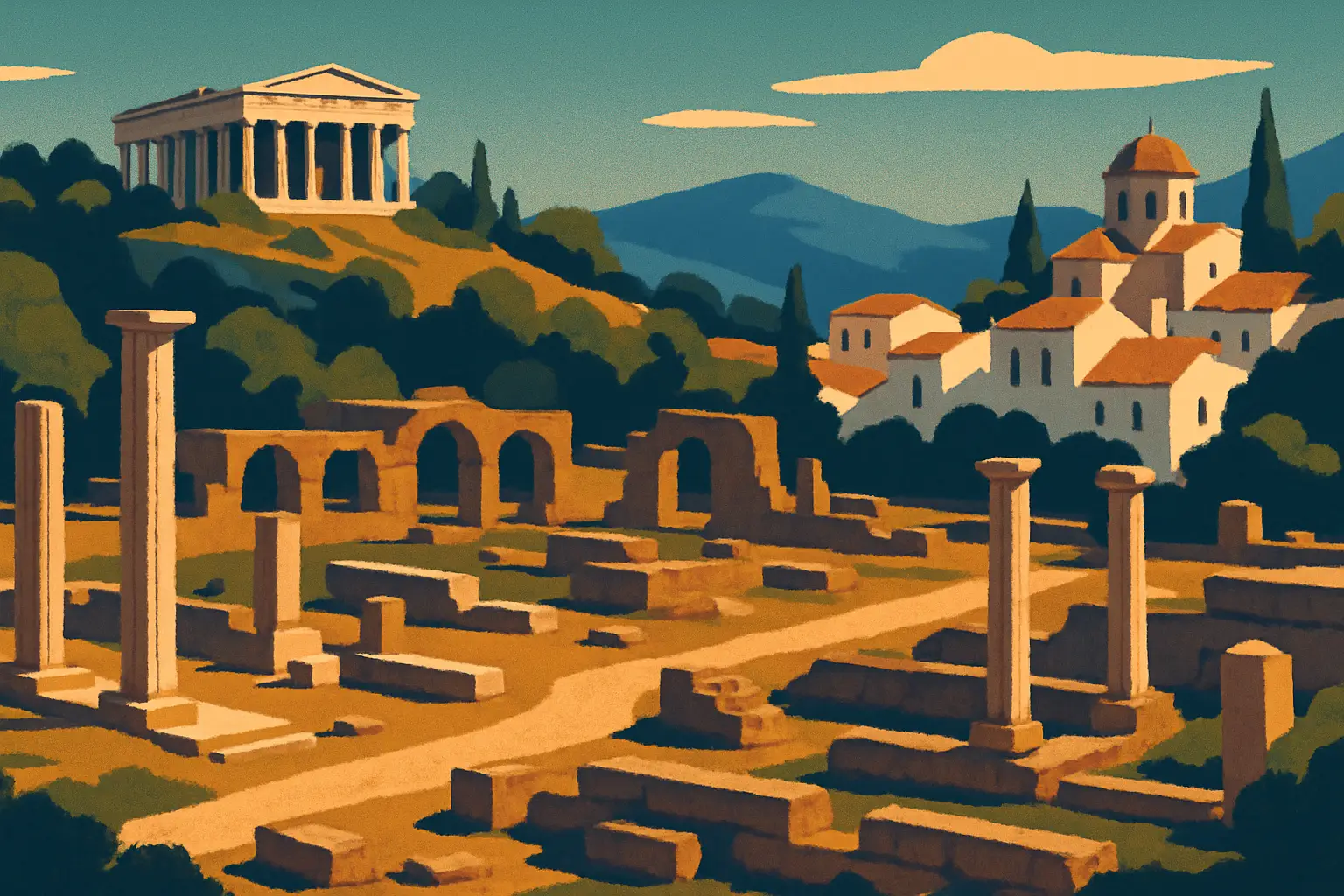
The Acropolis was where the gods lived. The Ancient Agora was where the Athenians lived — the commercial, civic, legal, philosophical, and religious center of the ancient city, in operation from roughly the 6th century BCE until the Roman period.
The word 'agora' derives from 'agoreuō' — to speak publicly. Before it described a marketplace, it described the act of public assembly and deliberation. On a typical day in classical Athens (450–350 BCE), the Agora contained law courts hearing cases, the Council of 500 drafting legislation, merchants selling grain and olive oil, and Socrates walking the colonnaded stoai asking difficult questions of whoever would answer. According to Plato, Socrates spent most of his time in exactly this space — the stoai were his classroom. When he was tried and condemned to death in 399 BCE, the proceedings began at the Royal Stoa on the Agora's northwest corner.
The site was excavated by the American School of Classical Studies at Athens, beginning in 1931 in one of the largest urban excavations ever undertaken. They demolished thousands of houses to expose what is now the open site — a fact the excavation reports do not linger on, but which shaped modern Athens' western neighborhoods.
Standing on the Kolonos Agoraios hill at the western edge of the Agora, the Temple of Hephaestus (Hephaisteon) is the single best-preserved ancient Greek temple anywhere — more complete than the Parthenon, more intact than any temple at Olympia or Delphi. Construction began in 449 BCE and was completed around 415 BCE, making it a direct contemporary of the Parthenon.
All 34 Doric columns are standing. The ceiling is intact in sections. The sculptural program is partially preserved in situ: the east frieze depicts the Labors of Heracles; the west and south metopes show the exploits of Theseus — the mythological founder of Athens, chosen deliberately during a period when Athens was asserting cultural dominance over the Greek world.
The temple was dedicated jointly to Hephaestus, god of the forge, and Athena Ergane (Athena the Worker) — a pairing that reflected the Kerameikos neighborhood directly below, populated by bronze-smiths and potters. Bronze cult statues of both deities stood inside; the Hephaestus figure was made by the sculptor Alkamenes, a student of Pheidias.
The temple's survival is explained by a practical accident: it was converted to a Christian church dedicated to Saint George around the 7th century CE. That conversion provided structural maintenance and deterred stone-robbing for over a thousand years. It remained a functioning church until 1834, when the new Greek state turned it into Athens' first archaeological museum.
Get short, interactive stories that make each place easier to remember while you travel.
The long colonnaded building along the Agora's eastern edge looks ancient. It was rebuilt in the 1950s — and that reconstruction is itself worth knowing.
The original Stoa of Attalos was built between 159 and 138 BCE by Attalos II, King of Pergamon (modern western Turkey), as a gift to Athens where he had studied under the philosopher Carneades. At 116.5 meters long, with 21 shops on each of its two stories, it was one of the largest commercial buildings in ancient Athens — covered space for merchants and for Athenians escaping the heat.
When the American School was granted excavation permission, a condition was attached: they had to provide a museum for the artifacts. The solution, executed between 1953 and 1956, was to rebuild the Stoa using ancient techniques — Pentelic marble from the same Mount Penteli quarries as the original, shaped by Greek craftsmen. The result is architecturally authentic enough to be occasionally mistaken for an original.
The Agora Museum inside contains objects excavated from the site: bronze voting tokens used in Athenian courts; clay water-clocks that timed legal speeches (litigants got a fixed quantity of water, not minutes); ostraka — pottery fragments inscribed with names of citizens being voted into exile — in the actual handwriting of fifth-century Athenians; and a bronze shield captured from Sparta at the Battle of Pylos in 425 BCE, still bearing its original painted decoration. The ostraka are remarkable: here are real people, writing in Greek, voting to banish specific politicians, 2,500 years ago.
The most important civic buildings in classical Athens were not temples — they were meeting rooms. At the southwest corner of the Agora, two structures did the operational work of democracy.
The Tholos (also called the Skias) was a circular building 18.3 meters in diameter, built around 470 BCE. It served as headquarters for the prytaneis — the 50-member executive committee drawn by lot from the 500-member Council. The 50 prytaneis on duty at any given time lived and ate in the Tholos at public expense; one third had to be on the premises at all times, day and night. A fire burned continuously here as Athens' official sacred hearth. Colonies of Athens carried fire from this hearth to light their own civic fires — a physical link to the mother city encoded in ritual.
Directly north of the Tholos, the Bouleuterion (Council House) is where the Council of 500 met — 50 citizens from each of Athens' 10 tribes, selected annually by lot, managing day-to-day governance: drafting legislation, managing finances, receiving ambassadors. Selection by lottery and annual rotation were deliberate design choices, built to prevent permanent power from accumulating in any individual's hands.
Running diagonally across the Agora from the northwest to the southeast corner is a wide paved road — 3 to 6 meters across — connecting the city's Dipylon Gate to the Acropolis. This was the Panathenaic Way, the processional route for Athens' largest annual civic-religious festival.
Every four years, the Greater Panathenaia brought a ship-shaped float on wheels up this road, carrying a freshly woven robe for the goddess Athena's cult statue on the Acropolis. The ruts of ancient cart wheels are still visible in the limestone paving at the Agora's southeast corner. The road also served as a horse-racing track during the festival, with spectators crowding the stoai on either side.
Walking the Panathenaic Way today — between the foundations of the stoai and public buildings — is the clearest available experience of moving through ancient Athens at human scale, without entering an indoor museum.
In the southeast corner of the Agora stands the Church of the Holy Apostles (Agii Apostoli) — one of the oldest Byzantine churches in Athens, built in the late 10th or early 11th century CE on the remains of an ancient nymphaeum (monumental fountain).
The church is small and cross-shaped, with exterior walls in cloisonné masonry — alternating courses of stone and brick, a Byzantine building technique. Its original frescoes were removed during the 1950s excavations and displayed in the Stoa of Attalos museum; reproductions remain inside the church. It was carefully restored between 1954 and 1956 rather than demolished to expose ancient layers below — an unusual decision during a period when most interventions prioritized the classical period over the Byzantine one. The church remains consecrated. A 1,000-year-old building in the middle of a 2,500-year-old site, still functioning as a church.
Best time to visit in summer? The Agora is largely unshaded, and Athens in June through August regularly reaches 34–38°C by midday. Visit before 9:30 a.m. or after 5:30 p.m. Morning visits also catch lower crowd levels — the Agora peaks between 10 a.m. and 2 p.m., often after the Acropolis has filled its daily cap of 20,000 timed-entry slots and visitors are looking for nearby alternatives. In 2026, Acropolis timed slots sell out weeks in advance for July and August, making the Ancient Agora an essential anchor for any Athens archaeology itinerary.
How long to spend? A focused visit — Temple of Hephaestus, Stoa of Attalos museum, Tholos, Panathenaic Way — takes 1.5 to 2 hours. Add 30–45 minutes for the museum collection. A full visit runs about 2.5 to 3 hours.
How to get there? The 2026 entrance is on Apostolou Pavlou Street, the pedestrianized walkway between Thissio and Monastiraki. From Thissio metro (Line 1), exit to the square and walk northeast along Apostolou Pavlou for 3 minutes. From Monastiraki metro (Lines 1 and 2), walk west along Adrianou Street through Monastiraki — about 5 minutes. The Kerameikos archaeological site is a 10-minute walk north along Ermou Street, making the two a natural half-day combination.