1. What Amorgos actually is — and why it differs from the rest of the Cyclades
Amorgos is a long, narrow island shaped like a knife — 18 kilometers from end to end, rarely more than 6 kilometers wide, oriented northeast to southwest across the Aegean. It is the easternmost island of the Cyclades, positioned beyond Naxos with the Dodecanese visible on a clear day to the east. The isolation is structural: there is no airport, no fast-ferry hub, and the main route from Piraeus runs on a slower schedule than the Santorini or Mykonos lines.
The consequence is an island that has remained closer to its pre-mass-tourism self than almost anywhere else in the Cyclades. There are no beach clubs, no cocktail bars with DJs, and no tour buses. The villages are genuinely inhabited by people who live there year-round. Tourism arrived later and in a different form — travelers rather than package tourists, in the distinction that local taverna owners tend to draw with some satisfaction.
The island has two main ports: Katapola on the west coast, the primary ferry terminal with the largest concentration of accommodation and restaurants, and Aegiali in the northeast, a smaller bay better positioned for beaches. Chora, the hilltop capital, sits at 350 meters above Katapola, 4 kilometers by road from the port. Understanding these three nodes — Katapola, Aegiali, Chora — is the foundation for navigating the island.
2. Panagia Hozoviotissa: the monastery embedded in a cliff face
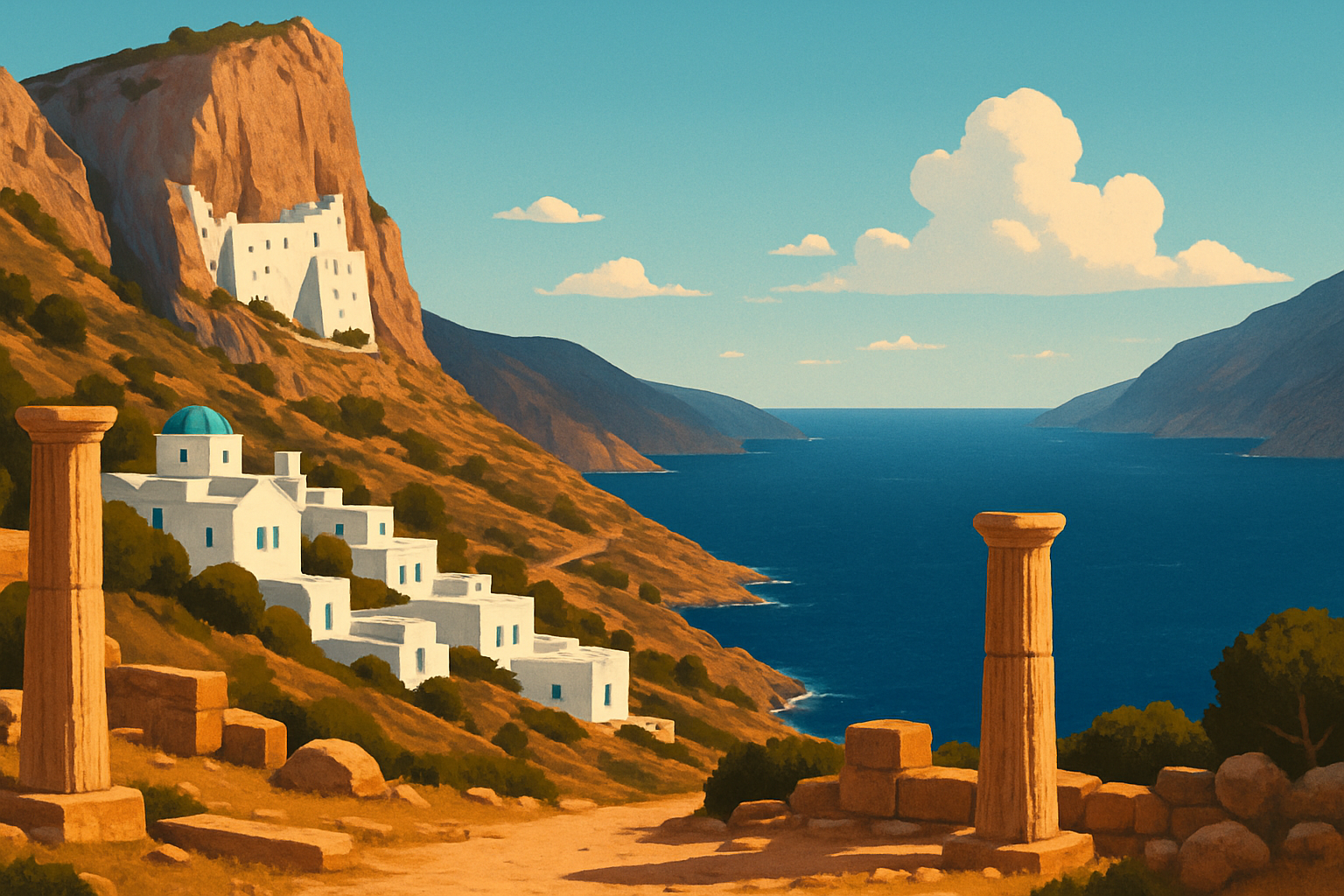
The defining image of Amorgos is a white building pressed flat against the south face of a 300-meter cliff above the sea. This is Panagia Hozoviotissa — a Byzantine monastery founded in 1088 under the Emperor Alexios I Komnenos — and its position is so unlikely that photographs of it read as digitally manipulated. The building is 40 meters long and only 5 meters wide at its maximum. It fits inside a natural vertical cleft in the rock face, and from the sea appears to grow directly from the cliff.
The founding story involves an icon of the Virgin Mary said to have traveled miraculously from the Palestinian town of Chozova during the period of Byzantine Iconoclasm, when religious images were being destroyed across the empire. The icon was found on the cliff, and the monastery was built at the site of its arrival. The Emperor's 1088 chrysobull — an imperial decree sealed in gold — formally established the monastery's autonomy. That document is still kept inside.
Access is via 271 stone steps climbing from the road below. The monastery is active: monks live there year-round and receive visitors in a small entrance room, offering a glass of raki and loukoumi before showing the interior — the original icon, the carved iconostasis, and the chapel cut directly into the rock. The visit takes 30–45 minutes. Morning is best, since the monastery closes at 1 p.m. The walk down to Agia Anna beach, directly below the monastery, takes another 15 minutes along a marked path.
3. Chora: the hilltop capital and the island's best walk
Four kilometers above Katapola, Chora is the administrative capital of Amorgos and the most visually complete Cycladic village in the island group. It is built around a Venetian kastro constructed in the 13th century during the period of Venetian control of the Cyclades — when the islands formed part of the Duchy of the Archipelago — with the outer ring of fortified houses rising sheer against the hillside, forming a defensive perimeter that still stands intact.
The streets inside Chora are too narrow for cars and run between whitewashed walls, through small squares anchored by Byzantine chapels (there are said to be more than 40 churches in a village of under 400 permanent residents), past doorways wrapped in bougainvillea and across terraces with views across the island toward the sea. A row of old windmills on the ridge above the village is one of the canonical images of the Cyclades — they worked into the 20th century and have not been restored, which makes them more atmospheric than the renovated versions elsewhere.
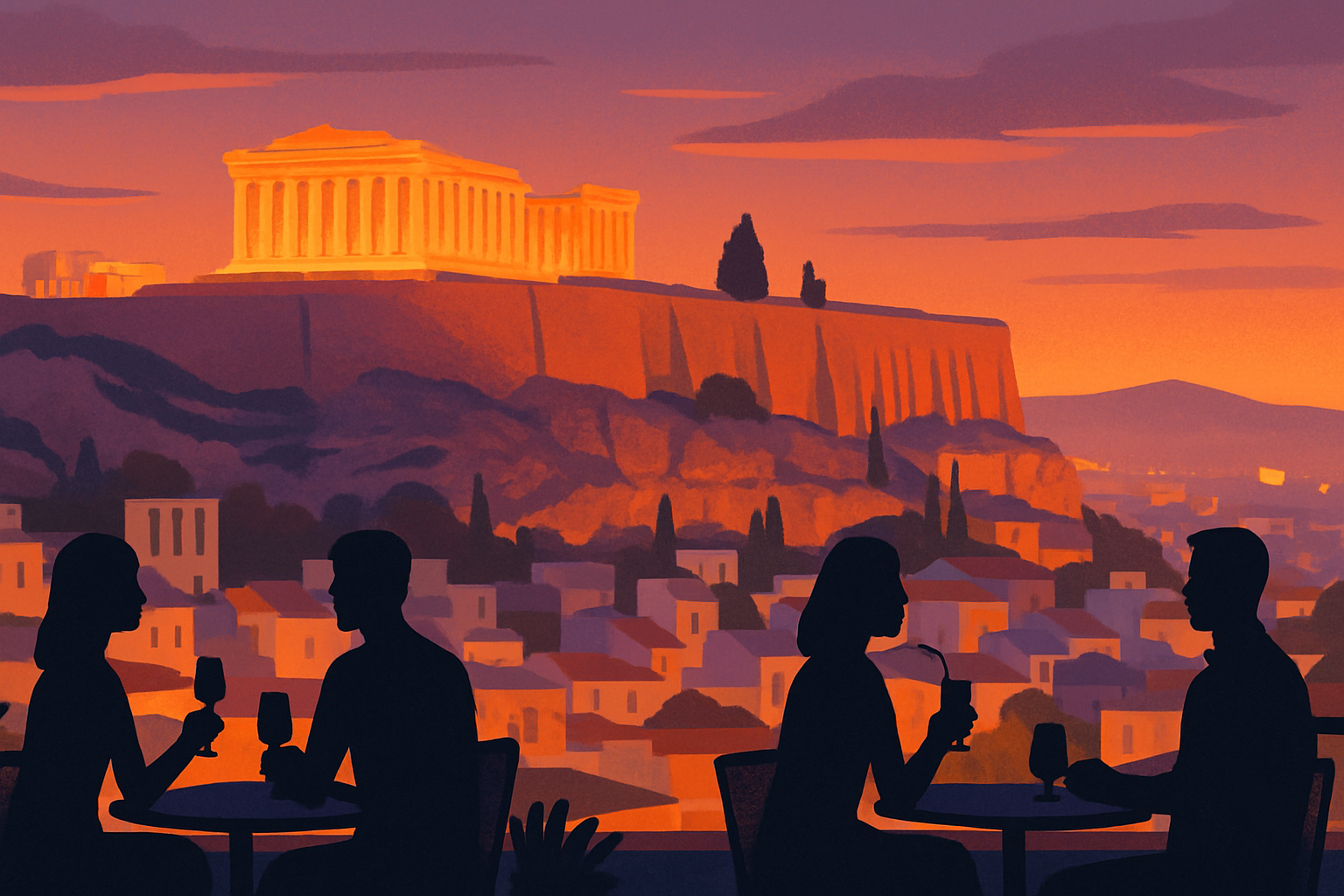
For dinner, Chora's central plateia has two or three tavernas running through summer evenings. The pace is slow: a table in the square, slow-cooked goat or fresh fish depending on what came in that day, and the village gradually filling up after 9 p.m. as residents and visitors converge from the surrounding lanes. The view at dusk — the kastro walls above, the island sloping toward the dark Aegean below — is the best free thing on Amorgos.
4. The Big Blue: the 1988 film and why it still draws people to Amorgos
In 1988, the French director Luc Besson filmed most of The Big Blue (Le Grand Bleu) on and around Amorgos. The film — a fictional story about competitive freediving set against the Aegean — became one of the most commercially successful French films ever made, running for over a year in French cinemas. In Greece it was less broadly seen but deeply felt in the islands: it transformed Amorgos from an obscure end-of-the-Cyclades island into a specific type of pilgrimage destination.
The beach at Agia Anna, directly below the Hozoviotissa monastery, appears in several key scenes. The small whitewashed chapel perched on the rocks above the beach is immediately recognizable from the film's imagery. The water visible from this stretch is deep, cold, and extraordinarily clear — the conditions that made it compelling for a film about people who descend without oxygen to depths most humans cannot survive.
The Besson connection drew a particular kind of traveler to Amorgos through the 1990s and 2000s: French visitors, film travelers, and anyone who found something in the film's atmosphere that they wanted to locate in real geography. The island accommodated them without changing for them. Visitors still arrive knowing the film; the island still looks precisely as Besson found it.
5. Beaches: where to swim on a dramatic island
Amorgos is not a beach island in the Naxos or Paros sense. Most of its coastline is steep cliff. But the beaches that exist are exceptional — not long stretches of resort infrastructure, but specific coves with cold, extraordinarily clear water and rock walls on three sides.
Agia Anna (below Hozoviotissa) is a small pebble beach reached by a path continuing past the monastery entrance. A single small taverna operates in summer. The water is deep blue-green and cold from depth. The setting — monastery above, open Aegean ahead — is one of the best-composed beach locations in Greece.
Mouros Beach, east along the south coast, is a longer pebble beach accessible by dirt road or by boat from Katapola. Boats from Katapola offer summer drop-off and pickup service here. No facilities, dramatic cliff backdrop.
Kalotaritissa, at the island's southwestern tip, is the most remote beach and accessible only by dirt track or boat. Bare rock, one bay, the open Aegean — Amorgos at its most elemental.
Near Aegiali, the beaches shift character: Tholaria beach and the bay in front of Aegiali itself are sandier and have sunbeds and tavernas through summer. For travelers who want amenities alongside swimming, Aegiali is the practical base.
6. Katapola or Aegiali: where to base yourself
Most visitors choose a base, since the two ports are 40–50 minutes apart by road.
Katapola is the practical choice: main ferry terminal, most accommodation options, closest to Chora (4 km) and Hozoviotissa (12 km), best taverna concentration. If your priorities are the monastery and village walks over beach time, stay here.
Aegiali is better for beaches and a quieter atmosphere. The bay is genuinely pretty — a semicircle of water with a string of tavernas on the waterfront and the villages of Tholaria and Langada visible on the hills above. From Aegiali a well-marked trail climbs to Tholaria in 30 minutes and continues to Langada with sea views on both sides of the ridge. For families or anyone prioritizing swimming over sightseeing, Aegiali is the stronger choice.
7. Getting to Amorgos from Athens: ferries, times, and prices
Amorgos is ferry-only. Ferries depart from Piraeus (Athens port, Metro Line 1 Green Line, the terminus) to both Katapola and Aegiali. Blue Star Ferries operates the primary routes; SeaJets and Hellenic Seaways add high-speed options in summer.
Conventional ferries from Piraeus to Katapola take 8–10 hours depending on intermediate stops at islands like Syros, Naxos, or Paros. High-speed services run in roughly 5.5–6.5 hours. In June–September, there are typically 5–7 sailings per week from Piraeus to Amorgos.
Ticket prices: deck passage runs €43–55 on conventional ferries; cabin berths add €25–40. High-speed tickets run €70–90 and above. The overnight conventional ferry is the best-value option for most travelers — you leave Athens in the evening and arrive at dawn having paid for transport and accommodation in a single ticket.
Alternatively, Amorgos is reachable by ferry from Naxos (2–3 hours) and Paros (3–4 hours), making it a natural addition to a Cycladic island sequence rather than a standalone destination.
8. Is Amorgos right for you? The honest trade-offs
Who Amorgos is for: Travelers who want a quiet island with serious natural and historical character. People who have done Santorini and Mykonos and are looking for the Cyclades before mass tourism reshaped it. Hikers — the island has marked trails connecting Chora, both ports, and the monastery. Anyone who watched The Big Blue and wanted to know what that water actually looks like in person.
What Amorgos does not offer: Sandy beaches with full amenities. Nightlife beyond taverna-pace wine at outdoor tables. An efficient two-day itinerary — the island rewards three or four nights, not a fast pass. Consistent mobile data on the south coast road between the ports.
Best time to visit: June is excellent — warm enough for swimming (sea temperature 22–23°C), summer crowds haven't peaked, and the evenings are cool enough to walk Chora comfortably after dinner. July–August fills up fast; ferries and accommodation book weeks in advance. September is the ideal month for most travelers: warm sea, cooler air, almost no queues. Avoid November through March unless you want the island entirely to yourself — ferry schedules reduce sharply and most restaurants close.