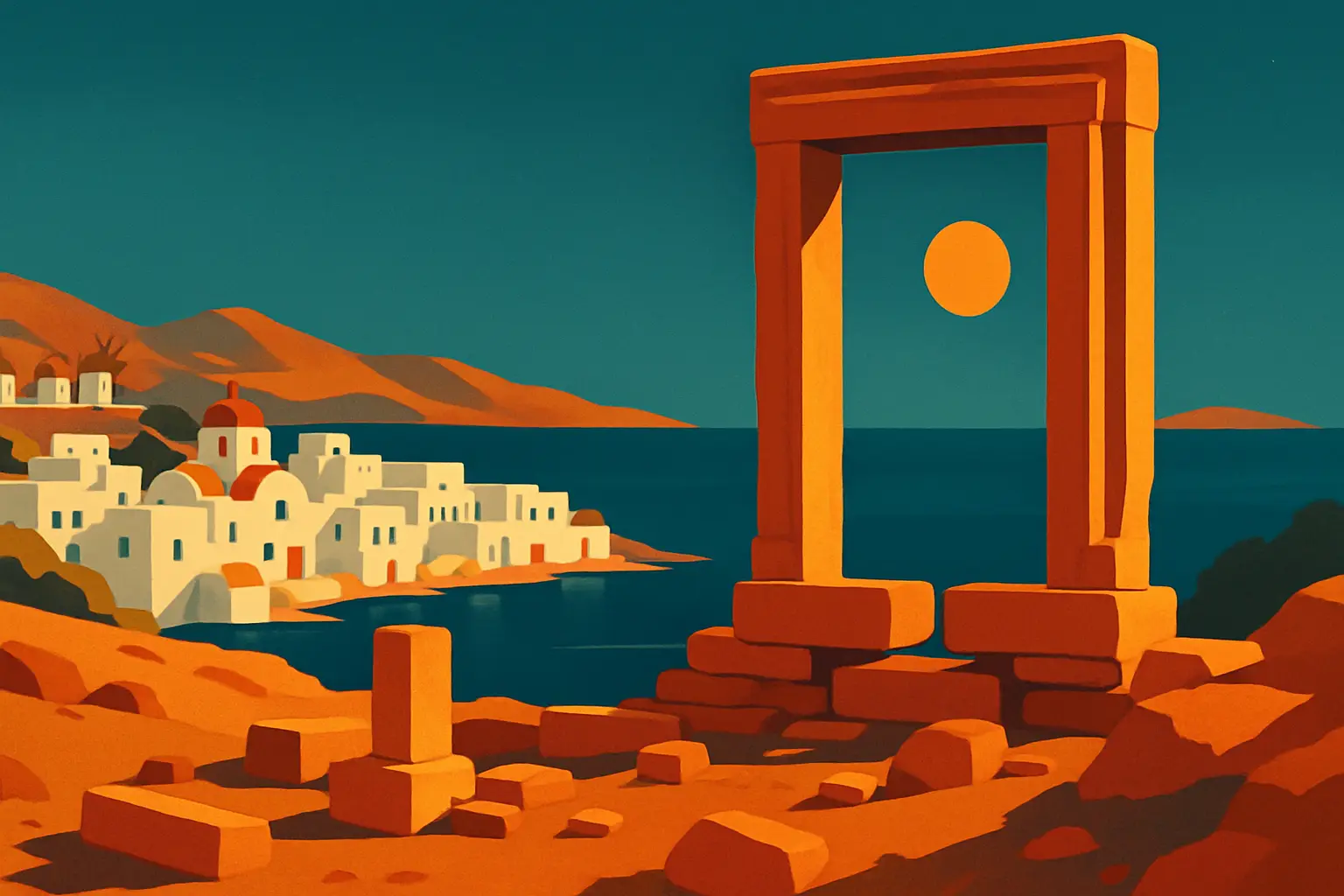
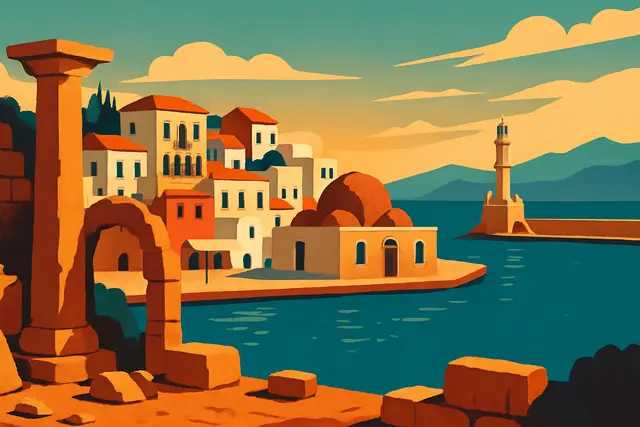
Mykonos is 85 square kilometers of granite and whitewash at the northern edge of the central Cyclades, 3.5 hours from Athens by fast ferry. Its permanent population sits around 10,000 — which roughly doubles in spring, quadruples in June, and at peak August can push past 80,000 people on an island the size of a mid-sized city district.
The reputation for nightlife, fashion, and luxury beach infrastructure is not wrong. Paradise Beach on the south coast has a full beach-club setup that has defined Greek island summer since the 1980s. Psarou Beach is where the celebrity-and-yacht circuit concentrates. The cosmopolitan density Mykonos delivers is real and specific — you cannot replicate it on Naxos, Paros, or Santorini.
But Mykonos has two centers that operate on entirely different logics. Mykonos Town (Chora) on the west coast is the cosmopolitan face: labyrinthine alleys, Little Venice, the Kato Mili windmills, and boutique hotels built into 18th-century sea-captain mansions. Ano Mera, 7 km inland, is what the island looked like before the jet set arrived in the 1970s: a quiet village square, a functioning 16th-century monastery, and tavernas serving goat cooked in lemon sauce since before anyone outside Greece had heard of Mykonos.
Mykonos came under Venetian control in 1207, when Marco Sanudo's Duchy of the Archipelago carved up the Aegean following the Fourth Crusade. Venetian rule lasted into the 18th century, when the island passed to Ottoman administration. Throughout this era, Aegean piracy was an existential problem — not occasional raids but organized fleets operating against coastal settlements across the eastern Mediterranean.
The response was architectural. Chora's street plan was built as a deliberate maze: alleys that dead-end without warning, corners that redirect at unexpected angles, passageways that tunnel under buildings and emerge facing a different direction. The whitewash on every surface and the absence of consistent landmarks meant that any attacker who breached the outer walls had no navigational reference points. A pirate who knew where every street led was dangerous; one who didn't was lost in seconds. Most alleys are barely wide enough for two people to pass with difficulty — too narrow for any group to move in formation.
At the northern edge of Chora, where the settlement meets the sea, stands Paraportiani Church — not a single building but a cluster of five interconnected chapels built in phases between roughly 1425 and the 17th century, whitewashed into a single organic mass. The compound looks less like a constructed building than a geological formation: rounded, irregular, bleached by centuries of lime wash. It functions as an active church; open during morning and evening services, with modest dress required. The terrace in front of it, facing the sea, is one of the calmer spots in Chora at almost any hour.
Get short, interactive stories that make each place easier to remember while you travel.
The Alefkandra district — universally called Little Venice — occupies the westernmost point of Chora where the settlement meets the Aegean directly. The buildings here are 18th-century sea captains' houses built with their foundations in the water: balconies cantilevered over the sea on wooden brackets, the Aegean breaking directly below. When the afternoon Meltemi wind picks up from the north, spray reaches the lower terraces. The name comes from the buildings-over-water arrangement, which mirrors Venice's canal edge — though the effect is distinctly Greek, with whitewash, blue shutters, and clear Aegean green below rather than murky canal water.
Most of the ground floors now hold bars. Sunset from Little Venice faces southwest, and in June the sun drops toward the horizon after 8:30 p.m. Arriving at 7:00 p.m. gives you the best light before the crowd from the cruise-ship departures regroups. Kastro Bar, established in the 1970s at the district's edge, is the oldest bar in the area and the one Mykonos regulars always mention first.
Immediately above Little Venice, on the promontory rising toward the south end of Chora, stand the Kato Mili windmills — seven surviving examples of the 16th- and 17th-century Venetian windmills built to exploit the Meltemi wind. They processed wheat and barley brought from across the Cyclades for grinding and export, operating as Mykonos's main commercial infrastructure until motor-powered mills made them obsolete in the mid-20th century. The Bonis Windmill, rightmost of the seven facing the sea, has been restored as a small agricultural museum by the Mykonos Cultural Foundation, with exhibits on milling history and the island's pre-tourism economy. Free or minimal entry; open in summer. The terrace between the windmills and Little Venice is the canonical Mykonos sunset viewpoint.
The single most important thing to understand about Mykonos is that it shares its immediate waters with Delos — a completely uninhabited island 9 km to the southwest and one of the most significant archaeological sites in the ancient Mediterranean.
According to ancient tradition, Delos was the birthplace of Apollo and Artemis, born to the Titan Leto on this island after every other place in the Aegean refused to shelter her for fear of Hera's anger. Because Delos was sacred, ancient law forbade births and deaths there: pregnant women and the terminally ill were ferried to the neighboring island of Rhenia for their final hours. You could visit, worship, and trade — you could not arrive or leave as anything other than a living adult.
First settled around 3000 BC, Delos operated for millennia as the central religious sanctuary of the Cyclades, then grew into one of the most important trading ports in the Hellenistic Mediterranean. At its peak in the 2nd–1st century BC, the island supported a population of 30,000 — merchants, slaves, pilgrims, priests, and interpreters from across the known world. The Roman-era slave market on Delos could process up to 10,000 people per day, making it the largest known slave market of the ancient world. The island was sacked by Archelaus, a general of Mithridates VI of Pontus, in 88 BC, and again in 69 BC. It never recovered.
Today the island is a UNESCO World Heritage Site with no permanent residents and no construction since antiquity. What remains: the Terrace of the Lions — a row of 7th-century BC archaic marble lions that were a votive offering, the originals inside the on-site museum and stone replicas marking the original terrace; the House of Dionysos with an intact floor mosaic of Dionysos riding a panther in extraordinary detail; the Sanctuary of Apollo with three consecutive temples; the Sacred Lake (drained after malaria outbreaks, now a palm-grove depression); and the Archaeological Museum at the site's center containing thousands of objects spanning 3,000 years of continuous occupation.
Boats depart Mykonos Old Port at 9:00, 10:00, and 11:00 a.m.; returns run at noon, 1:30 p.m., and 3:00 p.m. Round-trip ferry €25; site entry €20. Allow 3–4 hours.
Mykonos has more than 25 beaches. The useful organizing principle is not which is most beautiful — most share fine pale sand in sheltered Aegean bays — but which atmosphere fits what you are looking for.
Psarou Beach is the smallest and most exclusive: a 200-meter crescent of fine sand in a protected bay 6 km south of Chora. The Nammos beach club operates here with minimum sunbed spends and a clientele that arrives by speedboat from moored yachts. The water is genuinely exceptional; the atmosphere is intentionally rarefied.
Paradise Beach on the southeast coast is the original Mykonos party beach: full sound system from afternoon, a bar at the sand's edge, a crowd here specifically for this. Nearby Super Paradise, a 10-minute water taxi from Paradise, has a smaller footprint and a more mixed crowd. Both are exactly what they advertise — if you want this, they deliver it; if you don't, skip them.
Elia Beach is the island's longest sandy beach at roughly 500 meters, with a more relaxed setup — sunbeds available without minimum spends, a bar running at normal volume. LGBTQ+-friendly and bus-accessible from Chora (€2).
Agios Sostis on the north coast is the opposite of all of the above: no sunbeds, no bar, no infrastructure, accessible only by car or ATV down a dirt road. Almost exclusively locals and long-term Mykonos residents. For those who want to swim in the Aegean without a minimum spend attached.
Seven kilometers from Chora by the island's central road — reachable by bus from the Chora bus station every 30–45 minutes (€2) or by rented ATV — Ano Mera is the only other functioning settlement on Mykonos. Its main square has a central church, a handful of traditional tavernas, a small supermarket, and almost no evidence that the rest of the island is one of the most visited destinations in Europe.
Panagia Tourliani Monastery anchors the square. Founded in 1542 by the monks Lavrentios and Frantzeskos — both from the island of Paros — the present building was substantially rebuilt in the 18th century, when marble statues were imported from Florence for the interior courtyard and the carved wooden iconostasis was assembled inside the main church. The iconostasis — the gilded and painted screen separating the nave from the altar — is considered one of the finest examples of Byzantine woodcarving craft in the Cyclades: figures of saints, angels, and biblical scenes worked in detail across every surface. The monastery is still active; monks are in residence. Open to visitors in the mornings; covered shoulders and knees required. Free entry.
Barbarousa taverna on the main square serves Mykonian food in the original sense — dishes that predate tourism's version of Greek cuisine. Goat slow-cooked with lemon and herbs, loukaniko sausages from island pork, kopanisti spread on charcoal-grilled bread, and locally produced wine. This is where Mykonos residents eat when they want to eat well without spectacle.
Mykonos is the most expensive island in the Cyclades by a substantial margin. In July–August, mid-range hotel accommodation runs €300–600 per night; the beach clubs layer minimum sunbed spends on top of transport costs. A harbor-facing dinner in Chora costs 40–60% more than an equivalent meal on Paros or Naxos.
The honest answer depends on what you are buying. The premium pays for the most organized and socially concentrated beach-club scene in Greece — if that is why you are here, Mykonos delivers it in a form no other island does. The high-end property market (converted sea-captain mansions, boutique design hotels with infinity-edge pools over the Aegean) is also genuinely excellent at the top tier.
What the premium does not buy: Delos is one of the most significant archaeological sites in the Aegean, but so is Delphi — and the Delphi day trip from Athens costs a fraction of a Mykonos hotel night. Paros has quieter beaches, a Byzantine marble trail through the olive-grove interior, and a harbor town in Naoussa that hasn't been converted into a service corridor. If the scene is not the primary draw, the cost differential is hard to justify on cultural or culinary grounds alone.
By ferry from Piraeus: Seajets and Golden Star high-speed catamarans cover Athens (Piraeus) to Mykonos in 4.5–5 hours, €50–90 one-way. These sell out months in advance for August travel — book as soon as dates are confirmed. Blue Star Ferries runs a slower conventional overnight sailing from Piraeus (roughly 6 hours, €25–40 deck class) that is rarely fully booked.
By ferry from Rafina: The port of Rafina, on the east coast of Attica 30 km from central Athens, is the closer departure point for ships heading northeast to Mykonos. Several daily sailings; the KTEL bus from the Mavromataion terminal in Athens (near Pedion tou Areos park) reaches Rafina in 45 minutes (€3). The trip to Mykonos from Rafina runs 30–45 minutes shorter than from Piraeus.
By air: Mykonos Island National Airport (JMK) receives direct flights from most major European cities in summer. Aegean Airlines and Olympic Air fly from Athens in 40 minutes. Taxis from the airport to Chora take about 5 minutes; there is no bus service.
When to go: June is the most rational window for a first visit. Sea temperature reaches 22–24°C, all island services are running at full capacity, and accommodation runs 20–30% below July peak prices. The Meltemi is lighter in June than in August — calmer conditions for the Delos crossing and north-coast beaches. September offers similar logic with a post-August calm that many repeat visitors prefer. July and August deliver maximum scene density but require booking ferries and accommodation months in advance.