In the early 1900s, waves of Lebanese and Syrian Christian immigrants arrived in Mexico — first in Yucatán, then concentrating in Puebla and eventually Mexico City. Being Christian meant no dietary restriction on pork, and they brought their food culture with them: shawarma, cooked on a vertical spit, wrapped in flatbread, and seasoned with spice blends that had no equivalent in Mexican cooking at the time. In Puebla, where the Lebanese community settled most densely, the shawarma spit became the taco árabe — 'Arab taco' — made with lamb or pork served on a flour-based bread similar to pita. By the 1950s, the technique migrated north to Mexico City, where cooks made three critical adaptations: they switched to corn tortillas, they built a new marinade around achiote paste and guajillo chiles (replacing the Middle Eastern spice blend), and they placed a pineapple on top of the spit where it could caramelize and baste the meat with acid and sugar as it dripped down. The dish was renamed 'al pastor' — shepherd-style — a nod to the pastoral imagery of the vertical spit and the Lebanese herder traditions it referenced. The word 'pastor' is the linguistic ghost of a Lebanese cooking method, translated through migration and a century of refinement into something entirely and specifically Mexican. Today, Mexico City is the world capital of al pastor — nowhere else takes the trompo this seriously.
Lebanese immigrants brought shawarma to Puebla in the 1920s — first using lamb, eventually pork
The dish migrated to Mexico City in the 1950s, where achiote, guajillo, and corn tortillas replaced the original spice blend and pita
The pineapple on top is functional — it bastes the meat with acid and sugar as it drips down the spinning cone
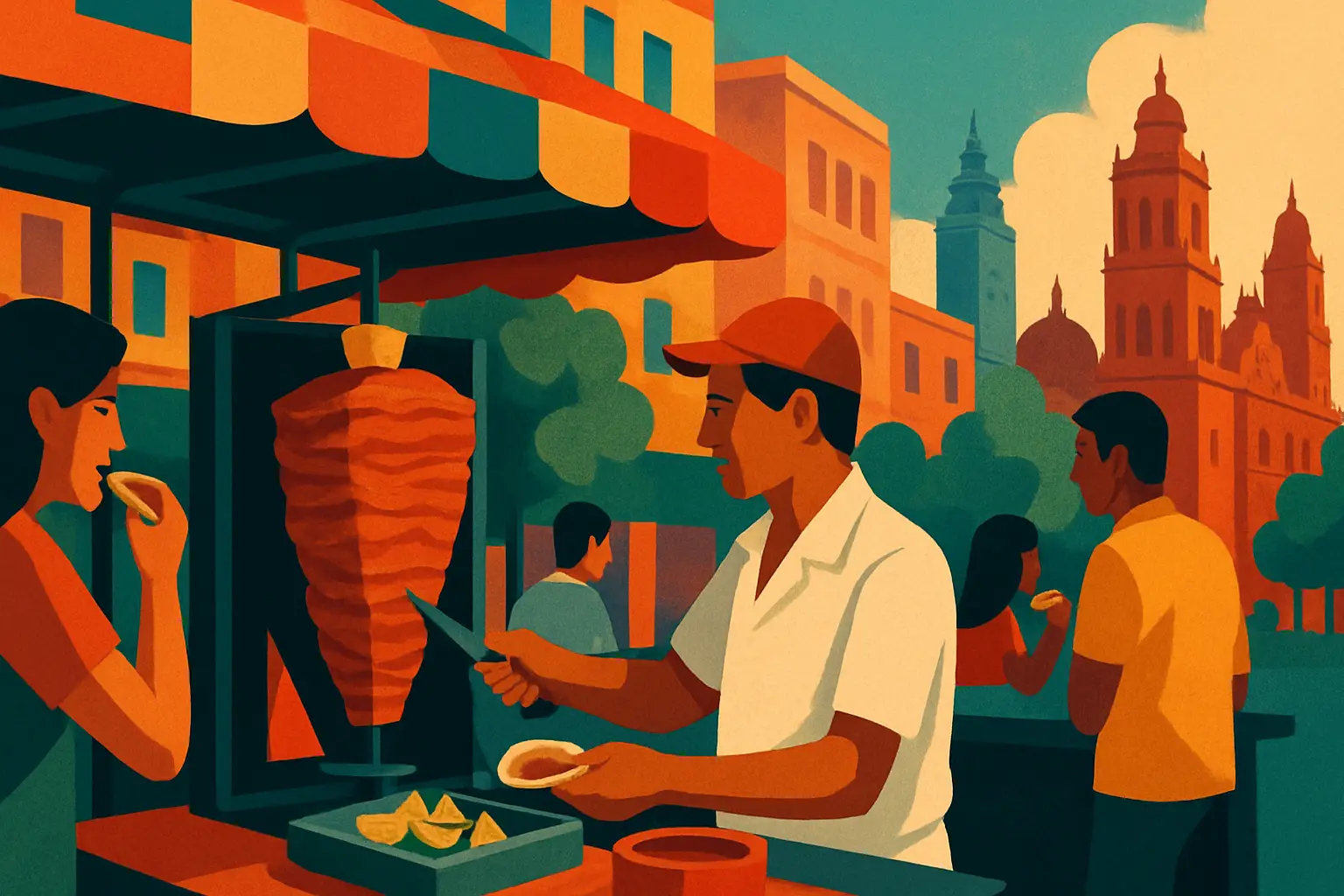
The trompo is the vertical rotating spit behind the taquería counter — a cone of marinated pork stacked and pressed into layers, spinning slowly beside a gas or charcoal flame. The outer edge of the cone is constantly crisping while the interior stays moist, which is why a skilled taquero shaves the meat in thin, curling strips with a long flat knife and catches them directly into a tortilla in one fluid motion. At the top of the trompo sits a chunk of fresh pineapple. This is functional, not decorative — as the heat rises, the pineapple releases juice that runs down the meat, adding sugar and acid that accelerate caramelization. A great taquero will occasionally slice a thin ring of pineapple directly into your taco with the same knife motion used to shave the meat. The marinade varies by taquería and is usually a trade secret, but the constants are achiote paste (which gives al pastor its signature orange-red color — not food coloring), dried guajillo and ancho chiles, garlic, cumin, and vinegar or pineapple juice as an acid. A well-marinated trompo should taste smoky, slightly sweet, and deeply earthy — the pineapple brightens it without making it dessert.
The outer layer crisps continuously while the interior stays moist — ask for surtida to get both textures in one order
Achiote paste is what gives al pastor its orange color — not artificial coloring
Watch how the taquero shaves: an even, thin curl from top to bottom means consistent quality throughout the cone
Get short, interactive stories that make each place easier to remember while you travel.
El Huequito opened on Calle Ayuntamiento in Centro Histórico in 1959, and many Mexico City food historians consider it one of the earliest — possibly the first — taquería to serve tacos al pastor in the format the dish takes today. The name means 'the little hole,' a reference to the original stall size, which was barely large enough to operate from. The tacos here are intentionally small — smaller than the palm-sized standard you'll find elsewhere in the city. This is by design: the thinking is that you should taste more of the trompo's variation across an order, rather than filling up on two large tacos. Order six and pay attention to how the flavor shifts between the deeply caramelized outer-edge pieces and the juicier interior cuts. The marinade at El Huequito is a closely guarded family recipe that hasn't changed in generations — what you can identify is a heavier guajillo presence than most competitors, giving it a darker, slightly smokier red color that distinguishes it at a glance. The original location is at Ayuntamiento 21 in Centro Histórico; additional branches operate elsewhere in the city, but the lineage is at the source.
Ayuntamiento 21, Centro Histórico — open since 1959, considered one of the originators of the al pastor format
Smaller-than-average tacos by design — order six to taste the range from crispy outer edge to moist interior
Heavier guajillo marinade than most taquerías — darker color, slightly smokier finish
El Vilsito operates out of a Nissan service center on Avenida Nueva York in Narvarte. During the day, mechanics work on cars. By early evening, the hydraulic lifts lower, the tools go away, and taco tables are set up in the exact space where oil changes happen. It is among the more specifically Mexico City things you can experience. The al pastor here has a different texture than El Huequito — chunkier cuts, a more pronounced pineapple sweetness in the marinade, and a smokier finish. The Volcán is the order to know: it's an open-faced taco served on a slightly larger corn tortilla, loaded with al pastor and a layer of melted Oaxacan cheese that runs to the edges. It eats more like a quesadilla-taco hybrid and is one of the better five-minute meals available in the city at 2 a.m. El Vilsito stays open until 3 a.m. on weekdays and 5 a.m. on Friday and Saturday nights. This is where people go after the mezcalerías and bars close — the clientele after midnight is a cross-section of cab drivers, couples walking home, and international food writers who planned this stop months in advance.
Avenida Nueva York, Narvarte — a working Nissan service center by day, a taquería institution by night
The Volcán: open-faced on a large corn tortilla with al pastor and melted Oaxacan cheese — the signature order
Open until 3 a.m. weekdays, 5 a.m. Friday and Saturday
Taquería Selene on Leibnitz 78 in Anzures has been running for over six decades, which in a city where taquerías open and close with the seasons is a meaningful track record. The reason for the longevity is less mystery than it is consistency: the meat-to-cheese ratio and the crispiness of the outer layer are both calibrated correctly and have been for years. At many taquerías offering a gringa or volcán variant, the cheese overwhelms the pastor. Selene's approach is the inverse — a generous amount of pastor meat, with cheese used as a finishing layer rather than a structural base. The result is that the achiote-guajillo flavor comes through clearly instead of being dulled by dairy. Selene also operates around the clock — it's one of the few genuinely 24-hour taquerías in the city with high quality regardless of what hour you arrive. For visitors staying near Polanco or the western Reforma corridor, Selene is the closest serious al pastor option.
Leibnitz 78, Anzures — between Polanco and the Reforma corridor, open 24 hours
More meat-forward than most taquerías — cheese is a garnish, not the base
Consistent quality at all hours, which is rare for a 24-hour taquería
The taquería counter moves fast and the vocabulary helps. Con todo means 'with everything' — onion, cilantro, and pineapple. This is the standard and the correct call unless you have a specific objection. Suave means the tortilla is soft and fresh; dorado (sometimes called costra) means the taquero fries the tortilla briefly on the griddle so it gets crispy with slightly charred edges. Dorado is excellent with al pastor — the caramelized tortilla mirrors the caramelization on the meat. A gringa is al pastor served on a flour tortilla with Oaxacan cheese melted onto it — the flour tortilla is a direct descendent of the Lebanese tacos árabes tradition and has never fully disappeared from the menu. A volcán is an open-faced version on a corn tortilla with cheese on top. A surtida order means 'mixed' — the taquero will pull from different parts of the trompo so you get the crisped outer pieces and the juicier interior cuts in the same order. Ask for surtida and you'll get the full range of what the trompo produces. For salsa, al pastor pairs best with a salsa verde — the tomatillo acid mirrors the pineapple and cuts through the fat — rather than a heavier red salsa.
Con todo = onion, cilantro, pineapple — the correct default
Surtida = mixed cuts from throughout the trompo, both crispy exterior and moist interior
Salsa verde over red salsa — the tomatillo acid mirrors the pineapple and cuts the pork fat
Al pastor from a busy, reputable taquería is one of the safer street food options in Mexico City — the pork is on a continuously rotating spit beside a constant heat source, meaning the outer surface is always at cooking temperature. The risks that occasionally accompany street food (unwashed raw produce, sauces left sitting out) apply more to the toppings than the meat itself. The practical safety standard is the same one locals use: a busy trompo means the meat is being shaved frequently, so the outer layer is constantly renewed and you're getting freshly caramelized cuts rather than meat that's been drying under heat for hours. A trompo with no customers isn't necessarily unsafe, but a consistent crowd is an easy quality signal. For first-time visitors, the main adjustment risk is the raw onion and the chile heat in the salsas — if your stomach is still acclimating to CDMX, ask for the salsa on the side and add it incrementally rather than pouring a full ladle over your first taco.
The continuous heat source makes the outer trompo layer consistently cooked — the meat isn't the risk
A busy trompo with fast turnover is the simplest quality and safety signal
New arrivals: put salsa on the side your first time and taste before committing to the full pour
Al pastor is everywhere in Mexico City, but it concentrates in certain areas and certain hours. Centro Histórico has the highest density of old-school taquerías — El Huequito on Ayuntamiento is the anchor, but the blocks around Metro Salto del Agua and toward La Merced have a dozen more worth exploring on foot. Narvarte, home to El Vilsito, is the late-night capital — the trompos here often spin until dawn. Roma Norte and Condesa have fewer dedicated taquerías but compensate with trompos that appear on weekend evenings, operating out of parking lots and sidewalk setups that exist only between 9 p.m. and 2 a.m. The best time to eat al pastor is lunch — between noon and 2 p.m. — when the trompo has been spinning long enough to develop full caramelization on the outer layers but hasn't been running so long that the interior dries out. Late night after midnight is the second-best window, for the same reason: busy spots like El Vilsito are turning meat over fast. Avoid the mid-afternoon slump between 3 and 6 p.m., when foot traffic is low and a trompo that's been sitting can dry out before the evening crowd arrives.
Best hours: noon–2 p.m. for a fully developed trompo; after midnight when busy spots turn meat over fast
Avoid 3–6 p.m. — the mid-afternoon slump is when trompos can dry out between the lunch and dinner rushes
Centro Histórico for the oldest taquerías; Narvarte for late-night; Roma and Condesa for weekend pop-ups