In a city defined by culinary extremes — tasting menus in Polanco alongside 20-peso street tacos — pan dulce is the great equalizer. A concha from a neighborhood panadería in Tepito costs the same as one from a corner bakery in Del Valle. The process of buying it is identical everywhere: tray, tongs, slow walk past the case. Mexico City alone has thousands of panaderías, from century-old institutions in the Centro Historico to the new artisan wave in Roma Norte. And unlike most of the city's food culture — which operates on rigid schedules (canasta tacos only until 11 a.m., barbacoa only on weekends) — pan dulce is available from the moment a panadería opens at 6 a.m. through the late afternoon. It functions simultaneously as breakfast, after-school snack, midnight craving, and religious offering. No other food in Mexico City crosses as many class, time, and neighborhood boundaries.
There are believed to be between 500 and 2,000 varieties of pan dulce across Mexico, but eight types dominate Mexico City panaderías. Concha: the most iconic — a soft, slightly sweet dome covered in a scored sugar paste crust that resembles a seashell (hence the name). Cuerno (horn): Mexico's adaptation of the French croissant, typically less buttery and sweeter, often filled with cream, chocolate, or guava paste. Polvorón: a crumbly shortbread disk made with lard and powdered sugar that dissolves on contact with your tongue in a way no other pastry does. Marranito: a pig-shaped gingerbread made with piloncillo (unrefined cane sugar) and anise — dense, dark, subtly spiced. Bigote (moustache): a small puff pastry rectangle folded into a moustache shape, usually filled with pastry cream or vanilla custard. Cubilete: a butter cake baked in a fluted mold, dense and orange-scented, often given as a gift. Garibaldi: a small round sponge cake coated in apricot jam and covered in nonpareil sprinkles — a distinctly Mexico City invention, named after the Italian general who was wildly popular here in the 19th century. Rebanada: literally a slice of slightly sweet milk bread, sometimes glazed. Everything else in a typical panadería case is a variation or regional interpretation of one of these eight forms.
Get short, interactive stories that make each place easier to remember while you travel.
Pan dulce owes its modern form to one of Mexico's most chaotic political episodes. When Napoleon III installed Austrian Archduke Maximilian as Emperor of Mexico in 1864, French and Austrian bakers followed the court to the capital. Maximilian's reign lasted only until 1867 — when Benito Juárez had him executed — but the bakers' influence lingered. Before the French intervention, Mexico had pan de pulque (bread leavened with fermented agave sap) and wheat breads introduced by Spanish missionaries in the 1500s. What the French brought was technique: laminated doughs, pastry creams, butter glazes, and the habit of naming breads whimsically after their shapes. Mexican bakers absorbed the structures and localized the ingredients — replacing butter with lard, adding piloncillo and anise and cacao, naming their creations after animals, body parts, and everyday objects. The concha emerged in this era. So did the cuerno, the bigote, and the garibaldi. Later, President Porfirio Díaz — who ruled from 1876 to 1911 and was openly enchanted by European culture — further elevated the French-influenced panadería as a mark of urban respectability. The self-service model, the glass cases, the tray-and-tongs system: all of it crystallized in Mexico City during the Porfiriato and has remained fundamentally unchanged for 150 years.
Pastelería La Ideal at República de Uruguay 75 in the Centro Historico is the benchmark. Founded in 1927 by Spanish immigrant bakers in a building that was originally a colonial-era convent attached to the Temple of San Francisco, La Ideal operates with vaulted ceilings, tiled walls, and worn marble floors that make the experience feel archaeological in the best possible way. Taste Atlas has rated it among the 150 best bakeries in the world, but it functions like a working panadería: daily cases of conchas, cubiletes, polvorones, and marranitos, plus a rear counter devoted entirely to wedding and birthday cakes by the slice. The empanadas de cajeta — pastry turnovers filled with goat milk caramel — are as good as anything in the city. The self-service area is at the front entrance; grab your tray and tongs there. La Ideal is open daily from 6 a.m. to 9 p.m. and sits five minutes from the Zócalo, making it a natural stop during a Centro Historico afternoon.
Chef Elena Reygadas opened Panadería Rosetta at Colima 179 in Roma Norte in 2012, shortly after her restaurant Rosetta had established her as one of Mexico City's most important chefs. The bakery became immediately famous for one item: the rollo de guayaba, a flaky spiral roll filled with guava paste that is almost always sold out by 9 a.m. if you arrive late. But the full case rewards a slow look: Rosetta's conchas use a higher-butter dough than traditional versions; the croissants are properly laminated; and seasonal items like pan de muerto in the weeks before Día de Muertos appear in a refined form that still respects the traditional anise and orange zest. What makes Rosetta significant beyond the food is the approach: Reygadas deliberately built on Mexican baking tradition rather than replacing it with European technique. The guava roll uses French lamination in service of a specifically Mexican filling found in any neighborhood cuerno. A second Rosetta bakery operates at Puebla 242, also in Roma Norte. Both open at 7 a.m. and run a line most mornings.
Centro Histórico has the highest density of traditional panaderías in the city. La Ideal (República de Uruguay 75) is the anchor, but the surrounding blocks on Uruguay, Mesones, and 16 de Septiembre have a half-dozen other working panaderías with almost no tourist traffic and excellent morning stock. Pastelería Madrid at Calle 5 de Febrero 25, founded in 1939, is worth a separate visit for the brazo de fresa — a small Swiss roll filled with chantilly cream and fresh strawberries — which its regular customers treat as a near-daily ritual. Roma Norte has Panadería Rosetta at Colima 179 and a cluster of artisan spots near Álvaro Obregón: Pancracia, a small takeaway bakery near the Álvaro Obregón median, makes a vigilante — a double-butter croissant — that operates in the same spirit as pan dulce even if it is not traditional. Narvarte and Del Valle have excellent neighborhood panaderías with no tourist markup and reliable rotating stock from 7 a.m. through noon. Coyoacán's Mercado de Coyoacán has a dedicated panadería section along the south wall where pan dulce is sold by weight and baked on-site through the morning.
Mexico City's pan dulce culture peaks twice a year with breads that exist for a matter of weeks and disappear completely. Pan de muerto is the most anticipated: a round sweet bread flavored with orange zest and anise, decorated with dough bones and a sugar-dusted skull on top, made exclusively in the weeks before Día de Muertos in late October and early November. The anis-and-orange combination has pre-colonial roots — both were used in Aztec ritual offerings — and the bread is placed on altars as an ofrenda before it is eaten. Every panadería in the city makes its own version; Panadería Rosetta's is particularly well-regarded, but the one from your neighborhood corner panadería, still warm, is the correct one to try first. Rosca de Reyes arrives for January 6, Día de Reyes: a ring-shaped sweet bread decorated with strips of candied fruit representing jewels and a hidden plastic figurine inside. Whoever finds the figurine in their slice is obligated to host a tamal party on February 2, Día de la Candelaria. These are not commercial novelties — they are among the most structurally important baking events on the Mexico City calendar, and the weeks surrounding each one change the smell of every neighborhood panadería in the city.
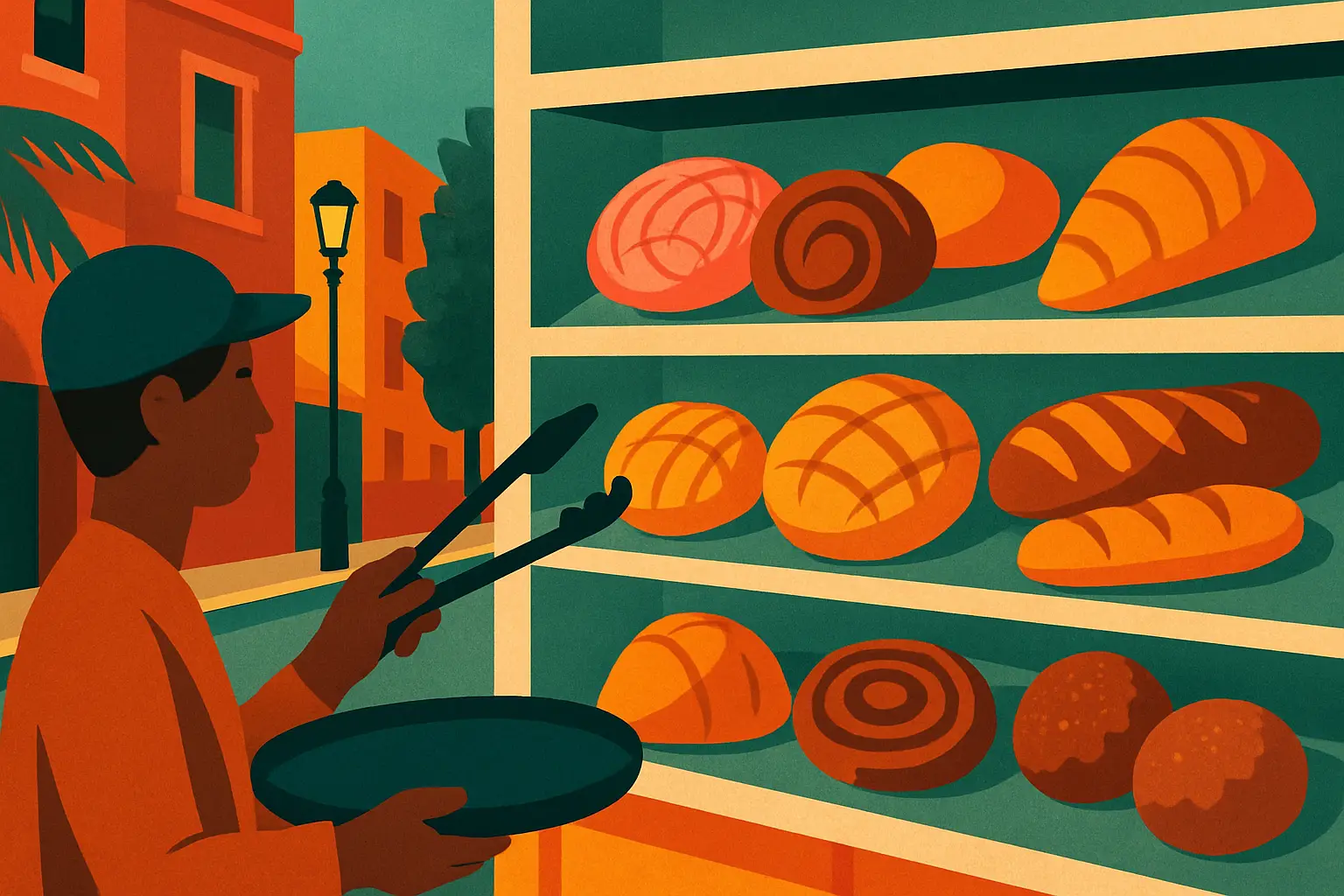
The process is self-guided: pick up the round metal tray and tongs at the panadería entrance, walk the case, use the tongs to place chosen pieces on the tray, then bring the full tray to the cashier to count and price. No order needed; no Spanish required until you reach the register. Prices: at traditional panaderías, individual pieces run 10 to 25 pesos (roughly 50 cents to $1.25 USD). La Ideal runs at the higher end of the traditional range. Panadería Rosetta charges 60 to 120 pesos per item — it is a different market. Most traditional panaderías are cash only; bring 50 and 100 peso bills. What to say: to ask which is freshest, try '¿Cuál está más fresco?' To ask for a bag, say '¿Me da una bolsa?' If a piece is behind the counter rather than in the self-service case, point and say 'uno de ese' (one of that). Pairing: most panaderías don't serve coffee, so carry your pan to a nearby café or find a street cart with café de olla. Pan dulce pairs naturally with the Mexico City coffee culture — the ritual of buying from both is essentially the same morning walk, just with two stops instead of one.