The right starting point is Terminal Central del Sur, commonly called Terminal Tasquena, accessible via Metro Linea 2 at the Tasquena station — the southern terminus of the line. The terminal connects to the metro through an internal walkway; follow signs for 'Taxco' or 'Guerrero' once inside and you'll find ticketing windows for Estrella de Oro and Estrella Blanca, the two main carriers on the route. Both run frequent departures starting around 6 am, with buses every 30 to 60 minutes through the morning. Tickets cost approximately 220–260 pesos one-way.
The journey via the MEX-95D toll highway takes 2.5 to 3.5 hours depending on traffic leaving the city. The toll highway is the only route worth taking — the free road through the mountains adds at least two hours and is far less comfortable. Buses are air-conditioned and smooth enough for the duration. Bring something to read for the stretch through Cuernavaca, where traffic can back up on weekend mornings.
Buses drop you at the Terminal Estrella de Oro in Taxco — a station at the lower edge of town, about 1.5 kilometers from Plaza Borda. From there, the primary way to move around is combis.
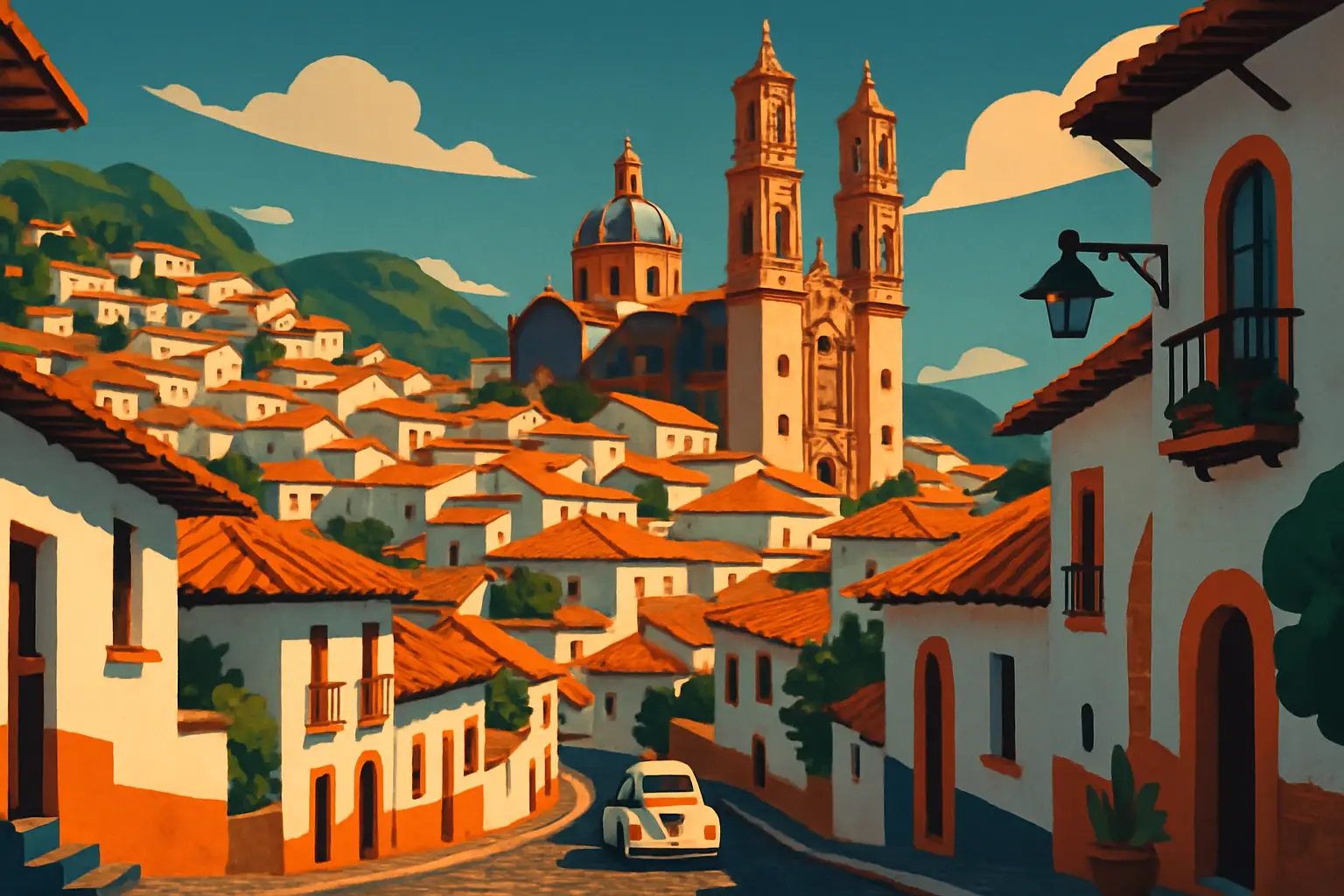
Taxco is built on a hillside — several hillsides, in fact — and understanding this changes how you plan the day. The colonial center climbs steeply from the bus terminal to Plaza Borda and then continues upward in every direction. There are no flat routes between anything. Streets that look adjacent on a map can require 15 minutes of switchbacking cobblestones to connect.
The solution the city settled on is combis — small shared minivans that circulate constantly through the hill routes, serving as de facto public transit. A ride costs 8–12 pesos, paid to the driver when you exit. Routes are announced by the driver shouting destinations out the window, but there are consistent patterns: the 'Zocalo' or 'Plaza' combis go directly from the bus terminal to the central plaza, which is where you want to start.
Once you're at Plaza Borda — the main square, named after the silver miner who bankrolled the city's most famous building — you have a workable anchor. Silver market stalls fan out from the plaza on multiple levels. The Santa Prisca Church faces the square directly. The narrow cobblestone streets leading to workshops, restaurants, and the Spratling Museum all radiate from here. The hill continues upward above the plaza toward the El Cristo Panoramico statue, where the whole city spreads out below — reachable on foot in about 20 minutes or by taxi in 5.
One practical note: cobblestones in Taxco are steep and uneven enough that closed-toe shoes with grip matter more than most guides suggest. Sandals work if that's all you have, but they make the day harder.
Get short, interactive stories that make each place easier to remember while you travel.
The story of Templo de Santa Prisca y San Sebastian — the pink-stone Churrigueresque church that dominates Plaza Borda — is inseparable from the story of Jose de la Borda, and the story of Jose de la Borda is one of the more remarkable arcs in Mexican colonial history.
Borda was born around 1700 in France, arrived in New Spain as a young man, and spent decades in the silver mining business working claims across Guerrero and Zacatecas. He made and lost several fortunes before striking the San Ignacio vein near Taxco in the 1740s — one of the richest silver discoveries of the 18th century. The wealth that followed was on a scale that required a response commensurate with the debt he felt he owed. His response was the church.
Construction ran from 1751 to 1758 — seven years for a building of this complexity, which speaks to the sheer volume of money being directed at the project. The facade is cantera rosa, warm pink quarrystone, carved in the Churrigueresque style: an extreme late-baroque form characterized by layers of ornamental relief so dense and intricate that the stone reads almost like embroidered fabric from a distance. Inside, the church contains 12 gilded altarpieces in near-original condition, along with paintings by Miguel Cabrera, one of the most celebrated artists of 18th-century New Spain.
Borda's fortune was so thoroughly redirected toward the church that he reportedly died in relative poverty. The phrase attributed to him — *Dios da a Borda, Borda da a Dios* (God gives to Borda, Borda gives to God) — whether he actually said it or not, captures the accounting: what came in through the mine went back out through the church. Entry to Santa Prisca is free. The interior is best seen in the morning when light enters the lateral windows at an angle that catches the gold of the altarpieces.
The silver mining era that built Santa Prisca ended by the late 18th century as the richest veins played out. By the early 20th century, Taxco had become a small, quiet colonial town — still beautiful, still on its hills, but economically marginal. What changed the trajectory was an American architect who arrived in 1929 with a different idea about what the town could be.
William Spratling came from New Orleans, showed up in Taxco on a research trip, and never left. He opened a workshop called Taller de las Delicias on Calle de los Plateros, hired local craftsmen, and began designing silver pieces that fused Art Deco aesthetics with pre-Columbian motifs — Aztec serpents, Zapotec geometric forms, Mixtec masks rendered in sterling. The designs were unlike anything in the Mexican market or in international jewelry at the time.
Spratling's workshop trained a generation of silversmiths. His students opened their own workshops. Their students trained more students. By the time Spratling died in a road accident in 1967, Taxco had evolved from a declining mining town into the self-described Silver Capital of the World, with hundreds of workshops operating simultaneously and an international reputation built on genuine craft. Today, estimates of working silversmith artisans in the Taxco area range from 1,500 to over 3,000.
For visitors, this means the silver in Taxco ranges from mass-produced tourist trinkets to exceptional handmade work — and the difference is significant. The large, well-lit shops facing Plaza Borda are oriented toward coach tour groups and priced accordingly. The better value, and often the more interesting work, is found by walking two or three streets back from the plaza and looking for workshops where the artisan is still at the bench. Pieces should be stamped with .925 (sterling standard) and carry a maker's mark. Asking to see the mark before buying is normal practice and no silversmith will take offense.
Spratling moved to Taxco in 1929 and fused Art Deco with pre-Columbian motifs — his students' students still run workshops here
Look for '.925' stamp (sterling silver) plus a unique maker's mark on every legitimate piece
Small workshops 2–3 streets off the plaza have better prices than the large plaza-facing shops and you can often watch the work being done
Spratling's legacy in Taxco extends beyond jewelry. During his decades in the town he assembled one of the most significant private collections of pre-Columbian artifacts in Mexico — ceramics, figurines, jade pieces, stone carvings, and metalwork spanning multiple civilizations and time periods. Before his death he donated the collection to the Mexican government.
The Museo Guillermo Spratling now occupies a building near the foot of Plaza Borda, below the main plaza level — easy to miss if you're focused on the church and the silver stalls. Admission runs around 55 pesos for international visitors. The collection inside is not enormous, but it is specific: Spratling chose with an eye for form and craft rather than size or prestige, and the result carries a cabinet-of-curiosities quality that large national museums don't quite reproduce. Olmec jade pieces, Colima dog figurines, Gulf Coast ceramic figures, and Aztec stone carvings fill the lower level, alongside documentation of Spratling's workshop and design process upstairs.
For visitors already familiar with the pre-Columbian galleries at the Museo Nacional de Antropologia, the Spratling Museum offers something different: the private collection logic, the intimacy of scale, and the direct line between what Spratling saw in these objects and the motifs that appeared in his silver designs 80 years ago.
Taxco is in Guerrero state, and the food reflects that — closer to the Pacific coast tradition than to the central Mexico City pantry. The local specialty worth tracking down is pozole blanco, Guerrero's version of the hominy soup. Unlike the red pozole common in Mexico City restaurants, the Guerrero version uses a clear broth and arrives with a table of garnishes — dried oregano, dried chili, lime, shredded cabbage, tostadas — that you add yourself. It's a lighter, more herbaceous result than the red version and genuinely different enough to warrant ordering even if you've had pozole before.
The Mercado Municipal, about three blocks from Plaza Borda on Plazuela San Juan, is the right place for a cheap breakfast or lunch: market-corridor stalls serve enchiladas, quesadillas, and egg dishes from early morning. Prices are a fraction of the plaza restaurants. For an afternoon drink with a view, restaurants lining the upper edge of Plaza Borda have terraces that look directly at Santa Prisca — expensive for food, appropriately priced for a mezcal and an hour of watching the plaza below.
One local curiosity for adventurous visitors: jumiles, small shield bugs native to the Taxco hill area, are a traditional Guerrero ingredient eaten toasted or ground into salsa. They taste vaguely of cinnamon and herbs — nothing like the category sounds. They appear at the local market and at a handful of restaurants that lean into regional identity. You don't need to eat them to have a good day in Taxco, but knowing they exist is part of understanding that you're somewhere genuinely specific.
Is Taxco safe to visit? The historic center of Taxco — Plaza Borda, the streets around Santa Prisca, the market and museum area — is safe for tourists and sees steady international visitor traffic throughout the year. Guerrero state as a whole has documented security issues in rural and outlying areas, and official travel advisories reflect this. The practical guidance for visitors: stay in the colonial center, travel via the toll highway (MEX-95D) rather than secondary mountain roads, and use the established first-class bus service from Tasquena. The bus companies that run the Taxco route use the toll highway and have a reliable safety record.
Day trip or overnight? A day trip is workable if you take an early bus. Arriving by 9:30 am and leaving on a 5 or 6 pm return bus gives you 7–8 hours — enough for Santa Prisca, the Spratling Museum, the silver market, lunch, and a mezcal with a plaza view. Overnight is better if you want to explore the side streets in the evening after the tour groups leave, or if you're timing a visit around a specific event. Hotel de la Borda on Cerro del Pedregal has colonial-era architecture and city views; prices are reasonable during low season.
Best time to visit? November through February for the quietest, clearest conditions. The Feria Nacional de la Plateria (National Silver Fair) takes place each November in Taxco, bringing silversmiths from across Mexico — the best opportunity to see the full range of contemporary Mexican silverwork in one place. Avoid Semana Santa unless you're specifically coming for the processions and have booked accommodation months in advance. Weekdays are dramatically quieter than weekends — Saturday and Sunday bring heavy bus-tour traffic that fills the plaza from 11 am to 4 pm.
What about the return trip? The same 2.5–3.5 hours on the same highway. Sunday evening buses back to Mexico City can run slow if traffic from Cuernavaca and Chilpancingo backs up — aim for a 4 pm departure at the latest if you're doing a Sunday trip.