Querétaro has an outsized presence in Mexican history for a city that most foreign visitors skip. In September 1810, a group of Creole intellectuals meeting under the cover of a 'literary club' were actually plotting the Conspiracy of Querétaro — the secret independence movement against Spain. When Spanish authorities discovered the plot, the conspirators moved the rebellion up by two weeks, resulting in Father Hidalgo's Grito de Independencia on September 16, 1810. In 1867, Habsburg emperor Maximilian I — the Austrian archduke installed by Napoleon III to govern Mexico — was captured outside the city and executed by firing squad at the Cerro de las Campanas on June 19, ending France's imperial project in the Americas. Then in 1917, Mexico's constitution — one of the world's first to guarantee labor rights, land reform, and limits on church power — was drafted and signed at the Palacio Federal on Avenida Madero. Three of the most consequential events in Latin American history, in one walkable colonial center. Most Mexican schoolchildren know all three dates. Most foreign visitors to CDMX don't know any of them.
1810: The Conspiracy of Querétaro — where the independence movement was born
1867: Execution of Emperor Maximilian at Cerro de las Campanas
1917: The Mexican Constitution drafted and signed at the Palacio Federal
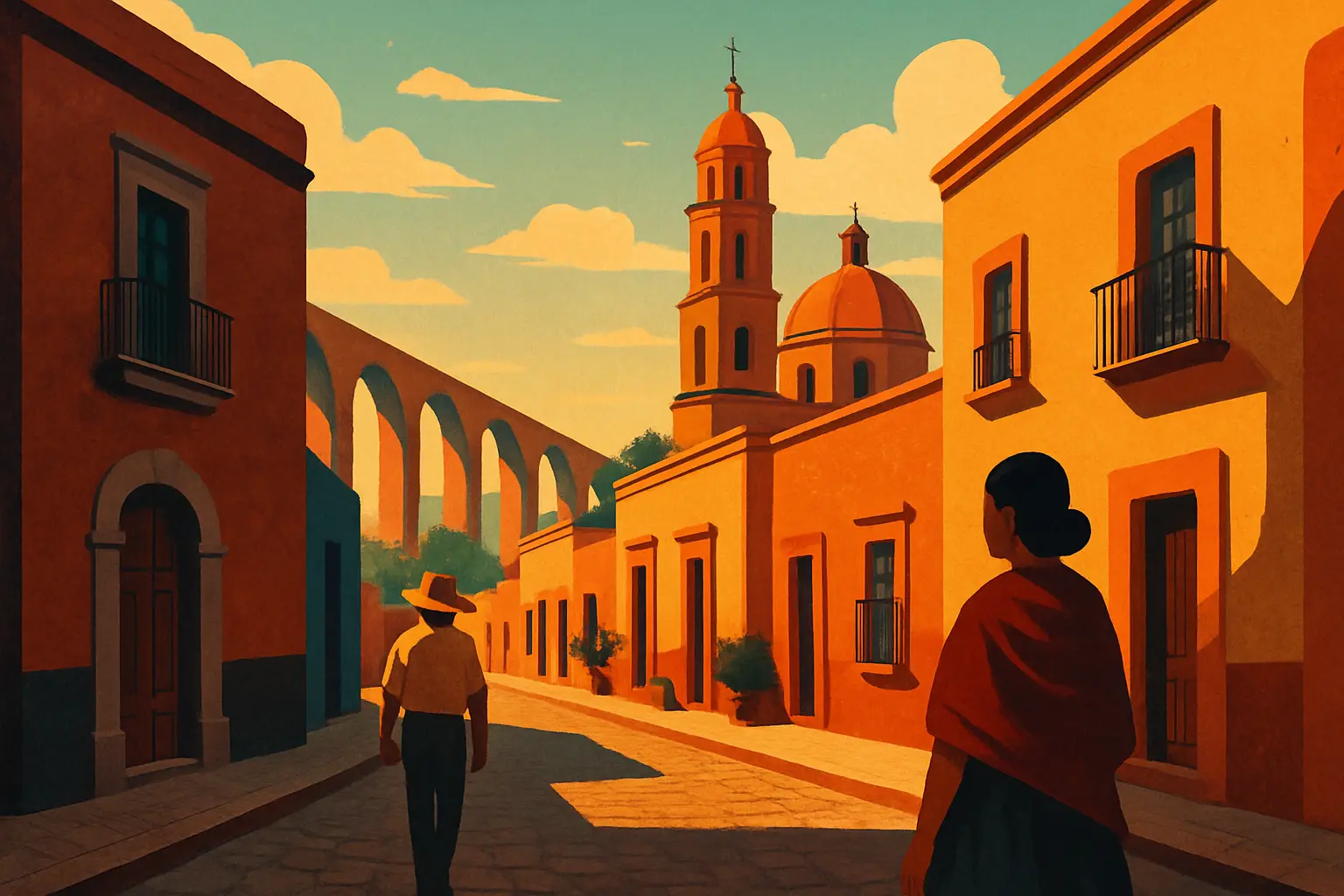
The Acueducto de Querétaro was completed in 1738 and is one of the most extraordinary pieces of colonial engineering in the Americas. Designed by Juan Antonio de Urrutia y Arana, it stretches 1.28 km across a valley south of the city, carrying water from mountain springs to the highest point of the urban core where it fed the city's fountains. The 74 arches reach up to 28.5 meters at their tallest — roughly nine stories — all built from cut stone and lime mortar with no pumps or machinery. The American Society of Civil Engineers has designated it an International Historic Civil Engineering Landmark, putting it in the same category as the Golden Gate Bridge. Unlike that bridge, you can walk the full length of it for free, with no timed-entry ticket and almost no other tourists on a weekday morning. Walk Avenida de los Arcos south toward the city center: the arches frame the hills behind the city in a way that doesn't photograph as well as it looks in person. Plan for 25 minutes just to walk it slowly.
74 arches, up to 28.5 m tall — completed 1738, no pumps, structurally intact
Walk Avenida de los Arcos for the full-length view — free, no ticket required
International Historic Civil Engineering Landmark (same designation as the Golden Gate Bridge)
Get short, interactive stories that make each place easier to remember while you travel.
Josefa Ortiz de Domínguez was the wife of Querétaro's royal corregidor — the Spanish-appointed mayor — and a central figure in the 1810 independence conspiracy. When Spanish authorities discovered the plot in September 1810, they locked her inside the Palacio Municipal on the Plaza de Armas. She managed to get word to rebel leader Ignacio Pérez through the floor, knocking out a signal that sent him riding through the night to warn Father Hidalgo and Ignacio Allende at San Miguel. The warning forced Hidalgo to launch the Grito weeks ahead of schedule — and changed the course of Mexican history. La Corregidora's house, the Palacio Municipal, still stands on the northeast corner of the Plaza de Armas and still functions as the city government building. The interior courtyard is free to enter, and a small plaque marks the room where she was held. Her remains are in the Templo de San Felipe Neri, two blocks southeast. One block east of the Jardín Zenea, the Plaza de la Corregidora has a statue of her that most visitors walk past without recognizing who she is.
Palacio Municipal, Plaza de Armas — the interior courtyard is free to enter
Templo de San Felipe Neri, two blocks southeast — her remains are interred here
Plaza de la Corregidora, one block east of Jardín Zenea — statue easy to walk past
Start at the Jardín Zenea — also called Plaza de Armas — the main square. The historic center is completely flat and about 12 blocks across, so you won't need a car or Uber once you're in. From Jardín Zenea, walk east four blocks to the Ex-Convento de San Francisco, now the Museo Regional de Querétaro, which holds artifacts from the independence era and documents from Maximilian's trial. From there, walk south about six minutes to the Cerro de las Campanas — a small hill where Maximilian and his two Mexican generals were executed by firing squad. A chapel built by the Austrian government in 1901 stands at the top, and the panoramic view of the city takes about ten minutes to reach on foot. On the way back toward the Jardín, stop at El Parián — a covered colonial arcade east of the main plaza with gorditas vendors, mezcal shops, and artisan crafts. The gorditas queretanas here — masa pockets stuffed with frijoles, cheese, or picadillo — cost about 25 pesos each and are the local fast food. End the loop at the Palacio Municipal for the La Corregidora connection.
Jardín Zenea → Museo Regional → Cerro de las Campanas → El Parián → Palacio Municipal
Cerro de las Campanas: 10-min walk up, free, Austrian-built chapel from 1901 at the top
Gorditas queretanas at El Parián: ~25 MXN each, three is a meal
About 45 minutes east of the city, the Bajío wine region is one of Mexico's best-kept secrets. Freixenet México — yes, the Catalan cava house — built a winery near Ezequiel Montes in the 1980s and launched a regional industry that now produces genuinely excellent wine at around 1,900 meters elevation. The winery runs tours and tastings Tuesday through Sunday; check the schedule online before driving out. Further east on the same road, the Pueblo Mágico of Bernal sits at the base of the Peña de Bernal — a 433-meter freestanding monolith, one of the three largest in the world. You can hike a maintained trail to the midpoint lookout in about 40 minutes round trip; the true summit requires technical gear. The town below has mezcal shops, artisan workshops, and gorditas de piloncillo that are noticeably different from the ones in the city. If you realize mid-afternoon that you don't want to bus back to CDMX, the city center has boutique hotels within walking distance of everything — the Friday-to-Saturday version of this trip, with wine country on Saturday morning, is dramatically better than the one-day rush.
Freixenet México winery, Ezequiel Montes — tours and tastings Tue–Sun
Peña de Bernal, ~55 km east: one of the world's three largest monoliths, partial hike free
Overnight option: boutique hotels in the historic center start around 1,200 MXN
The easiest option is the ETN Turistar or Primera Plus bus from Terminal Central del Norte — the northern bus hub at Metro Line 5, stop Autobuses del Norte. (If you haven't navigated the metro yet, the Mexico City metro guide covers the full network.) Buses depart every 30 to 40 minutes from around 6 a.m. until late evening, with an average journey time of 2 hours 45 minutes under normal traffic. Fares run 350 to 500 MXN one way — roughly USD 17 to 25. Buy tickets at the terminal on the day or through the ETN website in advance (weekend mornings sell out). Arriving at Querétaro's Central de Autobuses, take an Uber 15 minutes to Jardín Zenea — budget 80 to 120 MXN. By car on the MEX-57 toll highway, the drive is 2.5 hours from central Mexico City and costs approximately 450 MXN in tolls round trip — add 90 minutes on Friday afternoons. If you're flying into NAICM and heading directly to Querétaro, the airport bus station has direct connections that bypass the city entirely. Check schedules at the terminal before assuming you need to enter CDMX first.
Querétaro is consistently one of the safest cities in Mexico for tourists. The state maintains low crime rates relative to neighboring states, and the historic center has a visible tourist police presence that's actually responsive. Standard Mexico city rules apply: keep your phone down in less-busy areas, don't leave valuables in rental cars, and use Uber over street taxis late at night. The most common mistake tourists make is wandering past the UNESCO historic zone into the city's industrial periphery — everything worth seeing on a day trip is inside the compact historic center, so there's no reason to leave it. For timing, late March through early June is the sweet spot: warm days, clear skies, minimal rain, and lighter domestic tourism than summer brings. July and August have reliable afternoon showers (brief, usually clearing by 5 p.m.) and more Mexican family tourism. December through February is cold at night but clear and beautiful for daytime visits — bring a jacket. Avoid Semana Santa and Día de Muertos long weekends, when Querétaro becomes Mexico City's overflow destination and hotel rates spike.
Best window: late March through early June — warm, clear, fewer crowds
Avoid: Mexican long weekends (Semana Santa, Día de Muertos) when prices and crowds spike
Stay within the UNESCO historic zone — everything worth seeing on a day trip is inside it