Pachuca is the capital of Hidalgo state, a city of about 330,000 people on a hillside at 2,426 meters above sea level, 95 kilometers northeast of Mexico City. It almost never appears on Mexico City day trip lists. The standard circuit stops at Teotihuacan to the north, Tepoztlan to the south, and Puebla to the east — Pachuca falls off the mental map entirely.
That is changing in 2026. Mexico is co-hosting the FIFA World Cup alongside the United States and Canada, and Pachuca's identity as La Cuna del Fútbol — the Cradle of Football — has pushed the city into an unlikely spotlight. The story is genuinely remarkable: British miners who came to work the silver mines in the 1820s and 1890s brought not just mining technology but also a strange oval ball and a set of rules that eventually became the sport now watched by half the planet. The connection is not just historical trivia. Club de Fútbol Pachuca — Los Tuzos — is one of the most decorated clubs in Mexican football history, with six Liga MX titles and three CONCACAF Champions League trophies.
Beyond the football history, Pachuca offers something rare among Mexican cities of its size: genuine historical texture that has not been domesticated into a tourist product. The silver mining architecture, the Cornish pastry tradition, and the Pueblo Mágico of Real del Monte fifteen minutes uphill make this one of the most rewarding day trips in central Mexico.
95 km northeast of Mexico City at 2,426 m elevation — about 90 minutes by express bus from Terminal del Norte
Home to Club de Fútbol Pachuca, the oldest football club in Latin America, founded 1892
The 2026 World Cup has renewed international attention on Pachuca's role as the birthplace of Mexican soccer
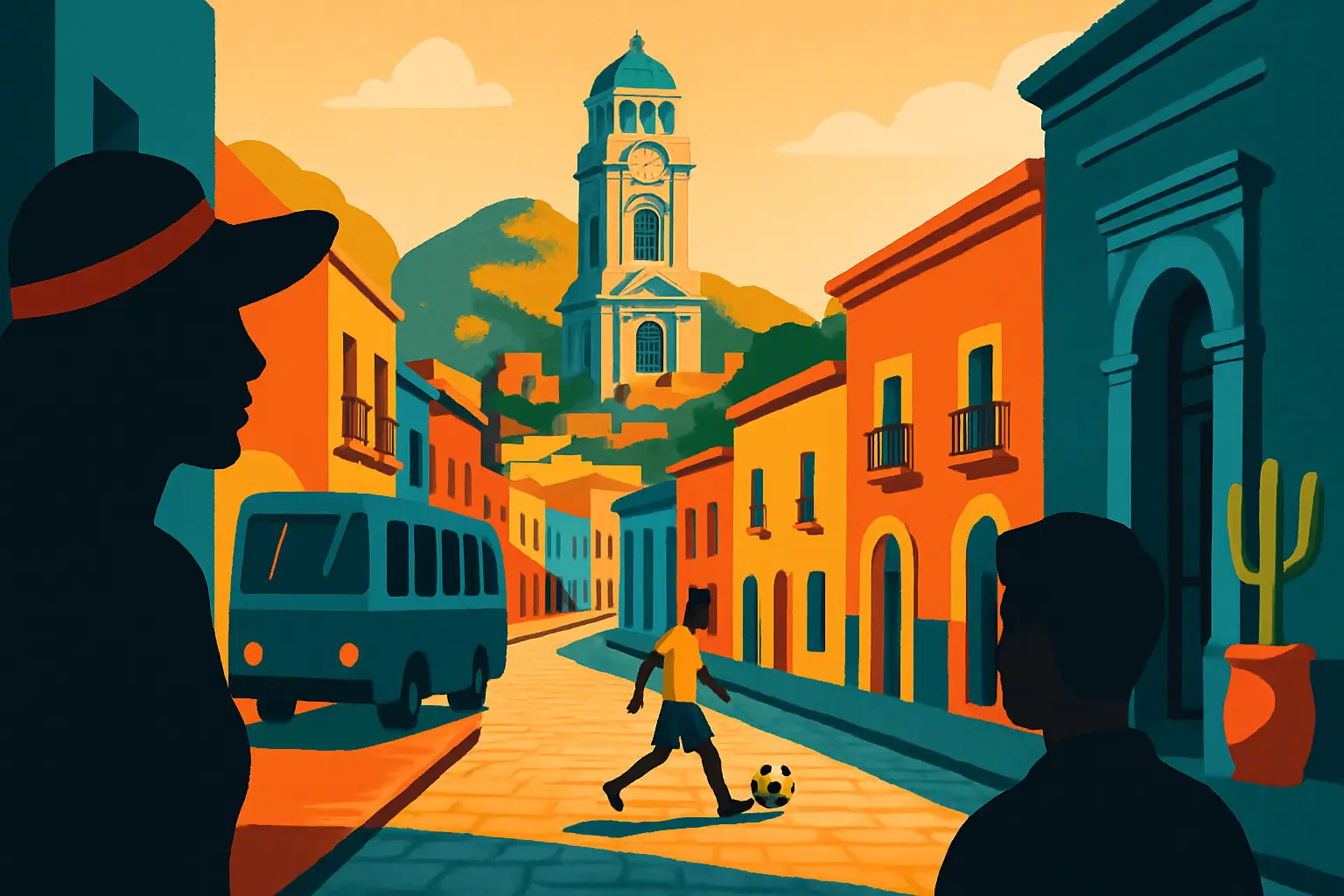
The first thing everyone photographs in Pachuca is the Reloj Monumental — a 40-meter neoclassical clock tower that dominates Plaza Independencia in the city center. Built between 1904 and 1910 to mark the centennial of Mexican independence, its clockwork mechanism was manufactured by the London firm Dent and Co. — the same company that built the movement for Big Ben. The connection is not incidental: British influence in Pachuca ran deep enough that local authorities imported English engineering for their civic monument.
The plaza itself is the best starting point for any visit. It is pedestrianized, surrounded by 19th-century buildings with arcades (portales) at street level housing cafes and paste shops, and busy with daily life in a way that feels city-sized rather than tourist-curated. Vendors sell flavored waters, esquites, and pastes from carts around the plaza perimeter. The clock tower is free to enter at the base; you can examine the original British clockwork from 1910, still running.
One block west of the plaza, the Pasaje Revolución — a covered arcade from the Porfirio Díaz era — runs through a 19th-century block and houses some of the better paste shops in the center, along with a good selection of Hidalgo-made mezcal and artisan craft stalls.
Reloj Monumental: 40-meter clock tower built 1904–1910, clockwork by Dent and Co. of London — the same firm that built Big Ben's movement
Plaza Independencia is pedestrianized — start here, walk the arcades, and buy your first paste from the street carts
Pasaje Revolución (one block west): Porfirio Díaz-era arcade with some of the best paste shops and Hidalgo mezcal in the center
Get short, interactive stories that make each place easier to remember while you travel.
In the 1820s, the British-owned Real del Monte Company sent Cornish miners from Cornwall, England, to revive the exhausted silver mines northeast of Pachuca. The miners brought with them the tools and techniques of deep-shaft mining — and the Cornish pasty, a folded pastry packed with meat, potato, turnip, and onion that could survive an eight-hour shift in a miner's pocket and be eaten underground without utensils.
By the time British mining operations wound down in the mid-19th century, the pasty had taken root in the local food culture, pronounced and spelled in Spanish as paste (PAH-steh, plural pastes). What happened next is a product of Mexican culinary creativity: the traditional savory filling — potato and minced beef — stayed, but it was joined by chile con carne, tinga de pollo, picadillo, chicharrón with salsa verde, and mole. Then came sweet versions filled with apple, pineapple, and cajeta. No other region of Mexico makes pastes. It is one of the more specific and underappreciated legacies of 19th-century British migration anywhere in Latin America.
The best places to try them are the paste carts around Plaza Independencia and the shops along Calle Guerrero just north of the plaza, where several family-run paste bakeries have operated for decades. A paste costs 25–40 pesos. Order two — one savory, one sweet — and eat them standing on the plaza like everyone else does.
Cornish miners arrived in the 1820s, bringing the pasty tradition — now spelled 'paste' and eaten across Hidalgo state
Savory fillings: chile con carne, potato-beef, tinga de pollo; sweet fillings: apple, pineapple, cajeta — found nowhere else in Mexico
Best carts: around Plaza Independencia and the shops on Calle Guerrero just north of the plaza; 25–40 pesos each
In 1892, a group of British technicians and engineers from the Pachuca Athletic Club formalized what had been informal football matches played in the silver mining camps outside the city. The club they created is recognized as the oldest football club in Latin America — predating Fluminense, Club Nacional, and every other contender by years. Three years later the Pachuca Athletic Club merged with the Cricket Club and the Velasco Cricket Club, and the formal sport began spreading from the mining camps to the Mexican elite who saw it as a marker of modernity and cosmopolitan taste.
The story's ground zero is Mineral del Monte, about 15 kilometers uphill from Pachuca, where a metal plaque on what is now a parking lot near the old Dolores Mine marks the field where the first formal match between British and Mexican teams was played. The Pachuca Athletic Club's founding documents were written in English.
In Pachuca's city center, the Museo del Fútbol traces the sport's arrival and spread across Mexico, with significant coverage of the club's founding role and Los Tuzos' Liga MX history. It is not a glossy international-style museum — the signage is in Spanish and the displays are low-tech — but for anyone interested in how a sport became a national religion, the source material here is remarkable. Entry costs around 50 pesos; allow 45 minutes.
Pachuca Athletic Club (1892): oldest football club in Latin America, founded by British miners, all original documents in English
First British-Mexican match played near the Dolores Mine in Mineral del Monte — a plaque still marks the spot
Museo del Fútbol in Pachuca's centro: ~50 pesos entry, traces the sport's spread from mining camp to national obsession
The most architecturally striking site in Pachuca's center is the Cuartel de Arte — a cultural complex built inside the former Convento de San Francisco, a Franciscan monastery begun in 1596. The convent's massive stone cloister and vaulted corridors now house museums, a theatre, the state public library, and an art gallery that together form one of the most complete cultural centers outside Mexico City.
The standout institution is the Fototeca Nacional — the national photography archive operated by INAH, which holds over one million photographs, including the entire Casasola Collection. Agustín Víctor Casasola and his network of photographers documented the Mexican Revolution from 1910 to 1921 with a systematic eye that produced what remains one of the most important photographic records of any 20th-century conflict in the world. Zapata, Villa, Carranza — and thousands of unnamed soldiers, women, and civilians — all documented in a sustained body of work that the Mexican government eventually recognized by housing the archive here in Pachuca. The rotating exhibitions draw from the full collection; the photography is the kind that stops you in front of a print for longer than you planned.
The Cuartel de Arte also houses temporary exhibition spaces that change regularly. Entry is free most days, though Fototeca exhibition halls may charge a small fee.
Convento de San Francisco (founded 1596): the colonial cloister alone rewards a slow walk, even before the museums
Fototeca Nacional: 1+ million photographs including the full Casasola Collection documenting the Mexican Revolution 1910–1921
Free entry most days — allow 1–1.5 hours if a Casasola exhibition is installed; the photographs demand more time than expected
From Pachuca's main bus terminal, shared combis and local buses leave regularly for Mineral del Monte — a village perched at 2,700 meters on a steep hillside 15 kilometers to the northeast. The ride takes about 30 minutes and climbs sharply through pine forest; the air at the top is noticeably cooler and thinner than in Pachuca.
Mineral del Monte carries Pueblo Mágico designation and earns it. Narrow cobblestone streets wind between brightly painted colonial houses with wrought-iron railings. The church of La Asunción anchors the central plaza. In the hillside cemetery, English-style Victorian gravestones mark the graves of Cornish miners who died in the shafts or from disease in the mining camps of the 1830s — it is genuinely surreal to find epitaphs in 19th-century English in the Hidalgo mountains. Two of the original mine shafts, Mina de Acosta and Mina La Dificultad, are open for guided tours with original British mining machinery from the 1800s still visible underground.
Real del Monte is also where the first formal football match on Mexican soil was played, on a field near the former Dolores Mine — a plaque marks the spot, easy to find, strange to stand on. The village restaurants serve a good comida corrida for 80–120 pesos. The weekend market sells locally made products, sweets, and pastes. Weekday visits still work well if you focus on the mining sites and the cemetery.
30-minute combi from Pachuca's central bus terminal — look for combis labeled 'Real del Monte' or 'Mineral del Monte' on Av. Revolución
English Victorian gravestones in the hillside cemetery, original 19th-century British mining equipment in open shafts — genuinely unlike anywhere else in Mexico
Best on weekends when the market runs and mine tours are most frequent; weekday visits still work for the cemetery, the plaza, and the football plaque
Pachuca is considered one of the safer mid-sized cities in central Mexico. The centro histórico, Plaza Independencia, Cuartel de Arte, and the route to Real del Monte are all calm and well-trafficked for daytime visitors. Standard precautions apply — keep your phone out of sight on quieter streets, use ADO or Omnibus express buses rather than informal rides for the Mexico City leg, and plan to be back at Pachuca's main bus terminal before dark.
The best season to visit is the dry season: November through April, when skies are clear and the road up to Real del Monte does not pass through afternoon rain or mountain fog. May and June are transitional — mornings are clear and workable, afternoon rains are starting to build toward the July-August peak. During World Cup 2026 (June through July), the city's energy is notably elevated: bars around Plaza Independencia show matches on outdoor screens, the football museum is running special exhibitions, and the historic significance of Pachuca as the birthplace of Mexican soccer is front and center everywhere you look. That added atmosphere makes June and July genuinely good months to visit despite the weather.
Allow a full day: 90 minutes on the bus each way plus five to six hours on the ground comfortably covers Pachuca's center, the Cuartel de Arte, and a two-hour round trip to Real del Monte. If you only have four hours total, skip Real del Monte and focus on the plaza, the pastes, and the Casasola archive — that alone is a full half-day. For background on the pre-Hispanic history of the broader region connecting Hidalgo state to the Mexico City basin, the Aztec history guide is useful reading before the trip.
Safe for daytime visitors — standard Mexico City precautions apply; use ADO buses and be back at the terminal before dark
Best season: November–April for clear skies; June–July during World Cup 2026 for elevated atmosphere and special football museum exhibitions
Full day: 90 min bus each way plus 5–6 hours on the ground covers Pachuca centro and Real del Monte comfortably