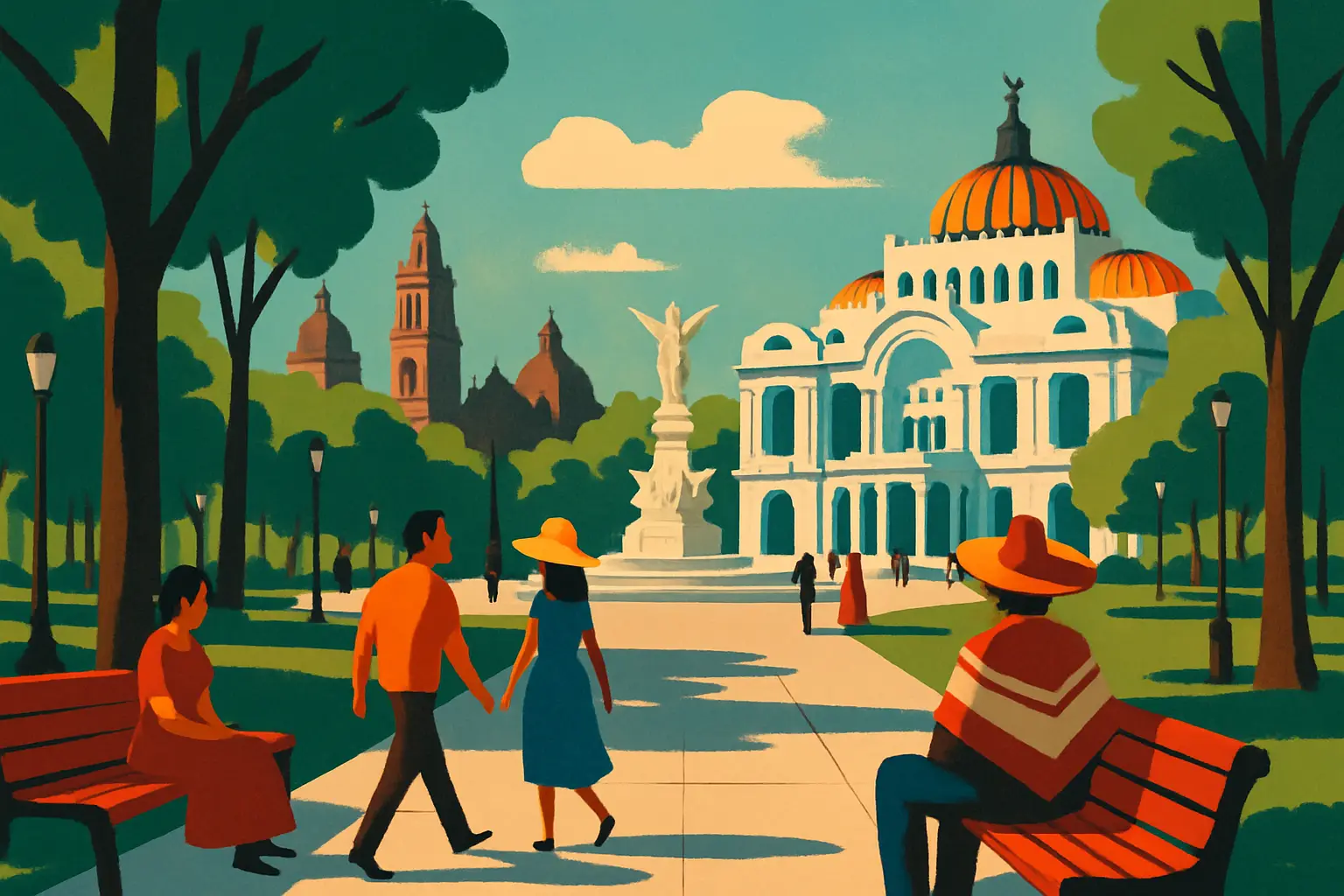
The Alameda Central was officially created on January 11, 1592, when Viceroy Luis de Velasco II ordered a public green space built for the residents of New Spain. He had a thousand alamo trees — poplars, which gave the park its name — brought from Coyoacan and planted in ordered rows. But the ground already had history. Before the conquest, the site was one of the great tianguis, the open-air Aztec markets where goods from across Mesoamerica were traded on a scale that stunned the first Spanish soldiers who saw them. The western section of the park — now facing Dr. Mora Street — carried the name El Quemadero (The Burning Place). This was where the Holy Office of the Inquisition publicly executed those convicted of heresy, apostasy, or witchcraft in ceremonies called autos de fe, attended by crowds of colonial-era residents. By 1770, the Inquisition had largely ended, and Viceroy Marques de Croix ordered the space torn up and absorbed into an expanded park. The past was literally paved over. Today the park runs along Avenida Juarez (south), Avenida Hidalgo (north), Eje Central Lazaro Cardenas (east), and Dr. Mora (west) — about seven city blocks of green space with 1,300 trees and twelve monumental fountains. Entry is free. It never closes.
On the southern edge of the park, facing Avenida Juarez, stands one of the most formally impressive monuments in Mexico City: the Hemiciclo a Juarez. Porfirio Diaz commissioned it in 1906 to mark the centennial of Benito Juarez's birth — Juarez being Mexico's first indigenous president and the man who defeated the French-backed occupation under Maximilian. Architect Guillermo Heredia designed the neoclassical structure; Italian sculptor Alessandro Lazzerini executed the figurative work in Rome using 70 tons of Italian Carrara marble. It was inaugurated September 18, 1910. The monument places Juarez seated at the center of a marble semicircle in a Roman toga, flanked by allegorical figures representing the Republic and the Reform — the sweeping 1850s laws that separated church and state, established civil marriage, and stripped the Catholic Church of its landholdings. The irony is historical: Diaz twice rebelled against Juarez's government during his lifetime before eventually succeeding him to power. By 1910, Juarez was four decades dead and his legacy politically useful. Stand in front of it at ground level, then step back to Avenida Juarez to take in the full scale of the structure. It is free to visit and requires nothing other than looking.
Get short, interactive stories that make each place easier to remember while you travel.
One block west of the park's southeastern corner, at Balderas 202, is the Museo Mural Diego Rivera — a building that exists for exactly one reason: to house a single fresco that is 15.6 meters wide and 4.7 meters tall. Sueno de una tarde dominical en la Alameda Central (Dream of a Sunday Afternoon in the Alameda Central) was painted in 1947, when Rivera was 61, on commission for the dining room of the Hotel del Prado, which faced the park. Rivera used the commission to paint 400 years of Mexican history as a single Sunday crowd: more than 150 figures from across the country's past occupying the same space and time. Hernan Cortes, Porfirio Diaz, Jose Marti, Emiliano Zapata, and Sor Juana Ines de la Cruz all appear. In the center stands La Catrina — the skeleton figure drawn originally by cartoonist Jose Guadalupe Posada, who also appears — and Rivera painted himself as a ten-year-old boy with a frog in his pocket. Frida Kahlo stands behind him, her hand on his shoulder. Rivera also painted the phrase 'Dios no existe' (God does not exist) on a placard in the mural, triggering enormous scandal. Catholic groups organized demonstrations; a student vandalized the unfinished fresco; Rivera was pressured to plaster over the inscription, which was later restored after his death. In 1985, the earthquake that killed thousands also destroyed the Hotel del Prado. Engineers carefully removed the mural intact, and the Mexican government built the current museum specifically to house it, opening in 1986. Admission is 40 MXN on weekdays and free on Sundays. Ask the museum staff for a character guide sheet — following Rivera's arrangement through the mural is worth the extra thirty minutes it takes. For more on Rivera's work across the city, the Diego Rivera murals guide covers the full body of work.
On the western edge of the park at Dr. Mora 7, the pale yellow building with the carved stone facade was originally the Templo de San Diego, a church built in the early 17th century as part of a Franciscan convent complex. It spent decades as the Pinacoteca Virreinal — a colonial-era gallery of paintings from New Spain — before being converted in 2000 into the Laboratorio Arte Alameda, one of the more specific art venues in Mexico City. The programming focuses on contemporary art in dialogue with technology: video installations, sound art, digital work, and experimental performance. The 17th-century architecture is treated as part of the exhibit rather than background — the contrast between carved stone arches and a projection or sound installation is intentional, not incidental. The Laboratorio is run by the Secretary of Culture and tends to attract a crowd that's more interested in being surprised than in seeing something recognizable. Admission is free on Sundays; check hours at the door for weekday access.
On the north side of the park at Plaza de la Santa Veracruz, facing Avenida Hidalgo, the Museo Franz Mayer occupies a building that was originally the Hospital de San Juan de Dios — one of the first hospitals in New Spain, established in the 16th century. The museum takes its name from Franz Mayer, a German businessman who emigrated to Mexico in 1905, became a Mexican citizen, and spent five decades assembling one of the country's finest collections of colonial decorative arts: carved cedar furniture, Talavera ceramics, silver liturgical objects, embroidered vestments, clocks, tiles, illuminated manuscripts, and paintings. It is not a great-masters painting museum but the material culture of colonial Mexico — the objects that filled convents, aristocratic homes, and government buildings across three centuries — and that specificity makes it genuinely absorbing. The museum's Cloister Cafe operates inside the colonial courtyard, surrounded by stone arches and a central garden. It is the best sit-down option immediately adjacent to the park for coffee or a light meal, and it is routinely overlooked by people who come for the collection and leave without finding it. Museum admission is 75 MXN for adults, free for seniors and children under 12. Open Tuesday through Friday 10am to 5pm, Saturday and Sunday 10am to 6pm.
The best version of the Alameda Central happens on Sunday mornings between about 10am and 2pm. The organilleros — Mexico City's traditional organ grinders — set up throughout the park, working in pairs: one turns the hand crank on a portable barrel organ mounted on a wheeled wooden cart, the other circulates collecting tips in a small cup. They wear an olive-green military-style uniform, a tradition the Organilleros Union has maintained since the 1920s. Fewer than two hundred officially registered organilleros remain working in the city, concentrated in Centro Historico. The music is deliberately nostalgic — Mexican popular songs from the 1920s through the 1950s — and the instruments themselves are mechanical: perforated paper rolls translate into melody through the bellows and pipes of the organ box. Families spread across the benches. Vendors push carts with elotes, churros, globos (balloon animals for children), and raspados. The park is also a regular departure point for political demonstrations, since the natural route from the Zocalo west toward Paseo de la Reforma passes directly through this area. On weekends you may find a march moving through the southern edge of the park — it's a normal part of the city's public life and rarely interferes with the rest of what's happening.
The closest Metro station is Bellas Artes on Line 2 (blue line), which deposits you at the corner of Eje Central and Juarez — the park is directly across the street. Hidalgo station on Lines 2 and 3 opens onto the park's northern edge near the Franz Mayer Museum. From Roma Norte or Condesa, Metrobus Line 1 runs along Insurgentes to Reforma, then it is a six-block walk west on Juarez. A thorough visit — the park and Hemiciclo, Museo Mural Diego Rivera, and a coffee at the Cloister Cafe — takes about three hours at a comfortable pace. Adding the Laboratorio Arte Alameda adds an hour. None of the sites require advance booking or tickets purchased online. The Alameda connects naturally to the rest of the Centro Historico: the Zocalo and Templo Mayor are a fifteen-minute walk east along Juarez and Madero. Is it safe? The park is heavily used throughout the day, which is the best practical safety factor in any public space. Daytime visits with standard urban awareness are completely fine. Avoid it after 10pm. What about rain? June through October, afternoon rain typically arrives between 3 and 5pm and clears by early evening. The practical rule is to do the outdoor monuments — the park itself and the Hemiciclo — in the morning, then move into the museums when the clouds build. The Rivera mural museum, Franz Mayer, and Laboratorio Arte Alameda are all within two blocks of each other and provide two to three hours of dry indoor time.