Who Was John Muir? The Scottish Immigrant Who Invented American Conservation
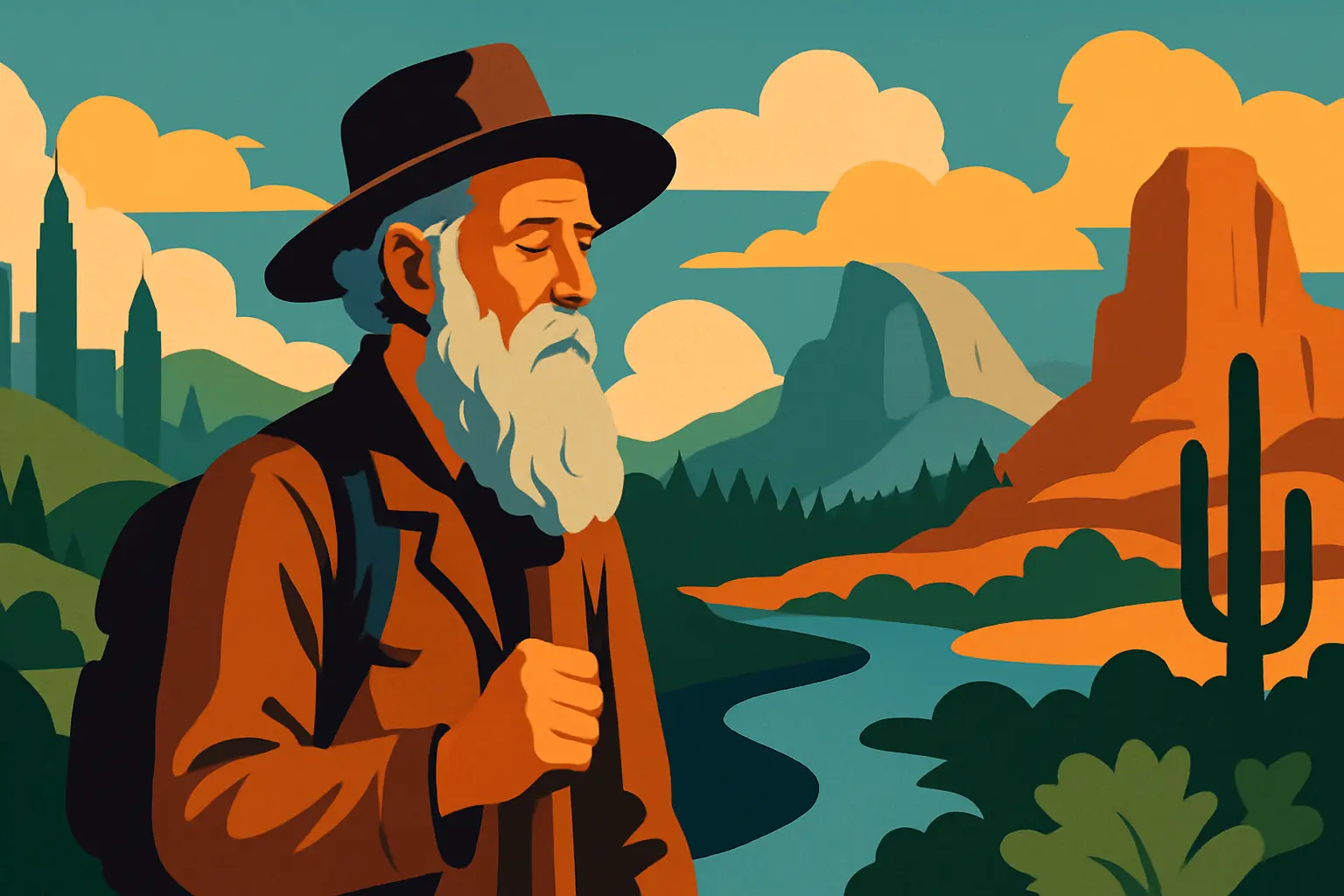
In 1867, a 29-year-old Scottish immigrant nearly lost his sight in a factory accident in Indianapolis. Lying in a darkened room for six weeks, he made a decision: if his vision returned, he would spend the rest of his life looking at the natural world rather than the inside of a machine shop. He walked — literally walked — roughly a thousand miles from Indianapolis to the Gulf of Mexico, then eventually made his way to California's Sierra Nevada, where he would spend the better part of a decade living in a hand-built cabin, studying glaciers, and writing with an almost evangelical intensity about wilderness. That man was **John Muir**, and the movement he helped create — the idea that wild landscapes deserve legal protection not because of their economic value but because of their intrinsic worth — reshaped the American relationship with land. He co-founded the **Sierra Club** in 1892, lobbied Congress for the creation of **Yosemite National Park**, and famously camped under the stars with President Theodore Roosevelt in 1903. But Muir's legacy is not without fractures. His writings contain views on Black Americans and Indigenous peoples that modern conservationists have had to reckon with honestly. This post covers all of it: the brilliance, the contradictions, and why his footprints are still visible across the American West.
🗽 Short stories • Collectible cards • Learn as you travel
The **John Muir National Historic Site** in Martinez, California (4202 Alhambra Ave) preserves his 17-room Victorian mansion. Admission is $15 for adults, free for children under 15. Open Wednesday–Sunday, 10 a.m.–5 p.m. The surrounding orchard where Muir worked and wrote is walkable in under an hour and is rarely crowded on weekday mornings.
Hike the John Muir Trail
The **John Muir Trail** runs 211 miles from Yosemite Valley to Mount Whitney — the highest peak in the contiguous United States at 14,505 feet. Permits are required and can be reserved through Recreation.gov starting six months in advance. Competition is fierce for summer dates; apply in February. Day hikers can access the first section from Happy Isles trailhead inside Yosemite National Park with no permit required.
Explore the Sierra Club archives
The **Sierra Club's Bancroft Library collection** at UC Berkeley (University of California, Berkeley) holds Muir's original journals, letters, and field sketches. Researchers can access materials free of charge by appointment through the Bancroft Library's online request system. For casual visitors, the Sierra Club's national headquarters in Oakland (2101 Webster St) displays historical materials and hosts public programs on conservation history.
The complete John Muir guide
1A Calvinist childhood and a continent's wilderness: where Muir came from
John Muir was born on April 21, 1838, in Dunbar, Scotland, a small coastal town on the Firth of Forth. His father, Daniel Muir, was a rigid Calvinist who believed that idle time was the devil's territory, and he ran his household with a severity that left marks on John for life. The children were expected to memorize large passages of the Bible daily — by the time John left Scotland, he had committed most of the New Testament and all of the Old Testament to memory, a feat of discipline that he later redirected toward scientific observation rather than scripture.
In 1849, Daniel Muir transplanted the family to Fountain Lake Farm near Portage, Wisconsin, chasing cheap frontier land. The Wisconsin wilderness — glacial lakes, prairies thick with wildflowers, oak savannas — was the first landscape that genuinely captivated young John. He began making mechanical inventions in the family barn: an early-rising machine that tipped him out of bed before dawn, intricate wooden clocks, a device that could automatically light a fire. These inventions earned him a spot at the Wisconsin State Fair in 1860, where a professor at the University of Wisconsin–Madison noticed him and encouraged him to enroll.
At Madison, Muir studied chemistry, geology, and botany under Ezra Slocum Carr and his wife Jeanne Carr, who became his lifelong intellectual mentor and the person who eventually pointed him toward Yosemite. He never formally graduated — he left in 1863 to explore the upper Midwest on foot, an early sign of the wandering life ahead. The walk to Florida in 1867–1868 was not a spontaneous burst of romanticism; it was the logical next step for a man who had already decided that the land itself was his laboratory, his cathedral, and his curriculum.
2Yosemite changed him — and he changed Yosemite
Muir arrived in Yosemite Valley in the spring of 1868, walking in from the San Joaquin Valley after crossing the Coast Ranges. His first response, recorded in his journal, was to drop to his knees. He would spend the next six years in and around the valley, first working as a shepherd and then as a sawmill operator for James Lamon, one of the valley's early settlers. He built himself a small cabin on the bank of Yosemite Creek, diverting water through it to create a natural coolant — an engineering solution that doubled as poetry.
The intellectual work he did in Yosemite was genuinely original. The dominant geological theory at the time, championed by the California State Geologist Josiah Whitney, held that Yosemite Valley had been created by a catastrophic subsidence — the floor simply dropped. Muir, spending winters studying the valley's cirques, moraines, and polished granite faces, concluded that glacial action was the primary sculptor of the landscape. Whitney publicly dismissed him as an ignorant sheepherder. Muir was correct: modern geology has entirely vindicated his glacial theory.
His writing from this period — eventually compiled in books like *The Mountains of California* (1894) and *My First Summer in the Sierra* (published 1911) — introduced millions of readers to a way of experiencing wilderness that was neither purely scientific nor purely romantic, but fused. He wrote about individual trees as personalities, about light on granite as a moral experience, about storms as invitations rather than warnings. A famous passage describes him climbing to the top of a 100-foot Douglas spruce during a windstorm so he could feel the tree sway — not a metaphor, but something he actually did.
By the time California set aside Yosemite Valley as a state reserve in 1864 (signed by President Lincoln), the valley was already being heavily grazed by sheep. Muir's campaign for federal protection, supported by his articles in publications like the *San Francisco Daily Evening Bulletin* and *Scribner's Monthly*, built the public pressure that led directly to the Yosemite Act of 1890, which established Yosemite as a national park — though the valley itself remained under California control until 1906. You can read more about the history of that park in our article on visiting Yosemite National Park.
Keep touring
Discover more about United States in minutes
Get short, interactive stories that make each place easier to remember while you travel.
3The Sierra Club, the Roosevelt campfire, and the political Muir
Muir was not a natural political operator. He was a solitary man who preferred the company of glaciers to congressmen. But he understood, by the early 1890s, that wilderness would not protect itself. In June 1892, he co-founded the Sierra Club in San Francisco with a group of University of California professors and civic leaders, serving as its first president — a position he held until his death in 1914. The Club's founding statement was explicit: to explore, enjoy, and *render accessible* the mountain regions of the Pacific Coast, and to enlist the support of government in preserving these features.
The most consequential single moment in Muir's political life came in May 1903, when President Theodore Roosevelt asked to visit Yosemite with him — just the two of them, no entourage, no press corps. Roosevelt had read Muir's writing and wanted to see the mountains through his eyes. They camped at Glacier Point, waking up under four inches of snow that had fallen overnight. They camped again at the base of Grizzly Giant, the massive sequoia in the Mariposa Grove. Over three nights and four days, Muir made his case: the valley needed federal protection, the sequoias needed buffer zones, the grazing had to stop.
Roosevelt came away converted. In the decade that followed, he used the Antiquities Act of 1906 and the Forest Reserve Act to set aside roughly 230 million acres of public land — including 18 national monuments, 55 national bird sanctuaries, 10 national parks, and 150 national forests. Muir's direct influence on these decisions is documented in Roosevelt's own letters. It is not an exaggeration to say that the two nights on the Yosemite granite translated into more protected American wilderness than any single piece of legislation before or since.
The relationship also had its limits. When the city of San Francisco began pushing to dam the Hetch Hetchy Valley — a glacier-carved canyon in Yosemite's northwest corner that Muir considered the equal of Yosemite Valley itself — Roosevelt ultimately sided with the city's water needs over Muir's objections. The Raker Act of 1913, signed by President Woodrow Wilson, authorized the dam. Muir died thirteen months later, in December 1914. Many who knew him believed the loss of Hetch Hetchy broke his heart.
4His philosophy: wilderness as a spiritual and democratic necessity
Muir's conservation philosophy was unusual for his era because it rested on spiritual rather than economic grounds. The prevailing argument for forest preservation in late 19th-century America — championed by figures like Gifford Pinchot, the first chief of the U.S. Forest Service — was utilitarian: protect the trees so they remain available for future resource extraction. Pinchot called this "wise use." Muir called it a category error.
For Muir, wild places had intrinsic value independent of human use. He drew on Ralph Waldo Emerson and Henry David Thoreau (he met Emerson in Yosemite in 1871, though he was disappointed that the aging philosopher refused to sleep outside), on the German naturalist Alexander von Humboldt, and on his own deep, eccentric reading of Calvinist theology — the idea that creation itself was God's text, and that destroying it was a form of illiteracy. His phrase "the clearest way into the Universe is through a forest wilderness" was not decorative. He meant it theologically.
He also made a democratic argument. The national parks, he wrote, should be accessible to everyone — the factory worker from Pittsburgh as much as the wealthy San Francisco merchant. This was a radical claim in the Gilded Age, when the assumption was that wilderness recreation was a luxury of the propertied class. The parks, in Muir's vision, were America's equivalent of Europe's great cathedrals: public, monumental, and morally elevating. "Everybody needs beauty as well as bread," he wrote in *The Yosemite* (1912), "places to play in and pray in, where Nature may heal and cheer and give strength to body and soul alike."
This philosophy — wilderness as a democratic and spiritual commons — became the intellectual foundation for the entire American national park movement. It influenced the National Park Service Act of 1916, which established the NPS two years after Muir's death, and it continues to shape debates about public land policy, conservation funding, and what exactly the parks are *for*.
5The uncomfortable truth: Muir's racial views and the reckoning with his legacy
In 2020, the Sierra Club took the unusual step of publishing a formal statement acknowledging that its founder held racist views. The statement, written by Executive Director Michael Brune, cited Muir's use of racist slurs when describing Black Southerners he encountered on his thousand-mile walk, his dismissive characterizations of Indigenous peoples in his early journals, and his association with figures in the early 20th-century eugenics movement, including his friendship with Madison Grant, whose 1916 book *The Passing of the Great Race* was later cited approvingly by Adolf Hitler.
The specific evidence is in Muir's own published and unpublished writings. In *A Thousand-Mile Walk to the Gulf* (published posthumously in 1916), he described Black families he encountered in terms that were dehumanizing. In his early Sierra Nevada journals, he characterized Miwok and Paiute peoples who had lived in and around Yosemite for thousands of years as degraded and incompatible with wilderness — ignoring the fact that Indigenous land management, including controlled burning, had shaped the very landscapes he celebrated as pristine.
This matters beyond simple moral accounting. Muir's vision of "wilderness" as a place without human presence was itself a fiction that required the erasure of Indigenous history. The removal of Ahwahneechee people from Yosemite Valley, which had begun before Muir arrived and continued during his campaigns for park protection, was a precondition for the "untouched" landscape he wrote about so rapturously. Many scholars of environmental history, including Dorceta Taylor and Carolyn Finney, have argued that this foundational erasure helps explain why the conservation movement remained predominantly white for so long, and why communities of color have historically felt alienated from national park spaces.
None of this unmakes the genuine achievement of protected wilderness. But it complicates the hagiography and raises questions that the conservation movement is still working through: whose land was being preserved, from whom, and for whose enjoyment? These are not rhetorical questions. They are live policy debates playing out in Indigenous land-back movements, in NPS diversity initiatives, and in the Sierra Club's own ongoing institutional reform.
6Where to follow Muir's footsteps across America today
Muir's life was unusually well-documented in physical space, and many of the places he lived, worked, and wrote about are accessible to contemporary visitors with a range of budgets and fitness levels.
The most intimate of these is the John Muir National Historic Site in Martinez, California (Contra Costa County), where he lived from 1890 until his death in 1914. The 14-acre site includes his Victorian mansion, the adjacent Strentzel family orchard, and a small visitor center with exhibits on his writing and campaigns. Admission is $15 for adults; the site is managed by the National Park Service and open Wednesday through Sunday. Martinez is 30 miles northeast of San Francisco, accessible by BART to the Martinez station.
In Yosemite, the Muir Gorge and the upper reaches of the Merced River preserve landscapes that look much as they did when Muir scrambled over them in the 1870s. The Happy Isles Nature Center inside the valley has interpretive materials on Muir's geological research. Yosemite National Park charges a $35 per-vehicle entrance fee; reservations are required during peak season (May through September) and must be booked through Recreation.gov.
For those interested in his early life, Fountain Lake Farm near Portage, Wisconsin, is now the John Muir Memorial County Park, operated by Columbia County. The glacial lake where young Muir first developed his love of natural history is still swimmable. Admission is free.
The John Muir Trail itself — 211 miles from Yosemite Valley to Mount Whitney through the Kings Canyon and Sequoia wilderness areas — is one of the most demanding and spectacular long-distance hikes in North America. Thru-hikers typically allow 21 days. The permit system is managed through Yosemite's wilderness permit office, and quotas are tight. For a sampler, the first 10 miles from Happy Isles to Nevada Fall and back offers dramatic scenery on a day-hike basis.
**John Muir National Historic Site**, Martinez, CA — 4202 Alhambra Ave; $15 adults, free under 15; Wed–Sun 10 a.m.–5 p.m.; nps.gov/jomu
**Yosemite National Park**, CA — $35/vehicle; peak-season reservations required via Recreation.gov; interpretive materials at Happy Isles Nature Center
**Fountain Lake / John Muir Memorial County Park**, Portage, WI — free admission; open year-round; managed by Columbia County Parks
**John Muir Trail** — 211 miles, Yosemite Valley to Mt. Whitney; permits via Recreation.gov; best weather July–September; thru-hike average 21 days
**Sierra Club Bancroft Library Collection**, UC Berkeley — free researcher access by appointment; bancroft.berkeley.edu
7What Muir's legacy means for American conservation in 2026
A century after his death, John Muir's fingerprints are on more American landscape than those of any other individual. The 63 national parks that currently exist, covering more than 52 million acres, descend directly from the philosophical and political groundwork he laid. The Wilderness Act of 1964 — which created the legal category of federally designated wilderness and now protects roughly 111 million acres — uses language that echoes his writing almost verbatim. When Congress passed the Land and Water Conservation Fund Act in 1964, it established a permanent funding mechanism for public land acquisition that has since protected over 7 million additional acres; the intellectual case for that fund rests substantially on Muir's argument that wild land has value beyond timber and mineral extraction.
But the conservation movement Muir helped found faces a set of challenges he could not have imagined. Climate change is altering the Sierra Nevada snowpack that feeds the rivers he wrote about; the glaciers he studied in Yosemite are effectively gone. Overtourism has created crowding pressures in Yosemite that have required reservation systems, shuttle mandates, and carrying-capacity studies — exactly the kind of bureaucratic management Muir resisted. And the long-deferred reckoning with the movement's racial exclusions is producing real institutional change: the NPS has significantly expanded its Indigenous consultation processes, and several national monuments have been co-managed with tribal nations under agreements negotiated in the 2020s.
Muir himself was not a systematic thinker; he was a writer and a walker and a lobbyist who worked more by conviction than by theory. The movement he helped create has had to develop the theory that his passion pointed toward. That ongoing development — messy, contested, and politically fraught — is itself a kind of tribute to someone who believed that the natural world was always more complicated and more magnificent than any single person's understanding of it. You can explore the broader story of America's public land system in our article on the history of the National Park Service.
Keep touring
Ready to walk in Muir's footsteps — and understand what you're actually standing on?
TourMe brings American history to life through short stories, collectible explorer cards, and interactive chapters tied to the exact places you're visiting. Explore Yosemite's geological history, the politics of the national park movement, and the Indigenous peoples whose land became America's "wilderness" — all unlocked as you travel. Download TourMe before your next national park trip and turn the trailhead into a classroom.