United States • Day Trips • West Texas Art & Culture
Marfa, Texas Day Trip from El Paso: Where Minimalist Art Meets High Desert Mystery
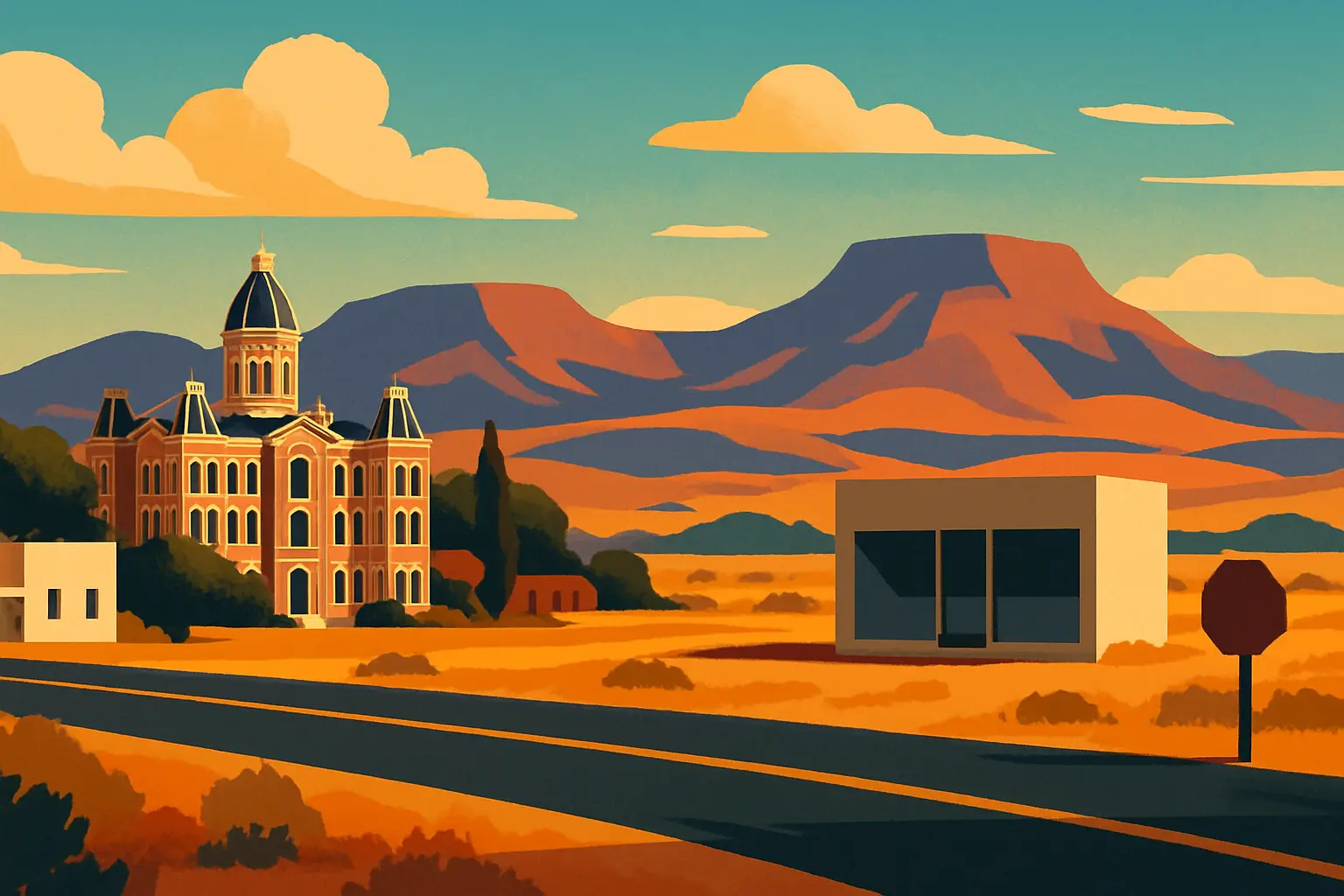
A town of roughly 1,800 people in the Chihuahuan Desert, sitting at 4,688 feet elevation with no traffic lights and no chain restaurants, should not be one of the most talked-about art destinations in the United States. Yet Marfa, Texas is exactly that — and the transformation hinges almost entirely on one man's obsessive decision in 1971 to move 220 miles from New York City and permanently install his life's work in a converted Army base. That man was sculptor and theorist **Donald Judd**, and what he built in Presidio County changed the way the art world thinks about permanence, site-specificity, and the relationship between a work of art and the landscape surrounding it. Today the drive from El Paso on US-90 takes about two and a half hours through some of the most cinematically spare terrain in North America — volcanic mountains, creosote flats, and sky that seems to belong to a different planet than the rest of the country. This guide covers everything worth doing in a single long day: the Chinati Foundation, the Judd Foundation studios, the surreal roadside sculpture **Prada Marfa**, the **Marfa Lights Viewing Area**, and a food scene that punches well above its demographic weight.
🗽 Short stories • Collectible cards • Learn as you travel
The Chinati Foundation (1 Cavalry Row, Marfa) offers guided tours Wednesday–Sunday. The comprehensive tour runs ~$25 per person and lasts about 3 hours. Reservations fill weeks in advance in spring and fall — book at chinati.org as soon as you set a date. Walk-in availability is extremely limited.
Time Prada Marfa for golden hour
The Prada Marfa sculpture sits on US-90, roughly 37 miles northwest of Marfa near the hamlet of Valentine. It's accessible 24/7 with no admission fee. Arrive around 7–8 AM on the way out or during the last hour of sunlight on the return for the most striking photographs against the desert backdrop.
Stay for the Lights viewing area
The Marfa Lights Viewing Area is on US-90, about 9 miles east of town. It's free, open all night, and staffed by informational panels. The lights appear most reliably on calm, clear nights between 9 PM and midnight. Build this into your return drive to El Paso — it adds only 15 minutes to the trip.
The complete Marfa, Texas day-trip guide from El Paso
1How a sculptor from New York City transformed a West Texas Army base into a global art pilgrimage
To understand Marfa, you have to understand Donald Judd's frustration. By the late 1960s, Judd — one of the leading figures in what critics were calling Minimalism, though he despised the label — had grown furious with the way New York galleries and museums handled contemporary art. Works were stored in basements, loaned out carelessly, lit incorrectly, and shuffled around in ways that destroyed the perceptual experience the artist intended. His solution was radical: acquire enough space to install his own work and the work of artists he admired in a permanent, controlled environment, and do it somewhere cheap enough to allow the architecture of display to be taken seriously.
In 1971, Judd began visiting Marfa, a former railroad and ranching town that had been economically hollowed out after the Army closed Fort D.A. Russell following World War II. He started buying property in 1973, eventually acquiring the 340-acre former fort complex along with several downtown buildings. In 1979 he established the Dia Art Foundation as a partner to fund the project, and by 1986 — after a public falling-out with Dia over funding priorities — he reorganized his vision under the Chinati Foundation, named for the nearby Chinati Mountains.
Judd died in 1994, but not before permanently installing 100 untitled works in milled aluminum across two massive artillery sheds — each piece unique in its internal divisions, each responding differently to the light that pours through the modified skylights at different hours of the day. He also installed Dan Flavin's fluorescent light works in six converted barracks buildings, and John Chamberlain's crushed automobile sculptures in a separate building. The Chinati Foundation now encompasses 15 large-scale, permanent installations across the old fort grounds. This is not a museum in any conventional sense — it's closer to Judd's original argument that art deserves a permanent home that respects the conditions of its making.
2What to actually expect inside the Chinati Foundation
First-time visitors sometimes arrive expecting a white-cube gallery experience and leave slightly stunned by something closer to a pilgrimage. The Chinati Foundation's guided tours are the only way to access most of the collection, and the pacing is deliberate — the comprehensive tour covers the full grounds over roughly three hours, and rushing it defeats the purpose.
The centerpiece remains Judd's 100 untitled works in mill aluminum (1982–1986), housed in two parallel artillery sheds each about 800 feet long, their north-facing windows replaced with glass and their roofs modified to control light. Each aluminum box is approximately 41 × 51 × 72 inches, but the interior configurations vary across every one of the hundred pieces — open tops, angled interiors, divided chambers — so that light hits each one differently depending on the time of day and season. Judd specified that no two works be placed in direct sightline of each other, forcing the viewer to move through the space rather than survey it from a fixed point. Morning tours catch the pieces when raking low light enters from the east; afternoon tours transform the same objects into something almost molten.
Dan Flavin's untitled (Marfa project), completed posthumously in 2000 from Flavin's own plans, fills six former barracks buildings with colored fluorescent light — the tubes arranged so that complementary colors bleed through doorways and windows, and the experience shifts entirely as you walk from room to room. It is among the most purely physical light experiences in American art.
Beyond the permanent collection, the Chinati Foundation maintains Donald Judd's former home and studios through a separate entity, the Judd Foundation (101 Spring Street in Manhattan and the Marfa properties), which offers its own tours of the Block — a collection of downtown Marfa buildings Judd transformed into living and working spaces. The Judd Foundation Marfa tours ($18 per person) run Wednesday through Sunday and must be booked separately at juddfoundation.org.
Chinati Foundation comprehensive tour: ~$25, Wed–Sun, roughly 3 hours — book at chinati.org
Chinati single-artist tour (Judd aluminum works only): ~$10, shorter duration
Judd Foundation Block tour: ~$18, Wed–Sun — book at juddfoundation.org
Address: 1 Cavalry Row, Marfa, TX 79843
No photography inside the aluminum artillery sheds; exterior and grounds photography permitted
Keep touring
Discover more about United States in minutes
Get short, interactive stories that make each place easier to remember while you travel.
3Prada Marfa: why a fake luxury boutique in the desert became an accidental cultural monument
About 37 miles northwest of Marfa on US-90, between the towns of Valentine and Sierra Blanca, a fully realized Prada storefront stands in the middle of absolutely nothing. There is no parking lot, no nearby building, no explanation beyond a small plaque. The windows display actual Prada handbags and shoes — all from the Fall/Winter 2005 collection — and the door doesn't open. It never has.
Prada Marfa was created by the Berlin-based artist duo Elmgreen & Dragset (Michael Elmgreen and Ingar Dragset) and installed in October 2005. The structure is made from adobe bricks, and it was deliberately built without a functioning door lock so that it could never actually be used as a retail space. The artists described it as a 'pop architectural land art project' — a permanent commentary on consumerism, luxury branding, and the way commercial aesthetics colonize even the most remote landscapes. Prada the company participated willingly, providing the merchandise and blessing the use of the brand.
Within 72 hours of its installation, vandals broke in and stole the handbags and shoes. Elmgreen & Dragset had the goods replaced — this time with bags that had their bottoms cut out and shoes with their right soles removed, so they'd be useless to thieves. The sculpture has survived multiple subsequent acts of graffiti and at least one vehicle collision.
What's remarkable about Prada Marfa is how completely it has transcended its original art-world context. It now draws social media pilgrims who have no particular interest in contemporary art, road-trippers who detour specifically for the photograph, and fashion journalists who treat the West Texas desert as backdrop. Whether that outcome validates or subverts the original critique of consumerism is a question worth sitting with on the drive back. There's no fee and no hours — it's a roadside artwork on public land, accessible any time.
For context on how West Texas's cultural landscape has developed around installations like this one, see our guide to Big Bend National Park and the Trans-Pecos region.
4The Marfa Lights: what science knows, what it doesn't, and how to watch them properly
The Marfa Lights have been reported in Presidio County since at least the 1880s, when ranch hand Robert Ellison described mysterious glowing orbs hovering over Mitchell Flat, the basin east of town between the Chinati Mountains and the Davis Mountains. For most of the 20th century they were a local curiosity — the kind of thing longtime residents mentioned casually to visitors. Then came the media cycle of the 1980s and 1990s, and Marfa's broader cultural ascent, and the lights became a national conversation.
The Marfa Lights Viewing Area, operated by TxDOT on US-90 about 9 miles east of town, opened in 2003 and includes a covered observation deck, informational panels, and restrooms. It's free and open all night. The lights — when they appear, which is not guaranteed on any given evening — manifest as glowing orbs that hover, split, merge, and move across Mitchell Flat at distances that make them impossible to approach. They are usually white to yellowish-white, occasionally reddish.
The scientific explanation most seriously advanced is atmospheric refraction of automobile headlights on distant US-67, which runs through the basin. A 2004 study by students from the University of Texas at Dallas concluded that a significant portion of the observed lights matched the timing and movement of vehicles on that highway. However, the lights were reported decades before automobile traffic existed in the region, and several documented sightings describe behavior that doesn't map neatly onto highway traffic patterns — including splitting and rejoining and hovering in locations where no road exists.
The honest answer is that the lights remain unexplained to the satisfaction of everyone who studies them. Which is, in its own way, a fitting epilogue to a day spent in a town that exists at the intersection of art, landscape, and the inexplicable. Go on a clear, calm night. Bring a jacket — even in summer, Marfa's elevation means temperatures can drop 30 degrees after dark.
5Eating in Marfa: a serious food scene with a population of 1,800
Marfa has no Applebee's, no McDonald's, no chain of any kind. What it has instead is a small cluster of restaurants and food operations that reflects the town's art-world transplant population and its deep roots in northern Mexican and cowboy food culture — often simultaneously.
Food Shark (corner of Highland Avenue and Lincoln Street) is the canonical Marfa lunch stop, a converted trailer that parks near the courthouse most weekday afternoons and serves a rotating menu of Mediterranean-inflected fare — the marfa-dener (a falafel wrap with local fixings) has been on the menu for years and remains the order for first-timers. Expect to pay $12–16 for a main. Cash or card; closed Sunday and Monday.
Cochineal (107 W. San Antonio St.) is the town's most serious sit-down restaurant, operating in a renovated home with a small garden patio. Chef Tom Rapp built the menu around local and regional sourcing — high-desert lamb, Presidio County produce when available, and a wine list with genuine thought behind it. Dinner mains run $28–45. Reservations are essential on weekends.
Mando's Restaurant (200 S. Highland Ave.) is the town's anchor for traditional Tex-Mex — enchiladas, menudo on weekends, breakfast tacos that open at 7 AM, which matters if you're starting your day in Marfa rather than El Paso. Plates run $10–16. It's been here longer than the art world arrived, and it'll be here after the last gallerist leaves.
Do Your Thing Coffee (103 S. Highland Ave.) handles morning coffee with a rotating selection of single-origin beans and a small pastry case. It opens at 7:30 AM, which aligns well with a pre-Chinati stop.
The Capri (601 W. Austin St.) serves Italian-influenced dinners in a whitewashed building with a small bar — seasonal pasta, wood-fired preparations, and a cocktail program that draws on agave spirits appropriately given the geography. Mains run $25–38.
Food Shark: Highland Ave & Lincoln St — lunch weekdays, $12–16, closed Sun–Mon
Cochineal: 107 W. San Antonio St — dinner Thurs–Sun, $28–45, reservations recommended
Mando's: 200 S. Highland Ave — breakfast & lunch daily, $10–16, opens 7 AM
Do Your Thing Coffee: 103 S. Highland Ave — opens 7:30 AM daily
The Capri: 601 W. Austin St — dinner Wed–Sun, $25–38
6The rest of Marfa: galleries, the Presidio County Courthouse, and the Hotel Paisano
The Chinati Foundation and Prada Marfa get most of the attention, but Marfa's walkable downtown rewards an extra hour of unstructured wandering. The Presidio County Courthouse (300 N. Highland Ave.), completed in 1886 in Second Empire style with a distinctive mansard roof, dominates the central plaza and is one of the finest 19th-century courthouses in West Texas. It's still a functioning county courthouse, and the exterior is free to examine any time.
The Hotel Paisano (207 N. Highland Ave.) is a Spanish Colonial Revival hotel completed in 1930, notable as the headquarters for the cast and crew of the 1955 film *Giant*, starring Rock Hudson, Elizabeth Taylor, and James Dean. The film was shot largely on location in and around Marfa, and the hotel maintains a small exhibit of production photographs in its lobby. Even if you're not staying (rates run $150–300 per night), it's worth walking through the lobby and having a drink in the bar, which retains its period character and has a relaxed, unhurried pace that suits the town.
Marfa's gallery scene is smaller than its reputation suggests but worth checking. Ballroom Marfa (108 E. San Antonio St.) is the most active alternative arts space in town, producing site-specific commissions and maintaining a free-entry public gallery. It also operates Marfa Public Radio from the same building. Wrong Marfa and several smaller project spaces cluster within a few blocks of the courthouse and keep irregular hours — checking their Instagram pages before visiting is more reliable than any printed schedule.
If you have time for a scenic detour on the return to El Paso, the drive north on TX-17 through Balmorhea and past the Davis Mountains adds about 45 minutes but passes through genuinely different terrain — higher, greener, with the McDonald Observatory visible on a distant ridgeline.
7Practical logistics: driving from El Paso, timing, and what a realistic day looks like
The drive from El Paso to Marfa is approximately 195 miles on US-62/US-180 east to Van Horn, then south on I-10 and US-90, or the more direct and slightly faster route on US-90 from Van Horn, totaling about 2 hours 20 minutes to 2 hours 45 minutes depending on traffic in El Paso. There is a single Border Patrol checkpoint on US-90 between Valentine and Marfa — have identification ready. Gas stations in Marfa are limited (one Stripes location on US-67 north of town); fill up before leaving El Paso or in Van Horn.
The best day-trip structure for someone leaving El Paso by 7 AM:
A realistic itinerary makes for a full but manageable day. If you prefer to arrive the previous evening and spend a night at the Hotel Paisano or the Thunderbird Hotel (601 W. San Antonio St., $120–180/night, motel-style with a pool), you'll have much more breathing room for the Chinati tour and an evening at the Lights viewing area.
The ideal seasons are March through May and September through November — spring wildflowers along US-90 are notable in good rainfall years, and fall brings lower temperatures and clearer skies for the Lights. Summer is viable (the desert heat peaks around 95°F in July but cools sharply after dark at this elevation), but Chinati tours in the midday artillery sheds can feel punishing. December through February offers cold nights but reliably clear skies and very few tourists.
Depart El Paso: 7:00–7:30 AM
Stop at Prada Marfa (~9:00 AM, 15–20 min): photograph before crowds arrive
Arrive Marfa by 9:30 AM: coffee at Do Your Thing, walk the courthouse plaza
Chinati Foundation tour: 10:00 AM or 11:00 AM start (confirm current schedule at chinati.org)
Lunch at Food Shark or Mando's: 1:00–2:00 PM
Judd Foundation Block tour (if booked): 2:30 PM
Ballroom Marfa and downtown galleries: 4:00–5:30 PM
Gas: fill up in El Paso or Van Horn — don't rely on Marfa for a full tank
Cell service: spotty on US-90 between Van Horn and Valentine; download offline maps
Keep touring
Ready to explore the art and mystery of the American West on your own terms?
TourMe's West Texas stories bring the history of Marfa, the Chinati Foundation, and the broader Trans-Pecos cultural landscape to life through short narrative chapters and collectible cards you can read on the road — including the story of Donald Judd's break with the New York art world and what drove him to the Chihuahuan Desert. Download the app to unlock interactive stories about American art movements, historic landmarks, and the unexpected places where culture took root across the United States.