Gettysburg Day Trip from Washington D.C.: What to See, Do, and Understand in One Day
Here is the counter-intuitive thing about Gettysburg: it's not primarily a battlefield. It's a cemetery — 3,512 Union soldiers buried across 17 acres — and the battle itself only happened because Robert E. Lee needed shoes. Confederate quartermasters had heard there was a supply depot in the small Pennsylvania town, and on July 1, 1863, advance units marched toward it. What they encountered instead were Union cavalry under Brigadier General John Buford, and within three days, nearly 50,000 men were dead, wounded, or missing. The battle's scale reshaped the war's trajectory and gave Lincoln the occasion for a 272-word address that remains the most studied speech in American history. Today, Gettysburg sits 80 miles from Washington D.C. — roughly a 90-minute drive up I-270 and US-15 — and the National Military Park preserves 6,000 acres of that ground almost exactly as it appeared in the summer of 1863. This guide gives you the historical context to make sense of what you're seeing, a practical sequence for the auto tour, the best stop in the national cemetery, and the logistical details — parking, prices, timing — to make the day genuinely worthwhile rather than just exhausting.
🗽 Short stories • Collectible cards • Learn as you travel
The National Park Service offers free ranger-led battlefield walks from late spring through early fall, departing from the Visitor Center at 1195 Baltimore Pike. Spots fill quickly in summer — check the NPS Gettysburg website and reserve at recreation.gov weeks in advance. These programs add context that no audio guide can replicate.
Start before 9 a.m. sharp
The Visitor Center opens at 9 a.m. and tour buses arrive in force by 10:30 a.m. Arriving early lets you watch the 22-minute film before crowds, enter the Cyclorama without a line, and reach popular stops like Little Round Top while it's still cool. Summer temperatures regularly hit 90°F by midday on the exposed ridgelines.
Carry cash for lunch in town
The Gettysburg National Military Park has no full-service restaurant on-site. The closest dining cluster is along Baltimore Street and Steinwehr Avenue in Gettysburg Borough, about a half-mile from the Visitor Center. Dobbin House Tavern (89 Steinwehr Ave) serves lunch from 11:30 a.m. and is the oldest structure in the borough, dating to 1776 — a detail that adds its own layer to the day.
The complete Gettysburg day-trip guide
1Why three days in July 1863 changed the entire direction of the Civil War
By the summer of 1863, the Confederate Army of Northern Virginia under General Robert E. Lee had won a string of stunning victories — Second Bull Run, Fredericksburg, Chancellorsville — that made Southern independence look like a genuine possibility. Lee's strategic logic for invading Pennsylvania was sound: carry the war north, threaten Philadelphia and Baltimore, relieve pressure on Confederate-held territory in Virginia, and possibly compel the Lincoln administration to negotiate. His army of roughly 75,000 men crossed the Potomac in June 1863 riding significant momentum.
What Lee did not anticipate was the ground. When Major General George Meade's Army of the Potomac — 93,000 strong — maneuvered quickly to intercept, the fighting congealed around a small market town that both armies had stumbled into rather than chosen. The terrain made all the difference. A long fishhook-shaped ridge called Cemetery Ridge gave Union forces a defensible high ground that Confederate commanders spent three days trying to crack.
The battle unfolded in three distinct phases. On July 1, Confederate forces pushed Union troops through Gettysburg town itself, but the retreating Federals held Cemetery Hill south of the borough. On July 2, Lee ordered simultaneous assaults on both flanks — Little Round Top on the Union left nearly fell before Colonel Joshua Lawrence Chamberlain's 20th Maine Infantry made a downhill bayonet charge that has been retold in military academies ever since. On July 3, Lee ordered Major General George Pickett to lead 12,500 men across three-quarters of a mile of open field against the Union center — an assault that broke on the Federal line at a low stone wall called the Angle and effectively ended Confederate offensive capacity in the Eastern Theater.
Lee retreated south on July 4, 1863, the same day Vicksburg fell to Ulysses Grant in Mississippi. The Confederacy never again mounted a major invasion of the North. Understanding this three-act structure before you set foot on the ground transforms what would otherwise be a collection of monuments into a legible, devastating story.
2The Visitor Center and Cyclorama: the right place to start, every time
Gettysburg National Military Park Visitor Center, located at 1195 Baltimore Pike, opened in 2008 after a $135 million reconstruction and is the correct first stop regardless of how pressed you are for time. The museum inside holds one of the most significant Civil War artifact collections in the country — Lincoln's signed copy of the Binkerd letter, original battle flags, field surgical instruments, and interactive maps that show troop movements hour by hour across the three days. Even a focused 45-minute walk-through recalibrates your sense of what the landscape outside actually means.
The film, *A New Birth of Freedom*, narrated by Morgan Freeman, runs 22 minutes and is included in the museum admission ($15 for adults, $10 for children 6–12, free for children under 6 as of 2025 rates). It's not a documentary in the conventional sense — it's designed specifically to give first-time visitors a working chronology before they step outside.
The centerpiece of the Visitor Center complex is the Cyclorama, a circular oil painting measuring 377 feet in circumference and 42 feet tall, depicting Pickett's Charge at its climactic moment on July 3, 1863. French artist Paul Philippoteaux completed it in 1884 after interviewing veterans and visiting the battlefield himself. Standing in the center of the room while narration explains the visual panorama around you is disorienting in the best sense — the painting wraps your full field of vision and uses three-dimensional foreground elements to blur the boundary between image and space.
Plan approximately 90 minutes at the Visitor Center total: museum, film, Cyclorama. That leaves five to six hours for the auto tour and cemetery if you arrive at 9 a.m. and plan to leave by late afternoon.
Visitor Center address: 1195 Baltimore Pike, Gettysburg, PA 17325
Hours: Daily 9 a.m.–5 p.m. (extended to 6 p.m. in summer)
Museum + film + Cyclorama: $15 adults, $10 ages 6–12, free under 6
Parking: Large free lots adjacent to the building; overflow lot across Baltimore Pike
Keep touring
Discover more about United States in minutes
Get short, interactive stories that make each place easier to remember while you travel.
3The auto tour: which stops to prioritize when you have one day
The Gettysburg Auto Tour covers 24 miles and 16 numbered stops, roughly following the battle's three-day sequence from north to south. Driving every stop with adequate time at each takes five to six hours — possible in a long day but demanding. If you're making the trip from D.C. and want genuine comprehension rather than a windshield survey, the following six stops deliver the most historical return per hour.
Stop 1 — McPherson Ridge: This is where the battle began on the morning of July 1. A small marker indicates where Brigadier General John Buford positioned his cavalry to delay Confederate infantry. Buford recognized the terrain's value and held long enough for Union infantry to arrive — a decision that gave the Army of the Potomac the high ground it would hold for three days.
Stop 4 — Oak Ridge: The rolling terrain here explains why the Union line collapsed on the first day. Stand at the observation tower and you can see exactly how Confederate forces overlapped both Union flanks simultaneously, driving Federal troops south through town in disorder. The tower climb is about 40 steps and takes five minutes.
Stop 9 — Little Round Top: The most visited single point on the battlefield, and justifiably so. The 20th Maine's position along the boulder-strewn southern slope is marked with a monument to Colonel Joshua Lawrence Chamberlain, whose order to fix bayonets and charge downhill when ammunition was exhausted is documented in both Union and Confederate after-action reports. The view from the summit also shows the entire Union line stretching north along Cemetery Ridge — one of the few places on the battlefield where the full Federal position is legible at a glance.
Stop 10 — Devil's Den: The rocky outcropping below Little Round Top where Confederate sharpshooters operated on July 2. The boulders are climbable and popular with families, but the position's tactical role — firing upward at Union defenders on Little Round Top — is easy to visualize from ground level.
Stop 13 — Virginia Memorial: The largest monument on the battlefield, featuring a bronze statue of Robert E. Lee on Traveller at its summit. This is the point from which Lee watched Pickett's Charge unfold on July 3 — and from which he watched it fail. Standing here and looking east across the open field toward the Union line at Cemetery Ridge gives you an immediate, visceral understanding of why the assault was so costly.
Stop 15 — The Angle and the High Water Mark: The stone wall where Pickett's Charge broke. A small copse of trees marks the exact spot — called the High Water Mark of the Confederacy — where Confederate troops briefly breached the Union line before being driven back. The Brian Barn nearby was a field hospital. This is the emotional and military climax of the entire battle, and it's worth spending 20 to 30 minutes here.
4Gettysburg National Cemetery: where Lincoln spoke and why the address still matters
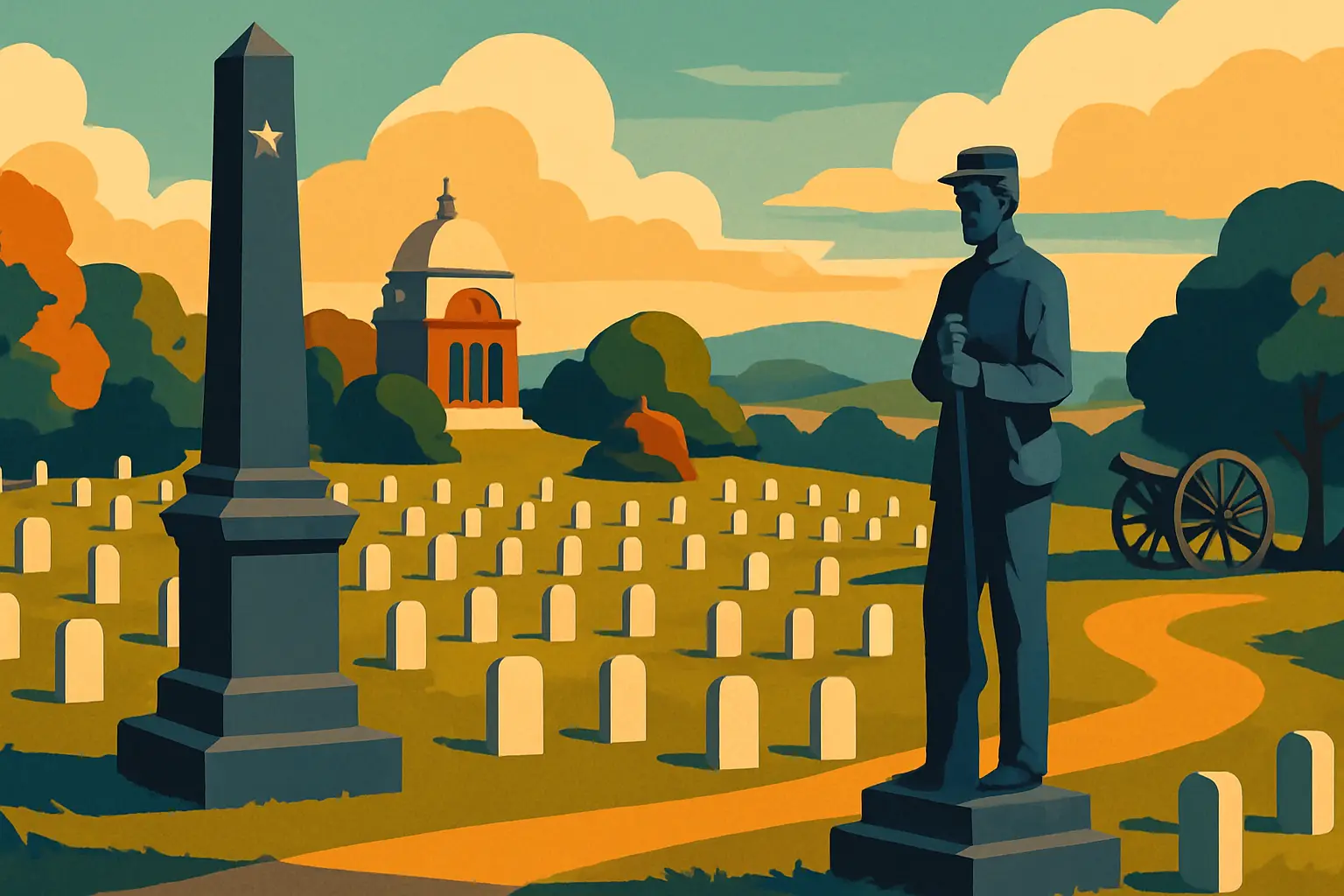
Gettysburg National Cemetery adjoins the battlefield along Baltimore Pike and can be entered directly from the Visitor Center parking area. It was established in the months immediately following the battle, as Pennsylvania Governor Andrew Curtin commissioned attorney David Wills to purchase 17 acres for a proper burial ground. Bodies had been hastily interred across the battlefield in the days after the fighting — some in mass graves — and the reinterment process was still underway when the cemetery was dedicated on November 19, 1863.
The dedication ceremony drew an enormous crowd estimated at 15,000 people. The keynote address was delivered by Edward Everett, a former Secretary of State and the most celebrated orator in America at the time. Everett spoke for two hours. Lincoln followed with 272 words. Everett wrote to Lincoln the following day: "I should be glad if I could flatter myself that I came as near to the central idea of the occasion, in two hours, as you did in two minutes."
The Soldiers' National Monument, a 60-foot-tall marble column at the cemetery's center, marks the approximate spot where Lincoln stood. The speech itself redefined the meaning of the Civil War — reframing it not as a constitutional dispute over states' rights but as a test of whether democratic self-governance could survive. The phrase "government of the people, by the people, for the people" was not original to Lincoln (Daniel Webster had used similar language decades earlier) but Lincoln's application of it to the soldiers buried at his feet gave it a weight that has never left American political rhetoric.
Walk the cemetery's rows of markers. The graves are organized by state, and the scale — 3,512 Union soldiers, with 979 identified only as "Unknown" — becomes real in a way that no museum exhibit can replicate. Confederate soldiers buried here were later moved to cemeteries in Richmond, Savannah, and other Southern cities; their absence from Gettysburg's cemetery is itself a historical fact worth noting.
5Beyond the monuments: the human stories the battlefield markers don't tell
The official auto tour narrative is necessarily compressed — it covers military positions, troop movements, and command decisions. But Gettysburg's story has always been inseparable from the civilian population of roughly 2,400 people who lived through the battle in the town itself.
Jennie Wade was the only Gettysburg civilian killed during the battle. On July 3, 1863, she was baking bread in her sister's house on Baltimore Street when a bullet passed through two doors and struck her. The Jennie Wade House Museum (548 Baltimore St, open daily in season, ~$12 adults) preserves the bullet holes in the original doorframes. It's a small but genuinely affecting stop that grounds the military history in something domestic and specific.
The town's Gettysburg Borough was also occupied by Confederate forces during the battle. Residents hid in basements, Confederate soldiers slept in parlors, and the Methodist church on High Street served as a field hospital. Walking the streets of the borough — particularly along Chambersburg Street and York Street — you're following the exact routes that Lee's army used to move through town on July 1.
Cemetery Hill at the northern end of the cemetery is where Brigadier General Alexander Schimmelfennig, a Prussian-born Union officer, hid in a pigsty for three days after being cut off during the July 1 retreat. He survived by eating scraps left by the pig's owner. It is the kind of specific, verifiable, and utterly human detail that makes the battle's chaos comprehensible.
For visitors with a serious interest in the social history of the battle — its impact on Black residents of Gettysburg, the role of enslaved people who traveled north with the Confederate army, and the free Black community's vulnerability during the invasion — Dr. James McPherson's book *Battle Cry of Freedom* and Margaret Creighton's *The Colors of Courage* are the two most rigorous starting points before you make the drive.
6How Gettysburg compares to other Civil War sites accessible from D.C.
Washington D.C. is unusually well-positioned as a base for Civil War history. Within a two-hour drive, you can reach Antietam National Battlefield (75 miles northwest via I-70), Manassas National Battlefield Park (30 miles southwest via I-66), Fredericksburg & Spotsylvania National Military Park (55 miles south via I-95), and Harpers Ferry National Historical Park (65 miles northwest via US-340). Each site tells a different chapter of the same conflict.
Antietam, fought on September 17, 1862, was the bloodiest single day in American history — 22,717 casualties — and gave Lincoln the Union victory he needed to issue the Emancipation Proclamation. It's quieter and less touristic than Gettysburg, and its cornfield and sunken road called Bloody Lane carry a stillness that many visitors find more affecting than the heavily monumented Gettysburg landscape. The Antietam day trip from D.C. is a natural companion to Gettysburg if you want the fuller arc of the Eastern Theater.
Manassas is where the Civil War began for the Eastern Theater in July 1861, when Union civilians drove out from Washington in carriages to watch what they expected would be a quick Federal victory. What they saw instead was a Confederate rout that sent Union soldiers fleeing back to the capital. It's the closest battlefield to D.C. and requires only two to three hours for a focused visit.
Gettysburg's distinction — what makes it the essential first stop among these options — is its combination of scale, preservation, interpretive infrastructure, and historical consequence. No other battlefield in the country offers the same concentration of legible terrain, walking access, and narrative completeness in a single day.
7Logistics, timing, and the practical details that make the day work
Getting there from D.C.: The most direct route is I-270 North to US-15 North, roughly 80 miles and 90 minutes in light traffic. Friday afternoons and Sunday evenings see heavy I-270 congestion — if possible, travel on a weekday or depart D.C. before 7 a.m. on a weekend. There is no direct public transit connection from Washington to Gettysburg; Amtrak does not serve the borough, and the nearest Greyhound stop is in Harrisburg (30 miles north). This is a drive-only day trip.
Best time to visit: Mid-September through October is the sweet spot — summer heat has broken, fall foliage begins on the ridgelines around mid-October, and crowds thin dramatically after Labor Day. July 1–3 each year draws large anniversary crowds and special ranger programs; it's immersive but congested. Avoid visiting in the week following July 4th if parking ease matters to you.
Guided tour options:
- Licensed battlefield guides (available at the Visitor Center) ride with you in your own vehicle for $80–$95 for a two-hour tour covering the full auto route. Booking in advance at gettysburgtourguides.org is strongly recommended in summer.
- The NPS audio tour app (free) syncs to GPS and triggers narration as you approach each stop — a solid fallback if a licensed guide isn't available.
- Segway and horseback tours are available through private operators along Steinwehr Avenue; prices range from $45–$85 per person.
Food and fuel:
- Dobbin House Tavern, 89 Steinwehr Ave: lunch from 11:30 a.m., Colonial-era setting, sandwiches $12–$18
- Gettysburg Eddie's, 217 Steinwehr Ave: casual, cash-friendly, open 11 a.m. daily
- Gas stations are available on US-15 approaching Gettysburg — fill up before entering the park to avoid backtracking
What to bring: Comfortable walking shoes (Little Round Top and Devil's Den involve uneven boulder terrain), sun protection (very little shade on Cemetery Ridge and the open fields), and at least one liter of water per person. The park has no water fountains along the auto tour route.
Drive time from D.C.: ~90 minutes via I-270 N and US-15 N
Visitor Center hours: Daily 9 a.m.–5 p.m. (summer: to 6 p.m.)
Museum admission: $15 adults, $10 ages 6–12, free under 6
Licensed battlefield guide: $80–$95 for 2-hour tour (gettysburgtourguides.org)
NPS audio tour app: free, GPS-triggered narration
Recommended total time on-site: 6–7 hours
Best months: September and October; anniversary programming July 1–3
Keep touring
Want to keep learning about the places that shaped American history — even after you leave the battlefield?
TourMe's Civil War and American history content includes short-form stories, collectible knowledge cards, and interactive chapters covering the key figures, turning points, and contested meanings of battles like Gettysburg and Antietam. Whether you're preparing for the drive or processing what you saw on the way home, TourMe gives you the deeper context in the time it takes to get through traffic.