United States • History & Culture • Civil Rights Movement
Birmingham, Alabama and the Civil Rights Movement: What Happened in 1963 That Changed America Forever
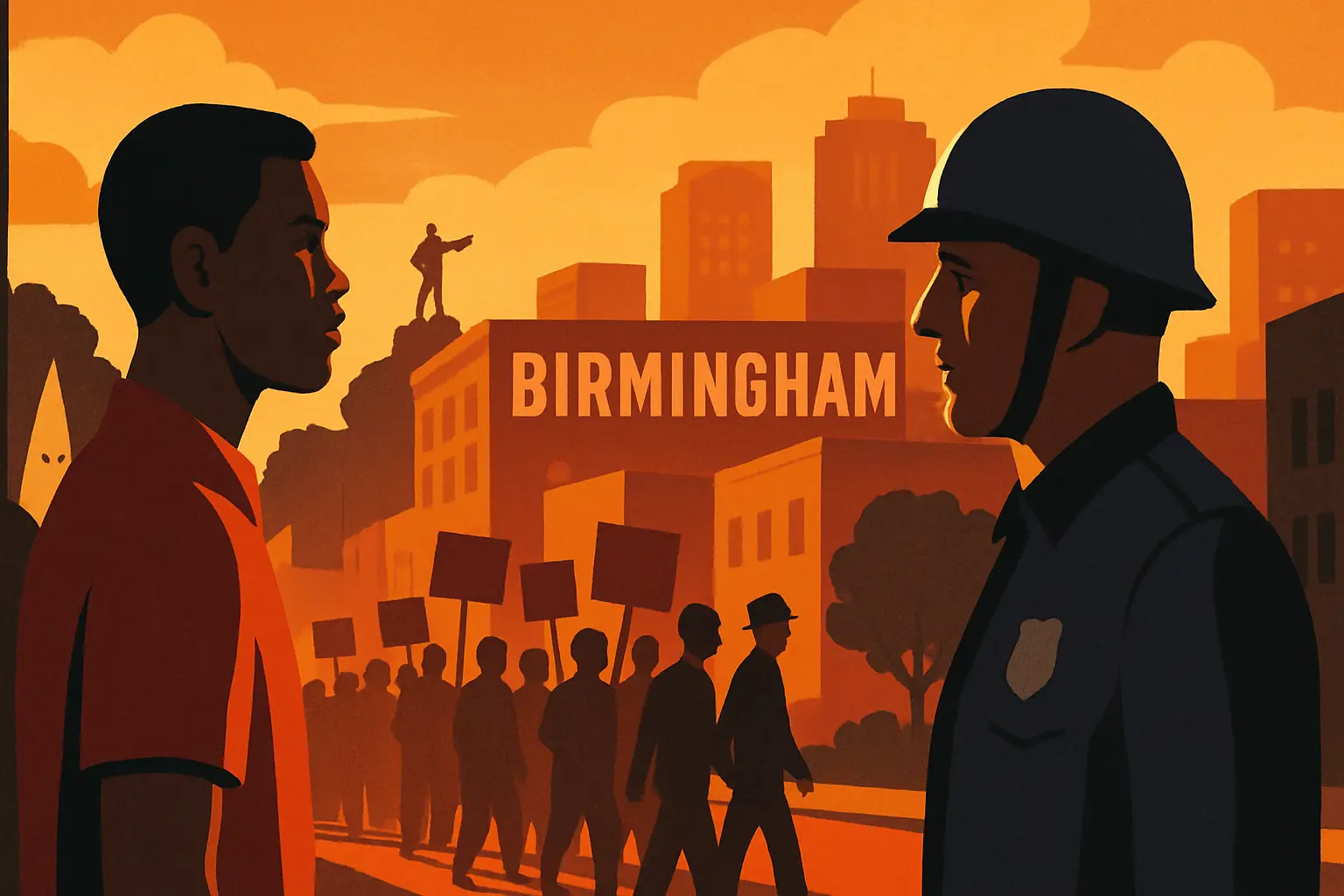
In the spring of 1963, the city of Birmingham, Alabama was one of the most aggressively segregated urban centers in the United States — a place where the Ku Klux Klan operated with near-impunity and Public Safety Commissioner Bull Connor had spent decades enforcing Jim Crow laws with iron consistency. What happened there between April and September of that year was not simply a chapter in the long story of the Civil Rights Movement. It was the hinge on which that story turned. The televised images of fire hoses and police dogs turned on peaceful Black demonstrators — many of them children — produced a national revulsion that gave President John F. Kennedy the political cover to propose comprehensive civil rights legislation. The 16th Street Baptist Church bombing in September, which killed four young girls, transformed that moral outrage into something that could not be ignored or delayed. By the time the Civil Rights Act of 1964 was signed into law, Birmingham had already done the heaviest lifting. This guide covers exactly what happened, who made it happen, and how you can walk the same ground today.
🗽 Short stories • Collectible cards • Learn as you travel
The Birmingham Civil Rights Institute (520 16th Street N) sells timed-entry tickets online at bcri.org. Adult admission is $15, seniors $13, children 17 and under free on Sundays. The museum requires 2–3 hours minimum to experience properly, so reserve the 9 a.m. opening slot to beat school groups.
Walk Kelly Ingram Park free
Kelly Ingram Park (between 16th and 17th Streets N, across from the BCRI) is open daily, free of charge, and contains the most powerful outdoor sculpture installations in the American civil rights landscape — including the Daniel Leroy Tucker 'Fire Hose' and 'Police Dog' bronze memorials. The 'I Am a Man' marker is the best photo stop.
Visit during April for context
Project C — the 1963 campaign — launched on April 3. Visiting Birmingham in early April places you in exact historical sync with the events. The BCRI often holds commemorative programming during this period. Check bcri.org/events for the current year's schedule before booking flights.
The complete Birmingham Civil Rights history and travel guide
1Why Birmingham in 1963: The City Bull Connor Built
To understand what happened in Birmingham in 1963, you first have to understand what Birmingham was. Steel and iron production had made it the wealthiest city in the Deep South by the early twentieth century, but its prosperity was built on a rigid racial caste system that local government had no interest in reforming. Theophilus Eugene 'Bull' Connor, who served as Commissioner of Public Safety almost continuously from 1937 to 1963, had personally overseen the enforcement of segregation ordinances covering everything from restaurants and restrooms to taxicabs and telephone booths. He had also looked the other way — by his own acknowledged inaction — when a Klan mob attacked Freedom Riders at the Trailways bus terminal in May 1961.
The city had earned the nickname 'Bombingham' long before 1963. Between 1947 and 1965, over fifty racially motivated bombings targeted Black homes and churches in the city, almost none of which resulted in arrests. The neighborhood of Dynamite Hill — centered around the Center Street and Eleventh Avenue corridor — earned its name from the frequency of attacks on Black professionals who had moved there.
This was the landscape that the Southern Christian Leadership Conference (SCLC) chose deliberately. The Reverend Fred Shuttlesworth, founder of the Alabama Christian Movement for Human Rights (ACMHR) and one of the most physically courageous figures in American civil rights history, had been inviting Martin Luther King Jr. and the SCLC to Birmingham for years. Shuttlesworth had survived a house bombing on Christmas Day 1956, been beaten with brass knuckles at Phillips High School in 1957, and kept organizing through all of it. He understood that Connor's brutality, if properly documented, would be Birmingham's undoing. King and the SCLC agreed. They called the campaign Project C — C for Confrontation. It launched April 3, 1963.
2Project C and the Children's Crusade: The Campaign That Broke Segregation
The early weeks of Project C did not go as planned. Adult demonstrators sat in at lunch counters, knelt in prayer outside City Hall, and submitted to arrest — but participation was limited. Many Black Birminghamians feared losing their jobs or their homes if they were seen on the picket lines. The jails were filling, but not fast enough to create the economic disruption the SCLC needed. Then James Bevel, an SCLC organizer, proposed something unprecedented: mobilize the city's Black schoolchildren.
On May 2, 1963 — a Thursday now called D-Day — more than a thousand Black children, some as young as six years old, marched out of 16th Street Baptist Church, singing freedom songs and heading toward downtown Birmingham. Connor's officers arrested over 600 of them. The next day, May 3, Connor ordered fire hoses with 100-pounds-per-square-inch pressure turned on the demonstrators in Kelly Ingram Park, and released police dogs against the crowd. Press photographers, including Bill Hudson of the Associated Press, were on the scene. Hudson's photograph of police dog K-9 officer Dick Middleton's German shepherd lunging at a teenager named Walter Gadsden appeared on the front page of the New York Times on May 4 and was seen around the world.
President Kennedy, who had been cautious about publicly endorsing civil rights legislation, reportedly told aides the photograph made him sick. The images gave the movement exactly what Shuttlesworth and King had predicted they would: incontrovertible visual evidence. By May 10, Birmingham's business leaders — watching the city's national reputation collapse and their downtown commerce evaporate — reached a negotiated agreement with the SCLC to desegregate public facilities. Bull Connor called it a capitulation. He was right.
The Children's Crusade remains one of the most debated tactical decisions in American protest history. Critics at the time, including Malcolm X, argued it was morally wrong to put children in harm's way. King's counterargument was direct: the children were already in harm's way, every day, under segregation. They chose to act.
Keep touring
Discover more about United States in minutes
Get short, interactive stories that make each place easier to remember while you travel.
3September 15, 1963: The 16th Street Baptist Church Bombing
The Birmingham campaign's negotiated victory in May did not end the violence. It intensified it. The Klan bombed the home of King's brother, A.D. King, on May 11. They bombed the Gaston Motel, King's Birmingham headquarters at 1510 Fifth Avenue North, the same night. Riots erupted. Then, on September 15, 1963, at 10:22 a.m. on a Sunday morning, a dynamic blast tore through the basement of 16th Street Baptist Church at 1530 Sixth Avenue North.
Four girls — Addie Mae Collins (14), Cynthia Wesley (14), Carole Robertson (14), and Carol Denise McNair (11) — were killed in the Sixteenth Street Church ladies' lounge where they had been preparing for Youth Day services. Twenty-two other people were injured. The four girls became among the most recognized victims of American domestic terrorism, their names now appearing on a memorial window in Westminster Abbey in London and on the exterior walls of Kelly Ingram Park.
Robert Edward Chambliss, a Klansman known as 'Dynamite Bob,' was convicted of murder in 1977 — fourteen years after the bombing — and died in prison in 1985. Two additional Klansmen, Thomas Edwin Blanton Jr. and Bobby Frank Cherry, were convicted in 2001 and 2002 respectively, nearly four decades after the crime.
The church itself, rebuilt, stands on its original site and is a working congregation. Tours of the sanctuary and the basement are offered to visitors. The pew where the girls sat before moving downstairs is marked. The stained-glass window — 'The Wales Window', a gift from the people of Wales depicting a Black Christ with a red slash across it symbolizing crucifixion — was installed in 1965. Standing inside the sanctuary with that context is an experience that photographs cannot replicate. Admission is $5 for adults; call 205-251-9402 to confirm tour times before visiting.
4The People Who Made It Happen: Beyond Martin Luther King Jr.
The Birmingham campaign is most often told through the lens of Martin Luther King Jr., who was indeed arrested on April 12, 1963 — Good Friday — and wrote his famous 'Letter from Birmingham Jail' in the margins of newspapers and on scraps of paper while confined in the city jail at 6th Avenue and 17th Street North. The letter, addressed to white moderate clergymen who had published a statement urging patience, is arguably the most intellectually rigorous defense of nonviolent direct action ever written. It deserves to be read in full, not in excerpt.
But the Birmingham campaign was built on a foundation laid by people whose names are less famous. Fred Shuttlesworth had been organizing in Birmingham since 1956, and it was his standing invitation and his local network that made the SCLC's engagement possible. When he was injured by a fire hose blast in May 1963 and taken to the hospital, King reportedly said, 'I don't think you should tell Fred how serious this is — if he heard it, he would come out of that hospital to lead the march.' Shuttlesworth was back the next day.
Diane Nash, an SCLC strategist and veteran of the Nashville sit-ins, and James Bevel — her husband at the time — designed much of the tactical architecture of Project C, including the Children's Crusade. Dorothy Cotton, the SCLC's Director of Education, trained many of the young demonstrators in nonviolent resistance through the Citizenship Education Program.
Among the young marchers, Audrey Faye Hendricks is often cited as the youngest documented participant in the Children's Crusade — she was nine years old when she was arrested on D-Day. She served a week in juvenile detention and later recalled that she didn't feel brave at the time; she just felt it was the right thing to do. The Birmingham Civil Rights Institute does an exceptional job of centering these less-known figures alongside King, and visiting with that context makes the exhibits considerably more meaningful.
5From Birmingham to the Civil Rights Act: How a City Changed Federal Law
The causal chain from Birmingham 1963 to the Civil Rights Act of 1964 is unusually direct for American legislative history. On June 11, 1963 — exactly one month after the Birmingham settlement — President Kennedy delivered a nationally televised address from the Oval Office calling civil rights 'a moral issue as clear as the American Constitution itself' and announcing that he would send comprehensive civil rights legislation to Congress. He had been pushed off the fence by Birmingham, and by the political reality that television had created: Americans who might never have set foot in Alabama had watched fire hoses and police dogs deployed against children on their living room screens.
Kennedy's bill was stalled in Congress when he was assassinated in Dallas on November 22, 1963. President Lyndon B. Johnson used the moral weight of Kennedy's death — and the continued pressure of the civil rights movement — to push the legislation through a resistant Senate, breaking a 60-day filibuster led by Southern Democrats. The Civil Rights Act of 1964 was signed into law on July 2, 1964, prohibiting discrimination based on race, color, religion, sex, or national origin in employment, public accommodations, and federally assisted programs.
The following year, the Voting Rights Act of 1965 — driven in part by the Selma-to-Montgomery marches and the events of Bloody Sunday on the Edmund Pettus Bridge — extended federal protections to the ballot box. If you're building an itinerary around the civil rights landscape, Selma and the Edmund Pettus Bridge is the natural companion to a Birmingham visit: the two cities are 94 miles apart on US-80, and together they tell a complete legislative story.
Birmingham's role in producing this legislation is why historians consistently treat the spring of 1963 as the movement's decisive turning point — not as one episode among many, but as the moment when the moral and political calculus of American segregation became publicly, irreversibly untenable.
6The Civil Rights District Today: Walking the Sites
The geography of Birmingham's civil rights history is remarkably compact. Almost every significant site from 1963 sits within a six-block radius in the city's downtown Fourth Avenue Historic District and the surrounding area, making it walkable in a single morning if you start early.
16th Street Baptist Church (1530 6th Ave N) is the emotional anchor of any visit. The current structure, built in 1911 in a Moorish Renaissance style, was restored after the 1963 bombing and is still an active congregation. Guided tours run Tuesday through Friday from 10 a.m. to 3 p.m. and on Saturdays from 10 a.m. to noon. Admission is $5 for adults.
Kelly Ingram Park (across from the BCRI on 16th Street N) is a 4-acre public park whose sculptures serve as an open-air museum. The 1992 installations by sculptor James Drake include life-sized figures of demonstrators facing fire hoses and police dogs. The park is laid out as a 'Freedom Walk' with interpretive markers. It's open daily and free.
Birmingham Civil Rights Institute (520 16th Street N) is the movement's most comprehensive single-site museum in Alabama. The permanent galleries use immersive environments — a recreation of a segregated Greyhound bus terminal, audio from the 1963 demonstrations — to move visitors through the chronology of the movement. Open Tuesday–Saturday 10 a.m. to 5 p.m., Sunday 1–5 p.m. Adult admission $15.
The Gaston Motel (1510 5th Ave N) served as SCLC headquarters during the campaign and was bombed in May 1963. The building is now the Gaston Hotel, undergoing restoration and development as a heritage site; check its current status before visiting as the project has proceeded in phases.
Bethel Baptist Church (3233 29th Ave N, in the Collegeville neighborhood) was Fred Shuttlesworth's congregation and was bombed three times between 1956 and 1962. It's a 10-minute drive north of downtown and is open for tours by appointment through the BCRI.
16th Street Baptist Church: 1530 6th Ave N | Tours Tue–Fri 10 a.m.–3 p.m., Sat 10 a.m.–noon | $5 adults | 205-251-9402
Birmingham Civil Rights Institute: 520 16th St N | Tue–Sat 10 a.m.–5 p.m., Sun 1–5 p.m. | $15 adults, free under 17 on Sundays | bcri.org
Kelly Ingram Park: Between 16th and 17th Streets N | Open daily | Free
Gaston Hotel (former Gaston Motel): 1510 5th Ave N | Check current status at gastonhotelal.com
Bethel Baptist Church: 3233 29th Ave N | Tours by appointment through BCRI
7Planning Your Birmingham Visit: Practical Logistics and Insider Advice
Birmingham is a genuinely underrated destination that most American travelers pass over for Atlanta or Nashville. That works in your favor: the civil rights sites are rarely overcrowded, parking is straightforward, and the cost of a full itinerary is modest.
Best time to visit: April (Project C anniversary programming) or September (16th Street Church bombing commemorations on September 15). Summer is hot and humid — high 80s to low 90s Fahrenheit — but the sites are indoors except Kelly Ingram Park.
Getting there: Birmingham-Shuttlesworth International Airport (BHM) has direct flights from Atlanta, Charlotte, Dallas, Chicago, and New York. The airport is 6 miles from downtown — about a $20 rideshare.
Getting around: Rent a car or use rideshare. The downtown civil rights sites are walkable, but Bethel Baptist Church and other neighborhood sites require wheels. WEGO Birmingham's free downtown circulator runs limited routes.
Where to stay: The downtown Renaissance Birmingham Ross Bridge Golf Resort & Spa is a full-service option (~$180–$230/night). The Elyton Hotel (1928 First Ave N) is a boutique hotel in a restored 1929 building downtown, closer to the civil rights sites (~$150–$200/night).
Food worth seeking out: Niki's West (233 Finley Ave W) is a legendary meat-and-three that has served Birmingham since 1957 — the same years as the movement. Lunch runs under $15 and the cafeteria line includes turnip greens, cornbread, and fried catfish. The restaurant is cash-only.
Guided tours: The BCRI offers guided group tours; individual visitors can call 205-328-9696 to inquire about availability. The Birmingham Historical Society (birminghamhistorical.org) offers periodic walking tours of the Fourth Avenue Historic District.
Full itinerary: Allow two full days minimum — one focused on the civil rights district, one for the **Birmingham Museum of Art** (2000 Rev Abraham Woods Jr Blvd, free admission) and the historic Avondale neighborhood for a broader sense of the city.
Keep touring
Ready to walk the streets where American history was made?
TourMe brings Birmingham's civil rights history to life through location-based audio stories, collectible historical cards, and interactive chapters you unlock as you move through the city. Stand in Kelly Ingram Park and hear the story of D-Day unfold around you, or explore the Letter from Birmingham Jail through an immersive guided chapter. The Birmingham Civil Rights collection inside TourMe is built for visitors who want depth, not just dates.