The building Americans now call Independence Hall was constructed between 1732 and 1753 as the seat of the Pennsylvania Provincial Assembly, and it was contentious from the start. Pennsylvania's colonial charter — issued by William Penn in 1681 — had created a uniquely permissive political culture: no state church, broad property rights, and a unicameral legislature that gave ordinary landowners real power. By the time the brick Georgian building was completed on Chestnut Street, Philadelphia was already the largest city in the British colonies, a mercantile hub of roughly 25,000 people, and the Assembly meeting inside it had already spent decades clashing with Penn's heirs over taxation and land rights.
The building's architecture was deliberately civic in its ambition. The Assembly Room on the ground floor — the chamber where history would unfold — measured just 40 by 40 feet, an intimate space that forced proximity and confrontation. Its twin pilasters, Venetian windows, and Windsor chairs were designed to project English institutional dignity, not revolutionary intent. The Supreme Court Chamber on the opposite side of the central hall handled colonial legal business. Upstairs, the Long Gallery served as a banquet space, and the Governor's Council Chamber handled executive functions.
This was, in other words, a fully functioning colonial government building before it became a revolutionary one. When the Second Continental Congress began meeting here in May 1775 — after the battles of Lexington and Concord — it was a radical act even to convene, let alone to contemplate independence. The delegates were not fringe agitators. They were lawyers, planters, merchants, and sitting colonial officials. Understanding that they were working within and against an existing institutional framework, inside a building designed for orderly governance, makes what followed in 1776 and 1787 considerably more dramatic.
The popular image — 56 men striding forward to sign the Declaration of Independence on July 4, 1776 — is largely cinematic. The actual sequence was considerably messier, and the Assembly Room was the stage for weeks of argument before anything was signed.
Richard Henry Lee of Virginia introduced the resolution for independence on June 7, 1776. Congress debated it, tabled it, and appointed a Committee of Five — including Thomas Jefferson, John Adams, Benjamin Franklin, Roger Sherman, and Robert R. Livingston — to draft a formal declaration while the main vote was postponed. Jefferson did the bulk of the writing in his rented rooms at 7th and Market Streets, two blocks away, not in the hall itself.
The vote on Lee's resolution for independence came on July 2 — a date Adams famously (and incorrectly) predicted would be celebrated as the great American holiday. Congress then spent July 3 and 4 editing Jefferson's draft, removing roughly one-quarter of his text, most notably his passage condemning the transatlantic slave trade, which Southern delegates refused to accept. Jefferson sat in visible discomfort as Franklin and Adams watched colleagues gut the document.
The formal engrossed parchment copy wasn't ready until August 2, 1776, when most delegates signed it. Some signed later; a few never signed at all. John Dickinson of Pennsylvania, who had argued passionately against independence as premature, refused to sign. The room's Windsor chairs — the originals, or period reproductions, depending on which piece — and the Rising Sun Chair used by the president of Congress are today among the most examined artifacts in the building. The gilt half-sun carved on the chair's crest rail prompted Franklin's famous remark at the Constitutional Convention's close: after months of uncertainty, he said he was now convinced it was a rising sun, not a setting one.
Eleven years after the Declaration, the same room hosted an entirely different gathering, and the stakes — though less mythologized — were arguably higher. The Articles of Confederation, which had governed the new nation since 1781, had produced something close to dysfunction: states imposed tariffs on each other's goods, the federal government couldn't levy taxes or raise a standing army, and Shays' Rebellion in Massachusetts in 1786 had demonstrated that the government couldn't put down an armed domestic uprising without begging states for troops.
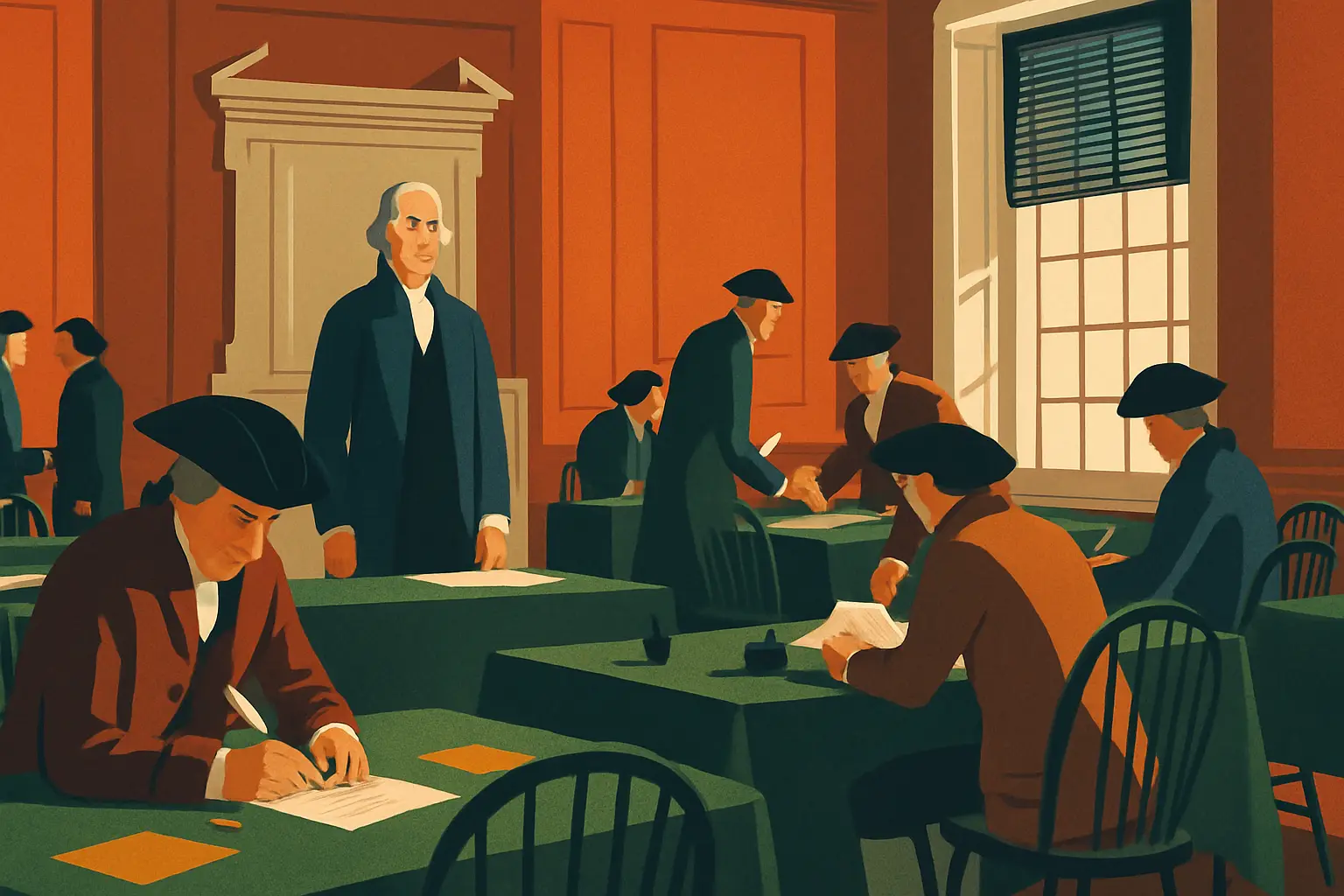
The Constitutional Convention convened on May 25, 1787, with George Washington elected president of the convention by unanimous vote on the first day. His presence was indispensable — not because he spoke often (he delivered almost no floor speeches) but because his moral authority kept delegates at the table when negotiations collapsed. Benjamin Franklin, 81 years old and carried to sessions in a sedan chair because gout made walking unbearable, offered the longest shadow of the Revolution and used it strategically.
The secrecy rule was absolute. Sentries stood at the hall's doors. Windows were sealed. The rule of secrecy passed on May 29 prohibited delegates from publishing, copying, or even discussing the proceedings outside the room. This wasn't paranoia — it was political calculation. Delegates knew that if their compromises leaked while they were still being made, factions back home would kill the process before it finished. James Madison of Virginia kept his famous daily notes by sitting directly in front of Washington's presiding chair and transcribing the debates in longhand, then expanding them from memory each evening. Without that private discipline, we would know almost nothing of what was said.
The convention ran from late May to September 17, with frequent recesses and multiple near-collapses — making the final product, a document of 4,543 words, a minor miracle of endurance.
The Constitutional Convention didn't flow smoothly toward its famous conclusion. Three distinct crises nearly ended it, and each resolved through compromises that carry consequences Americans still live with today.
The Virginia Plan vs. the New Jersey Plan — May through June 1787. Edmund Randolph opened the convention by presenting the Virginia Plan, drafted primarily by Madison, which proposed scrapping the Articles of Confederation entirely and replacing them with a bicameral legislature where representation was proportional to population. Larger states loved it. Smaller states, led by William Paterson of New Jersey, countered with the New Jersey Plan, which preserved equal state representation. By late June the convention had deadlocked so severely that Alexander Hamilton gave a six-hour speech proposing a near-monarchy — and was largely ignored. The resolution came through the Connecticut Compromise (also called the Great Compromise) on July 16, proposed by Roger Sherman: a House of Representatives based on population and a Senate with equal state representation. The margin of passage was one vote.
The Three-Fifths Compromise — July 1787. The question of how to count enslaved people for purposes of congressional representation produced the convention's most morally compromised moment. Southern states wanted enslaved people counted fully for representation (while denying them any rights) but not for direct taxation. Northern states took the inverse position. The three-fifths clause — counting each enslaved person as three-fifths of a free person — had actually already appeared in a 1783 congressional proposal and was adopted with less floor debate than its consequences deserved. Gouverneur Morris of Pennsylvania delivered one of the few explicit condemnations of slavery on the floor, calling it a 'nefarious institution.' His speech changed no votes.
The Commerce and Slave Trade Compromise — August 1787. Southern states, led by South Carolina and Georgia, threatened to leave if the convention granted Congress power to regulate the slave trade. The deal struck: Congress could not ban the international slave trade before 1808, and the Navigation Acts compromise gave Congress power over interstate commerce without requiring a supermajority. Both provisions passed. The 1808 deadline was met — Congress banned the international slave trade on January 1 of that year — but the domestic trade continued, and the underlying contradiction the convention refused to resolve would cost 620,000 lives in the Civil War.
The National Park Service manages Independence Hall as part of Independence National Historical Park, and the building has been meticulously restored to its late-18th-century appearance. Here is what each space contains and why it matters.
The Assembly Room (ground floor, south side) is the centerpiece. The room holds period Windsor chairs arranged as they would have been during the 1787 convention, a silver inkstand used during the signing of both the Declaration and the Constitution (on loan from the American Philosophical Society), and Washington's Rising Sun Chair, positioned at the front on a low platform. The green baize-covered tables, the brass candelabras, and the low natural light from sealed windows give the space a claustrophobic intimacy that photographs don't convey. This is the room.
The Supreme Court Chamber (ground floor, north side) housed Pennsylvania's colonial and state supreme court. It contains the original judge's bench, a prisoner's dock, and period legal furniture. It's a reminder that the building was a working government facility, not a monument.
The Long Gallery (second floor) runs the full width of the building and was used as a banquet hall, a hospital during the British occupation of Philadelphia in 1777–78, and a storage space for Charles Willson Peale's natural history collection. Today it contains period portraits and is accessible on the standard tour.
The Governor's Council Chamber (second floor) is where Pennsylvania's executive council met. It's furnished with period pieces and offers context for what colonial executive governance actually looked like — less ceremonial than modern visitors expect.
The building exterior — Georgian brick with a wooden steeple reconstructed in 1828 based on original plans — is best photographed from the Independence Mall lawn to the north, which offers the classic symmetrical view. The steeple houses a replica of the original bell (the actual Liberty Bell is in the adjacent center across Chestnut Street).
The Constitutional Convention had 55 delegates from 12 states (Rhode Island refused to participate). Five are worth understanding specifically because their contributions — and contradictions — illuminate what actually happened in that room.
James Madison (Virginia) arrived in Philadelphia weeks early, studied every failed republic in history from Thucydides to the Dutch Republic, and drafted the Virginia Plan before the convention opened. He is often called the 'Father of the Constitution,' a title he resisted because he knew how much the document differed from his original design. He lost as many arguments as he won, including on the Senate's equal representation, which he opposed until his death.
Gouverneur Morris (Pennsylvania) was assigned to the Committee of Style in the convention's final weeks and is largely responsible for the Constitution's actual prose — including the famous Preamble's opening, 'We the People.' He wrote cleaner English than almost anyone in the room and used that skill to embed ambiguities that courts are still interpreting.
George Mason (Virginia) helped draft the Virginia Declaration of Rights (a direct precursor to the Bill of Rights) and refused to sign the finished Constitution, primarily because it lacked a bill of rights and because the slave trade compromise disgusted him. His refusal was a preview of the ratification fights ahead.
Roger Sherman (Connecticut) was the only delegate to sign all four of the era's major founding documents: the Articles of Association (1774), the Declaration of Independence (1776), the Articles of Confederation (1777), and the Constitution (1787). His Connecticut Compromise saved the convention.
Alexander Hamilton (New York) signed the Constitution despite having proposed ideas far more radical than what passed — and despite the fact that his two fellow New York delegates had gone home in disgust, leaving him as the state's sole representative. His signature carried more symbolic than political weight in the room, but his subsequent authorship of 51 of the 85 Federalist Papers made ratification possible.
For a deeper look at the figures who shaped the early republic, the story of Philadelphia's founding neighborhoods offers essential context on the city that shaped all of them.
Independence Hall sits within Independence National Historical Park in Old City Philadelphia, managed by the National Park Service. The hall itself is free to enter but requires a timed-entry pass, and the logistics differ by season.
Admission and tickets:
- Entry to Independence Hall: free; timed passes required March 1 through late November
- Reserve at recreation.gov (search 'Independence Hall Philadelphia'); $1 processing fee per reservation
- Same-day standby tickets available at the Independence Visitor Center, 6th and Market Streets, starting at 8:30 a.m. — arrive by 8:15 a.m. in peak summer months
- Liberty Bell Center: free, no tickets required, open 9 a.m. – 5 p.m. most days
- National Constitution Center: ~$16 adults, ~$12 children (ages 4–12), ~$14 seniors; 525 Arch Street
Best times to visit:
- Early morning tours (first slot, typically 9 a.m.) are less crowded and cooler in summer
- Late September through early November offers comfortable temperatures and thinner crowds
- Avoid July 4th week unless you plan months ahead — the area hosts major public events and capacity is tightly restricted
What most visitors miss:
- The Second Bank of the United States at 420 Chestnut Street, a Greek Revival masterpiece housing one of the finest portrait collections of founding-era figures in the country — free admission, often empty
- Carpenters' Hall at 320 Chestnut Street, where the First Continental Congress met in 1774, predating Independence Hall's role entirely — also free
- The Benjamin Franklin Museum underground at Franklin Court, 314–322 Market Street (~$5 adults), which uses the 18th-century footprint of Franklin's actual house as its layout
Getting there: SEPTA's Market-Frankford Line stops at 5th Street Station, one block from the visitor center. Parking garages on 2nd and 3rd Streets run $20–$35 for a half-day. Amtrak serves 30th Street Station (~15 minutes by taxi or rideshare).