United States • History & Culture • Harlem, New York City
The Harlem Renaissance Explained: How One Neighborhood Changed American Culture Forever
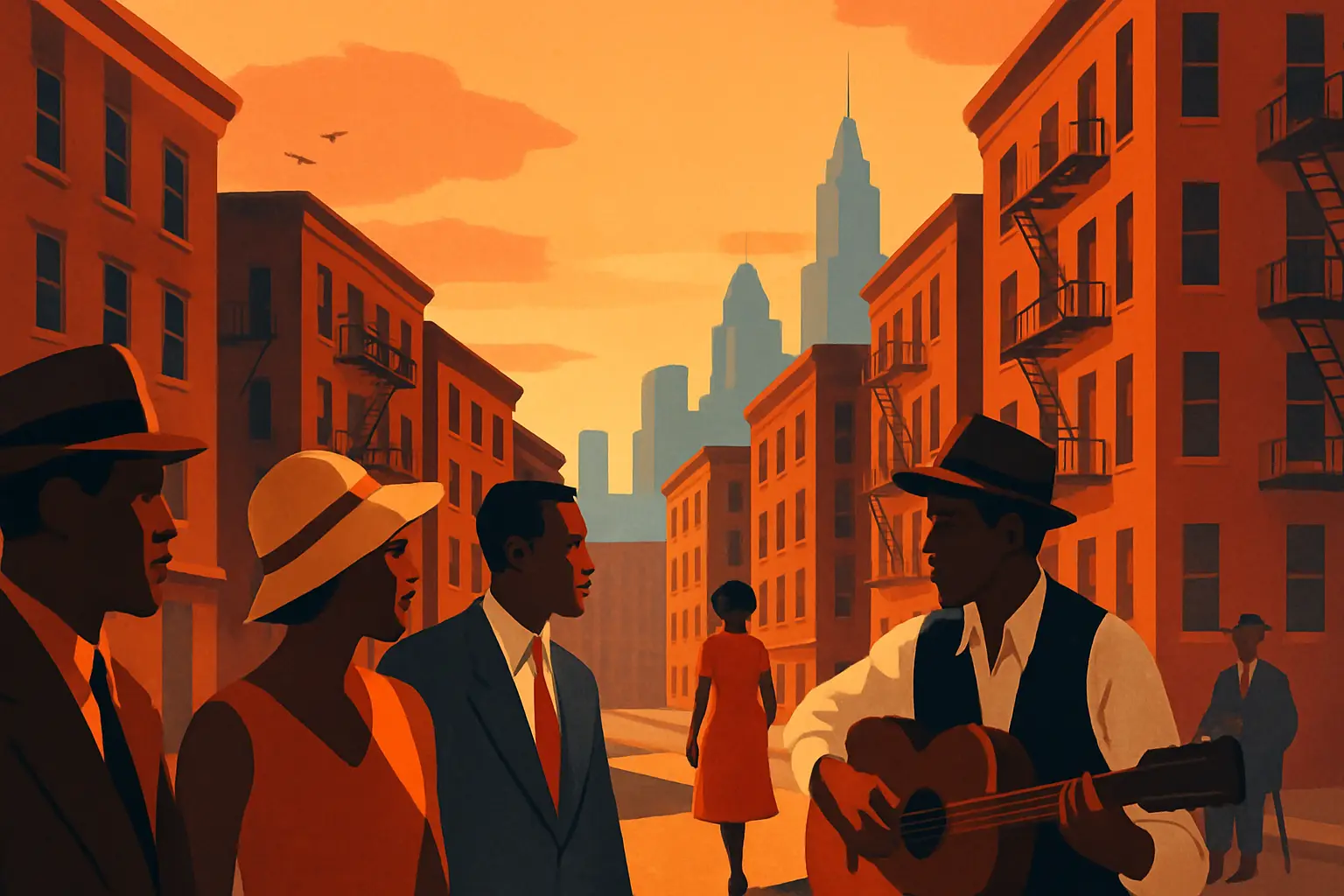
In 1920, Harlem was not the cultural capital of Black America — it was a real estate gamble that had gone spectacularly wrong for white developers who built upscale apartment buildings too fast and were forced, reluctantly, to rent to Black tenants just to cover their mortgages. Within a decade, that accident of economics had produced one of the most concentrated eruptions of artistic genius in American history. Between roughly 1920 and 1940, a forty-block stretch of upper Manhattan became home to Langston Hughes, Zora Neale Hurston, Duke Ellington, Louis Armstrong, Aaron Douglas, and dozens of other figures who collectively reinvented what American literature, music, painting, and political thought could be. This was not a gradual evolution — it was a detonation. The Harlem Renaissance forced mainstream America to reckon with Black intellectual and artistic achievement at a time when segregation was the law in much of the country. This guide traces the movement block by block, figure by figure, venue by venue — and tells you exactly what still stands, what you can visit today, and why making the trip up to 125th Street remains one of the most rewarding decisions any culturally serious traveler can make in New York City.
🗽 Short stories • Collectible cards • Learn as you travel
Sunday mornings offer gospel brunches and services at Abyssinian Baptist Church (132 Odell Clark Place W). Arrive by 9:00 AM — pews fill fast and no reservations are taken. Pair it with brunch at Sylvia's Restaurant (328 Lenox Ave) for a full cultural morning without heavy tourist crowds.
Free museum admission tip
The Studio Museum in Harlem (144 W 125th St) is free and open Thursday–Friday 12–9 PM and Saturday–Sunday 10 AM–6 PM during its renovated building's programming. The Schomburg Center for Research in Black Culture (515 Malcolm X Blvd) is also free — its exhibition galleries require no ticket and hold some of the most important primary documents from the Renaissance period.
Walking tour vs. self-guided
Big Onion Walking Tours offers a dedicated Harlem history walk for approximately $25 per adult. Alternatively, the NYC Landmarks Preservation Commission publishes a free downloadable Harlem Renaissance map at nyc.gov/landmarks — it pinpoints 30+ surviving buildings and is more granular than most paid tours.
The complete Harlem Renaissance cultural guide
1Why Harlem? The migration, the real estate collapse, and the accident that created a capital
The Harlem Renaissance did not materialize from thin air. It was the product of two colliding forces: the Great Migration and a spectacular failure of speculative real estate development.
Between 1910 and 1930, approximately 1.6 million Black Americans left the Jim Crow South for northern industrial cities. New York received several hundred thousand of them, and Harlem — which had been developed in the 1890s and early 1900s as an upper-middle-class white neighborhood — absorbed a disproportionate share. The reason was agent Philip Payton, a Black real estate entrepreneur who approached desperate white landlords in 1904 and offered to fill their empty buildings with Black tenants at slightly higher rents. The landlords, hemorrhaging money, agreed. Payton founded the Afro-American Realty Company and began systematically placing Black families in Harlem's finest brownstones, particularly along what is now Adam Clayton Powell Jr. Boulevard (Seventh Avenue) and Lenox Avenue (Malcolm X Boulevard).
White residents organized block associations and tried to buy out buildings to re-segregate the neighborhood, but the financial tide had turned. By 1920, central Harlem — bounded roughly by 110th Street to the south, 155th Street to the north, and Fifth to Eighth avenues east to west — was majority Black. Crucially, the neighborhood's architectural stock was excellent. These were not slums; they were solidly built limestone and brownstone rowhouses, wide boulevards, and large apartment buildings originally intended for affluent tenants.
This physical quality mattered for the cultural explosion that followed. Writers, musicians, and artists were moving into apartments with parlors large enough for salons. The infrastructure of a sophisticated urban neighborhood — theaters, ballrooms, churches, libraries — was already in place. All it needed was the talent, which the Great Migration delivered in extraordinary quantities. The Harlem Renaissance was not despite the neighborhood's unusual origins; it was substantially because of them.
2The writers who made Harlem the literary center of Black America
Any honest account of the Harlem Renaissance's literary output has to start with the sheer improbability of what happened in a few blocks around 125th Street and Seventh Avenue during the 1920s. Within roughly a decade, this neighborhood produced the poetry of Langston Hughes, the anthropological fiction of Zora Neale Hurston, the essays of Alain Locke, the novels of Claude McKay, and the autobiography of James Weldon Johnson — a body of work that permanently altered the trajectory of American letters.
Langston Hughes arrived in Harlem in 1921, initially working as a busboy and writing poems on napkins. His 1926 essay *The Negro Artist and the Racial Mountain*, published in The Nation, became the movement's artistic manifesto, arguing that Black artists should embrace their own culture rather than imitate white aesthetics. Hughes lived for many years at 20 East 127th Street, a building that still stands and carries a New York City landmark designation. His poetry collections *The Weary Blues* (1926) and *Fine Clothes to the Jew* (1927) used jazz rhythms as a structural device — a genuinely radical formal innovation that anticipated spoken word and hip-hop by decades.
Zora Neale Hurston brought a different angle. Trained as an anthropologist under Franz Boas at Columbia, she combined fieldwork in Southern Black folklore with fiction to produce *Their Eyes Were Watching God* (1937), now considered one of the twentieth century's essential American novels. Hurston was also a fixture of the salons hosted by A'Lelia Walker — heiress to Madam C.J. Walker's hair-products fortune — at 108–110 West 136th Street, where artists, writers, and downtown socialites mixed in a space Walker called the Dark Tower.
Alain Locke, a Howard University philosophy professor and the first African American Rhodes Scholar, edited the 1925 anthology *The New Negro*, which is often cited as the movement's founding document. His framing — that a cultural renaissance would prove Black intellectual equality more effectively than political argument alone — shaped the Renaissance's self-understanding and its reception by white patrons and publishers.
Keep touring
Discover more about United States in minutes
Get short, interactive stories that make each place easier to remember while you travel.
3The jazz clubs and ballrooms where the music was invented in real time
If Harlem's literary scene had a library at its center — the Schomburg Collection, now the Schomburg Center for Research in Black Culture at 515 Malcolm X Boulevard, assembled by Puerto Rican-born Black bibliophile Arturo Alfonso Schomburg — its musical life had a constellation of venues that collectively changed American music.
The most famous is the Apollo Theater at 253 West 125th Street, which opened in its current form in 1934 (having previously operated as a whites-only burlesque house called Hurtig & Seamon's). The Apollo's Amateur Night, which began in 1934 and continues today, launched Ella Fitzgerald (she won in 1934 at age 17), Billie Holiday, and later James Brown. The theater charges approximately $30–$50 for most live performances today and remains an active venue — not a museum piece.
But during the Renaissance's peak years, the action was in the ballrooms. The Savoy Ballroom, which opened in 1926 at 596 Lenox Avenue (the block between 140th and 141st Streets), could accommodate 4,000 dancers and ran two bandstands simultaneously so music never stopped. It was here that Lindy Hop — the foundational American social dance that evolved into swing — was codified. The Savoy was demolished in 1958 and replaced by a housing project; a plaque on the sidewalk marks the site.
Small's Paradise at 2294½ Seventh Avenue (near 135th Street) was famous for waiters who danced the Charleston while carrying trays. Duke Ellington and his orchestra took up their famous long residency not in Harlem but downtown at the Cotton Club (which relocated to 200 West 48th Street in 1936 after originally operating at 142nd and Lenox from 1923–1936) — a painful irony, since the Cotton Club enforced a whites-only audience policy while presenting exclusively Black performers. Ellington and Louis Armstrong both recorded for OKeh Records and Columbia Records during this period; the recordings made in New York between 1925 and 1932 constitute the foundational catalog of jazz.
For visitors today, Ginny's Supper Club in the basement of the Red Rooster restaurant (310 Lenox Ave) offers live jazz on weekends in a room that consciously evokes the supper club atmosphere of the 1930s. Cover charges run approximately $15–$25.
Apollo Theater: 253 W 125th St — live performances year-round, tickets $30–$50, box office open Mon–Sat 10 AM–6 PM
Schomburg Center: 515 Malcolm X Blvd — free exhibitions, open Mon–Wed noon–8 PM, Thu–Fri noon–6 PM, Sat 10 AM–6 PM
Ginny's Supper Club: 310 Lenox Ave — live jazz Fri–Sat, $15–$25 cover, reservations recommended via resy.com
4Visual art and the painters who gave the Renaissance a face
The Harlem Renaissance is most commonly discussed through its literature and music, which means its visual art is consistently undervalued — a significant oversight, given that figures like Aaron Douglas, Jacob Lawrence, and Augusta Savage produced work of extraordinary originality that directly shaped how the movement understood and represented itself.
Aaron Douglas was the Renaissance's preeminent visual artist. Born in Topeka, Kansas, he arrived in Harlem in 1924 and quickly became the go-to illustrator for the movement's two flagship publications: The Crisis (the NAACP's magazine, edited by W.E.B. Du Bois) and Opportunity (published by the Urban League). His style fused West African motifs with Art Deco geometry and Egyptian profile figures to create a distinctly Black modernist visual language. His most ambitious work, the four-panel mural series *Aspects of Negro Life* (1934), was commissioned for the 135th Street branch of the New York Public Library — now the Countee Cullen Branch at 104 West 136th Street — where it can still be seen today, free of charge, during library hours.
Augusta Savage was a sculptor from Green Cove Springs, Florida, who established the Savage Studio of Arts and Crafts at 163 West 143rd Street in 1932, making it one of the first free art schools for Harlem's Black community. She had previously been denied a spot in a summer arts program in France solely because of her race — a discrimination she fought publicly, helping to establish the principle that publicly funded arts programs could not exclude on racial grounds. Her most famous work, *The Harp* (also called *Lift Every Voice and Sing*), was commissioned for the 1939 World's Fair in Queens; the original plaster cast was destroyed after the fair, and no bronze was ever made. Only photographs survive.
Jacob Lawrence arrived in Harlem as a teenager in 1930 and studied under Savage. His sixty-panel series *The Migration of the Negro* (1940–41) told the story of the Great Migration in flat, boldly colored tempera panels. The series was acquired jointly by the Museum of Modern Art (MoMA, 11 West 53rd St) and the Phillips Collection in Washington, D.C., alternating between the two collections — meaning roughly half the panels are viewable in New York at any given time.
5The politics underneath the art: Du Bois, Garvey, and the battle for Black identity
It would be a mistake to experience the Harlem Renaissance purely as an aesthetic phenomenon. Underneath the poetry readings and jazz performances ran fierce, sometimes bitter debates about what Black political identity in America should look like — and two of the most consequential figures in that debate both operated within a few blocks of each other in Harlem.
W.E.B. Du Bois, editor of The Crisis from its founding in 1910 through 1934, believed in integration, higher education, and what he called the Talented Tenth — the idea that a vanguard of educated Black leaders would uplift the entire community through example and advocacy. Du Bois was a co-founder of the NAACP and operated from offices at 70 Fifth Avenue in Manhattan, though he was a constant presence in Harlem's intellectual circles. His 1903 book *The Souls of Black Folk* had introduced the concept of double consciousness — the experience of always perceiving oneself through the eyes of a hostile white gaze — which became the intellectual framework through which many Renaissance writers understood their own work.
Marcus Garvey offered a radically different vision. A Jamaican-born activist who arrived in Harlem in 1916, Garvey founded the Universal Negro Improvement Association (UNIA) and built a mass movement — at its peak, the UNIA claimed four million members — around Black nationalism, Pan-Africanism, and the idea of a return to Africa. Garvey operated from Liberty Hall at 120 West 138th Street and published the newspaper *Negro World*, which was distributed internationally. His Black Star Line shipping company, intended to literally transport Black Americans back to Africa, collapsed due to mismanagement and federal fraud charges; Garvey was convicted in 1923 and eventually deported in 1927.
Du Bois and Garvey despised each other publicly and personally — Du Bois called Garvey "the most dangerous enemy of the Negro race," while Garvey dismissed Du Bois as a tool of white philanthropy. Their conflict mapped a debate that runs through Black American political thought to this day: integration versus separatism, gradual reform versus radical transformation. The Harlem Renaissance happened in the middle of that argument, drawing energy from both poles.
6What ended the Renaissance — and what it actually left behind
Historians conventionally date the Harlem Renaissance's end to the late 1930s, with two events cited most often: the Great Depression, which destroyed the leisure economy that had supported jazz clubs and publishing advances, and the Harlem Riot of 1935, in which frustrated residents — suffering 50% unemployment in some blocks — attacked white-owned businesses along 125th Street. The riot was not a random outburst; it reflected the gap between Harlem's cultural prestige and the grinding economic reality of its residents, many of whom were locked out of the very clubs and restaurants that celebrated their culture.
The Depression cut Harlem's arts infrastructure severely. White patrons withdrew. Publishers became more conservative. The Cotton Club closed its Harlem location in 1936. Many Renaissance figures scattered — Hurston returned to Florida, Hughes continued writing but struggled financially, and the dense creative community that had concentrated in a few blocks began to disperse.
But measuring the Renaissance by its formal endpoint misses the point. The movement's actual legacy operates on a different timeline. The Harlem Writers Guild, founded in 1950, grew directly from Renaissance networks and nurtured Maya Angelou, Paule Marshall, and John Oliver Killens. The Black Arts Movement of the 1960s explicitly positioned itself as the Renaissance's political heir. Hip-hop, which emerged from the South Bronx and quickly claimed Harlem as part of its geography in the late 1970s, drew on the Renaissance's insistence that Black vernacular culture — not a sanitized, white-approved version of it — was the authentic starting point for artistic creation.
The Renaissance also fundamentally changed what American literature could sound like. Before Hughes, jazz rhythm was not considered a legitimate structuring device for poetry. Before Hurston, Black Southern vernacular speech was not considered appropriate literary language. Both of those prohibitions were permanently demolished. Every subsequent American writer who uses vernacular speech, musical rhythm, or regional dialect as a formal literary tool is working in a tradition the Harlem Renaissance created.
7Planning your visit: the specific addresses, hours, and routes that make the trip worthwhile
Harlem is a working neighborhood, not a theme park, and the sites of the Renaissance require some effort to connect. The most efficient approach is a self-guided walk that runs roughly north from 125th Street to 145th Street along Lenox Avenue (Malcolm X Boulevard), then back south on Seventh Avenue (Adam Clayton Powell Jr. Boulevard). The round trip covers about two miles and can be done in three to four hours, with stops.
Getting there: Take the 2 or 3 subway train to 125th Street station, or the A, B, C, or D to 125th Street at St. Nicholas Avenue. From Midtown, the ride is approximately 20–25 minutes.
Anchor stops with confirmed public access:
Apollo Theater (253 W 125th St): Box office open Mon–Sat 10 AM–6 PM. Studio tours available for $18/adult. Check apollotheater.org for current performance schedule.
Studio Museum in Harlem (144 W 125th St): Free admission. Thu–Fri noon–9 PM, Sat–Sun 10 AM–6 PM. Currently operating from temporary gallery space during its new building construction — confirm hours before visiting at studiomuseum.org.
Schomburg Center (515 Malcolm X Blvd at 135th St): Free. Mon–Wed noon–8 PM, Thu–Fri noon–6 PM, Sat 10 AM–6 PM. The Langston Hughes lobby auditorium and permanent gallery are the highlights.
Countee Cullen Branch Library (104 W 136th St): Free. Aaron Douglas murals viewable during library hours — Mon/Wed 10 AM–6 PM, Tue/Thu noon–8 PM, Sat 10 AM–5 PM.
Abyssinian Baptist Church (132 Odell Clark Place W): Sunday services at 9 AM and 11 AM. Visitors welcome but this is an active congregation — dress respectfully.
Strivers' Row / St. Nicholas Historic District (138th–139th Sts between Adam Clayton Powell Jr. and Frederick Douglass Blvds): Exterior viewing only. These 1891 row houses were home to Renaissance-era physicians, musicians, and professionals — the blocks remain remarkably intact.
Red Rooster / Ginny's Supper Club (310 Lenox Ave): Restaurant open daily for dinner from 5:30 PM; jazz in Ginny's basement Fri–Sat with $15–$25 cover.
Keep touring
Ready to walk the blocks that changed American culture?
TourMe brings the Harlem Renaissance to life with GPS-triggered audio stories, collectible illustrated cards featuring Hughes, Ellington, and Savage, and an interactive chapter that guides you block by block through the surviving landmarks. Download the app and the Harlem history chapter before you step off the subway at 125th Street — every building gets its story told in real time.