Chicago Deep Dish: Who Actually Invented It — and Why It's Definitely Not a Casserole
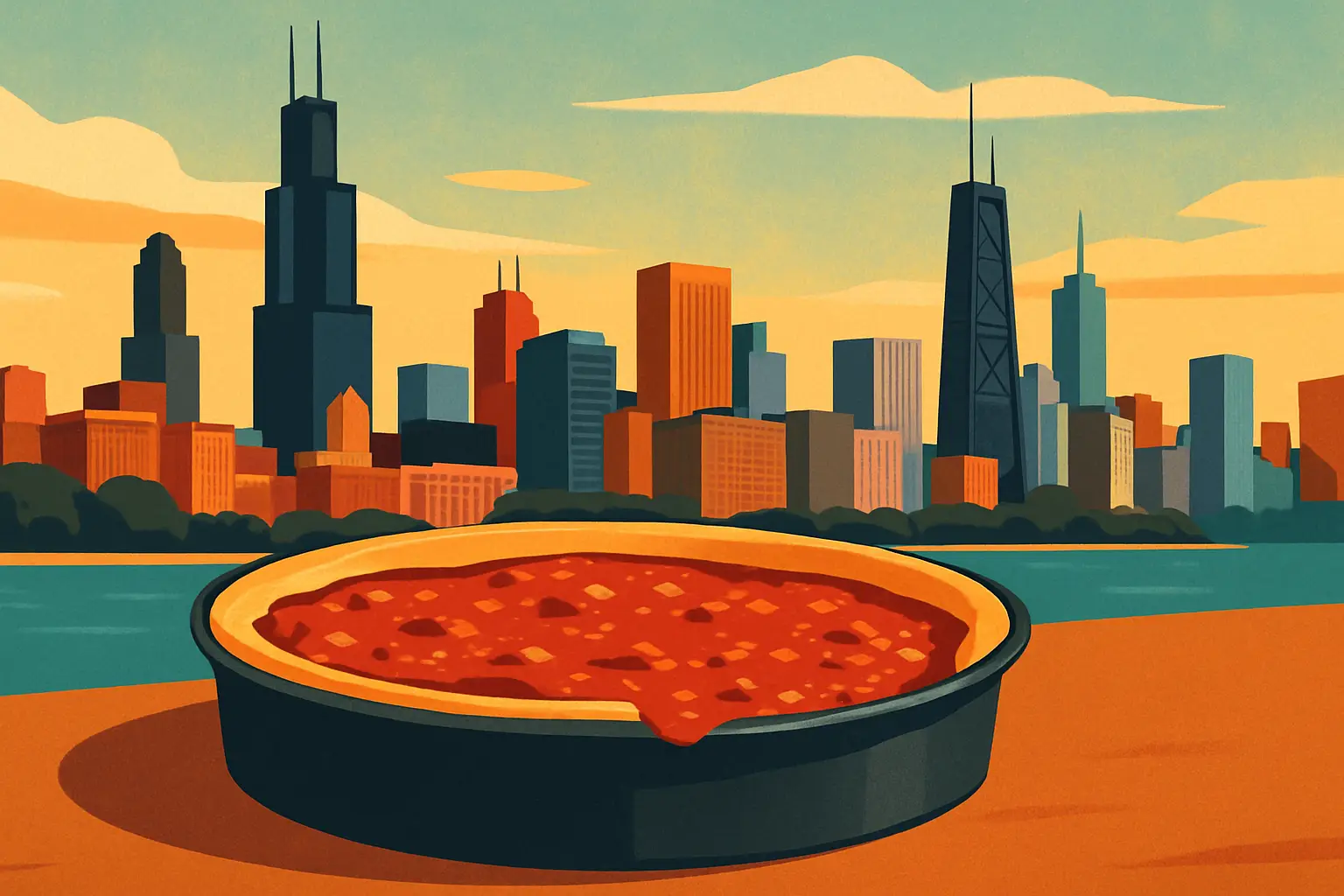
Here is the most counter-intuitive fact about Chicago deep dish pizza: the crust is not thick. It's paper-thin. The illusion of a towering bread structure comes entirely from the high-sided steel pan, which holds a shallow shell of dough pressed up along its walls like a tart rather than built up like a loaf. What fills that pan — layers of mozzarella (placed directly on the dough to prevent sogginess), then meat or vegetables, then a chunky, lightly cooked tomato sauce on top — is assembled in reverse order compared to every other pizza you've eaten. That inverted logic alone should put to rest the lazy cultural shorthand that calls deep dish a casserole. It is, structurally and philosophically, a pizza. The casserole accusation mostly comes from people who have never eaten a proper one. What's genuinely contested, and far more interesting, is who invented it. The standard answer — Ike Sewell and Ric Riccardo at **Pizzeria Uno** in 1943 — turns out to be incomplete at best, and at worst a story that edits out the chef who actually did the cooking. This article untangles the real history.
🗽 Short stories • Collectible cards • Learn as you travel
Pizzeria Uno (29 E. Ohio St., Chicago) does not take reservations for most tables and weekend waits routinely hit 45–90 minutes. Arrive before 11:30 a.m. for lunch or by 4:30 p.m. for dinner to beat the worst of it. A small personal deep dish runs about $15–18; a large feeds two to three people for around $30–35.
Deep dish takes 45 minutes
Every serious deep dish spot in Chicago — Uno, Lou Malnati's, Giordano's — bakes their pies for 35–50 minutes. Order your deep dish the moment you sit down, then take your time with drinks and appetizers. Tourists who order late frequently miss their train or their next reservation.
Giordano's vs. Lou Malnati's
These are not the same dish. Giordano's (multiple locations; flagship at 130 E. Randolph St.) makes stuffed pizza — a second layer of dough seals the filling before the sauce goes on top. Lou Malnati's (439 N. Wells St. in River North, plus 30+ locations) makes classic deep dish with a buttery, cornmeal-dusted crust and whole peeled tomatoes. Choose based on whether you want a two-crust construction or the original open-pan style.
The complete Chicago deep dish pizza guide
1Why 1943 Matters: Chicago's Food Culture at the Moment Deep Dish Was Born
To understand why deep dish pizza appeared in Chicago specifically, and not in New York or Boston or any other city with a large Italian-immigrant population, you have to understand what Chicago's food economy looked like in the early 1940s. The city had been processing and distributing American meat for half a century — the Union Stock Yards on the South Side were still operating at massive scale. Cheese production from Wisconsin flowed south through Chicago's rail networks. The city had cheap, abundant dairy and protein in a way that coastal cities simply did not.
It also had a specific neighborhood culture around Italian immigrants that differed from New York's. Chicago's Italian communities, concentrated on the Near North Side and in neighborhoods like Taylor Street on the Near West Side, tended toward southern Italian and Sicilian roots — culinary traditions that favored olive oil-rich doughs, heavily seasoned tomato sauces, and generous portions. The thin Neapolitan pizza that defined New York's immigrant pizzerias was not the only template available.
Into this environment walked Ike Sewell, a Texas-born former University of Texas football player turned liquor salesman, and Ric Riccardo, an Italian-American artist and restaurateur. The two partnered to open a restaurant on the corner of Ohio and Wabash — a location that would become Pizzeria Uno — in late 1943. Sewell wanted to serve food substantial enough to justify the cost of a night out; he reportedly found standard Neapolitan pizza too insubstantial for his Texas-sized appetite. The deep pan format solved that problem. But the leap from concept to executed dish required a trained cook, and that's where the history gets complicated.
2The Chef Who History Almost Forgot: Rudy Malnati Sr. and the Real Kitchen Story
Ike Sewell told the invention story so effectively for so many decades that it became canonical. He was a natural salesman and a compelling personality, and he was present at Pizzeria Uno from the beginning. But multiple food historians and investigative journalists — most notably journalist and Chicago food writer Peter Engler, who researched the topic extensively — have pointed to a different figure as the actual culinary architect of deep dish: Rudy Malnati Sr.
Malnati was hired as the pizza maker at Pizzeria Uno shortly after it opened. He had professional kitchen experience and the technical understanding of dough that neither Sewell nor Riccardo possessed. The argument that Malnati developed the recipe rather than simply executing someone else's idea rests on several factors: Sewell's background contained no culinary training whatsoever; Riccardo's expertise was in front-of-house operations and aesthetics; and Malnati went on to train the next generation of Chicago pizza makers, including his sons Lou and Marc, who founded Lou Malnati's Pizzeria in Lincolnwood in 1971 using a recipe the family has always described as a direct inheritance from Rudy's work.
The Malnati family has been diplomatically pointed about this history for years. Lou Malnati's website describes the family's connection to the origins of deep dish, and the restaurant's crust — buttery, slightly flaky, pressed into a well-seasoned steel pan — is widely regarded by Chicago pizza cognoscenti as the closest living link to the original Uno recipe, arguably more faithful than what Uno itself now serves under Lettuce Entertain You Enterprises, the hospitality group that eventually acquired the brand.
None of this is definitive — no contemporaneous documents from 1943 survive that settle the question — but the weight of culinary evidence points toward Malnati as the hands-in-the-dough inventor, with Sewell as the entrepreneurial force who brought the product to market and told the story afterward.
Keep touring
Discover more about United States in minutes
Get short, interactive stories that make each place easier to remember while you travel.
3Pizzeria Uno to Pizzeria Due: How the Format Spread Across One City Block
Pizzeria Uno at 29 E. Ohio Street became successful enough by 1955 that Sewell and Riccardo opened a second location one block away at 619 N. Wabash Avenue: Pizzeria Due. The two restaurants operated as a tag team — when Uno filled up, which happened regularly, staff would direct overflow customers to Due. This arrangement made practical sense because both locations drew from the same tourist and business-lunch traffic around the Magnificent Mile and River North.
Due is often overlooked in the origin mythology because it came second, but it matters for a specific reason: the opening of Due confirmed that deep dish pizza was not a novelty but a scalable format. It proved the dish could be consistently replicated across kitchens, which was not a given in an era before standardized food-service systems. It also established the physical neighborhood — roughly the two-block stretch of Ohio and Ontario streets between Wabash and State — as the geographic center of deep dish culture.
Both restaurants remain open today and are worth visiting as historical sites as much as dining destinations. Uno is the more tourist-trafficked of the two; Due tends to have a slightly shorter wait and a marginally quieter atmosphere. Prices at both run in the same range: a small personal pizza starts around $15, and a large that serves two to three costs $30–36. Neither should be your only deep dish stop in Chicago — the ownership changes over the decades mean the current product, while competent, does not represent the cutting edge of what the format has become — but as the physical origin point of a dish that altered American food culture, they earn a visit.
One practical detail that surprises many visitors: both locations are cash-friendly but also accept cards, they open for lunch (11 a.m. at Uno, 11:30 a.m. at Due), and the bar areas at both serve alcohol, which makes the 45-minute bake time considerably more tolerable.
4The Architecture of the Dish: Why Deep Dish Is Structurally a Pizza and Not a Casserole
The casserole accusation deserves a direct rebuttal, because it rests on a misunderstanding of the dish's construction. A casserole is defined by its cooking vessel — ingredients are assembled in a baking dish and cooked together, with the vessel itself providing structure. Deep dish pizza uses a pan as a shaping tool, not a structural one. Once baked, a proper deep dish releases cleanly from the pan and holds its shape as a freestanding slice.
The sequence of assembly is: dough pressed into a well-oiled high-sided steel pan, pushed up the walls to form a shallow shell roughly two inches high; mozzarella cheese placed directly on the raw dough (this is the crucial inversion — cheese goes first, not last, so it melts into the crust rather than sitting on top and creating a moisture barrier); toppings — Italian sausage pressed into a flat layer is the traditional Chicago choice, though pepperoni, vegetables, and other proteins appear; then tomato sauce applied generously over everything, often from whole canned San Marzano-style tomatoes that are crushed by hand or lightly cooked with garlic and oregano; finally, a dusting of Parmesan or Romano over the sauce.
The sauce-on-top arrangement exists for a specific technical reason: during the 35–45 minute bake at approximately 450°F, the cheese and toppings need protection from direct oven heat. Sauce provides that insulation. It also continues to concentrate and reduce during baking, developing a brightness that balances the richness of the cheese and meat below.
The steel pan itself is not incidental. Dark, well-seasoned steel conducts heat more aggressively than aluminum or glass, which is what produces the characteristic crisp, slightly fried bottom crust that distinguishes deep dish from every other pizza format. Many serious deep dish kitchens keep their pans in continuous rotation for years, never washing them, only wiping them out and re-oiling between uses — the accumulated seasoning is part of the flavor.
5Stuffed Pizza: Chicago's Second Invention and Why It's Not the Same Thing
Sometime in the mid-1970s, a second Chicago pizza format emerged that gets routinely conflated with deep dish: stuffed pizza. The distinction matters both historically and gastronomically. Stuffed pizza is made at Giordano's and Nancy's Pizzeria, and the format works as follows: a bottom crust is pressed into the pan as with deep dish, toppings and cheese are added, and then a second, thinner sheet of dough is stretched over the top and sealed to the edges. Tomato sauce goes over this sealed upper crust before baking. The result is a fully enclosed pie that looks from the outside like a deep dish but contains a structurally distinct interior.
Giordano's was founded by two brothers from Turin, Efren and Joseph Boglio, who opened their first location in 1974 on Chicago's South Side. They based their stuffed format on the Italian torta di pasqua, an Easter pie from their hometown. The Giordano's claim to independent invention is well-documented and the Turin connection gives the dish a different genealogy from the Malnati-Sewell-Riccardo lineage.
Nancy's Pizzeria makes a competing claim for stuffed pizza's invention. Rocco Palese, who founded Nancy's on the North Side in 1971, says he developed the format first, inspired by his mother's scarpiello — a stuffed Italian Easter bread. Both claims are plausible and neither fully cancels the other; it's possible the format was developed independently and nearly simultaneously by two different cooks working from similar Italian pastry traditions.
For the visitor, the practical distinction is this: if you want the original 1943 format in its most faithful contemporary execution, go to Lou Malnati's. If you want to try the stuffed variant that many Chicagoans actually prefer, Giordano's flagship at 130 E. Randolph Street is the standard-bearer. Ordering both on the same trip — they keep well as leftovers — is the only way to fully appreciate that these are genuinely different dishes.
6The New Wave: Where Chicago's Deep Dish Scene Stands in 2026
Chicago's deep dish landscape in 2026 is more interesting than it's been in decades, partly because a generation of Chicago chefs trained in fine-dining kitchens has revisited the format with better ingredients and more precise technique. The old argument that deep dish was inherently a tourist dish — something locals ate occasionally but didn't take seriously — has largely dissolved.
Coalfire Pizza (1321 W. Grand Ave., Ukrainian Village) doesn't make deep dish but is essential context: its wood-fired thin-crust pies represent the counter-tradition that serious Chicago pizza eaters have always maintained alongside the deep dish culture, and understanding both sides clarifies what deep dish is actually doing.
Pequod's Pizza (2207 N. Clybourn Ave., Lincoln Park) is the deep dish shop that local food writers consistently rank above the tourist-circuit institutions. Pequod's distinguishes itself through its caramelized crust edge — cheese is packed against the pan walls so that it melts, runs down, and burns against the hot steel, creating a dark, crispy cheese crust around the perimeter. The result is visually alarming to the uninitiated and genuinely exceptional once you understand what you're looking at. Pequod's opens at 4 p.m. on weekdays and 11 a.m. on weekends; a large pizza runs $25–32 and the wait, even mid-week, can approach an hour.
Labriola (535 N. Michigan Ave.) and Chicago Pizza and Oven Grinder (2121 N. Clark St.) offer additional variation worth exploring, the latter being technically distinct — they serve individual pot pies that invert the deep dish format entirely, with the sauce on the bottom and the crust baked on top, then flipped at the table.
For the genuinely curious visitor with limited time: Lou Malnati's for historical authenticity, Pequod's for the best current execution, and Giordano's to understand that stuffed pizza is its own distinct tradition.
7Planning Your Deep Dish Itinerary: Logistics, Prices, and What Not to Skip
Chicago's deep dish restaurants cluster in a few neighborhoods, which makes it practical to build a pizza-focused afternoon and evening around a larger itinerary. River North and Streeterville (where Uno and Due sit, adjacent to the Magnificent Mile) are dense with hotels and tourist infrastructure. Lincoln Park, where Pequod's operates, is a 20-minute cab or rideshare from the Loop and pairs well with a walk along the lakefront path or a visit to the free Lincoln Park Zoo.
Pizzeria Uno — 29 E. Ohio St., River North. Opens 11 a.m. daily. Small personal deep dish ~$15–18, large ~$30–35. No reservations for most seating; arrive at opening to avoid a wait.
Pizzeria Due — 619 N. Wabash Ave., River North. Opens 11:30 a.m. Mon–Fri, 11 a.m. weekends. Same price range as Uno, typically shorter waits.
Lou Malnati's (River North) — 439 N. Wells St. Opens 11 a.m. daily. Small deep dish (1–2 people) ~$17–20, large ~$28–34. Online ordering available; uncooked pies can be shipped nationwide.
Giordano's (Loop flagship) — 130 E. Randolph St. Opens 11 a.m. daily. Medium stuffed pizza (2 people) ~$26–30. Expect 40–50 minute bake time.
Pequod's Pizza — 2207 N. Clybourn Ave., Lincoln Park. Opens 4 p.m. Mon–Fri, 11 a.m. Sat–Sun. Large deep dish ~$25–32. Cash and card accepted; no reservations, walk-in only.
Budget note: a full deep dish meal for two with a drink each runs $45–65 at most of these spots, including tip. Deep dish is genuinely filling — a large pizza intended for two will leave most people with leftovers, which reheat well in a 350°F oven for 10 minutes.
Dietary note: Lou Malnati's offers a gluten-free crustless 'sausage patty' version for celiac diners, and most locations have vegetarian options. Vegan deep dish remains difficult to source from legacy operators; newer spots like My Pi Pizza (2010 N. Damen Ave.) have more flexibility.
Keep touring
Ready to explore Chicago's food history one story at a time?
TourMe's Chicago collection includes interactive stories and collectible cards covering the city's food culture — from the Union Stock Yards that shaped its ingredient economy to the River North blocks where deep dish pizza was born. Each chapter gives you the historical context to understand what you're eating and where it came from, so your next meal tastes like a destination rather than just a restaurant.