The conventional story of American plantation agriculture frames enslaved people as unskilled forced labor applied to crops that European colonizers selected and understood. In the South Carolina Lowcountry, this framing collapses almost immediately under historical scrutiny. When English colonists arrived in the Carolina colony in the late seventeenth century, they had no meaningful knowledge of how to cultivate rice — a crop that requires sophisticated water management, specific soil preparation, and a precise understanding of tidal flooding cycles. Their attempts at rice farming largely failed.
What changed the trajectory of the colony was the deliberate importation of enslaved Africans from the Rice Coast — the region encompassing present-day Sierra Leone, Guinea-Bissau, Senegal, and Ghana — where wet-rice cultivation had been practiced for centuries. Slave traders and Carolina planters specifically advertised for and sought Africans from these regions precisely because of their agricultural knowledge. This practice is documented in shipping records and colonial-era advertisements held at the South Carolina Historical Society in Charleston.
The enslaved men and women who arrived brought with them not only the knowledge of how to grow rice but also how to cook it. They understood that rice is not merely a starch vehicle — it is a flavor-absorbing medium, a textural anchor, and a nutritional foundation. They brought techniques for parboiling, for cooking rice in seasoned liquid, for building one-pot stews over live fire. They brought mortar-and-pestle grain processing, a tool and technique that is West African in origin and which persisted in Gullah communities well into the twentieth century. The Lowcountry food tradition that is today celebrated in upscale Charleston restaurants grew directly from this enforced transplantation of West African culinary knowledge. To eat hoppin' john is to eat something that traveled across an ocean under the worst possible circumstances and survived anyway.
Hoppin' john is the dish most frequently cited as a symbol of Gullah Geechee foodways, and its composition — black-eyed peas cooked with rice, onion, and smoked pork — maps precisely onto a class of West African rice-and-legume dishes that are still prepared today in Sierra Leone, Senegal, and Nigeria. The black-eyed pea itself (Vigna unguiculata) is native to West Africa and was almost certainly introduced to the American South through the slave trade. The tradition of eating hoppin' john on New Year's Day for good luck is a cultural practice that Gullah communities maintained and that spread into broader Southern foodways from there.
Red rice — also called Charleston red rice — is the Lowcountry cousin of the West African dish thiéboudienne and the Carolina riff on Spanish arroz rojo. It is cooked in tomato, onion, bell pepper, and smoked sausage, the tomatoes providing both color and acid that balance the starchy rice. The tomato base technique appears across the African diaspora in the Americas, from Senegalese thiéboudienne to Brazilian arroz de carreteiro, a diaspora fingerprint made visible through a shared ingredient logic.
Perloo (also spelled purloo, pilau, or perlo) is a one-pot rice dish built on long-simmered meat or shellfish — traditionally chicken, oysters, or shrimp — cooked down with aromatics until the rice absorbs all the cooking liquid. Its name is almost certainly derived from the Persian-origin word pilaf, which traveled to West Africa through trans-Saharan trade routes before arriving in the Lowcountry. The Gullah Geechee Cultural Heritage Corridor, a National Heritage Area that spans 425 miles of Atlantic coastline, identifies perloo as one of the cornerstone dishes of the tradition. At Scott's Bar-B-Que in Hemingway, SC (2734 Hemingway Highway), the hash served over rice is a direct descendant of this one-pot tradition.
Get short, interactive stories that make each place easier to remember while you travel.
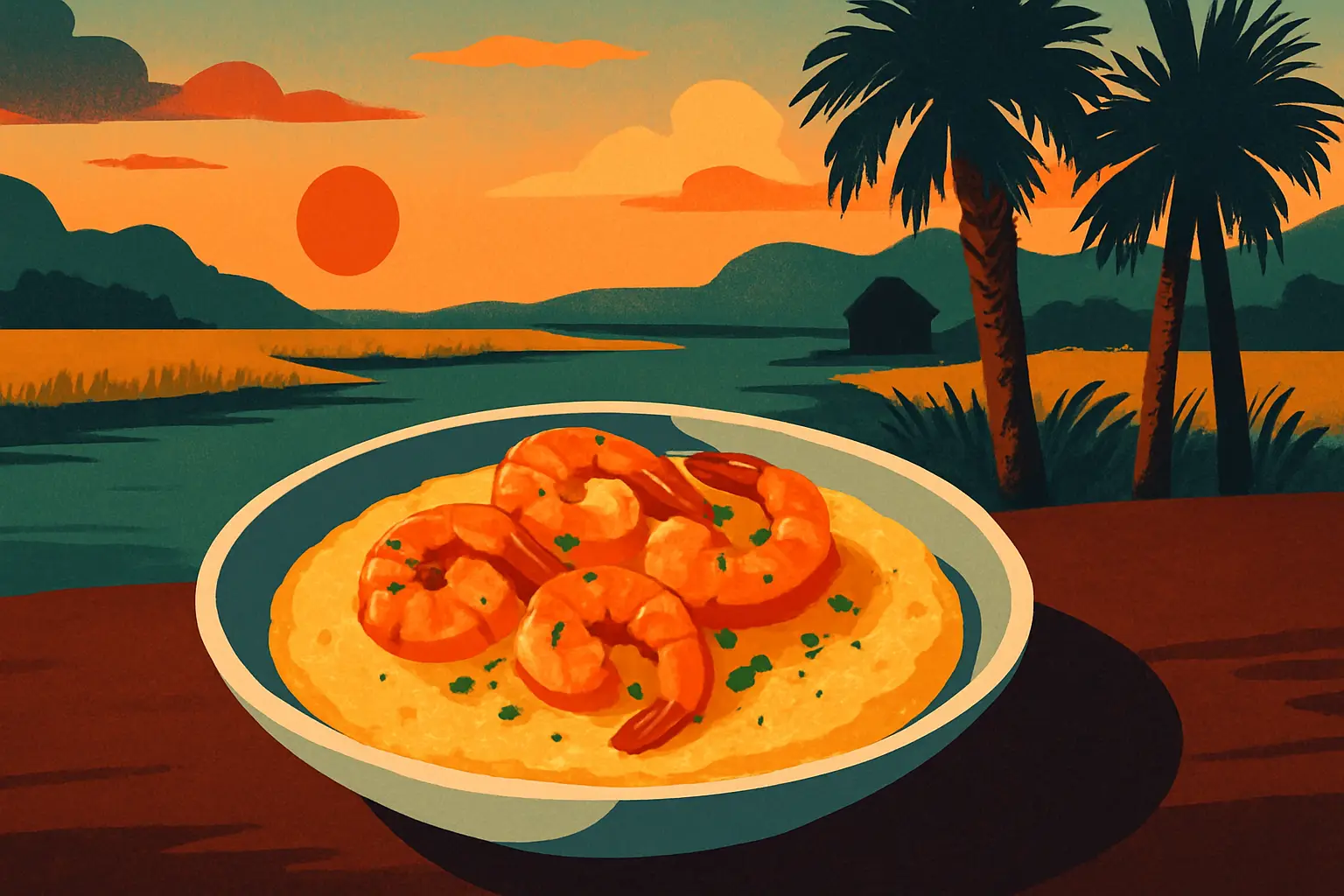
When Craig Claiborne reviewed a shrimp and grits preparation by Bill Neal of Crook's Corner in Chapel Hill, North Carolina, in a 1985 *New York Times* piece, he helped launch a national conversation about Southern food's sophistication. But the dish itself — shrimp cooked in a savory, often pork-enriched gravy and served over stone-ground corn grits — had been eaten by Gullah fishermen and their families along the South Carolina and Georgia coast for generations before any restaurant put it on a menu.
The Gullah version is simpler and more direct than most restaurant iterations: fresh-caught shrimp, often creek shrimp from the tidal marshes, sautéed quickly in bacon fat with onion and sometimes tomato, served over coarse-ground grits that retain their texture. The grits themselves are ground from hominy corn, a grain processed using nixtamalization or wood-ash lye treatment — a technique with both Indigenous American and West African parallels.
Anson Mills in Columbia, SC, has spent more than two decades reviving the heirloom Carolina Gold rice and antebellum-era corn varieties that formed the backbone of Gullah cooking. Their stone-ground grits, available at ansonmills.com, are made from open-pollinated corn grown on South Carolina farmland and are the closest commercial equivalent to the grits that Gullah cooks would have used historically.
For a restaurant benchmark in Charleston, Husk at 76 Queen Street serves a version of shrimp and grits using sourced Lowcountry ingredients. But for a closer approximation of the original tradition, Hannibal's Kitchen at 16 Blake Street in Charleston has been serving Gullah home cooking to a largely local clientele since 1985, with a shrimp and grits preparation that skips the heavy cream reductions of the fine-dining versions and lets the shrimp and the grits carry the dish on their own terms.
The reason Gullah Geechee culture survived with more coherence than almost any other African American regional tradition in the United States is, in large part, geographic. The sea islands of South Carolina and Georgia — St. Helena Island, Daufuskie Island, Sapelo Island, Hilton Head Island, and dozens of smaller barrier islands — were physically isolated from the mainland. Before bridges and paved roads arrived in the twentieth century, these communities maintained a degree of autonomy unusual in the American South. The Gullah Creole language, which has linguistic roots in English, Mende, Temne, Twi, Wolof, and other West African languages, survived here in part because the islands provided insulation from the linguistic assimilation pressures present on the mainland.
That isolation also preserved foodways. On Sapelo Island in Georgia — accessible only by ferry from Meridian, Georgia, with departures on a limited schedule — the Hog Hammock community is one of the last remaining Gullah Geechee settlements with continuous occupancy. The approximately 50 residents of Hog Hammock maintain traditions including cast-net fishing, oyster harvesting, and the preparation of dishes like coush coush (a cornmeal porridge with West African antecedents) and fufu-adjacent corn dishes that echo Central African cooking traditions.
The ferry to Sapelo Island departs from the Sapelo Island Visitors Center in Meridian, GA (912-437-3224), on Wednesdays, Fridays, Saturdays, and the last Tuesday of the month, with tickets running approximately $15 round-trip for adults. The island has no restaurants — food must be brought or arranged through a tour — which itself communicates something important: this is not a culinary tourism destination packaged for visitors. It is a living community, and any engagement with it should be undertaken with corresponding respect.
The attention that shrimp and grits and hoppin' john receive can obscure the breadth of Gullah Geechee foodways, which encompass a full year-round cycle of preserved, foraged, fished, hunted, and garden-grown foods. A more complete picture includes:
Cooter stew (freshwater turtle stew) was a staple protein source that required no fishing equipment or hunting license and could be made year-round. Frogmore stew — a boil of shrimp, sausage, corn, and potatoes — takes its name from the old name for the community on St. Helena Island now called St. Helena. It is often presented as quintessentially South Carolinian without acknowledgment that it was Gullah cooks who developed and standardized the preparation.
Sweet potato cultivation and cooking holds enormous significance in Gullah foodways. The sweet potato is native to the Americas but was embraced and transformed by Gullah cooks who developed uses for it in both savory preparations — sweet potato biscuits, mashed sweet potato as a side dish — and in pies and puddings that reflect both African and Indigenous American influences on the culture.
Okra is one of the clearest lines of African culinary inheritance in the South. The word itself derives from the Igbo word okwuru, and okra soup — a thick, gelatinous stew of okra, shellfish, and aromatics — is a direct descendant of West African soupou kandja and similar okra-based stews found across the diaspora. Gullah gumbo, distinct from Louisiana gumbo in its simpler spice profile and focus on local shellfish over roux complexity, is okra soup's Lowcountry expression.
The preservation of these dishes has been the life's work of figures including the late Sallie Ann Robinson, a cookbook author and native of Daufuskie Island whose book *Gullah Home Cooking the Daufuskie Way* (University of North Carolina Press) remains the most intimate firsthand account of this food tradition in print.
Gullah Geechee food culture does not survive on sentiment — it survives because specific people have chosen to document, teach, and defend it, often against significant commercial and development pressures. Queen Quet, the elected chieftess and head of state of the Gullah Geechee Nation, has been one of the most prominent voices connecting food sovereignty to cultural survival, arguing that the loss of sea island land to resort development directly threatens the agricultural and fishing practices that underpin the cuisine.
In the academic sphere, Dr. Jessica B. Harris, whose book *High on the Hog: A Culinary Journey from Africa to America* (Bloomsbury, 2011) was adapted into a Netflix documentary series in 2021, has done more than almost any other scholar to map the specific connections between West African food traditions and American Southern cooking. The Netflix series features a Lowcountry episode that traces rice cultivation from Sierra Leone to Charleston with visual clarity that no book passage fully replicates.
BJ Dennis, a Charleston-based Gullah Geechee chef who grew up partly in Walterboro, SC, has spent years cooking pop-up dinners and private events that present traditional dishes in their correct cultural context — identifying origins, naming the specific communities that developed each preparation, and refusing to flatten the cuisine into generic Southernness. Dennis does not run a permanent restaurant, which means accessing his cooking requires following his schedule at events and festivals, but his presence on social media (@bjdennis) provides advance notice of appearances.
The Avery Research Center for African American History and Culture at the College of Charleston (125 Bull Street, free admission) holds archives that include oral history recordings of Gullah foodways, WPA-era interviews with formerly enslaved people that describe cooking practices, and photographs of Lowcountry food preparation that constitute an irreplaceable documentary record.
The Gullah Geechee Cultural Heritage Corridor runs from Wilmington, NC, to Jacksonville, FL, but the highest concentration of relevant sites, restaurants, and cultural institutions is in the Charleston–Beaufort–Hilton Head triangle in South Carolina. Here is a practical framework for a three-to-five-day visit focused on this food culture.
**Bertha's Kitchen** (2332 Meeting Street Rd, North Charleston): Open Mon–Fri 11 a.m.–sell-out. Cash only. $12–$18 per plate. Fried chicken, pork chops, lima beans, rice. No reservations.
**Hannibal's Kitchen** (16 Blake Street, Charleston): Open Mon–Sat 11 a.m.–7 p.m. approx. $10–$15 per plate. Gullah home cooking, shrimp and grits, oxtail. Neighborhood restaurant without tourist pricing.
**Gullah Grub Restaurant** (877 Sea Island Pkwy, St. Helena Island, SC): Run by Bill Green, this roadside restaurant on St. Helena Island serves crab rice, shrimp and grits, and smothered pork chops. Open Tue–Sat, lunch hours. ~$15–$22 per entrée.
**Penn Center Museum** (16 Penn Center Circle W, St. Helena Island): ~$7 admission. Open Mon–Sat 9 a.m.–4 p.m. Context-setting before any meal in the area.
**Sapelo Island Ferry** (Meridian, GA, 912-437-3224): ~$15 round-trip. Wed, Fri, Sat, last Tuesday of the month. No food available on the island — pack provisions.
**Avery Research Center** (125 Bull Street, Charleston): Free admission. Mon–Fri 10 a.m.–5 p.m. Archive visits by appointment for deeper research.
**Gullah Festival, Beaufort SC**: Memorial Day weekend, late May. Free admission. Cooking demos, traditional food vendors, cultural programming.
**Best timing overall**: Late September through November. Heat and humidity are reduced, shrimp season is at its peak, and oyster roast season begins in October. Lowcountry oysters from the ACE Basin are among the most briny and distinctive on the East Coast.
**What to buy to cook at home**: Anson Mills Carolina Gold rice (ansonmills.com, ~$8–$12/lb), dried Sea Island red peas, and stone-ground grits. These ingredients allow you to recreate hoppin' john and perloo with historically appropriate components.