American BBQ Styles Explained: Why Texas, Carolina, and Kansas City Barbecue Are Fundamentally Different Things
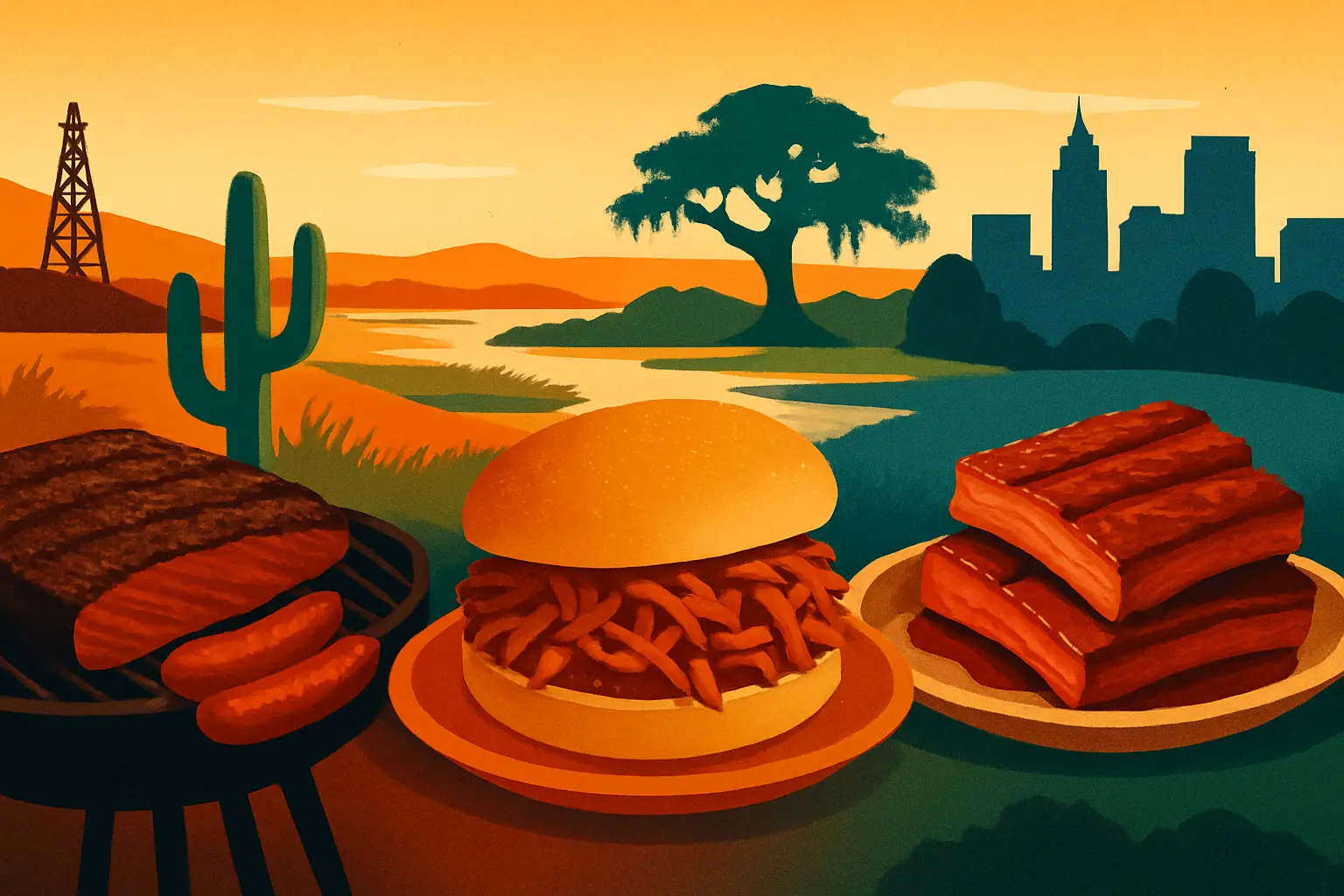
Here is the most misunderstood fact in American food culture: barbecue is not a cooking method. It is not grilling, it is not smoking in the casual sense, and it is emphatically not what you do at a backyard cookout on the Fourth of July. True American barbecue is a low-and-slow wood-smoke process that can take anywhere from six to twenty-two hours, and the word itself almost certainly derives from the Taíno Caribbean term 'barbacoa,' describing a wooden framework used to cure and smoke meat over indirect heat. What happened to that original technique as it traveled through the American South, the Great Plains, and cattle country of Texas is one of the most fascinating stories in the nation's culinary history — a story shaped by the animals that were locally abundant, the wood that grew nearby, the immigrant communities that settled each region, and the economics of which cuts of meat the wealthy didn't want. This guide breaks down the four major American barbecue traditions — Texas, the Carolinas, Kansas City, and Memphis — explaining not just what they taste like, but why they developed the way they did and where to eat them at their best.
🗽 Short stories • Collectible cards • Learn as you travel
The most celebrated BBQ joints in Texas and the Carolinas often sell out of their best cuts by early afternoon, sometimes by noon on weekends. Franklin Barbecue in Austin (900 E. 11th St.) opens at 11 a.m. and routinely sells out by 1 p.m. Arriving on a Tuesday or Wednesday and joining the line by 9 a.m. dramatically improves your odds of getting brisket.
Order across all four styles
Kansas City is the only American city where you can taste all four major regional BBQ traditions in a single trip. Joe's Kansas City Bar-B-Que (3002 W. 47th Ave., Kansas City, KS) serves exemplary local-style ribs and burnt ends, while the broader KC metro has restaurants representing every regional school. Budget roughly $20–$35 per person for a full plate with two sides.
Know the two Carolinas rule
North Carolina and South Carolina each have their own internal BBQ geography. In North Carolina, the eastern part of the state uses the whole hog with vinegar sauce; the Piedmont region (Lexington style) uses just the shoulder with a tomato-tinged vinegar sauce. In South Carolina, the only state where mustard-based 'Carolina Gold' sauce is the default, look for it concentrated around Columbia and the Midlands region.
The complete American regional BBQ guide
1Why American barbecue fractured into distinct regional traditions in the first place
The divergence of American barbecue into distinct regional schools is not a marketing invention — it reflects genuine differences in agricultural history, geography, and the communities that did the cooking. The practice of slow-smoking meat over indirect heat arrived in the American South via the Caribbean and was refined by enslaved African Americans, who became the recognized masters of the technique on Southern plantations and at large communal gatherings throughout the 18th and 19th centuries. Their expertise, their palates, and their improvisations with local ingredients are the foundation of every American BBQ tradition that followed.
The key variable that sent each region in a different direction was the dominant livestock animal. Pigs were the primary protein across the colonial South because they were cheap to raise, required little land, and could forage for themselves in the woods. This is why pork dominates in the Carolinas, Tennessee, and the mid-South. As settlement pushed west into Kansas City and the surrounding plains, beef cattle became more prevalent, introducing a wider range of beef cuts into the BBQ canon. Texas, settled heavily by German and Czech immigrants in the Hill Country alongside Mexican vaquero traditions in the south, developed an entirely beef-centric culture, with butcher shops evolving directly into the BBQ joints we know today.
The sauces — or the deliberate absence of them — follow the same geographic and cultural logic. Vinegar-based sauces in the Carolinas reflect a time before refrigeration, when acid served as a preservative and a tenderizer. The tomato-and-molasses sauces of Kansas City emerged later, made possible by commercial tomato production and railroad distribution of goods. Texas pitmaster culture traditionally rejected sauce almost entirely, viewing it as an insult to properly smoked beef. These are not arbitrary stylistic choices; they are archaeological records of how people lived.
2Texas BBQ: beef, post oak smoke, and a philosophy that borders on religion
Texas barbecue is fundamentally a beef tradition, and its spiritual center is the Central Texas style concentrated in the corridor between Austin and Lockhart. The holy trinity of Central Texas BBQ is brisket, beef ribs, and sausage — and the technique is as minimal as the ingredient list suggests. Meat is rubbed with salt and black pepper, nothing more, and smoked low and slow over post oak wood for anywhere from twelve to twenty-two hours. The result, when done correctly, is a brisket with a jet-black bark on the exterior, a pink smoke ring just beneath, and interior fat that has fully rendered into something approaching silk.
The origin of this style traces directly to the German and Czech butcher shops that opened across the Texas Hill Country in the mid-19th century, particularly in towns like Lockhart, Luling, and Taylor. These butchers smoked unsold cuts of meat to preserve them, and customers began eating at the counter. The tradition persisted: Smitty's Market (208 S. Commerce St., Lockhart) has been operating continuously since 1900 and still charges by the pound at the counter. Black's Barbecue (215 N. Main St., Lockhart), opened in 1932, is the oldest BBQ restaurant in Texas still run by the same family.
The modern era of Texas BBQ is largely defined by Franklin Barbecue in Austin, where Aaron Franklin — a James Beard Award winner and the subject of a Netflix documentary — turned the Central Texas tradition into a national phenomenon after opening in 2009. His influence spread the gospel of properly smoked brisket across the country. But the Texas tradition also includes the East Texas style, which uses more pulled pork and sweeter sauces, and the South Texas barbacoa tradition, which involves slow-cooking a whole cow's head wrapped in maguey leaves — a technique with deep roots in Mexican ranch culture that predates the Texas Republic.
Franklin Barbecue — 900 E. 11th St., Austin, TX. Opens 11 a.m.; expect a line from 8 a.m. Brisket $35/lb.
Smitty's Market — 208 S. Commerce St., Lockhart, TX. Opens Mon–Sat 7 a.m., Sun 9 a.m. Brisket ~$24/lb.
Black's Barbecue — 215 N. Main St., Lockhart, TX. Opens daily 10 a.m. Beef ribs ~$15 each.
La Barbecue — 2401 E. Cesar Chavez St., Austin, TX. Widely considered Austin's best after Franklin.
Keep touring
Discover more about United States in minutes
Get short, interactive stories that make each place easier to remember while you travel.
3Carolina BBQ: whole hog, vinegar, and the oldest unbroken tradition in American cooking
North Carolina barbecue is arguably the oldest continuous regional food tradition in the United States, with accounts of whole-hog pits at large public gatherings dating back to the 1600s. The defining technique of Eastern North Carolina style is the whole hog: a pig split open, laid flat over a wood pit, cooked skin-side-up for twelve or more hours over hickory and oak coals, then chopped and dressed with a sauce that is nothing but apple cider vinegar, red pepper flakes, salt, and sometimes a whisper of sugar. There is no tomato, no molasses, no sweetness to speak of. The acid of the vinegar cuts the richness of the pork fat, and the fat is the point — cooking the whole animal means every part of the pig's flavor ends up in the final pile of chopped meat.
Skylight Inn BBQ (4617 S. Lee St., Ayden, NC), founded in 1947 by Pete Jones and still run by his family, is the most celebrated practitioner of the Eastern style. It was among the first BBQ establishments to receive recognition from the James Beard Foundation. The building is topped with a miniature replica of the U.S. Capitol dome, a gesture of unapologetic regional pride.
One hundred miles west, the Piedmont (or Lexington) style of western North Carolina departs meaningfully from the Eastern tradition. Here, pitmasters cook only the pork shoulder rather than the whole hog, and the sauce — known locally as a dip — adds a small amount of ketchup or tomato to the vinegar base, creating a faintly pink liquid that locals guard like a state secret. Lexington Barbecue (100 Smokehouse Lane, Lexington, NC), known locally as the Monk, is the pilgrimage site for this style. Lexington itself, a small city of about 20,000 people, has more BBQ restaurants per capita than anywhere else in the United States.
South Carolina adds a fourth school of thought entirely: the mustard-based sauce, sometimes called Carolina Gold, which is the default in the state's Midlands region around Columbia. This style traces directly to German immigrant settlers who brought their mustard-making traditions in the 18th century. It produces a tangy, golden sauce that looks nothing like any other American BBQ condiment and tastes entirely unlike what most people expect when they order barbecue.
Skylight Inn BBQ — 4617 S. Lee St., Ayden, NC. Mon–Sat 10 a.m.–7 p.m. Plates from ~$10.
4Kansas City BBQ: the most democratic style, built on burnt ends and molasses
If Texas BBQ is a meditation on beef and Carolina BBQ is a philosophy of pork, Kansas City BBQ is an argument for inclusivity. The KC tradition uses essentially every protein — beef brisket, pork ribs, pulled pork, chicken, turkey, and sausage — and its defining characteristic is the sauce: a thick, sweet, tomato-and-molasses-based condiment that is generously applied to the meat both during and after cooking. The style emerged in the early 20th century at a moment when Kansas City was one of the largest meatpacking centers in the world, with the Kansas City Stockyards processing millions of cattle and hogs annually. When every cut of every animal is available in quantity, you develop a tradition that uses all of it.
The founding father of Kansas City BBQ is Henry Perry, an African American pitmaster from Tennessee who began selling slow-smoked meat from a streetcar barn in the 18th and Vine jazz district around 1908. Perry's influence spread through his employees, most notably the Bryants: Charlie Bryant and later his brother Arthur Bryant (of Arthur Bryant's Barbeque, 1727 Brooklyn Ave.) built the restaurant that made KC BBQ nationally famous when Calvin Trillin wrote about it in Playboy in 1972, calling it the single greatest restaurant in the world. The restaurant still operates at the same address.
Kansas City's most distinctive invention is the burnt end: the charred, fatty tip of a beef brisket point, which was originally given away free at Arthur Bryant's as scrap while sliced brisket was sold to paying customers. Today, burnt ends are the most sought-after item in KC BBQ, served cubed and sauced, with a caramelized crust and a molten, collagen-rich interior. Joe's Kansas City Bar-B-Que (3002 W. 47th Ave., Kansas City, KS), housed in a working gas station and widely ranked among the best BBQ restaurants in the country, serves the definitive version. Their Z-Man sandwich — brisket, smoked provolone, onion rings on a Kaiser roll — has its own cult following. The Kansas City BBQ Society, founded in 1986, now sanctions more than 500 competitions annually and essentially set the rules for competitive BBQ in America.
Joe's Kansas City Bar-B-Que — 3002 W. 47th Ave., Kansas City, KS. Mon–Sat 11 a.m.–3 p.m. (or until sold out). Z-Man ~$12.
Arthur Bryant's Barbeque — 1727 Brooklyn Ave., Kansas City, MO. Mon–Thu 10 a.m.–9:30 p.m. Burnt ends ~$18/lb.
Q39 — 1000 W. 39th St., Kansas City, MO. Upscale, full-service KC BBQ with an award-winning pitmaster.
Jack Stack Barbecue — 101 W. 22nd St., Kansas City, MO. Multiple locations; known for beef short ribs.
5Memphis BBQ: ribs two ways, and a city that runs on dry rub
Memphis, Tennessee occupies a distinctive position in the American BBQ landscape because it is the only major regional tradition built around a binary choice presented to every diner at the point of ordering: wet or dry. Both options involve pork ribs — specifically, St. Louis-cut spare ribs or baby back ribs — but they represent fundamentally different philosophies about what barbecue should taste like.
A dry rib in Memphis is rubbed before cooking with a proprietary blend of spices — paprika, garlic, onion, cayenne, black pepper, and a half-dozen other components depending on the pitmaster — and smoked over hickory until the bark is deeply set and the meat pulls from the bone. No sauce is applied during cooking, and a purist eats dry ribs exactly as they come off the smoker. A wet rib gets a tomato-based sauce basted on during the final stages of cooking, then is briefly returned to heat to set the glaze. The sauce is tangier and less sweet than Kansas City's, and the wood smoke is always present underneath.
The Rendezvous (52 S. 2nd St., Memphis, TN) is the institution most associated with the dry style. Founded in 1948 by Charlie Vergos in a basement alley across from The Peabody hotel, it has served essentially the same dry-rubbed ribs to the same clientele — lawyers, musicians, politicians, tourists — for over 75 years. The restaurant seats 600 people and the ribs arrive with a side of beans and coleslaw in an experience that is as much a Memphis ritual as listening to live music on Beale Street.
Interstate Bar-B-Que (2265 S. Third St.) and Central BBQ (multiple locations across Memphis) represent the wet-rib tradition, and Central BBQ in particular has become the gateway BBQ experience for visitors because of its multiple locations and consistent quality. Memphis also has a strong tradition of BBQ spaghetti, a local peculiarity that involves coating pasta in thinned-down BBQ sauce — a dish that polarizes outsiders but has genuine devotees across the city.
6The wood, the fire, and the science that separates great BBQ from ordinary smoked meat
Regional BBQ differences are not just cultural preferences — they are partly determined by which trees grow in each area, because the wood is everything. Different woods burn at different temperatures, produce different amounts of creosote, and impart entirely different flavor compounds to the meat. Understanding wood is the fastest way to understand why BBQ tastes different from region to region.
Hickory is the dominant wood of the South — used throughout the Carolinas, Tennessee, and the mid-South. It burns hot, produces a bold, slightly bitter smoke, and creates a deeply flavorful bark on pork. It can overpower delicate proteins if used carelessly, which is partly why it pairs so well with fatty pork shoulder and ribs rather than lean chicken.
Post oak is the defining wood of Central Texas BBQ, and there is an almost evangelical quality to how Central Texas pitmasters discuss it. It burns slower and cleaner than hickory, produces a more subtle, sweet smoke, and is considered the only appropriate wood for a 16-hour brisket cook. Post oak grows throughout the Texas Hill Country, which is part of why this style developed exactly where it did.
Pecan is used widely in Texas and across Louisiana, adding a slightly nutty sweetness to the smoke. Apple and cherry woods are used for competition BBQ and in some Kansas City restaurants, particularly for chicken and pork, because they add a mild sweetness and a deep red color to the exterior of the meat without the bitterness of hickory.
The science of the smoke ring — the pink layer just beneath the surface of properly smoked meat — is one of the most discussed phenomena in BBQ. It is caused by myoglobin in the meat reacting with nitric oxide and carbon monoxide in the wood smoke, forming a stable pink compound called carboxymyoglobin. The smoke ring is not a reliable indicator of flavor, but it has become a visual signal that the meat was cooked properly, low and slow, over real wood. Gas-smoked BBQ can achieve an artificial smoke ring using curing salts, and experienced pitmasters can identify the difference.
Cook temperatures vary by tradition but generally fall between 225°F and 275°F. Texas pitmasters often cook at the higher end of this range to achieve a better bark; Carolina whole-hog cooks at the lower end to avoid burning the exterior over the long cook time.
Post oak — Central Texas brisket; slow, clean burn; subtle, sweet smoke
Pecan — Texas, Louisiana; nutty, medium smoke; versatile for beef and pork
Apple/cherry — Competition BBQ, Kansas City chicken/pork; mild, sweet, gives red color
Mesquite — South and West Texas; very hot, strong smoke; best for short cooks
7Planning your BBQ road trip: what to eat, where to go, and what it will cost
A dedicated American BBQ road trip is one of the most rewarding food journeys the country offers, and it is genuinely affordable compared to equivalent culinary pilgrimages in other parts of the world. The major BBQ regions are geographically compact enough that each can be explored in a long weekend, or combined into a two-week loop that covers serious distance but rewards proportionally.
For Texas, fly into Austin and rent a car. The Lockhart-Austin corridor is a 45-minute drive and can be covered in a single day. Spend two days in Austin to hit Franklin Barbecue, La Barbecue, and the city's other strong options; drive to Lockhart for a half-day of Smitty's, Black's, and Kreuz Market. Budget $50–$80 per person per day on food if you are eating seriously.
For the Carolinas, fly into Raleigh-Durham for North Carolina. Eastern-style pits are concentrated in towns like Ayden, Wilson, and Goldsboro, roughly 70–90 miles east of Raleigh. Lexington is 90 minutes west of Raleigh. A five-day trip covering both Carolinas — including a drive south to Columbia, SC for mustard-sauce BBQ — is entirely feasible by car.
For Kansas City, fly directly into Kansas City International Airport (MCI). The city's top BBQ restaurants are scattered across both the Missouri and Kansas sides of the metro, and most are within a 20-minute drive of downtown. A two-day visit can cover Joe's, Arthur Bryant's, Q39, and Jack Stack comfortably.
For Memphis, fly into Memphis International. The Rendezvous is five minutes from the airport. A single full day in Memphis can cover the major joints; extend to two days to combine BBQ with a visit to Beale Street and Sun Studio.
Best months to visit: April–October for outdoor pit culture; avoid July 4th weekends at top spots (sold out early)
Dress code: casual everywhere; wear clothes you don't mind smelling like smoke for the rest of the day
Cash vs. card: Skylight Inn (NC) accepts cards now; Scott's Bar-B-Que (SC) is cash only; most Texas spots accept cards
Ordering strategy: always ask what's available before ordering — brisket, burnt ends, and whole hog sell out first
Sides matter: don't skip the sides. At Skylight Inn, the cornbread is as important as the pork. In KC, the beans are the dish.
Related reading: American Food Road Trips Worth Planning
Keep touring
Ready to taste American history one smoke ring at a time?
TourMe includes curated story cards on American food culture — including the African American pitmasters who invented Southern BBQ, the German butcher shops behind Texas brisket, and the Kansas City jazz district where Henry Perry first set up his pit. Unlock interactive chapters on American culinary history, collect regional food culture cards, and get location-aware prompts that tell you the story behind what you're eating before you take the first bite.