Who Was Harriet Tubman? The Spy, the Tactician, and the Woman Behind the Underground Railroad Legend
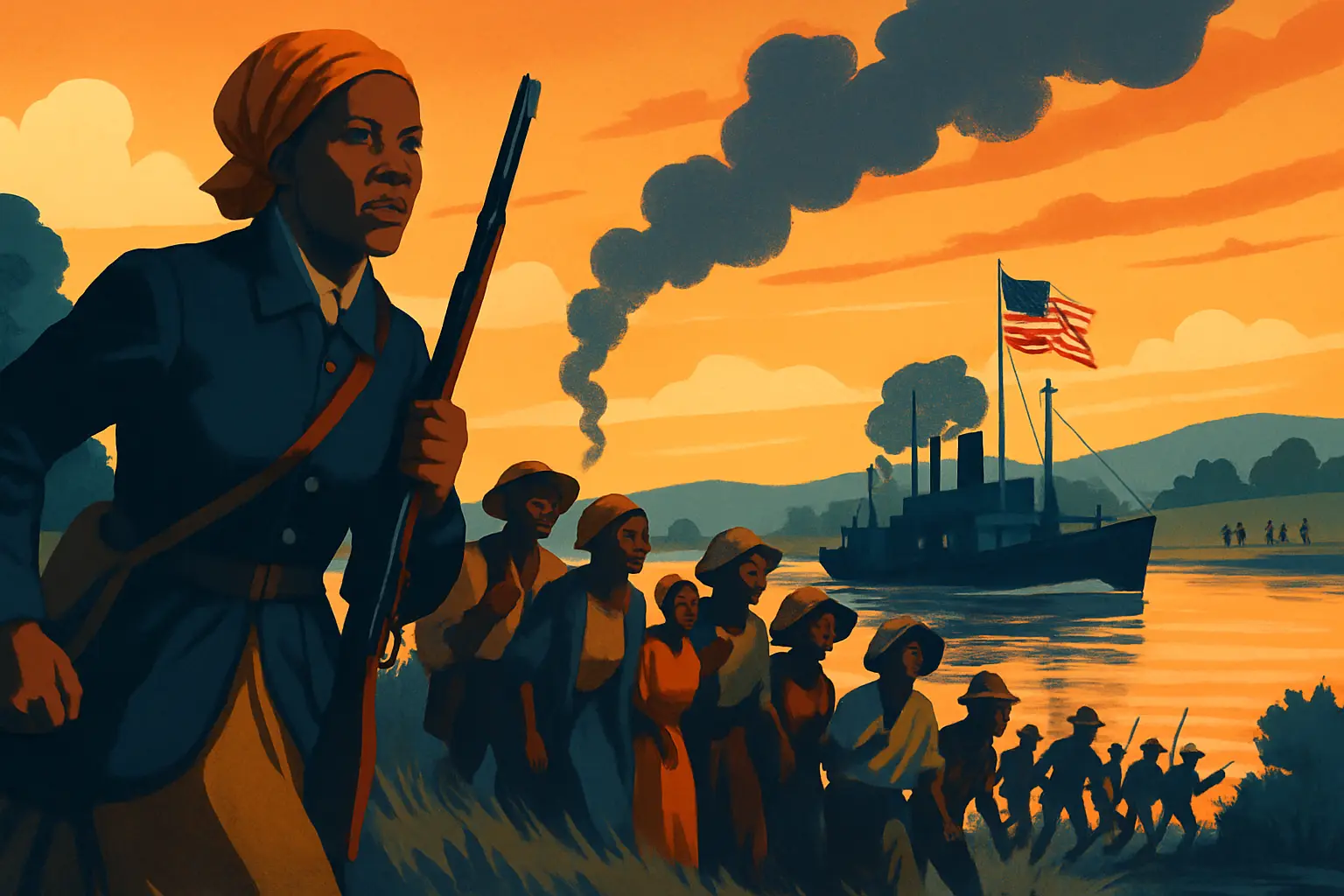
Most Americans can name Harriet Tubman. Far fewer can tell you that she commanded a Union Army raid in June 1863 that freed more than 700 enslaved people in a single night — making her the first woman in American history to lead an armed military operation. The **Combahee River Raid** in South Carolina barely registers in the average school curriculum, yet it dwarfed, in a single evening, the total number of people she liberated across all thirteen of her legendary Underground Railroad missions. Tubman was not simply a courageous freedom runner. She was a trained intelligence operative, a Union Army nurse, a recruiter for the Black regiment of Colonel James Montgomery, and a lifelong suffragist who stood on stages into her eighties demanding women's right to vote. She was also a deeply private woman who never learned to read or write, yet outwitted every slave-catcher Maryland could deploy. This article traces her full biography — from the Dorchester County marshes where she was born into bondage around 1822, through the Civil War spy rings she ran out of Beaufort, South Carolina, to the Cape Fear farmhouse in Auburn, New York, where she died in 1913 at roughly 91 years old. Along the way, you'll find the actual places you can visit today to understand the landscape she fought across.
🗽 Short stories • Collectible cards • Learn as you travel
The Harriet Tubman Underground Railroad Visitor Center (4068 Golden Hill Rd, Church Creek, MD 21622) is free and open daily 9am–5pm, but the adjacent Blackwater National Wildlife Refuge auto-tour road gets congested on fall weekends. Arrive before 9am in October for solitude and better wildlife sightings. The visitor center's 45-minute orientation film is genuinely excellent — don't skip it.
Combine sites into one Maryland day
The Harriet Tubman Underground Railroad Byway links 36 sites across Dorchester and Caroline counties in Maryland. Download the official byway map at exploredorchester.com before you go. A focused day starting at the Visitor Center, then driving to the Brodess Farm site on Greenbriar Road, then finishing at the Stewart's Canal site covers Tubman's early life geography in under 40 miles of driving.
Visit the Auburn, NY home in summer
The Harriet Tubman National Historical Park in Auburn, New York (180 South St, Auburn, NY 13021) operates guided tours of the Tubman Home for the Aged Thursday–Sunday, 9am–5pm, from June through October. Admission is free. The adjacent Thompson AME Zion Church, where Tubman worshipped and was buried, is open to visitors and holds her original grave marker — a detail most travel guides omit entirely.
The complete Harriet Tubman biography and travel guide
1Born into the marshes: Dorchester County and Tubman's early bondage
Harriet Tubman was born Araminta Ross around 1822 — the exact year is uncertain because enslaved people's births were rarely recorded — in Dorchester County, Maryland, on the Eastern Shore of the Chesapeake Bay. Her parents, Ben Ross and Rit Green, were both enslaved on separate plantations, and her mother served the Brodess family, who would control Araminta's life for her first twenty-seven years. Dorchester County in the 1820s and 1830s was a patchwork of tidal marshes, pine forests, and small tobacco and timber plantations. It was not the grand plantation economy of the Deep South; most enslaved people here worked in small groups, sometimes hired out to neighboring farms. That economic structure gave Tubman something unusual: semi-regular contact with free Black workers and white laborers, and a working knowledge of the region's waterways, roads, and social networks that would prove invaluable later.
As a child, Araminta was hired out repeatedly, including to a brutal trapper named Edward Brodess's neighbor, who forced her to check muskrat traps in freezing marsh water. Around age twelve or thirteen, she suffered the injury that would define her physiology for life. While at a dry-goods store in Bucktown, she refused to restrain an enslaved man who was attempting to flee. An overseer hurled a two-pound lead weight at the man; it struck Araminta in the head instead. The resulting traumatic brain injury caused narcoleptic episodes — sudden, uncontrollable losses of consciousness — that persisted for the rest of her life. She would fall asleep mid-conversation, mid-meal, mid-mission. Every conductor on the Underground Railroad who worked with her knew to account for it.
The Bucktown Village Store, where this incident occurred, still stands at 4303 Bucktown Rd, Bucktown, MD 21613, and is preserved as a heritage site. It is one of the most emotionally specific places in the entire Tubman landscape — a modest, weathered building that makes the violence of her early life tangible in a way that no museum exhibit quite replicates.
2The thirteen missions: what the Underground Railroad actually was
The phrase Underground Railroad is so embedded in American mythology that it has become almost metaphorical — evoking secret tunnels, hidden rooms, and a vast coordinated network. The historical reality was more improvisational, more dangerous, and in many ways more impressive. The Underground Railroad was not a single organization but a loose, decentralized web of free Black families, Quaker communities, and sympathetic white allies who sheltered freedom seekers moving north. Routes changed constantly. Communication was coded and oral. There were no membership cards.
Tubman made her own escape in September 1849, traveling approximately 90 miles on foot from Dorchester County to Philadelphia, Pennsylvania — then a free state. She followed the North Star and used the Choptank River and its tributaries as navigational guides, sheltering with a Quaker family in the town of Sandtown along the way. When she reached Philadelphia and freedom, her reaction, recorded later in an interview with abolitionist Thomas Garrett, was not triumphant: she said she felt like a stranger in a strange land, because everyone she loved was still in Maryland.
She went back. Between 1849 and 1860, Tubman conducted thirteen documented rescue missions and liberated approximately 70 people, including three of her brothers, her parents, and multiple nieces and nephews. She operated primarily in winter, when long nights provided cover. She carried a revolver — not just to defend against slave-catchers, but by her own admission, to enforce discipline among the people she was guiding. Anyone who panicked and threatened to turn back endangered everyone; she would press the gun to their temple and say, in her words, "You'll be free or die."
After the Fugitive Slave Act of 1850 made the northern United States legally dangerous for escaped people, Tubman extended her routes into Canada, particularly to St. Catharines, Ontario, where she lived periodically and where a significant community of formerly enslaved people had settled. In eleven years of missions, she was never caught and never lost a passenger. Frederick Douglass wrote to her in 1868: "I know of no one who has willingly encountered more perils and hardships to serve our enslaved people than you have."
Keep touring
Discover more about United States in minutes
Get short, interactive stories that make each place easier to remember while you travel.
3Civil War spy: the Combahee River Raid and Tubman's military career
When the Civil War broke out in April 1861, Tubman did not retreat to safety. Within two years she was working as a Union Army intelligence operative based in Beaufort, South Carolina, recruited by Massachusetts Governor John Andrew through the abolitionist network. She nursed wounded soldiers, including Black troops of the 54th Massachusetts Infantry, and simultaneously built a spy ring of formerly enslaved people who moved freely through Confederate-held territory gathering intelligence on troop positions and supply routes.
Her most spectacular military contribution came on the night of June 1–2, 1863. Working with Colonel James Montgomery of the 2nd South Carolina Infantry (a Black regiment), Tubman guided three Union gunboats — the John Adams, the Harriet A. Weed, and the Sentinel — up the Combahee River through a minefield she had mapped in advance using intelligence from her local network. The boats destroyed Confederate rice plantations and infrastructure along the riverbanks and, critically, collected more than 700 enslaved people who had been pre-warned to gather at the river's edge. The entire operation was executed in a single night.
Newspapers in the North, including the Boston Commonwealth, reported the raid and identified Tubman by name as its architect — one of the rare occasions when a woman, and a Black woman at that, received public military credit during the war. Despite this documented service, the U.S. government refused to pay her a pension for decades. She received $8 per month as the widow of her second husband, Nelson Davis, a Civil War veteran, but was not granted a military pension in her own right until 1899, thirty-six years after the raid — and only after sustained lobbying by veterans' groups and former supporters. The amount: $20 per month. The irony of that number, given the current $20 bill redesign bearing her portrait, is not lost on historians.
4Auburn, New York: the home she built and the causes she never abandoned
After the Civil War, Tubman settled permanently in Auburn, New York, a small city in the Finger Lakes region that had been a center of abolitionist activity largely because of its proximity to the home of William H. Seward, Lincoln's Secretary of State. It was Seward who sold Tubman a modest house and land at 182 South Street in 1859 for $1,200 — a significant sum she paid off over years through fundraising and speaking engagements.
The Auburn years revealed yet another dimension of Tubman's character. She was not a woman who retired into quiet domesticity. She hosted meetings of the National Woman Suffrage Association, corresponded with Susan B. Anthony and Elizabeth Cady Stanton, and appeared at suffrage conventions across New York State into her eighties. Her relationship with the suffrage movement was not uncomplicated — some white suffragists explicitly argued for women's voting rights by invoking racial hierarchies, a position Tubman publicly opposed — but she remained committed to the cause of universal suffrage until her death.
In 1896, she purchased additional land adjacent to her property and established the Harriet Tubman Home for the Aged, a residence for elderly and indigent Black men and women in an era when such facilities were essentially nonexistent for Black Americans. She donated the property to the African Methodist Episcopal Zion Church in 1903, and it continued operating as a care facility for years after her death.
Tubman died on March 10, 1913, surrounded by friends and family at the Home for the Aged. Her last words, recorded by those present, were: "I go to prepare a place for you." She was buried with military honors at Fort Hill Cemetery in Auburn, and her grave was later moved to the grounds of Thompson Memorial AME Zion Church at 33 Parker St, Auburn — a church she helped found and where her original headstone still stands alongside a later bronze marker erected in 1937.
Today the Harriet Tubman National Historical Park encompasses both the Tubman Home for the Aged and the Thompson AME Zion Church. The National Park Service operates free guided tours; the experience of walking the actual rooms where she lived in her final decades is quiet and affecting in a way that larger monuments rarely achieve.
5The Maryland landscape today: visiting the places she navigated
The geography of Tubman's early life and escape routes is remarkably well-preserved in Dorchester and Caroline counties in Maryland's Eastern Shore — not because of aggressive historic preservation, but partly because the region's economy never boomed enough to replace the 19th-century built environment. That melancholy fact makes it one of the most authentic antebellum landscapes in the eastern United States.
The centerpiece of any visit is the Harriet Tubman Underground Railroad Visitor Center, operated by the National Park Service in partnership with the State of Maryland at 4068 Golden Hill Road, Church Creek, MD 21622. Opened in 2017, the facility is architecturally striking — low-slung and landscape-integrated, with outdoor interpretive panels that orient visitors in the actual terrain Tubman crossed. The permanent exhibition is among the best on this subject in the country, using primary sources, replica artifacts, and immersive audio to reconstruct both the physical and psychological reality of her missions. Admission is free; the orientation film runs approximately 45 minutes and is worth every minute.
From the visitor center, the Harriet Tubman Underground Railroad Byway — a Maryland Scenic Byway encompassing 125 miles and 36 documented sites — extends through the surrounding counties. Key stops include:
- Brodess Farm site, Greenbriar Road near Bucktown: the plantation where Tubman spent most of her enslaved life; the original structures are gone but the landscape is intact and sobering
- Bucktown Village Store, 4303 Bucktown Rd: where the lead weight incident occurred; open seasonally, free
- Stewart's Canal, Madison, MD: the timber-cutting operation where Tubman's father Ben Ross worked as a free man and where the family maintained community connections that supported her later missions
- Blackwater National Wildlife Refuge, adjacent to the visitor center: the tidal marshes Tubman crossed repeatedly at night; the 4.5-mile Wildlife Drive auto-tour ($3 per vehicle) traverses terrain that looks almost exactly as it did in the 1840s
The combination of the visitor center, a 2-hour byway drive, and a walk along the refuge trails adds up to a genuinely moving half-day. Pair it with the afternoon at the Museum of the Eastern Shore in Cambridge, MD, for full regional context.
6The $20 bill debate and why representation in currency matters
In April 2016, the Obama Treasury Department announced that Harriet Tubman would replace Andrew Jackson on the front of the $20 bill — the first time a woman would appear on American paper currency since Martha Washington appeared on the $1 silver certificate in the 1890s, and the first time a Black American would appear on a widely circulated Federal Reserve note. The announcement was culturally significant precisely because the displacement of Jackson — a slaveholder and the architect of the Indian Removal Act — was explicit and intentional, not incidental.
The redesign was then delayed by the Trump administration in 2019 under the stated rationale of anti-counterfeiting technology requirements, pushing the projected release date to 2028. The Biden administration accelerated the timeline in 2021, and as of this writing the Bureau of Engraving and Printing has confirmed a target release in the late 2020s, though no final date is locked. The delay has itself become a flashpoint in ongoing debates about whose stories American institutions choose to memorialize — and at what pace.
For Tubman's historical legacy, the currency debate has had one useful effect: it introduced her biography to millions of Americans who knew the name but not the details. Sales of biographies — particularly Kate Clifford Larson's *Bound for the Promised Land* (2004) and Catherine Clinton's *Harriet Tubman: The Road to Freedom* (2004) — spiked repeatedly around each news cycle. Both books remain the scholarly standard and are available at the visitor center's bookshop in Church Creek.
What the currency debate cannot fully convey is the texture of Tubman's actual life: the narcoleptic episodes that she reframed as divine visions, the years of fundraising to pay off her own mortgage while simultaneously financing other people's freedom, the decades of government non-recognition for military service that would have generated automatic honors had she been a white man. The $20 bill is a symbol. The woman behind it operated at a level of sustained, strategic courage that remains almost impossible to fully absorb.
7Plan your visit: practical details for both Maryland and Auburn
Whether you're building a dedicated Tubman itinerary or incorporating these sites into a broader East Coast road trip, the logistics are manageable and the entry costs are remarkably low — nearly every major site is free.
Harriet Tubman Underground Railroad Visitor Center — 4068 Golden Hill Rd, Church Creek, MD 21622 | Open daily 9am–5pm | Free admission | NPS-operated | Orientation film included
Blackwater National Wildlife Refuge Auto-Tour — adjacent to Visitor Center | Wildlife Drive: $3/vehicle | Open dawn to dusk daily | Best wildlife viewing: October–November for waterfowl migration
Bucktown Village Store — 4303 Bucktown Rd, Bucktown, MD 21613 | Open seasonally (typically May–October, weekends only) | Free | Call Dorchester County Tourism at (410) 228-1000 for current hours
Harriet Tubman National Historical Park (Auburn, NY) — 180 South St, Auburn, NY 13021 | Guided tours Thursday–Sunday, 9am–5pm, June–October | Free | Reserve at recreation.gov to guarantee a tour spot in peak season
Thompson Memorial AME Zion Church — 33 Parker St, Auburn, NY | Open to visitors; check with the church for current access hours | Tubman's grave is on the grounds with original headstone
Nearest airports: Baltimore/Washington International (BWI) is approximately 1.5 hours from Church Creek, MD. Syracuse Hancock International (SYR) is approximately 30 minutes from Auburn, NY
Recommended guidebook: the official NPS Harriet Tubman Underground Railroad companion booklet, free at the visitor center, is more detailed than most commercially published guides
Best time to visit Maryland sites: late September through early November for cooler temperatures and migratory birds in Blackwater; spring is also excellent but summer heat and insects in the marshes can be intense
Keep touring
Ready to walk the ground Harriet Tubman crossed?
TourMe's American history collection includes dedicated story cards on the Underground Railroad, the Combahee River Raid, and the abolitionist networks of the Eastern Shore — each built for reading on-site as you move through the actual landscape. Unlock interactive chapters on Maryland's freedom geography and collect illustrated cards on the figures who made the network possible, from Thomas Garrett to Frederick Douglass.