United States • Who Was • American History & Culture
Who Was Frederick Law Olmsted? The Man Who Shaped America's Parks, Its Cities, and Its Conscience
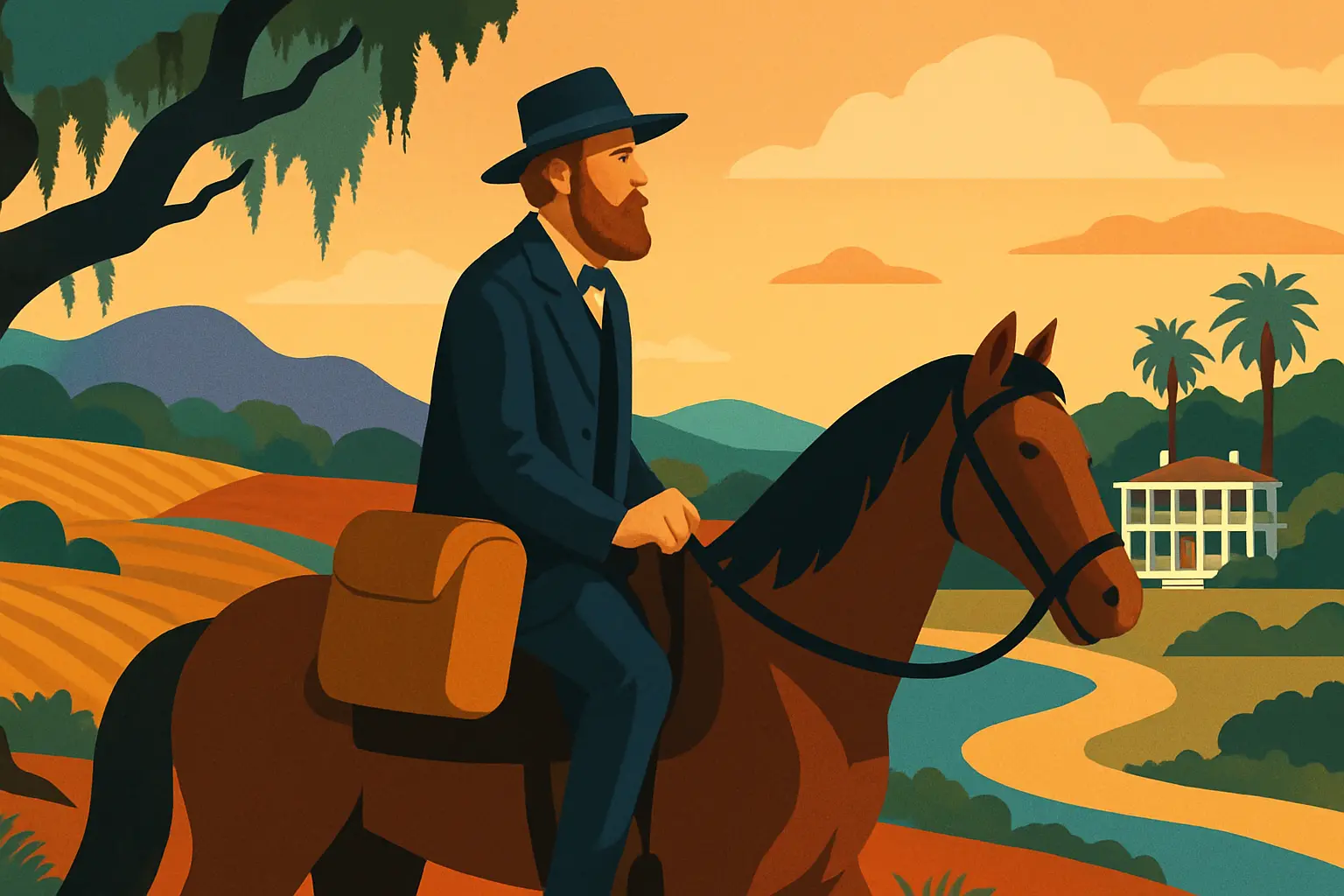
Before Frederick Law Olmsted ever put pencil to a landscape plan, he spent three years riding through the antebellum South on horseback, filing dispatches for the New-York Daily Times that would become some of the most damning eyewitness accounts of slavery ever published. He was 30 years old, had failed at farming, and had no formal training as a landscape architect — yet within a decade he would win the competition to design Central Park in New York City and go on to reshape the physical character of America more profoundly than almost any architect, engineer, or urban planner of his era. Olmsted designed or co-designed more than 500 landscapes across the United States and Canada, including Prospect Park in Brooklyn, the U.S. Capitol Grounds in Washington, D.C., the Emerald Necklace park system in Boston, the campus of Stanford University, and the grounds of the 1893 World's Columbian Exposition in Chicago. He also helped establish Yosemite as a protected public space, writing the philosophical case for wilderness preservation decades before Theodore Roosevelt made conservation a national cause. Understanding Olmsted means understanding how Americans came to believe that green space is a democratic right — and why so many of the most beloved places in the country look the way they do.
🗽 Short stories • Collectible cards • Learn as you travel
The Ramble — a 36-acre woodland in Central Park between 73rd and 79th Streets, Manhattan — is one of Olmsted's most intentional design gestures. He engineered its winding paths to feel wild and disorienting, a deliberate contrast to the city grid outside. Free to enter 24/7; best visited at dawn when it's quiet and birders are active. Over 200 bird species have been recorded here during spring migration.
See the Capitol Grounds for free
Olmsted redesigned the U.S. Capitol Grounds in Washington, D.C. starting in 1874, planting over 100 tree species and building the distinctive marble Summer House drinking fountain on the West Front (still functioning). The grounds are open daily from 7 a.m. to dusk at no charge — one of the most underrated Olmsted landscapes in the country, especially beautiful in late April when the flowering trees peak.
Tour the Biltmore Estate grounds
Olmsted's last great project before his mental health declined was the landscape of the Biltmore Estate in Asheville, North Carolina (1 Lodge St, Asheville, NC 28803). He designed the 8,000-acre estate grounds including the winding Approach Road, the Walled Garden, and the Bass Pond. Estate admission runs approximately $65–$85 for adults depending on the season; grounds access is included. The gardens are at their most spectacular in mid-April during the Biltmore Blooms festival.
The complete Frederick Law Olmsted guide
1Why a Failed Farmer Became America's Greatest Landscape Architect
Frederick Law Olmsted was born on April 26, 1822, in Hartford, Connecticut, into a prosperous merchant family. His formal education was erratic — recurring bouts of sumac poisoning in childhood damaged his eyesight and kept him out of Yale — but he read voraciously and traveled widely in his twenties, sailing to China as a merchant seaman at 19 and later making an extended walking tour of England and Scotland that proved decisive. In England, Olmsted visited Birkenhead Park near Liverpool, designed by Joseph Paxton and opened in 1847 as one of the world's first publicly funded parks. He was struck not just by the beauty of the landscape but by something more social: working-class families and wealthy merchants walking the same paths, using the same lawns, sharing the same pastoral escape from industrial city life. It was, Olmsted later wrote, 'a people's garden,' and the phrase lodged in his mind.
Back in the United States, Olmsted tried farming on Staten Island through the late 1840s and early 1850s, running a scientific farm on what is now Tohtenville. He was good at observation and bad at profit. What actually sharpened his thinking during this period was journalism. He began contributing travel essays to newspapers, and in 1852 the New-York Daily Times — the paper that would become the New York Times — commissioned him to travel through the slaveholding states and report on the economic and social conditions he found. The resulting dispatches, collected into three volumes and later condensed into The Cotton Kingdom (1861), combined meticulous economic analysis with unflinching moral witness. Historians still cite it as one of the essential primary sources on the antebellum South. It also gave Olmsted an analytical habit of mind — the ability to read a landscape, understand who it was designed to serve, and ask whether it could be designed differently.
2Central Park: A Political Act as Much as a Design Achievement
In 1857, New York City cleared approximately 1,600 acres of rocky, swampy land in the middle of Manhattan — displacing a thriving Black community called Seneca Village in the process, a dispossession that urban historians have increasingly documented — and announced a competition for the design of a new public park. Olmsted, recently appointed as the park's superintendent, partnered with the English-born architect Calvert Vaux to enter the competition under the pseudonym 'Greensward.' Their plan won.
What distinguished the Greensward Plan was its radicalism of means. Olmsted and Vaux had to take a landscape of exposed schist, malarial ponds, and bone-boiling factories and transform it, over roughly 15 years of construction and planting, into something that felt like pastoral countryside dropped into the world's fastest-growing city. They sank four transverse roads below grade so that commercial traffic could cross the park without entering its visual field — a feat of infrastructure that still functions today. They engineered the Ramble as a deliberately labyrinthine woodland. They designed the Sheep Meadow as an open expanse that would give urban workers the experience of a wide horizon, something most immigrants from rural Europe had not seen since leaving home.
The democratic argument was explicit. Olmsted believed that pastoral landscape — curving paths, meadows, mixed woodland, water — had a measurable restorative effect on the urban mind, and that this effect was accessible to everyone, regardless of income. A seamstress in the Sixth Ward and a merchant on Fifth Avenue would walk the same paths and feel the same relief. This was not naïve romanticism; Olmsted backed it with references to contemporary psychology and public health data. In an era before public housing, labor laws, or municipal sanitation were established rights, the idea that the city owed its poorest residents access to beauty was genuinely radical.
Central Park remains one of the most visited urban parks in the world, receiving an estimated 42 million visitors per year.
Keep touring
Discover more about United States in minutes
Get short, interactive stories that make each place easier to remember while you travel.
3From Brooklyn to Boston: The Full Scope of Olmsted's American Portfolio
Central Park made Olmsted famous, but it was only the beginning of a career that would span four decades and leave its mark on cities from coast to coast. In Brooklyn, he and Vaux designed Prospect Park (1866–1873), which many Olmsted scholars consider superior to Central Park precisely because the designers had more control over the terrain. The Long Meadow — at 90 acres, one of the longest unobstructed meadows in any American urban park — and the 60-acre Prospect Lake were both engineered from scratch. The park opened to the public in 1867 and remains the anchor of Brooklyn's park system.
In Boston, Olmsted was hired in 1878 to solve one of the city's most persistent problems: the Muddy River corridor, a network of tidal flats and sewage-laden streams that flooded regularly and spread disease. His solution was the EmeraldEcklace, a six-mile chain of connected parks and parkways running from Boston Common through the Back Bay Fens, the Riverway, Olmsted Park, Jamaica Pond, the Arnold Arboretum, and Franklin Park. It is perhaps his most ambitious urban infrastructure project — a system that simultaneously managed stormwater, created wildlife corridors, and gave Boston's working neighborhoods accessible green space. The Arnold Arboretum, managed jointly with Harvard University and located at 125 Arborway in Jamaica Plain, is free to enter and contains one of the most significant collections of trees and shrubs in North America.
Olmsted also designed parks and parkways in Louisville, Kentucky (the Louisville Park System, still intact), Buffalo, New York (the city's interconnected park system, one of the first in the country), Montreal's Mount Royal Park, the grounds of the McLean Psychiatric Hospital in Belmont, Massachusetts (demonstrating his belief that restorative landscapes could serve therapeutic functions), and dozens of private estates and university campuses including Lawrenceville School in New Jersey and the early plans for the University of Chicago.
Prospect Park, Brooklyn: Main entrance at Grand Army Plaza, Brooklyn, NY 11238. Free, open daily 5 a.m.–1 a.m.
Arnold Arboretum, Boston: 125 Arborway, Jamaica Plain, MA 02130. Free, open daily dawn to dusk.
Louisville's Olmsted Parks: Cherokee, Iroquois, and Shawnee Parks — all free, connected by the original Olmsted parkway system.
Buffalo's Olmsted Park System: Delaware Park, the largest, is free and open year-round; the Olmsted Parks Conservancy offers guided tours from May through October (~$15/person).
4The Conservation Argument: Yosemite and the Birth of American Wilderness Policy
In 1864, while Olmsted was still deep in the construction of Central Park, President Abraham Lincoln signed the Yosemite Grant, transferring the Yosemite Valley and the Mariposa Grove of Giant Sequoias to the state of California for public use and protection. It was the first time the U.S. federal government had set aside land specifically for public preservation — a precedent that would eventually lead to the creation of the National Park Service in 1916. Olmsted was appointed to chair the first Board of Commissioners to manage the grant.
In 1865, Olmsted drafted a report for the California legislature that remains one of the foundational documents of American conservation philosophy. He argued that natural scenery of the highest quality — the kind found in Yosemite — exercised a specific and essential influence on human mental health, and that the government had a positive obligation to preserve it not just for present citizens but for all future generations. 'The enjoyment of scenery employs the mind without fatigue,' he wrote, 'and yet exercises it; tranquilizes it and yet enlivens it.' The report was quietly shelved by political opponents and not rediscovered until 1952, but the ideas it contained became the intellectual DNA of the American conservation movement.
Olmsted visited Yosemite again in 1890, the year John Muir and others successfully lobbied for its establishment as a national park. Muir and Olmsted were not close collaborators — Muir's wilderness philosophy was more purely preservationist, Olmsted's more tied to democratic access — but they shared the conviction that wild places had intrinsic value beyond economic extraction. Olmsted's framing of that argument in terms of public health and democratic rights gave it a political traction that Muir's more transcendentalist approach sometimes lacked.
5The World's Fair, the White City, and Olmsted's Final Work
By the time Chicago won the bid to host the World's Columbian Exposition of 1893 — celebrating the 400th anniversary of Columbus's arrival in the Americas — Olmsted was 70 years old, partly deaf, and struggling with the memory lapses that would eventually require his institutionalization. He designed the landscape of the fair anyway, and it remains one of the most influential temporary landscapes in American history.
The exposition was built on 690 acres of Jackson Park and the Midway Plaisance on Chicago's South Side, much of it reclaimed lakefront swamp. Olmsted's landscape plan created the lagoon system that connected the fair's grand neoclassical buildings — the 'White City' designed by Daniel Burnham and a roster of the country's leading architects — with a network of waterways navigated by gondolas. The interplay of water, greenery, and classical architecture attracted 27 million visitors in six months and profoundly influenced American ideas about urban design, sparking the City Beautiful movement that reshaped dozens of American downtowns in the following decades.
Jackson Park in Chicago (6401 S. Stony Island Ave) still carries the outline of Olmsted's lagoon design and is currently being restored as part of the Obama Presidential Center development — a project that has itself generated debate about green space, public access, and neighborhood impact not entirely unlike the arguments Olmsted was making in the 1850s. The Museum of Science and Industry, one of the original fair buildings, still stands at 5700 S. Lake Shore Drive; admission is approximately $21.95 for adults.
Olmsted's last major project was the landscape of the Biltmore Estate in Asheville, North Carolina, for George Vanderbilt — 8,000 acres of formal gardens, managed forestry, and pastoral scenery that he began in 1888. The Biltmore commission was also significant for launching the career of Gifford Pinchot, who managed the Biltmore's forests and later became the first chief of the U.S. Forest Service under Theodore Roosevelt.
6Legacy: How Olmsted's Ideas Live in Today's Cities
Olmsted was committed to McLean Hospital in Belmont, Massachusetts in 1898 — the same institution whose grounds he had designed decades earlier — and died there in 1903. His sons, John Charles Olmsted and Frederick Law Olmsted Jr., continued the firm of Olmsted Brothers until 1980, extending their father's influence into the twentieth century through commissions that included the master plan for Acadia National Park in Maine, the landscape of the National Mall in Washington, D.C., and park systems in Portland, Oregon and Seattle, Washington.
The scope of the Olmsted legacy is difficult to fully inventory. The National Association for Olmsted Parks and the Olmsted Research Guide at the Library of Congress have documented over 500 confirmed projects in the United States and Canada. The Frederick Law Olmsted National Historic Site in Brookline, Massachusetts — at 99 Warren Street, managed by the National Park Service — preserves the family home and office where Olmsted Brothers operated for nearly a century. Admission is free; tours run Friday through Sunday from 10 a.m. to 4 p.m.
What Olmsted's legacy ultimately represents is the argument, made in dirt and grass and stone over 40 years of practice, that the design of public space is a moral act. Every time a city debates whether to build a park or a parking garage, whether to preserve a waterfront or sell it to developers, whether green space should be distributed equitably across neighborhoods or concentrated in wealthy ones, the argument is Olmstedian. He didn't invent the idea that public space matters — but he gave it a philosophical framework, a body of built evidence, and a democratic vocabulary that American cities are still drawing on.
The National Park Service's history of American conservation owes more to Olmsted's 1865 Yosemite report than most visitors to any national park realize.
Frederick Law Olmsted National Historic Site: 99 Warren St, Brookline, MA 02445. Free admission. Tours Fri–Sun, 10 a.m.–4 p.m. Includes Olmsted's original design archives.
Central Park Conservancy tours: Guided walks of Olmsted's original design depart from the Dairy Visitor Center (mid-park at 65th St). Free; reservations recommended at centralparknyc.org.
Prospect Park Alliance tours: Free guided walks of Vaux and Olmsted's Brooklyn masterpiece depart from the Picnic House on weekends in spring and fall; check prospectpark.org for schedule.
Jackson Park, Chicago: Free, open year-round; the South Lagoon and Wooded Island preserve Olmsted's 1893 fair landscape. The Wooded Island is a major migratory bird stopover in spring.
7Practical Guide: How to Experience Olmsted's America Today
Visiting Olmsted's landscapes requires no special knowledge or planning — almost all of them are free, open daily, and located in or near major American cities. But knowing what you're looking at transforms the experience. A few principles Olmsted applied consistently across his work are worth carrying in your head as you walk: paths curve to create suspense and reveal; open meadows alternate with dense woodland to produce rhythm; water appears at the lowest point of the composition as a visual anchor; and transitions between spaces are gradual, never abrupt. Once you start seeing these patterns, you'll find them everywhere.
The best single introduction to Olmsted's work for a first-time visitor is probably Prospect Park in Brooklyn rather than Central Park, because it's less crowded and Olmsted had more freedom to execute his vision. Enter at Grand Army Plaza and walk the full loop of the Long Meadow; the scale of the open space relative to the surrounding urban density is exactly what Olmsted intended to produce.
For history-minded travelers, the Frederick Law Olmsted National Historic Site in Brookline is the essential stop. The house and office are modest but the archive is extraordinary — the site holds over 60,000 original design plans. Rangers lead 45-minute tours that contextualize the work across Olmsted's entire career.
Best time to visit Central Park: Late April for cherry blossoms around the Reservoir; early October for fall color in the Ramble. Avoid summer weekends — the Sheep Meadow reaches capacity by noon.
Best time to visit Prospect Park: May for the Long Meadow wildflower bloom; early November for fall foliage over Prospect Lake. The park is dramatically less crowded than Central Park year-round.
Best time to visit the Arnold Arboretum, Boston: Late May for Lilac Sunday (the only day picnicking is permitted on the grounds — a beloved Boston tradition since 1908). Free all year.
Best time to visit Biltmore Estate, Asheville: Mid-April for spring gardens; expect crowds. Late October for fall color and lower ticket prices on weekdays (~$65 vs. $85+ in peak season).
Getting to the Olmsted NHS, Brookline: Accessible via the MBTA Green Line D branch to Brookline Hills station (~10-minute walk to 99 Warren St). No parking on site.
Photography note: Olmsted designed his landscapes to look best in soft morning or late-afternoon light — harsh midday sun flattens the texture of the meadows and woodland he worked so hard to layer.
Keep touring
Ready to see Olmsted's America through new eyes?
TourMe's American history and culture content includes in-depth stories and collectible cards about the designers, thinkers, and reformers who built the country's public spaces — including Frederick Law Olmsted's life, his journalism in the antebellum South, and the parks you can visit today. Explore interactive chapters on Central Park, the Emerald Necklace, and the conservation movement, and collect cards that trace how Olmsted's democratic vision of green space still shapes American cities.