United States • Neighborhood Guides • Savannah, Georgia
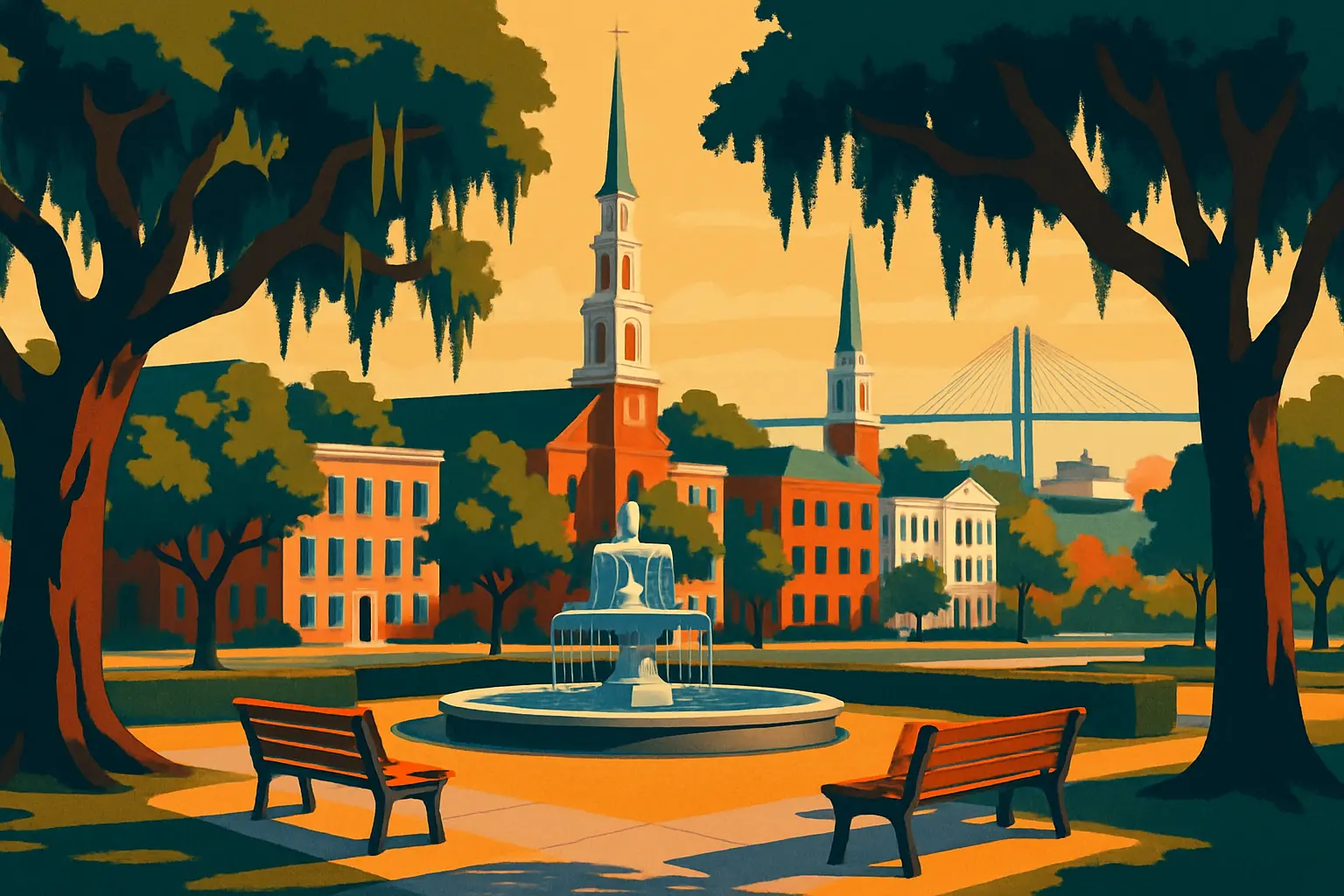
Savannah's 22 Squares: A Walking Guide to the Most Deliberately Planned City in America
Most American cities grew organically — a port here, a railroad junction there — and the street grid was retrofitted around the mess. Savannah, Georgia, is the exception that makes every urban planner's pulse quicken. In February 1733, **James Edward Oglethorpe** arrived on a bluff above the **Savannah River** with 114 colonists and a blueprint so precise that it still governs how the city breathes today. His ward system — a repeating module of residential lots, trust lots for civic buildings, and a central park square — produced what is arguably the earliest example of planned urban design in North America. Originally 24 squares were laid out before the Civil War; two were lost to traffic and development, leaving 22 intact today across roughly 2.5 square miles of the **Savannah National Historic Landmark District**. These aren't decorative roundabouts or afterthought greenways. They function as outdoor living rooms, protest grounds, wedding venues, and noon-hour lunch spots. This guide covers the squares that carry the deepest history, the most compelling architecture, and the most honest sense of what contemporary Savannah actually is — not just what the tourism brochures promise.
🗽 Short stories • Collectible cards • Learn as you travel
Go between late March and mid-May or mid-October through November. Summer humidity in Savannah regularly reaches 90%+ with heat indices above 100°F, making a midday square-hopping walk genuinely unpleasant. Spring and fall give you Spanish moss swaying in a breeze instead of a wall of subtropical air.
Free parking near the squares
Street parking in the Historic District is metered Mon–Sat 8am–8pm at $1.50/hour. The Bryan Street Garage (100 E. Bryan St.) charges $2/hour and is a five-minute walk from Johnson Square. Arriving before 9am on weekdays almost always gets you a free on-street spot near the perimeter squares.
Trolley vs. walking
The **Old Town Trolley** (day pass ~$34 adults, ~$14 ages 4–12) hits 14 stops and is useful for context on a first visit, but its route skips several of the best squares — Troup, Whitefield, and Chatham. Walking the full grid at a relaxed pace with stops takes about four hours. A focused half-day walk of the seven essential squares can be done comfortably in under two hours.
The complete Savannah squares neighborhood guide
1The Ward System: Why Oglethorpe's 1733 Plan Was Radical — and How It Survived
Urban historians have studied Oglethorpe's ward plan for nearly three centuries and still argue over its influences. Some point to Robert Castell's 1728 book *Villas of the Ancients*, which Oglethorpe owned and which illustrated Roman villa layouts. Others see echoes of London's Bloomsbury district, which was being built during Oglethorpe's youth. What is certain is that the plan was intentional, scalable, and — remarkably — adhered to by the city for over 120 years as Savannah expanded westward along the bluff.
Each ward was a self-contained unit of 40 lots arranged around a central open square. The lots were divided into types: residential tything lots on the east and west sides, and larger trust lots on the north and south reserved for civic purposes — churches, schools, and later, commercial buildings. The central square was kept open. No ward was supposed to have direct traffic running through its heart. When a new ward was platted, the pattern simply replicated itself.
The system worked because it distributed civic life evenly rather than concentrating it at a single center. Every resident lived within a short walk of green space, and every neighborhood had its own institutional anchor — a church, a school, a market. This was not accidental charity. Oglethorpe was a social reformer who had spent years investigating English debtors' prisons, and the Georgia Colony was partly conceived as a rehabilitation project. The spatial equality embedded in the ward plan reflected his belief that physical environment shapes moral character.
By 1856, the city had platted 24 squares. Two — Elbert Square and Liberty Square — were eventually sacrificed, one to a school building and one to a highway extension. The remaining 22 were designated part of the Savannah National Historic Landmark District in 1966, a designation that effectively froze the grid against further demolition. The ward system had outlasted the colony, the Confederacy, and the urban renewal bulldozers that flattened comparable districts in other American cities.
2Johnson Square and Ellis Square: The Commercial Core, Then and Now
Johnson Square, the first square Oglethorpe laid out in 1733, sits at the intersection of Bull and St. Julian Streets and functions as the unofficial financial center of the Historic District. The square is dominated by a tall obelisk monument to Nathanael Greene, the Revolutionary War general who was given a plantation near Savannah after the war and died there in 1786. Greene's remains were relocated beneath the monument in 1902. The obelisk was one of the first monuments erected to an American military figure after the Washington Monument design was proposed, which gives Johnson Square a quietly significant place in the history of American public commemoration.
The surrounding trust lots hold a concentration of banks and law offices — some of the oldest commercial real estate in the city. Christ Church (1 W. Christ Church Square, open Mon–Fri 9am–5pm, free) occupies the north trust lot and dates to 1838 in its current form, though the congregation itself is the oldest in Georgia, established by Oglethorpe in 1733. The interior is plain Federal-style brick, which is startling in its austerity compared to the elaborate ironwork just outside.
Two blocks west on Ellis Square, the mood shifts completely. Ellis Square was the site of Savannah's slave market from roughly the 1760s until the trade was banned in Georgia in 1798, a history that was largely suppressed in public interpretation for most of the 20th century. The square was then paved over in 1954 to build a parking garage. The garage was demolished and the square restored in 2010, and it now contains the Savannah Visitor Information Center and a popular outdoor seating area. A bronze sculpture of Johnny Mercer — the Savannah-born songwriter behind 'Moon River' and 'Autumn Leaves' — anchors the southeast corner. The contrast between the square's actual history and its current cheerful, tourist-friendly character is one of Savannah's most unresolved tensions.
Johnson Square: Bull St. & St. Julian St. — open 24 hours, free
Christ Church: 1 W. Christ Church Square — Mon–Fri 9am–5pm, free admission
Ellis Square: W. Congress & Barnard St. — open 24 hours, Visitor Center Mon–Sat 8:30am–5pm
Johnny Mercer statue: southeast corner of Ellis Square, free
Keep touring
Discover more about United States in minutes
Get short, interactive stories that make each place easier to remember while you travel.
3Chippewa Square and Madison Square: Where Savannah's Architecture Hits Its Stride
Walk south along Bull Street from Johnson Square and you're tracing the city's ceremonial spine. Chippewa Square, named for the 1814 Battle of Chippewa, is where most film crews set up when they want a quintessential Savannah shot — and where the production team for *Forrest Gump* placed the bench from which Tom Hanks delivers his 'box of chocolates' monologue. The actual bench was a prop and lives in the Savannah History Museum (303 Martin Luther King Jr. Blvd., $8 adults, $6 seniors/students, open Mon–Sat 9am–5pm). The square itself contains a bronze statue of James Oglethorpe by Daniel Chester French — the same sculptor who created the seated Lincoln at the Lincoln Memorial — installed in 1910. French depicted Oglethorpe facing south, his sword hand resting at ease, supposedly looking toward Spanish Florida as a permanent strategic gesture.
One block south, Madison Square is arguably the most architecturally coherent of the 22 squares. The surrounding streetscape has retained more of its antebellum character than almost anywhere else in the district. On the west side, the Green-Meldrim House (14 W. Macon St., tours Tues–Fri 10am–4pm, Sat 10am–1pm, $10 adults) is one of the finest examples of Gothic Revival residential architecture in the American South. General William T. Sherman used it as his headquarters after capturing Savannah in December 1864 — it's from this house that he sent President Lincoln the famous telegram offering Savannah as a Christmas gift. The house is now owned by St. John's Episcopal Church, which explains both its preservation and the slightly reverent atmosphere on the tour.
The square's central monument honors Sergeant William Jasper, a hero of the 1779 Siege of Savannah who died planting the American flag under British fire. The statue is modest by Washington standards — a bronze soldier mid-stride — but its placement in a square still ringed by working 19th-century townhouses gives it an immediacy that larger monuments sometimes lack.
Chippewa Square: Bull St. & McDonough St. — open 24 hours, free
Savannah History Museum: 303 Martin Luther King Jr. Blvd. — Mon–Sat 9am–5pm, $8 adults / $6 seniors & students
Madison Square: Bull St. & Harris St. — open 24 hours, free
Green-Meldrim House: 14 W. Macon St. — Tues–Fri 10am–4pm, Sat 10am–1pm, $10 adults
4Monterey Square and Forsyth Park: The Southern Anchor of Bull Street
Bull Street terminates — emotionally if not literally — at Monterey Square, the southernmost of the five squares on the Bull Street corridor and the one that most consistently appears in literature about Savannah. John Berendt set key scenes of *Midnight in the Garden of Good and Evil* (1994) in the buildings surrounding it, particularly Mercer-Williams House (429 Bull St., tours Mon–Sat 10:30am–4pm, Sun 12–4pm, $12.50 adults), the Italianate mansion built for the family of songwriter Johnny Mercer and later acquired by antiques dealer Jim Williams, whose trial for murder became Berendt's subject. The house is in extraordinary condition and the tour is unusually candid about the Williams story, which makes it worth the admission even if you haven't read the book.
The square's central monument honors Casimir Pulaski, the Polish-born cavalry commander who died at the 1779 Siege of Savannah — one of the bloodiest single engagements of the American Revolution in the South. The 1854 monument sat undisturbed for over 150 years until 2019, when archaeologists excavating beneath it during restoration work discovered a lead coffin containing skeletal remains. DNA and forensic analysis strongly suggested the remains were Pulaski's, including evidence that Pulaski may have been intersex — a finding that generated significant international coverage and reframed how historians discuss the general.
Two blocks south, Forsyth Park isn't technically one of the 22 squares — it's a later, larger addition to the public green space system, covering 30 acres. But no walk of the Historic District is complete without it. The Forsyth Fountain, modeled on similar cast-iron fountains in Paris and Cuzco, was installed in 1858 and is probably the most photographed object in Savannah. On weekend mornings, the perimeter path becomes a continuous loop of joggers, dog walkers, and couples with coffee from the Collins Quarter (777 Bull St., open daily 7am–10pm), a café in an 1860s building just north of the park.
Monterey Square: Bull St. & Wayne St. — open 24 hours, free
Mercer-Williams House: 429 Bull St. — Mon–Sat 10:30am–4pm, Sun 12–4pm, $12.50 adults
Forsyth Park: entrance at Bull St. & Gaston St. — open daily dawn to dusk, free
Collins Quarter: 777 Bull St. — daily 7am–10pm
5The Squares the Tour Buses Skip: Troup, Whitefield, and Calhoun
The five Bull Street squares get 80% of the tourist foot traffic. The remaining squares — spread across the grid on Abercorn, Habersham, Price, and Barnard Streets — carry a quieter, more genuinely residential character. Three are worth singling out for different reasons.
Troup Square (Habersham St. & Macon St.) is the only square in the Historic District with an armillary sphere as its central monument rather than a human figure — a 19th-century astronomical instrument depicting the celestial equator, mounted on a cast-iron pedestal. The surrounding architecture is a mix of modest Greek Revival townhouses and Italianate commercial conversions, and the square functions primarily as a neighborhood park. On warm evenings, residents from the adjacent Starland District — Savannah's informal arts neighborhood to the south — use it as a casual gathering point. The Vault Kitchen + Bar (Barnard and Park St., about a 10-minute walk) is a reliable option for a meal that doesn't cater exclusively to tourists.
Whitefield Square (Habersham St. & Wayne St.) sits at the eastern edge of the Victorian District and contains a white-painted wooden gazebo that functions as a wedding altar roughly every other weekend from March through November. The surrounding blocks have some of the best-preserved Queen Anne and Victorian Italianate residential architecture in Savannah, distinct from the Federal and Greek Revival styles that dominate the squares closer to the river. Walking Whitefield's perimeter is the quickest way to register how architecturally varied the Historic District actually is beneath its marketing uniformity.
Calhoun Square (Abercorn St. & Wayne St.) is the only square directly associated with Wesley Monumental United Methodist Church (429 Abercorn St., open for tours Mon–Fri 9am–12pm, free), a Gothic Revival structure completed in 1890 and named for John and Charles Wesley, who preached in Savannah in the 1730s. The church's interior — dark wood, stained glass depicting scenes from Methodist history, a pipe organ installed in 1929 — is one of the most undervisited interiors in a city full of them.
6Race, Memory, and the Squares: What the Monuments Tell You — and What They Don't
Savannah's 22 squares contain more than 30 monuments, fountains, and commemorative plaques. Reading them as a system reveals a great deal about which histories the city chose to memorialize, and when. Almost all of the major figurative monuments were installed between 1850 and 1920 — a period that overlapped with the height of the Lost Cause movement in the South, which romanticized Confederate memory while deliberately minimizing the history of slavery.
The Confederate Monument in Forsyth Park, a 48-foot column topped with a soldier facing north, was erected in 1879 and remains in place, though it has been the subject of sustained public debate since 2017. By contrast, there is no major monument in the squares to Savannah's enslaved population, which made up more than 40% of the city's population before the Civil War. The First African Baptist Church (23 Montgomery St., tours Mon–Fri 10am–4pm, Sat 10am–2pm, $10 adults) — the oldest Black Baptist congregation in North America, founded in 1773 — is a more significant memorial to that history than anything in the squares. Its basement floor still bears holes drilled by enslaved people who used the space as a stop on the Underground Railroad.
The Ralph Mark Gilbert Civil Rights Museum (460 Martin Luther King Jr. Blvd., open Mon–Sat 9am–5pm, $8 adults) provides the most direct interpretation of Savannah's civil rights history, including the 1960 lunch counter sit-ins that desegregated downtown businesses before similar actions became nationally publicized in other cities. W.W. Law, a mail carrier and NAACP chapter president who organized Savannah's movement, is memorialized with a small plaza near the museum but remains largely unknown outside the city. These sites are not on the standard square-hopping itinerary, but they are essential to understanding why the squares look the way they do — who built them, who was excluded from them, and who fought to claim them.
First African Baptist Church: 23 Montgomery St. — Mon–Fri 10am–4pm, Sat 10am–2pm, $10 adults
Ralph Mark Gilbert Civil Rights Museum: 460 Martin Luther King Jr. Blvd. — Mon–Sat 9am–5pm, $8 adults
Confederate Monument: Forsyth Park, Bull St. & Gaston St. — open 24 hours, free
7Practical Guide: Walking the Squares Without Wasting Half a Day
The 22 squares span roughly 1.5 miles north to south and 1 mile east to west — a manageable distance if you have a plan. Most visitors make the mistake of following a single street and missing the grid's lateral richness. The most efficient approach is a modified figure-eight that covers the Bull Street corridor in one pass and the Abercorn/Habersham squares in a second.
**Suggested 2-hour walk (7 squares):** Start at Johnson Square → Chippewa Square → Madison Square → Monterey Square → Calhoun Square → Whitefield Square → Troup Square. The loop is about 2.2 miles.
**Full grid walk (all 22 squares):** Allow 4–5 hours with short stops. Bring water — even in spring, the humidity is real. The **Savannah College of Art and Design (SCAD)** operates several buildings around the grid and their campus map (free at scad.edu) doubles as an excellent architectural guide.
**Best coffee stop mid-walk:** The **Foxy Loxy Café** (1919 Bull St., open Mon–Fri 7:30am–8pm, Sat–Sun 8am–8pm) is just south of Forsyth Park and has reliable Wi-Fi and shaded outdoor seating — practical if you're doing the full grid.
**Ghost tours:** Savannah markets itself heavily as one of America's most haunted cities. The walking ghost tours (~$25–$30 per person, numerous operators) run nightly and cover most of the major squares. They're genuinely entertaining and include real historical content, though the supernatural claims vary in credibility.
**Savannah Belles Ferry:** If you want a free break mid-walk, the **Savannah Belles Ferry** runs between River Street and Hutchinson Island every 15–20 minutes (free, operates daily 7am–11pm) and gives you the best elevated view of the bluff that Oglethorpe stood on in 1733.
**Accessibility:** The squares are flat and paved, but the surrounding brick sidewalks are uneven and in some sections quite rough. Wheelchair users and strollers should stick to the cross streets (Bull, Abercorn) which have smoother surfaces.
**Parking:** Bryan Street Garage, 100 E. Bryan St., $2/hour. Arrive before 9am for free street parking on the perimeter.
Keep touring
Ready to walk Savannah's squares with the full story in your pocket?
TourMe's Savannah chapter includes interactive story cards on Oglethorpe's ward plan, the Pulaski monument discovery, and the civil rights movement that transformed the Historic District in the 1960s. Each square on the walking route is tagged with collectible cards that surface the history most audio tours skip — from the slave market beneath Ellis Square to the architectural signatures that separate Federal from Greek Revival townhouses. Download the app and let the grid tell its own story.