The French Quarter Beyond Bourbon Street: A Block-by-Block Guide to America's Oldest Urban Neighborhood
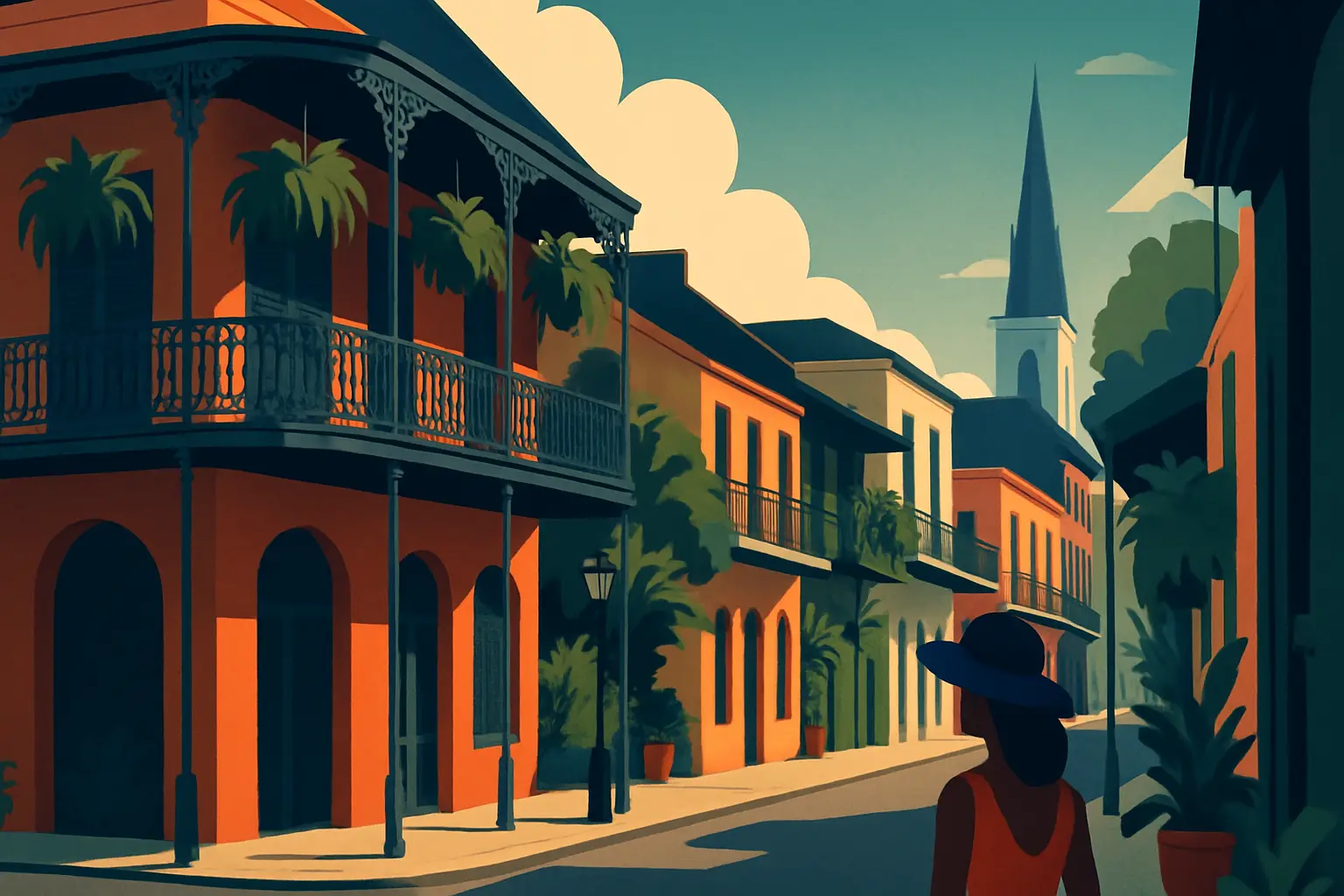
Here is a genuinely surprising fact about the French Quarter: it is not French. The cast-iron balconies, the arcaded streets, the stucco facades hiding lush interior courtyards — these are predominantly Spanish, built after two catastrophic fires leveled the original French colonial town in 1788 and 1794. The neighborhood most Americans imagine as the jewel of French Louisiana was rebuilt under Spanish Governor Andrés Almonester y Roxas and reflects the architectural vocabulary of Havana and Cartagena as much as Paris. That gap between reputation and reality is precisely what makes the **Vieux Carré** — the French term for 'Old Square' — so endlessly rewarding for anyone willing to walk one block off Bourbon Street. This guide covers the thirteen blocks of the French Quarter that tourists routinely overlook: the antique galleries and jazz-era courtyards of **Royal Street**, the culinary and religious history of **Chartres Street**, the working waterfront culture of **Decatur Street**, and the quiet residential blocks above **St. Ann** where the neighborhood actually lives and breathes. Bring comfortable shoes, an appetite, and a tolerance for afternoon humidity. The French Quarter rewards the curious.
🗽 Short stories • Collectible cards • Learn as you travel
Arrive in the French Quarter before 10 a.m. or after 8 p.m. to avoid peak cruise-ship crowds. The blocks between Canal Street and St. Ann on Royal and Chartres are passable by 9 a.m. and the courtyards of Preservation Hall and Pat O'Brien's are quieter at opening. Summer mornings are brutally humid but almost tourist-free before 10.
Skip the Bourbon Street cover charges
Nearly every live music venue on Bourbon Street charges $10–$20 cover, but Fritzel's European Jazz Pub at 733 Bourbon Street has no cover and has hosted traditional jazz nightly since 1969. Frenchmen Street in the adjacent Marigny neighborhood (a 10-minute walk from Esplanade Avenue) offers four or five venues with free or $5 admission after 9 p.m.
Hidden courtyards are public (sometimes)
Several of the Quarter's famous interior courtyards are accessible during business hours without a reservation. The courtyard at the Historic New Orleans Collection at 533 Royal Street is free to enter Tuesday through Sunday, 9:30 a.m. to 4:30 p.m. The Cornstalk Hotel at 915 Royal Street allows passersby to photograph its cast-iron fence, one of only two cornstalk fences in the city, at no cost.
The complete French Quarter neighborhood guide
1Why the French Quarter is Spanish, and why that changes everything you see
The original Nouvelle-Orléans was laid out in 1718 by Jean-Baptiste Le Moyne de Bienville on a crescent of land between the Mississippi River and Lake Pontchartrain. The grid that engineer Adrien de Pauger drew in 1721 — eleven blocks wide by six blocks deep, with a central Place d'Armes — is the same grid you walk today. But almost nothing standing in the Quarter predates 1794. The first great fire of Good Friday, 1788 destroyed 856 of the city's 1,100 structures. A second fire in 1794 burned another 212 buildings. What replaced them was rebuilt under Spanish colonial rule, which the Louisiana Territory had been under since 1762, and the architecture reflects that governance entirely.
Spanish builders favored thick stucco walls over timber framing, arcaded ground floors designed to shade pedestrians from subtropical heat, and interior patios rather than front-facing gardens. The famous wrought-iron and cast-iron balconies — which most visitors assume are French — were in fact popularized during and after the Spanish period, with the most elaborate examples dating to the American period of the 1830s through 1850s, when wealthy American merchants tried to outdo Creole neighbors in decorative ostentation. The Pontalba Buildings flanking Jackson Square, completed in 1850 by Baroness Micaela Almonester de Pontalba, contain some of the earliest cast-iron balconies in the country and the oldest continuously occupied apartment buildings in the United States.
Understanding this layered colonial history — French grid, Spanish architecture, American embellishment, African and Caribbean cultural influence — makes every walk through the Quarter more legible. The peeling stucco on a building at, say, 619 Chartres Street is not neglect; it is centuries of competing materials and climates showing through. The Vieux Carré Commission, established by Louisiana state constitution in 1936, now regulates every exterior change in the neighborhood, making the Quarter one of the most rigorously preserved historic districts in the United States.
2Royal Street: The Quarter's living room
Royal Street runs parallel to Bourbon Street, one block toward the river, and the contrast between them is almost comically complete. Where Bourbon offers neon, frozen daiquiri machines, and amplified cover bands, Royal offers antique shops, art galleries, operating gas lamps, and, on weekend afternoons, brass bands that set up at the intersection of Royal and St. Peter and play for tips. The music is better and it is free.
The street's antique trade is serious and old. M.S. Rau Antiques at 630 Royal Street has operated since 1912 and stocks inventory that includes American and European furniture, jewelry, and fine art at prices ranging from a few hundred dollars to well into six figures — it is a museum you can buy from. Bush Antiques at 2109 Magazine Street has a French Quarter satellite presence, but the main Royal Street cluster runs from the 300 to 900 blocks and includes roughly thirty dealers within walking distance. Even if purchasing is not on the agenda, the window displays alone — a 19th-century Creole armoire here, a collection of Newcomb College pottery there — constitute an informal survey of Louisiana decorative arts history.
At 533 Royal Street, the Historic New Orleans Collection occupies a complex of historic buildings including the Merieult House, one of the few structures to survive the 1794 fire. Its free permanent galleries cover Louisiana history from colonial settlement through the 20th century with original maps, photographs, and manuscripts. The research center is used by scholars from around the world. Across the block, at 613 Royal Street, stands the Louisiana Supreme Court Building (now used by the Fourth Circuit Court of Appeal), a 1910 Beaux-Arts structure so grandiose it required demolishing an entire city block of 18th-century buildings — a decision that still generates debate among preservationists.
On weekend mornings, the block of Royal between St. Peter and St. Louis becomes an informal pedestrian zone as street performers, sketch artists, and the brass bands draw crowds thick enough that cars simply cannot pass. This is the French Quarter functioning as a neighborhood plaza rather than a tourist corridor, and it is worth timing a visit accordingly.
M.S. Rau Antiques — 630 Royal St.; Mon–Sat 9 a.m.–5:15 p.m., Sun 10 a.m.–5 p.m.
Historic New Orleans Collection — 533 Royal St.; Tue–Sat 9:30 a.m.–4:30 p.m., Sun 10:30 a.m.–4:30 p.m.; free general admission
Brass band corner: Royal and St. Peter, weekend afternoons, tip-based; no schedule, arrive and wait
Keep touring
Discover more about United States in minutes
Get short, interactive stories that make each place easier to remember while you travel.
3Chartres Street and the religious geography of the Quarter
Chartres Street (pronounced 'CHAR-ters' by locals, never like the French cathedral city) is the Quarter's ecclesiastical and institutional spine. It begins at Canal Street with the massive bulk of the old New Orleans Custom House, begun in 1848 and not completed until 1881, making it one of the longest federal construction projects of the 19th century. The building's Marble Hall — the main business room, a soaring 95-foot-long barrel-vaulted space with fourteen marble columns — is occasionally open to the public and worth every effort to enter.
Two blocks down Chartres, Jackson Square opens up, and the view from its central iron fence toward St. Louis Cathedral is the most photographed image in Louisiana. The Cathedral itself, dedicated in 1794 on the site of two earlier churches and consecrated in 1851 after a major reconstruction, is the oldest continuously active Roman Catholic cathedral in the United States. Masses are held daily; the interior, with its painted vaulted ceiling and massive pipe organ, is open to visitors between services at no cost. The Cabildo and Presbytere, flanking the Cathedral on either side, are state museums operated by the Louisiana State Museum system. The Cabildo — the old Spanish colonial government building — is where the Louisiana Purchase transfer documents were signed in 1803. Admission is $9 for adults.
Below Jackson Square, Chartres becomes quieter and more residential. The block between Ursulines and Governor Nicholls contains the Old Ursuline Convent at 1100 Chartres Street, completed in 1752 and the oldest surviving building in the Mississippi River Valley and the oldest building in the United States that has been in continuous use. The Ursuline nuns arrived in New Orleans in 1727 to run a hospital and school; their convent, now a museum and archive, still belongs to the Archdiocese of New Orleans. Guided tours run Tuesday through Friday at 10 a.m., 11 a.m., 1 p.m., and 2 p.m. for $10 per person. The quiet courtyard behind the convent, visible through iron gates on the Chartres Street side, is one of the oldest enclosed green spaces in urban America.
St. Louis Cathedral — Jackson Square; open daily to visitors 8:30 a.m.–4 p.m. between Masses; free
The Cabildo — 701 Chartres St.; Tue–Sun 10 a.m.–4:30 p.m.; $9 adults, $7 seniors, free under 12
Old Ursuline Convent — 1100 Chartres St.; guided tours Tue–Fri, four daily departures; $10 adults
4Decatur Street and the working waterfront that shaped Creole cuisine
Decatur Street runs along the river side of the Quarter, separated from the Mississippi by the Moon Walk promenade and the elevated flood-protection levee. This was the commercial waterfront of colonial New Orleans, and its character — rougher, louder, more transactional than Royal or Chartres — reflects centuries of longshoremen, riverboat workers, sailors, and market vendors. French Market, which stretches along Decatur from Jackson Square to Barracks Street, has operated on this site since 1791, making it the oldest public market in the United States. The covered arcades of the original market building were completed in 1813. Today, the market hosts a combination of produce vendors, craft sellers, and a permanent flea market section that operates daily from 9 a.m. to 6 p.m. The produce hall, closest to Jackson Square, is the most historically authentic section.
At the upriver end of the French Market complex, Café Du Monde at 800 Decatur Street has served beignets and café au lait continuously since 1862 — with the exception of a closure after Hurricane Katrina in 2005. The beignets ($5.50 for three as of 2025) are fried to order and buried in powdered sugar; the coffee is chicory-blended, a tradition dating to the Civil War when coffee was scarce and chicory root was used as an extender. The café is open 24 hours a day, every day except Christmas. Powdered sugar on black clothing is essentially unavoidable.
The food traditions of Decatur and the French Market connect directly to what Creole cuisine actually means: a cooking tradition that synthesized French technique, Spanish seasoning, African cooking methods (particularly the use of filé powder from the Choctaw, and the okra that enslaved West Africans brought to Louisiana), and the produce abundance of the Mississippi Delta. Central Grocery at 923 Decatur — open since 1906 and operated by the same Italian-immigrant family tradition — claims invention of the muffuletta, the round Sicilian-bread sandwich loaded with Italian meats and olive salad. A whole muffuletta runs about $25 and feeds two people comfortably. The grocery closes by 5 p.m. most days, so plan accordingly.
5The residential Quarter above St. Ann: Where locals actually live
The French Quarter is divided informally into two zones by St. Ann Street, which cuts across the neighborhood at its midpoint. Below St. Ann (toward Canal Street and the CBD) is the tourist Quarter: Bourbon Street at its loudest, the hotels, the clubs, Preservation Hall, Antoine's. Above St. Ann, toward Esplanade Avenue and the Faubourg Marigny, the Quarter is residential and has been for most of its history. This is where writers, artists, musicians, and a decreasing number of working-class Creole families have lived — and where the neighborhood's domestic architecture is most legible.
The blocks of Ursulines, Governor Nicholls, Barracks, and Esplanade contain some of the finest surviving examples of the Creole cottage and Creole townhouse building types: single-story or two-story structures set flush to the sidewalk with no front yard, tall shuttered windows that reach the floor (functioning as doors when open to catch river breezes), and deep rear yards that extend to a dependency building housing what were, in the 18th and 19th centuries, enslaved workers' quarters. This building typology is unique to New Orleans and directly reflects the city's colonial-era urban slavery, a history the Whitney Plantation outside the city tells explicitly, but which the Quarter's residential blocks encode architecturally.
Lafitte's Blacksmith Shop at 941 Bourbon Street — in this upper residential stretch — is worth noting for both its architecture and its mythology. Built between 1722 and 1732, it is one of the oldest surviving structures in the Mississippi Valley, a rare example of briquette-entre-poteaux (brick-between-posts) construction in which the structural wooden frame is filled with bricks. The bar operating inside it has no sign above the door and no bright lighting; it is lit primarily by candles. The pirate Jean Lafitte may or may not have operated a blacksmith shop here as a front for illegal activities — the historical evidence is thin, but the building is entirely real and entirely extraordinary.
6Preservation Hall and the music ecosystem tourists almost always get wrong
Preservation Hall at 726 St. Peter Street is one of the most misunderstood venues in American music. Founded in 1961 by Allan and Sandra Jaffe as a dedicated space for traditional New Orleans jazz at a moment when the style was being displaced by rhythm and blues and rock, it is not a museum or a tourist attraction designed to simulate jazz history — it is an active performance organization that employs musicians, records albums, and tours internationally. The Preservation Hall Jazz Band has performed at Carnegie Hall, at the Kennedy Center, and with the Foo Fighters. Attending a set here is not nostalgia tourism; it is attending a living institution.
The practical details matter: the hall holds roughly 100 people standing. Doors open at 5 p.m. and shows run every 45 minutes through 11 p.m. General admission is $20, purchased at the door (cash only for door sales; online tickets at $35–$50 include a reserved spot). Lines begin forming 30 minutes before each set; arriving early is essential for the first set of the evening. The hall has no air conditioning and no bar — bring water if you are sensitive to heat. The physical space, a converted 19th-century residence with peeling paint and mismatched seating, is deliberately un-renovated. That aesthetic is intentional.
Beyond Preservation Hall, the French Quarter's music geography extends to Frenchmen Street in the Marigny, accessible via a 10-minute walk down Esplanade Avenue from the Quarter's upper boundary. The Spotted Cat Music Club at 623 Frenchmen Street and d.b.a. at 618 Frenchmen Street both charge $5–$10 cover and feature jazz, funk, brass, and Americana from local working musicians seven nights a week. The New Orleans Jazz & Heritage Festival, held annually at the Fair Grounds Race Course the last weekend of April and first weekend of May, is the large-scale version of what the Quarter's smaller venues do year-round: present the full spectrum of Louisiana music at professional quality.
Preservation Hall — 726 St. Peter St.; shows 5 p.m.–11 p.m. nightly; $20 door (cash), $35–$50 online
The Spotted Cat Music Club — 623 Frenchmen St.; no cover most nights, $5–$10 on weekends; open from 4 p.m.
d.b.a. — 618 Frenchmen St.; $5–$10 cover after 9 p.m.; open daily from 5 p.m.
7Practical guide: When to go, how to navigate, and what to budget
The French Quarter rewards visits structured around time of day more than season. January through March offers the most comfortable walking temperatures (55–72°F) and the lowest hotel rates outside of Mardi Gras season. Mardi Gras itself — the two weeks culminating on Fat Tuesday, which falls anywhere from early February to early March — transforms the Quarter into a genuinely different experience: massive crowds, closed streets, extraordinary spectacle on the parade routes, but difficult logistics for anyone trying to visit specific venues or restaurants. Jazz Fest weekends in late April and early May bring similarly dense crowds and hotel rates that triple or quadruple.
June through September is hot, humid, and prone to afternoon thunderstorms, but the Quarter is relatively uncrowded and hotels are inexpensive — rates at mid-range properties like the Hotel Monteleone (214 Royal Street, a 1886 landmark with a famous rotating Carousel Bar) can drop to $150–$200 per night versus $300–$500 in peak season. The Carousel Bar itself, which rotates one full revolution every 15 minutes, serves classic cocktails for $14–$18 and requires no reservation — arrive at opening (11 a.m.) to guarantee a seat on the revolving section.
Best walking weather: January–March; average high 62–72°F, minimal rain
Hotel Monteleone — 214 Royal St.; from $150/night off-season, $350+ during Mardi Gras and Jazz Fest
Carousel Bar at Hotel Monteleone — open daily 11 a.m.–midnight; no cover, cocktails $14–$18
Café Du Monde — 800 Decatur St.; open 24 hours except Christmas; beignets $5.50 for three
Central Grocery muffuletta — 923 Decatur St.; whole $25, half $13; open Mon–Sat 9 a.m.–5 p.m., Sun 10 a.m.–5 p.m.
Parking: avoid driving into the Quarter; the Rampart Street garage charges $15–$25/day and streetcar access from Canal Street is $1.25 per ride
Safety: the Quarter is heavily policed and generally safe until late night; the blocks above Bourbon toward Rampart Street after midnight are less so — trust your instincts
Keep touring
Ready to walk the French Quarter like you actually know what you're looking at?
TourMe's New Orleans collection includes interactive story chapters on the colonial history of the Vieux Carré, collectible cards for landmark buildings from the Cabildo to the Old Ursuline Convent, and audio-guided walks along Royal and Chartres streets that explain what you are seeing in real time. Each card unlocks historical context you won't find on a standard tour — including the architectural evidence of New Orleans' Spanish colonial period that most guides skip entirely.