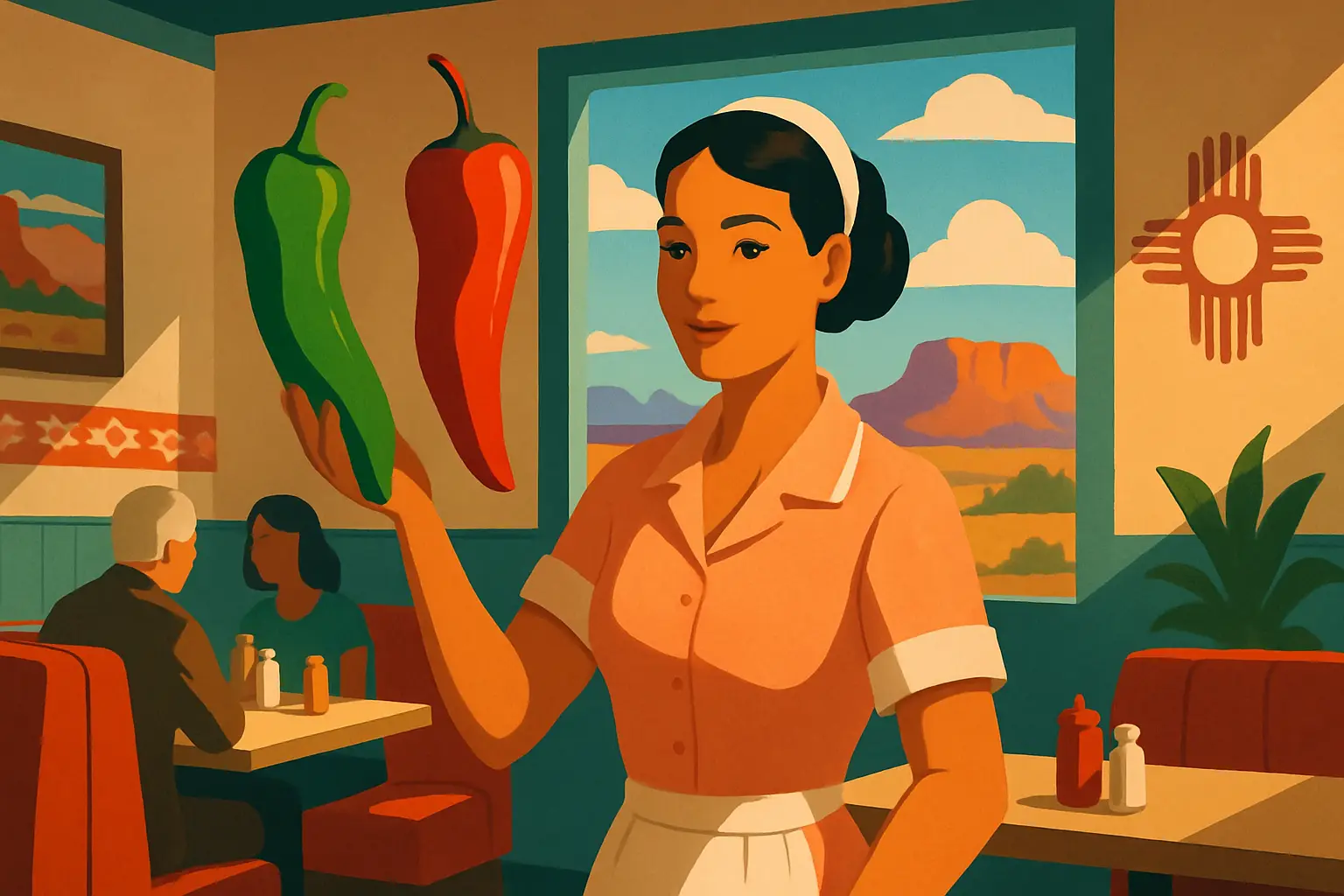
Long before New Mexico was a U.S. territory, chile peppers were already central to the food culture of the Pueblo peoples who had cultivated capsicum varieties in the Rio Grande corridor for centuries. When Spanish colonizers arrived with Juan de Oñate's 1598 expedition — establishing the first permanent European settlement in what is now the American Southwest at San Juan de los Caballeros, near present-day Española — they encountered a chile-forward cooking tradition they didn't replace but absorbed. The fusion that developed over the following two centuries, blending Spanish livestock, grains, and cooking fats with indigenous chile, corn, and squash, became the foundation of New Mexican cuisine, a culinary tradition distinct from both Mexican regional cooking and American Southwestern food.
The pivotal agricultural development came in the late nineteenth century, when Dr. Fabián García at the New Mexico College of Agriculture and Mechanic Arts (now New Mexico State University in Las Cruces) began systematic chile breeding. By 1913, García had released New Mexico No. 9, the first standardized chile cultivar developed through scientific selection — a pod that was meatier, more consistent in heat, and better suited to commercial cultivation than the landrace varieties grown by Pueblo and Hispanic farmers. His work established the genetic lineage of nearly every commercial New Mexico chile grown today.
The Hatch Valley, roughly 40 miles north of Las Cruces along the Rio Grande, emerged as the epicenter of commercial production because of its unique combination of high desert altitude (approximately 4,000 feet), alkaline soil, intense summer sun, and dramatic day-to-night temperature swings — conditions that stress the plants in ways that concentrate sugars and capsaicin. By the mid-twentieth century, 'Hatch chile' had become a regional brand, even though chile grown elsewhere in New Mexico (and even parts of southern Colorado) is botanically identical. The name is geographical marketing as much as agricultural designation, but the terroir argument is real: blind taste tests consistently show Hatch-valley-grown pods have a flavor complexity that differs from the same cultivar grown in California's San Joaquin Valley.
Green chile is simply the unripe, fresh-harvest version of the New Mexico chile pepper (most commonly cultivars like Big Jim, Sandia, Lumbre, or Heritage 6-4). Harvest runs from late July through early October, with peak season in August and September. At this stage, the pods are thick-walled, moist, and bright green — intensely vegetal, with flavors that range from grassy and slightly sweet to sharp and fruity, depending on variety and heat level.
The defining preparation step is fire-roasting. Fresh green chiles are tumbled in large rotating wire drums over propane burners — you'll see these rigs running outside grocery stores and roadside stands across New Mexico every August, filling entire parking lots with smoke that smells like nothing else on earth. The fire blisters and chars the outer skin, which is then removed after the pods steam in closed bags or containers. What remains is a soft, smoky, deeply flavored flesh that can be chopped into sauce, stuffed, frozen whole, or layered directly onto burgers, eggs, or burritos.
Green chile sauce — the stuff poured over enchiladas, smothered on burritos, or ladled into bowls of green chile stew — is typically made by sautéing garlic and onion in lard or oil, adding chopped roasted green chile, flour or masa as a thickener, and chicken or pork stock. Caldillo, the green chile stew served as a main course, adds cubed pork shoulder or beef and is a cold-weather staple across northern New Mexico. The heat level of green chile is genuinely unpredictable year to year — a wet summer produces milder pods, a dry one produces fire — which is why experienced New Mexican cooks taste-test every batch before committing a heat level claim to their customers.
Chefs at Rancho de Chimayó (300 Juan Medina Rd, Chimayó, NM) and Casa de Benavidez in Albuquerque both emphasize that good green chile sauce should taste of the pepper itself, not disappear into a generic 'hot sauce' profile. The freshness window matters enormously: green chile frozen within 24 hours of roasting is dramatically superior to any canned product.
Get short, interactive stories that make each place easier to remember while you travel.
Red chile is not a different variety of pepper — it is the same New Mexico chile allowed to ripen fully on the plant until it turns red, then dried. This sounds like a minor distinction. The flavor difference is profound. The drying process, which traditionally happens by stringing the pods into ristras (those long hanging chains of dried red chiles you see on every adobe wall in Santa Fe and Taos) and leaving them in the sun for weeks, concentrates sugars, develops earthy and raisin-like complexity, and produces a fundamentally different flavor compound profile. Red chile tastes of dried fruit, dark earth, chocolate undertones, and a slow-building heat that tends to linger longer than green chile's sharper, more immediate punch.
Red chile sauce is made by rehydrating whole dried pods — stems and seeds removed — in hot water, then blending the softened flesh with garlic, cumin, oregano (specifically Mexican oregano, which is a different plant from Mediterranean oregano), and often lard-rendered pork stock. The result is a thick, smooth, deep burgundy-red sauce with a silky texture that is nothing like the tomato-based 'red sauce' found in Tex-Mex restaurants outside New Mexico. There are no tomatoes in traditional New Mexican red chile. The addition of tomatoes is widely considered a Tex-Mex or California adaptation.
The Chimayó pepper, a landrace variety grown for centuries in the village of Chimayó in the Sangre de Cristo foothills north of Santa Fe, produces red chile with a particularly complex, slightly smoky flavor distinct from commercial Hatch varieties. El Potrero Trading Post (15 Santuario Dr, Chimayó, NM 87522) sells Chimayó red chile powder for approximately $12–$18 per pound — a significant premium over commodity New Mexico red chile powder, but considered worth it by serious home cooks. The village's red chile is one of the most geographically specific flavor profiles in American food, comparable in concept to a single-origin coffee or a named-vineyard wine.
Hatch, New Mexico (population approximately 1,600) sits along U.S. Highway 26 in Doña Ana County, roughly 38 miles north of Las Cruces. The town has exactly one major industry and one annual moment of international fame. During the Hatch Chile Festival on Labor Day weekend, the population swells to an estimated 30,000 visitors who arrive from across the country to buy fresh-roasted chiles, watch the crowning of the Chile Queen, eat green chile cheeseburgers, and load their cars with sacks of peppers before the season ends.
The surrounding Hatch Valley produces an estimated 60–70 percent of New Mexico's commercial chile crop, though the exact figure fluctuates with irrigation availability from the Rio Grande and competition from Mexican imports, which have captured a significant share of the processed chile market since the 1990s. Local farmers like those operating under the Hatch Chile Growers Association have pushed for a formal geographic indication similar to a European PDO designation, but as of mid-2026, 'Hatch chile' remains an unprotected regional brand — meaning chile grown in California, Colorado, or Mexico can legally be labeled 'Hatch-style.'
Within Hatch itself, Pepper Pot Restaurant (formerly one of the most storied local institutions) and Sparky's Burgers, BBQ & Espresso (115 Franklin St, Hatch, NM 87937) are the two most recommended dining stops. Sparky's is genuinely eccentric — a roadside BBQ joint decorated with fiberglass dinosaurs and vintage Americana — but its green chile cheeseburger, made with locally grown roasted green chile, is consistently cited as one of the best versions in New Mexico. Expect to pay $10–$14 for a burger and plan for a wait on weekends.
Shopping for chiles to take home is straightforward: most farms sell direct during harvest season. Hatch Chile Express and Matt's Chile Market both set up along the highway with fresh and roasted product by the bag, typically selling a 35-pound burlap sack of roasted, unpeeled green chile for $30–$50 depending on the year's crop quality and heat level designation (mild, medium, hot, extra hot).
Understanding 'red or green' in the abstract is useful. Understanding it in the context of an actual New Mexico plate is essential for navigating a menu without confusion.
The New Mexico enchilada is not rolled — it's stacked. Three corn tortillas are layered flat with filling (typically ground beef, chicken, or cheese) and stacked like a short tower, then smothered in sauce, topped with cheese, and often finished with a fried egg. The egg yolk, when broken, runs into the sauce and is considered by many locals to be non-negotiable. When you order at a traditional New Mexican restaurant, the server's 'red or green?' is asking which sauce goes over that stack.
'Christmas' — answering that you want both red and green — is a fully accepted and common response. It's not a joke order or a tourist move; it's practical when you genuinely want to compare both sauces or when a restaurant has particularly strong versions of each. At The Shed in Santa Fe, the Christmas enchilada comes with both sauces separated by a thin dividing line of cheese, allowing you to eat each side distinctly before merging them. At Café Pasqual's (121 Don Gaspar Ave, Santa Fe, NM 87501), the breakfast enchiladas with Christmas sauce are among the most photographed dishes in the city.
The green chile cheeseburger deserves separate mention. It is New Mexico's most beloved fast-food export — not a fine dining item, but a diner and drive-in staple. Bob's Burgers in Albuquerque, Duran's Pharmacy (1815 Central Ave NW, Albuquerque, NM 87104 — yes, an actual pharmacy with a lunch counter), and Owl Bar & Café in San Antonio, NM (not Texas — a tiny village near the Trinity nuclear test site) are all considered canonical green chile cheeseburger destinations. The Owl Bar's version ($9–$12) uses locally grown green chile and has been drawing road-trippers for decades.
For travelers exploring New Mexico's culinary landscape, the chile sauce choice is the entry point into a much larger conversation about regional identity.
New Mexico chile heat is measured using the Scoville scale, but the more practical system used by growers and restaurants is a four-tier labeling: mild, medium, hot, and extra hot. The problem is that these designations are relative to New Mexico's palate, not to a national standard. A 'medium' New Mexico green chile from a hot growing year can exceed 15,000–25,000 Scoville Heat Units — comparable to a serrano pepper — while 'mild' from a wet season might clock in around 2,000–5,000 SHU, roughly on par with a poblano.
The NuMex cultivar family, developed at New Mexico State University's Chile Pepper Institute (NMSU campus, Las Cruces, NM 88003) over the past century, encompasses dozens of named varieties. NuMex Big Jim, released in 1975 by horticulturist Dr. Roy Nakayama, was once certified by Guinness as the world's largest chile pepper and remains the most widely grown commercial green chile cultivar. NuMex Lumbre and NuMex Barker are hotter alternatives; NuMex Heritage 6-4 is a modern re-release of García's original 1950s commercial variety, developed to recapture the flavor profile that decades of commercial hybridization had gradually diluted.
The Chile Pepper Institute at NMSU is genuinely worth visiting if you're in Las Cruces. It maintains a living gene bank of more than 6,000 capsicum accessions — one of the largest in the world — and offers a small museum and demonstration garden open to the public. Hours are typically Monday–Friday 8 a.m.–5 p.m.; admission is free, though donations are encouraged. The institute's online seed store sells heritage and specialty New Mexico chile varieties for home growers, with packets priced at $4–$8.
For travelers with serious heat tolerance, asking a server which specific variety is being used that week is not a pedantic question — it's practical self-defense. In a good New Mexican restaurant, the staff knows exactly where their chile came from and what the heat profile is this season.
The geography of great New Mexican chile cooking roughly follows the Rio Grande corridor north from Las Cruces through Albuquerque, Santa Fe, Española, and up to Taos. Each city has its own character and its own iconic establishments. Below are the most consistently recommended destinations with practical details for planning a trip.
**The Shed, Santa Fe** — 113½ E Palace Ave, Santa Fe, NM 87501. Open Tue–Sat 11 a.m.–2:30 p.m. and 5–9 p.m. Closed Sunday and Monday. Reservations strongly recommended for dinner. Enchilada plates $15–$22. The red chile here is made from Chimayó-adjacent pods and is considered a benchmark version.
**Café Pasqual's, Santa Fe** — 121 Don Gaspar Ave. Breakfast and lunch daily 8 a.m.–3 p.m.; dinner Thursday–Saturday 5:30–9:30 p.m. Expect a 20–40 minute wait for breakfast on weekends. Dishes $14–$28. Known for globally influenced New Mexican food; the huevos rancheros with Christmas sauce is a consistent standout.
**Duran's Pharmacy, Albuquerque** — 1815 Central Ave NW. Mon–Fri 9 a.m.–6:30 p.m., Saturday 9 a.m.–5 p.m. Cash preferred. Full lunch plates $9–$14. An actual working pharmacy with a walk-up lunch counter serving posole, red chile enchiladas, and sopapillas. Absurd and wonderful.
**Rancho de Chimayó, Chimayó** — 300 Juan Medina Rd, about 28 miles north of Santa Fe. Open Tuesday–Sunday for lunch (11:30 a.m.–3 p.m.) and dinner (5–9 p.m.); closed Monday. Entrees $16–$28. Set in a 19th-century hacienda; the green chile stew and carne adovada (pork marinated in red chile) are the must-orders.
**Owl Bar & Café, San Antonio NM** — 77 U.S. Highway 380, San Antonio, NM 87832. Mon–Sat 8 a.m.–9 p.m. Cash only. Green chile cheeseburger $9–$12. Worth a detour on the drive between Albuquerque and White Sands National Park.
**Sparky's Burgers, Hatch** — 115 Franklin St, Hatch, NM 87937. Wednesday–Sunday 10:30 a.m.–6 p.m. Burgers $10–$14. The most eccentric dining room in New Mexico, the most chile-forward cheeseburger, and a mandatory stop if you're making the Hatch pilgrimage.
**Sadie's of New Mexico, Albuquerque** — 6230 4th St NW. Open daily 11 a.m.–9 p.m. Plates $12–$20. Huge portions, reliably good green and red chile, and a local crowd that tells you something. The salsa alone is worth the visit.