United States • History & Culture • Natural Science
New England Fall Foliage Explained: The Chemistry, the Trees, and the Perfect Year
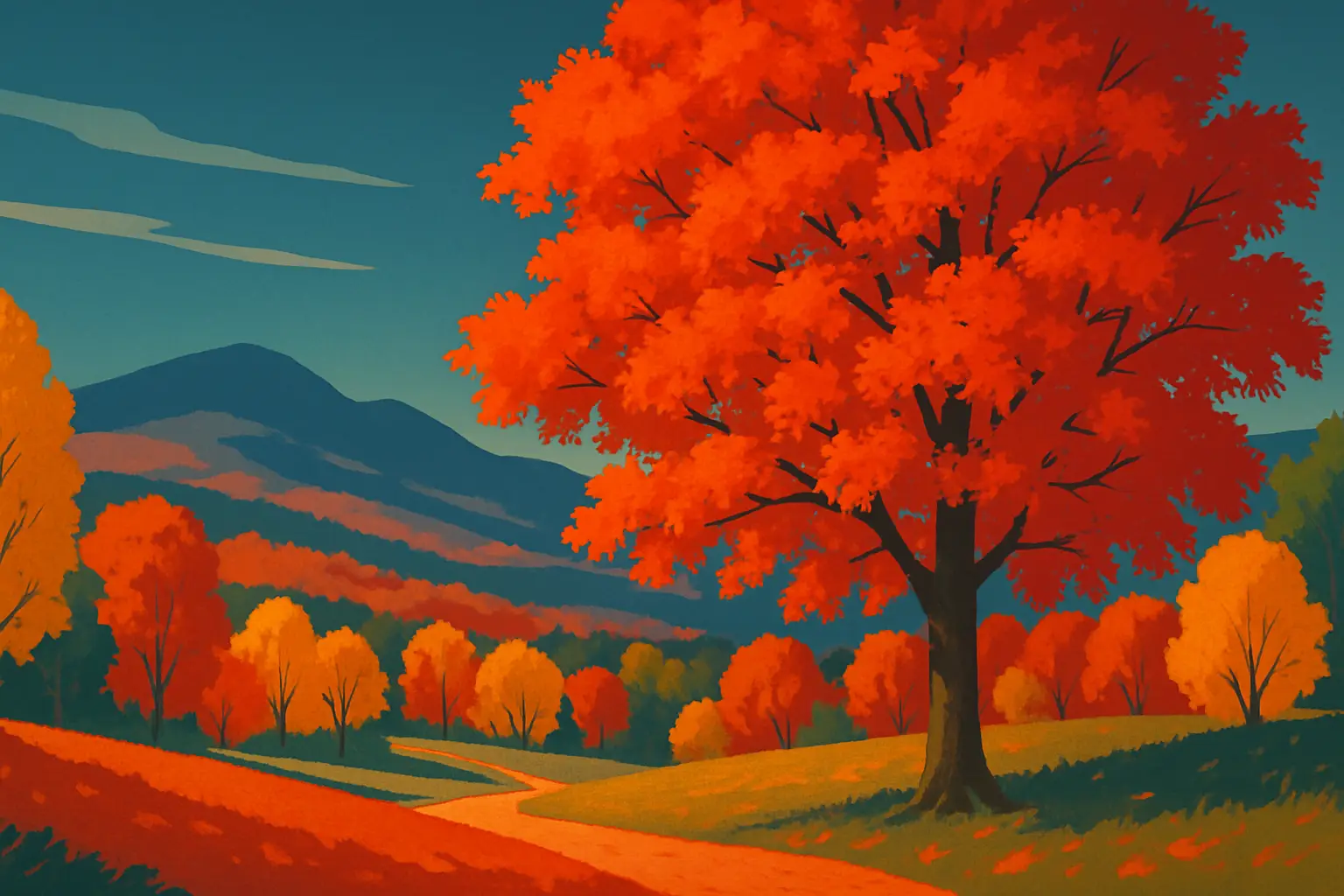
The red in a Vermont sugar maple isn't inherited from the tree's summer self — it's manufactured from scratch in the final weeks of autumn, a last-burst chemical production that costs the tree energy it will never recover. That's the counter-intuitive fact at the heart of New England's most famous seasonal spectacle: the colors you see each October aren't revealed by the loss of green pigment alone. The yellows and oranges were always there, masked by chlorophyll all summer. But the reds and purples? Those are brand-new molecules, anthocyanins, synthesized specifically as leaves die. Understanding that distinction changes how you look at the landscape entirely. This article walks through the precise biological and atmospheric mechanics behind New England's foliage season — why day length triggers the process, why temperature determines the intensity, which specific tree species are responsible for which colors, why some years produce jaw-dropping displays while others disappoint, and how to read forecasts intelligently so you actually arrive at peak rather than a week too late. By the end, you'll understand why a warm September followed by cold, clear October nights is the formula every foliage chaser prays for.
🗽 Short stories • Collectible cards • Learn as you travel
Peak foliage in northern Vermont and New Hampshire's White Mountains typically falls in the first two weeks of October; central Massachusetts and Connecticut peak roughly two to three weeks later, around mid-to-late October. Check the University of Vermont's free Foliage Report (uvm.edu/foliage) updated weekly starting in late September — it's the most scientifically grounded public tracker available and breaks color progression down by county.
Best roads, not just best views
Vermont Route 100 from Stowe south to Wilmington passes through 100 miles of mixed hardwood forest with almost no highway stretches. Allow a full day at minimum. The Kancamagus Highway (NH Route 112) through White Mountain National Forest is 34.5 miles of federally protected land with no traffic lights and eight developed overlooks — arrive before 8 a.m. on weekdays to avoid the leaf-peeper traffic that clogs it by midday on weekends.
Book lodging months early
Inns along Vermont Route 100 — places like the Stowe Motel & Snowdrift (738 Mountain Road, Stowe, VT; rooms from approximately $180/night) or the Inn at Long Trail in Killington ($150–$220/night) — sell out by August for Columbus Day weekend. If you're flexible on exact dates, aim for a Tuesday-through-Thursday stay when rates drop 15–25% and viewing areas are markedly less crowded.
The complete New England fall foliage guide
1Why New England? How geography and glacial history created the world's most celebrated foliage display
New England's autumn color show is not geographically inevitable — it's the result of a specific convergence of latitude, glacial soil history, tree species diversity, and oceanic climate influence that few other regions on earth replicate at the same scale. The Appalachian mountain chain, which spine-bones the region from Connecticut north through Vermont and New Hampshire into Maine, creates elevation gradients that stagger the onset of foliage by altitude, meaning a single landscape can display every stage of the color transition simultaneously. A hillside in Stowe, Vermont might show peak reds at 2,000 feet while the valley floor below is still mostly green — a layered panorama impossible in flat terrain.
The glacial history matters enormously. When the Laurentide Ice Sheet retreated roughly 12,000 years ago, it left behind thin, nutrient-poor, well-drained soils across much of northern New England. Those soils favor exactly the hardwood species — sugar maple (*Acer saccharum*), American beech (*Fagus grandifolia*), yellow birch (*Betula alleghaniensis*), red maple (*Acer rubrum*), and white ash (*Fraxinus americana*) — that produce the most dramatic autumn pigmentation. Regions with richer, deeper soils tend toward oak dominance, which produces respectable burgundy tones but lacks the electric scarlet of the sugar maple.
The Atlantic Ocean and the Gulf of Maine moderate summer temperatures enough to prevent the prolonged heat stress that degrades chlorophyll prematurely, while the region's position between 41° and 47° north latitude ensures that autumn day-length shortening is steep and rapid — one of the key triggers for the entire biochemical sequence. Essentially, New England sits in a climatic sweet spot: cold enough to trigger dramatic color change, wet enough through summer to keep trees well-hydrated, and topographically complex enough to extend the viewing season across six weeks rather than collapsing it into ten days. That's not luck; it's geology and climate aligned with unusual precision.
2The chemistry of color: what's actually happening inside a dying leaf
Every autumn color story begins with chlorophyll, the molecule responsible for photosynthesis and the green color of every deciduous leaf through spring and summer. Chlorophyll is inherently unstable — it breaks down constantly and must be continuously regenerated. During the long days of summer, trees produce it faster than it degrades. When day length drops below a critical threshold in late August and early September, a specialized layer of cells called the abscission zone begins forming at the base of each leaf stem, progressively cutting off the flow of nutrients and water between leaf and branch.
With the supply of raw materials interrupted, chlorophyll production stops. Existing chlorophyll degrades within days, and as the green mask disappears, the carotenoids — yellow and orange pigments that were present in the leaf all along, performing accessory roles in photosynthesis — become visible for the first time. This is why yellows and oranges appear reliable and relatively consistent year to year: they don't require new synthesis. Birch, aspen, hickory, and tulip poplar produce their characteristic golds and ambers primarily through carotenoid revelation rather than new pigment production.
The reds and purples are an entirely different story. Anthocyanins — the pigments responsible for the scarlet of sugar maples and the deep crimson of red maples — are produced fresh in the leaf as it senesces, manufactured from sugars trapped in the leaf after the abscission zone forms. The synthesis of anthocyanins requires sunlight and sugar, which is why their intensity is so sensitive to weather: warm, sunny days that drive photosynthesis and cool nights that slow sugar transport out of the leaf produce the highest sugar concentrations and therefore the most vivid red and purple tones. A cloudy, warm October produces dull reds. A sunny October with nights dropping into the low 40s°F produces colors that seem almost artificially saturated.
The exact biochemical purpose of anthocyanin synthesis in dying leaves remains an active area of research. The leading hypothesis is photoprotection — that the red pigment shields leaf cells from UV damage long enough for the tree to reabsorb valuable nutrients like nitrogen before the leaf drops. In effect, the tree is dismantling the leaf in an orderly fashion, and the brilliant red is a kind of sunscreen worn during the disassembly process.
Keep touring
Discover more about United States in minutes
Get short, interactive stories that make each place easier to remember while you travel.
3The specific trees responsible for each color — and where to find them
Knowing which tree produces which color transforms a foliage drive from passive appreciation into active identification, and New England's forests are diverse enough to reward the attention. The sugar maple (*Acer saccharum*) is the undisputed star: its leaves turn orange, scarlet, and occasionally deep burgundy depending on the individual tree's genetics and its microclimate exposure. Sugar maple dominates the hillside forests of Vermont's Green Mountains and the Berkshire Hills of western Massachusetts, and it's the tree most responsible for Vermont's reputation as the single best foliage state in the country.
Red maple (*Acer rubrum*) turns earlier than sugar maple — often by mid-September in northern zones — and produces a slightly more uniform, intense crimson. It tolerates wetter soils than sugar maple, so you'll find it in valley bottoms and along riverbanks. The Connecticut River Valley from Northampton, Massachusetts north through Vermont offers excellent red maple displays, often with the river as a mirror for the color.
American beech retains its dead leaves through winter, but in peak autumn they turn a warm copper-gold before settling into their characteristic pale brown. Beech is common throughout Acadia National Park in Maine, where it mixes with birch and maple on the granite slopes above Jordan Pond. The park's carriage roads, built by John D. Rockefeller Jr. between 1913 and 1940, offer 45 miles of gravel paths that pass through mixed hardwood stands at elevations ranging from sea level to nearly 1,000 feet.
Yellow birch produces soft, butter-yellow tones, and its presence signals you're in higher-elevation or north-facing terrain — it's a reliable indicator of the boreal transition zone. White ash turns a distinctive purple-bronze before dropping, providing a complement to the maple palette. Sumac (*Rhus typhina*), though a shrub rather than a tree, lines roadsides throughout New England and turns a flaming orange-red weeks before the forest canopy peaks, serving as an early-season signal that the main event is approaching.
Sugar maple: orange, scarlet, burgundy — peaks early-to-mid October in Vermont and NH
Red maple: deep crimson — peaks late September to early October, found in wet lowlands
American beech: copper-gold — peaks mid-October, excellent at Acadia National Park, ME
Yellow birch: butter yellow — peaks mid-October, common above 2,000 ft elevation
White ash: purple-bronze — peaks early-to-mid October; note: ash populations declining due to emerald ash borer
Sumac: bright orange-red — peaks late September, a reliable 2-3 week advance indicator
4Why some years are spectacular and others are merely pretty
Foliage forecasters — and they exist, employed by state tourism bureaus and university extension services — spend August analyzing summer rainfall data, September temperature records, and long-range October forecasts to predict whether a given year will be memorable or mediocre. The variables they track most closely are summer drought stress, the timing of the first frost, and the sequence of temperature swings through September and October.
Summer drought degrades leaf color by triggering early senescence: trees under severe water stress drop leaves prematurely, before anthocyanin synthesis can reach its peak. The severe drought years in Vermont and Massachusetts during the early 2020s produced displays that peaked a week to ten days earlier than average and were noticeably less vivid in the stressed areas. Conversely, a summer with consistent, moderate rainfall — not flooding, but adequate soil moisture — keeps trees healthy enough to go through an unhurried, complete senescence with maximum pigment production.
The first frost date is equally critical but in a counter-intuitive way: a frost that arrives before peak color actually damages anthocyanin-producing cells, resulting in browning rather than deepening reds. The ideal scenario is a gradual chill without hard frost — nights in the high 30s°F to low 40s°F through October — that slows sugar transport and maximizes anthocyanin synthesis without killing the leaf tissue outright. The record-quality foliage years New Englanders cite most often — 2017 and 2020 in Vermont, 2019 across most of the region — all featured this pattern: a dry, sunny late September and an October with nighttime lows that dipped gradually without spiking below 28°F.
Cloudy, rainy October weather is the most common foliage disappointment. Rain accelerates leaf drop mechanically, tearing leaves from branches before their colors fully develop. Cloud cover reduces the sunlight-driven sugar production that feeds anthocyanin synthesis. A full week of overcast, wet October weather can compress what would have been a ten-day peak window into four or five days, and the colors will never reach their potential saturation. This is why experienced foliage travelers watch weather forecasts obsessively rather than simply booking based on historical peak dates.
5The five best states for foliage — ranked by experience, not just color intensity
All six New England states produce significant foliage displays, but the experience of witnessing them varies considerably based on landscape, infrastructure, and the ratio of natural scenery to tourist congestion.
Vermont earns its reputation as the premier foliage destination through sheer consistency and landscape coherence. The state's relatively low population density, strict billboard ban (in effect since 1968), and preponderance of working farms and small villages mean the foliage is rarely framed by commercial sprawl. Stowe, Woodstock, and Grafton are the classic base towns, each within 30 minutes of excellent viewing without requiring a car at all.
New Hampshire offers the White Mountains as its centerpiece — a federally protected landscape where Franconia Notch State Park and the Kancamagus Highway provide dramatic mountain-framed color. The Mount Washington Auto Road (base at 1,600 ft, summit at 6,288 ft) lets visitors drive through every stage of senescence in a single vertical ascent. Road toll is approximately $38 per car plus $9 per adult passenger as of 2025.
Maine delivers the most remote and least crowded experience. Acadia National Park (park entrance pass approximately $35 per vehicle for a 7-day pass) combines coastal scenery with hardwood color in a combination unique on the East Coast. The Moosehead Lake region in the state's interior offers boreal forest foliage with almost no tourist infrastructure — rewarding for self-sufficient travelers.
Massachusetts provides the most accessible entry point. The Mohawk Trail (Route 2) through the Berkshires has been drawing leaf-peepers since the early 20th century — it was one of the first scenic byways in the United States, designated in 1914. Northampton and Lenox serve as comfortable bases with strong restaurant and cultural offerings to supplement the outdoor experience.
Connecticut peaks latest and offers the most understated display, but the Litchfield Hills in the state's northwest corner produce underrated foliage amid Revolutionary-era village greens and covered bridges that draw far smaller crowds than Vermont equivalents.
6Climate change and the future of foliage season
The spectacle New Englanders and their visitors take for granted is already shifting measurably. Researchers at Boston University and the Harvard Forest in Petersham, Massachusetts — one of the longest-running ecological research sites in the United States, with continuous records dating to 1907 — have documented a consistent trend: autumn senescence in New England is occurring later in the season as average temperatures rise, and the duration of peak color is compressing.
The mechanism is straightforward. Warmer autumns delay the temperature cues that trigger abscission zone formation. When trees receive those cues later, the window between peak color and the first hard frost narrows, because the frost date hasn't shifted proportionally. The result in some years is an accelerated, truncated display rather than the extended three-to-four-week peak that characterized the mid-20th-century foliage season.
The emerald ash borer (*Agrilus planipennis*), an invasive beetle that arrived in North America from Asia around 2002 and has since killed hundreds of millions of ash trees across the eastern United States, has already altered foliage composition in parts of New England. White ash, which provided the distinctive purple-bronze accent to the maple palette, is functionally disappearing from many forests. Some researchers argue that this loss, combined with warming-driven shifts in species composition — oak advancing northward at the expense of sugar maple as average temperatures rise — could materially change the character of New England foliage within decades.
None of this makes the current display less worth experiencing. If anything, the ecological context adds urgency. Harvard Forest's public trails in Petersham (Route 32, Petersham, MA 01366; free admission, open dawn to dusk) offer a rare opportunity to walk a forest where scientists have been tracking exactly these changes for over a century, with interpretive signs explaining ongoing research. It's one of the most intellectually honest foliage experiences available in New England.
7Practical planning: when to go, where to stay, and how to read a foliage forecast
Planning a foliage trip well requires treating peak color like a perishable event — because it is. The window between 50% color and 80% color (the range most people find genuinely spectacular) is typically five to ten days in any given location. Here's how to maximize your odds of hitting it.
**Peak timing by region** — Northern Vermont/NH White Mountains: Oct 1–15; Central VT/MA Berkshires: Oct 10–22; Connecticut/Rhode Island: Oct 15–31. These shift by a week earlier or later depending on the year's weather pattern.
**Best free forecasting tools** — Vermont Foliage Report (vermontfoliage.com, updated weekly Sep–Oct); NH Division of Forests & Lands (nhstateparks.org); Foliage Network (foliagenetwork.com) aggregates volunteer reports from across the region.
**Driving routes worth the detour** — Route 100 (VT, full length); Kancamagus Highway (NH-112); Mohawk Trail (MA-2, Greenfield to North Adams); Route 302 through Crawford Notch, NH.
**Lodging price benchmarks** — Budget motels along VT Route 100: $130–$180/night at peak; Mid-range inns in Stowe or Woodstock: $200–$350/night; Full-service resorts (Woodstock Inn, Twin Farms): $500–$1,200/night. Book 60–90 days out minimum for Columbus Day weekend.
**Best times of day for photography** — First two hours after sunrise produce the warmest light and lowest road traffic. Overcast days, despite being less ideal for color saturation, eliminate harsh shadows and can produce even, rich color in photographs.
**Leaf-peeper traffic reality check** — Vermont Route 100 through Stowe sees serious congestion from 10 a.m. to 4 p.m. on October weekends. The Kancamagus Highway parking areas fill by 9 a.m. on peak weekends. Plan driving east-to-west in the morning (sun behind you) and arrive at popular overlooks before 8 a.m.
**Hiking for foliage** — Acadia's Beehive Trail (1.6 miles, strenuous) delivers panoramic coastal-meets-hardwood views. Vermont's **Long Trail** section near **Camel's Hump** (3,791 ft) provides above-treeline views looking down into the canopy. Mount Greylock (3,491 ft, MA's highest peak) has a paved auto road and a fire tower with 360° views across four states.
**Entry fees** — Acadia National Park: $35/vehicle 7-day pass; White Mountain National Forest parking: America the Beautiful Pass ($80/year) covers all developed recreation sites; Most Vermont and Massachusetts state parks charge $4–$6/vehicle day-use fee.
Keep touring
Ready to experience New England's forests with the full story behind every color?
TourMe brings the science and history of American landscapes to life through short, beautifully written stories and collectible cards you unlock as you travel. Explore chapters on New England's natural history, the Indigenous land stewardship practices that shaped these forests before European settlement, and the cultural history of leaf-peeping itself — from 19th-century railroad excursions to the modern foliage forecast industry. Every drive, every trailhead, every overlook becomes richer when you know what you're actually looking at.