1. The dog that guided souls to the underworld
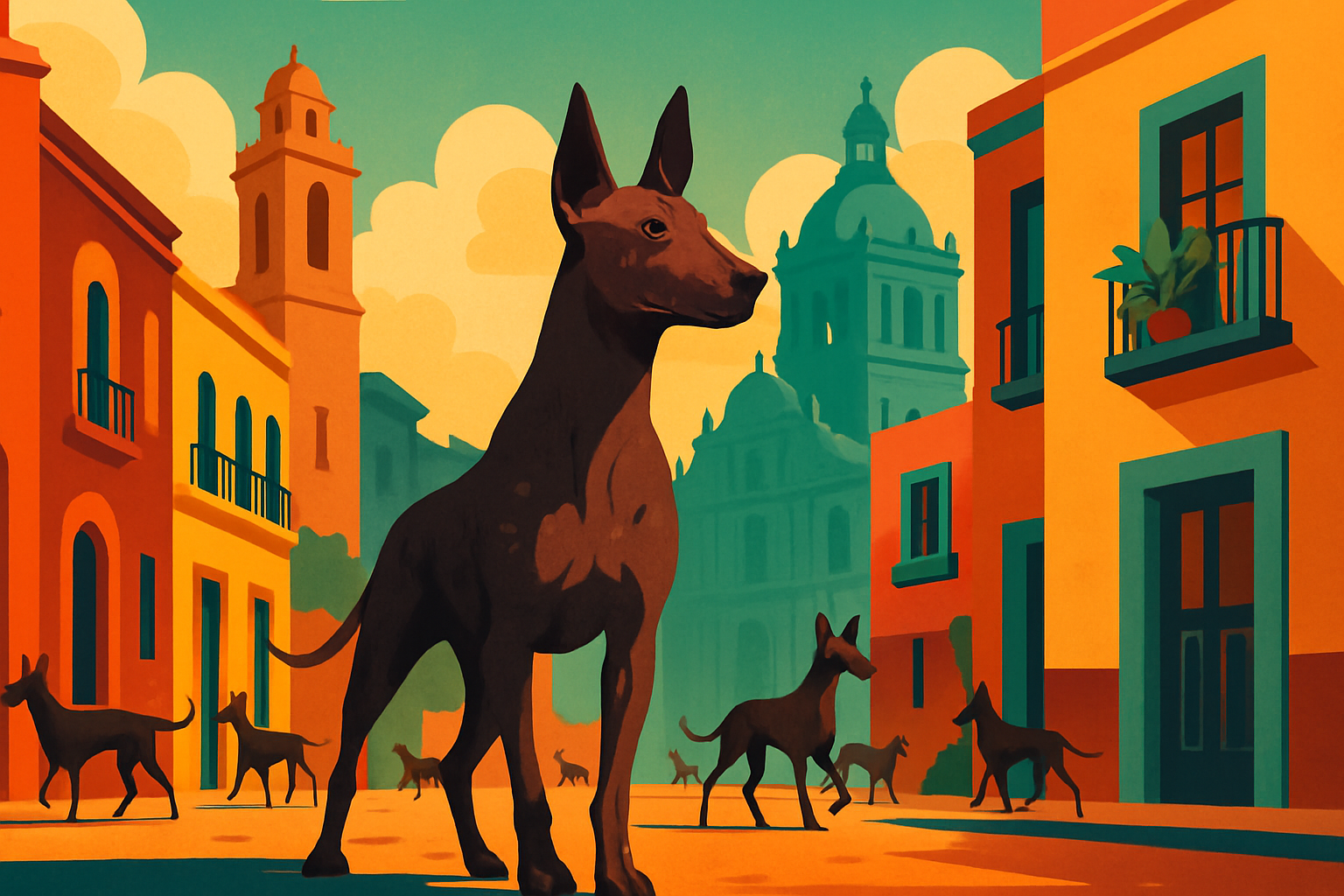
The Xoloitzcuintli — pronounced shoh-loh-eets-QUEENT-lee — takes its name from two Nahuatl words: Xolotl, the Aztec god of lightning and death, and itzcuintli, the Nahuatl word for dog. This naming is not incidental. In Aztec cosmology, the Xolo was the living companion of the god Xolotl himself — a dog specifically designed to guide the souls of the dead through the nine levels of Mictlan, the underworld, to their final resting place.
The journey to Mictlan took four years and required crossing a wide underground river. The Aztecs believed only a Xolo could lead a soul safely across. For this reason, Xolos were bred specifically to be sacrificed and buried alongside their owners — a practice archaeologists have confirmed at dozens of pre-Hispanic sites across Mexico, including at the Templo Mayor in Mexico City's Centro Historico. The most documented burial context is Offering 141, excavated during the 1978–1982 dig of the Templo Mayor temple complex after a utility crew accidentally broke through a colonial-era building wall and into the ancient site beneath. Xolo skeletal remains were found alongside human burials in ritual positions consistent with the ceremonial role documented in Aztec codices.
A ceramic Xolo figurine from roughly 600 CE sits in the Museo Nacional de Antropologia on Paseo de la Reforma — on the same floor as the Aztec Sun Stone. The complete guide to Aztec history covers the cosmological framework that gave the Xolo its sacred role in more depth.
2. What makes a Xolo a Xolo
The Xolo is not simply 'a hairless dog.' The breed exists in three size categories and two coat types, a combination that surprises most first-time visitors. The standard Xolo stands 46–60 cm at the shoulder and weighs 11–18 kg. The miniature variety stands 33–45 cm. The toy stands under 33 cm. Within each size, the breed naturally produces both hairless individuals and fully coated individuals — coated Xolos carry one recessive gene and are genetically identical to their bald littermates, usually appearing in the same litter.
The hairless Xolo's skin is smooth, taut, and noticeably warm to the touch — warmer than most dogs because without fur, the body radiates heat directly through the skin. This physical trait contributed to another documented historical use: Aztec healers placed Xolos against arthritic joints as heat therapy, a practice described in 16th-century colonial medical texts. The dogs also served as living blankets in the cold highland nights of the central plateau — at Mexico City's elevation of 2,240 meters, pre-Hispanic homes without fireplaces were genuinely cold after dark.
Today the Xolo is Mexico's national dog, officially recognized since 1956 by the Federacion Canofila Mexicana and acknowledged by the American Kennel Club since 2011.
3. The Dolores Olmedo Museum: where to meet a living pack
The easiest place in Mexico City to encounter living Xoloitzcuintlis is the Museo Dolores Olmedo at Avenida Mexico 5843 in the La Noria neighborhood at the southern edge of Xochimilco. The museum occupies a 17th-century hacienda estate that art collector Dolores Olmedo Patino acquired in 1962 and converted into a public museum in 1994. A pack of 14–17 Xoloitzcuintlis — hairless standard and miniature varieties — roams two grassy courtyard areas adjacent to the main buildings, well-socialized to visitors, wandering freely between stone archways and the estate's gardens alongside a small flock of peacocks.
The Xolos are only one reason to come. Olmedo was Diego Rivera's close friend and longtime patron, and the collection she assembled and donated to the Mexican public is extraordinary: 145 paintings by Rivera spanning his early cubist period through his mature muralist era, plus 25 works by Frida Kahlo, plus approximately 6,000 pre-Hispanic figurines and ceramics. The hacienda layout means you pass between gallery rooms and the open garden continuously — a dog may follow you from one Rivera room to the next.
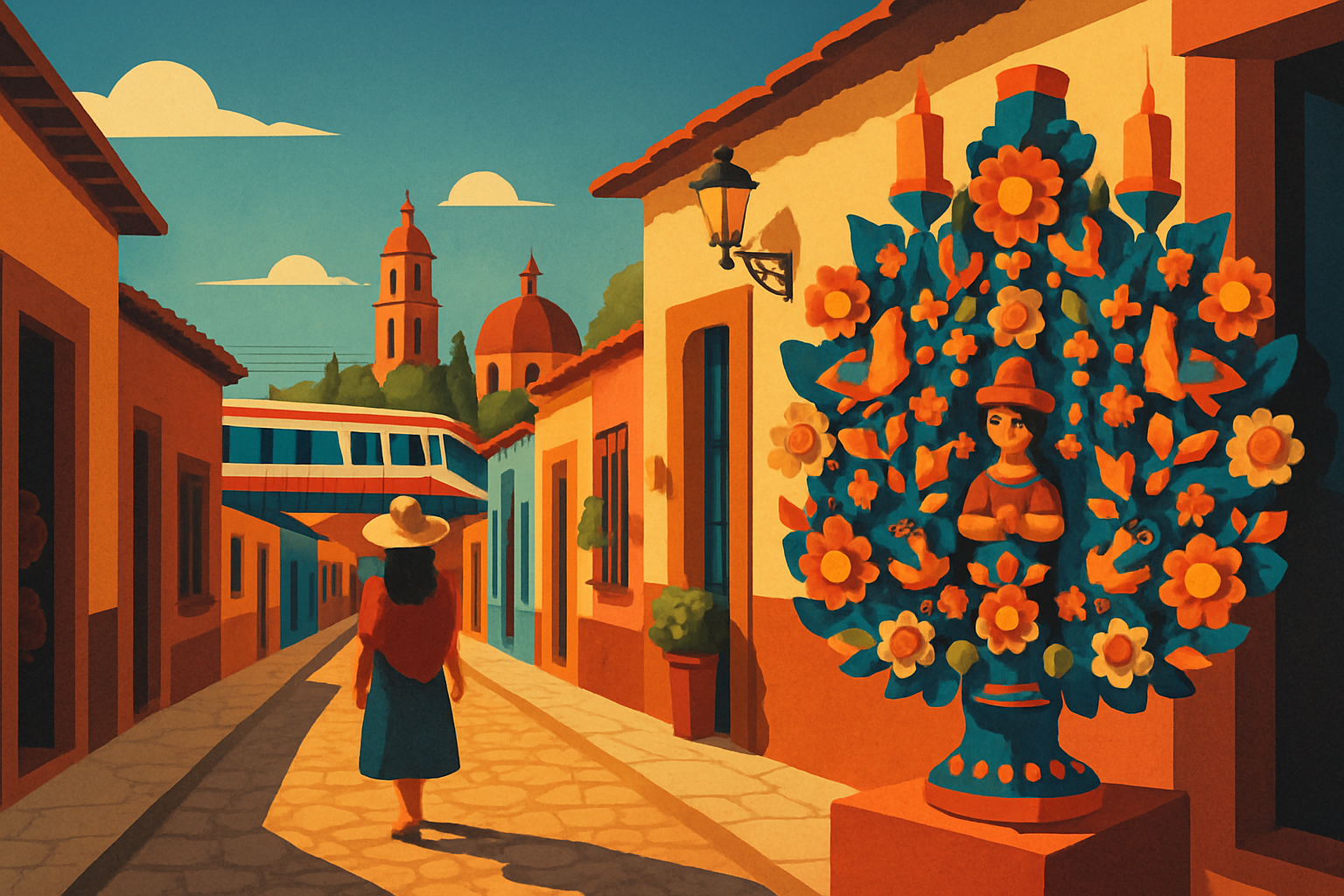
To get there, take Metro Line 2 south to Tasquena (the line's end), then board the Tren Ligero light rail heading toward Xochimilco and ride four stops to La Noria. The museum is a five-minute walk east along Avenida Mexico from the station. The trip takes about 30–35 minutes from the city center and costs two metro fares total. If you are already planning a visit to Xochimilco's canals, the museum pairs naturally on the same day.
4. The archaeological record — buried under Mexico City
Evidence of the Xolo's ceremonial role runs in a continuous line from 1500 BCE to the Spanish conquest. Xolo ceramic figurines have been found at Tlatilco burial sites on the western edge of what is now Mexico City — Tlatilco was occupied roughly 1200–800 BCE, predating the Aztec empire by nearly 3,000 years. At Teotihuacan, the great pre-Aztec pyramid city about 50 km northeast of Mexico City, Xolo skeletal remains appear in ritual burial contexts consistent with sacrificial use.
The Aztecs later formalized what earlier Mesoamerican cultures had already practiced. Post-conquest Spanish accounts from the 1520s document Xolos in indigenous households across Tenochtitlan — the colonial city that became Mexico City — noting both their ceremonial significance and their practical role as a food source in times of scarcity, a detail that complicated European missionaries' attempts to fully map the animal's spiritual standing.
The fact that Mexico City sits directly on top of Tenochtitlan means that construction projects continuously surface pre-Hispanic material. The Templo Mayor discovery in 1978 is the largest example, but workers building the Metro in the 1960s and 1970s uncovered burial sites at multiple stops along Lines 1 and 2. Xolo-related artifacts from those excavations are held at the Museo del Templo Mayor at Seminario 8 in the Centro Historico, two blocks from the Zocalo.
5. Coco — what Pixar got right, and what it invented
The 2017 Pixar film Coco introduced the Xolo to a global audience through Dante, the skeletal spirit dog who guides the living protagonist Miguel through the Land of the Dead. The filmmakers visited Mexico during production and consulted specifically on Dia de Muertos traditions and the Xolo's role in Aztec mythology. The core premise — a Xolo as guide through a death journey — is accurately drawn from the Nahuatl cosmological tradition described above.
What the film invented: Dante's skeletal transformation in the spirit world, and the Xolo as a facilitator of memory recovery rather than simply a physical navigator. In actual Aztec belief, the dog's function was logistical — crossing the underground river — not psychological. The Coco version is a compelling creative adaptation, not a traditional belief.
The film's release measurably increased interest in Xolo ownership and travel to Dolores Olmedo. The Federacion Canofila Mexicana reported higher breed registration inquiries in the years following. If your curiosity about the Xolo started with Dante, the Dolores Olmedo garden is where you cross from the film's version to the real animal — warm-skinned, curious, and unlikely to glow in the dark.
6. Diego Rivera, Frida Kahlo, and the Xolo's near-extinction
The Xolo came close to disappearing after the Spanish conquest. Colonial-era accounts document campaigns by Spanish administrators to eliminate indigenous dogs from New Spain, partly on hygienic grounds and partly because of their association with pre-Christian ritual. By the early 20th century, the breed had been reduced to small populations in remote coastal and highland regions of Mexico.
The deliberate recovery of the Xolo as a recognized breed is directly linked to Diego Rivera and Frida Kahlo. Both kept Xolos at the Casa Azul in Coyoacan — Frida's home, now the Museo Frida Kahlo at Londres 247. Rivera advocated publicly for the breed's preservation and incorporated Xolo imagery into several paintings and murals. Their involvement gave the recovery effort cultural legitimacy at a moment when it needed it. The 1956 Federacion Canofila Mexicana recognition came partly as a result of that sustained advocacy.
At the Dolores Olmedo Museum, this history comes full circle: Olmedo was Rivera's patron, the museum holds his largest public collection, and Xolos roam the garden as they did during Rivera's lifetime. The three — Rivera, the Xolo, and Dolores Olmedo — are threaded together in a way that makes the museum experience more than a zoo visit.
•Casa Azul (Museo Frida Kahlo), Londres 247, Coyoacan — Frida Kahlo and Diego Rivera kept Xolos here; the house is open to visitors Tuesday through Sunday
•Dolores Olmedo Museum, Av. Mexico 5843 — Rivera's patron's estate, now home to both his largest public collection and a living Xolo pack
•Federacion Canofila Mexicana, 1956 — official recognition that secured the breed's survival; AKC followed in 2011
7. Is the Xolo actually difficult to care for?
Relative to most dogs, not particularly — but the maintenance is different, not nonexistent. Hairless skin without the protection of fur needs two specific things: sunscreen for extended direct sun exposure (Mexico City's high-altitude sun is intense even in overcast months) and regular skin cleaning to prevent oil buildup that causes blemishes. The logic is closer to human skincare than dog grooming. Some Xolos grow a light dusting of hair on the skull and tail tip, which is normal and does not indicate a coated gene.
Temperamentally, the breed is athletic, alert, and loyal to its household — traditionally described as a one-family dog that is reserved with strangers rather than immediately gregarious. They are not especially vocal. At Mexico City's altitude and temperature range (roughly 8–24°C year-round), a hairless Xolo will need a light jacket in December and January evenings, which is why you will see Xolos in sweaters in the city during winter — this is accurate care, not affectation.
Allergy sufferers who are triggered by pet dander often tolerate Xolos without issue, which has made the breed popular among expats in Mexico City who want a dog but have historically avoided them for health reasons.
8. Where else do Xolos appear in Mexico City?
Beyond the Dolores Olmedo Museum, Xolos turn up across Mexico City in ways that reward attention once you know to look. The breed appears in multiple Diego Rivera murals — most notably in the Palacio Nacional mural on the east wall of the main courtyard, where Rivera painted a detailed Aztec market scene that includes a Xolo in the foreground. The Palacio Nacional is on the east side of the Zocalo, free to enter on weekdays.
In Parque Mexico in Hipodromo — one of the city's best-used neighborhood parks — Xolo owners meet regularly on weekend mornings, and the breed is visible enough in that neighborhood that locals do not look twice. Coyoacan's dog culture is similarly Xolo-friendly.
For travelers specifically interested in the breed, the Federacion Canofila Mexicana occasionally hosts dog shows in the Foro Sol and Palacio de los Deportes area where Xolos compete alongside other breeds. Show dates are posted on their website. The dogs at Dolores Olmedo are the most reliable sighting, but the city has more Xolos than most visitors realize — 3,500 years of urban history has a way of leaving things behind.