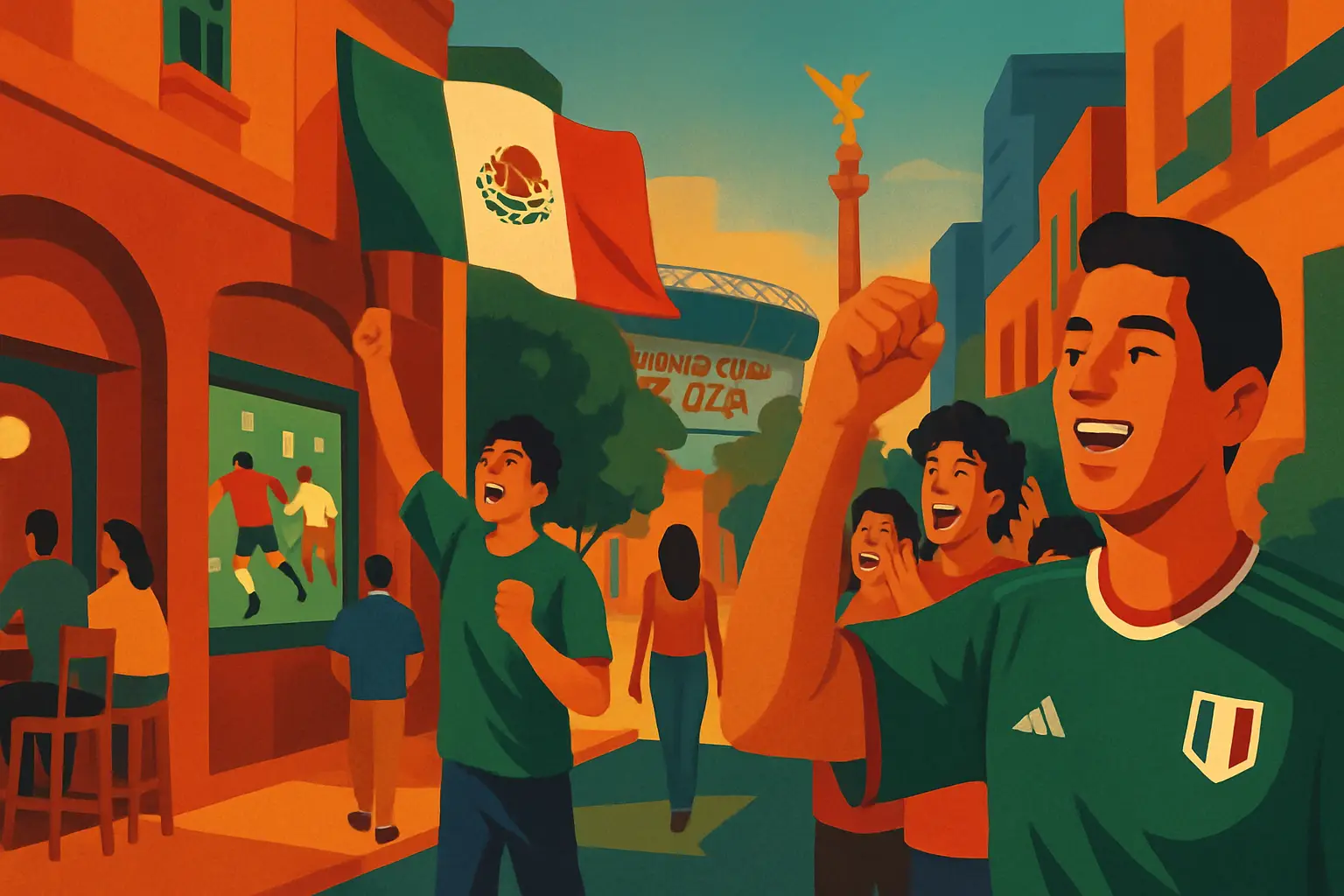
The Zocalo — the main plaza in Centro Historico and one of the largest public squares on earth — has been transformed by FIFA into the official Fan Festival for the tournament's Mexico City leg. Every match of the 2026 World Cup is broadcast live on one of the largest screens erected for the event, alongside a main stage with live concerts and DJ sets that run before and after kickoff. Entry is free. Capacity is roughly 100,000 at full occupation, which the venue reportedly hit during Mexico's 2-0 opener over South Africa on June 11. Banda El Recodo performed after the final whistle. The festival runs from June 11 through July 19, covering the full tournament regardless of how far Mexico advances.
Practical logistics: the nearest Metro station is Zocalo (Line 2, orange), and the main plaza entrance is about 200 meters from the exit turnstiles. The surrounding streets — Calle Madero, Av. 5 de Mayo — are pedestrian-only near the square, so walking in from Bellas Artes station via Calle Madero takes about eight minutes. Security checks operate at the perimeter with bag inspection. Leave anything you don't need for the event at your accommodation — the crowd density during Mexico matches makes pockets a liability.
Free entry — no tickets, no registration required
Metro: Zocalo (Line 2 orange) — 200 meters from the main entrance
Arrives at 100,000 capacity for Mexico matches; non-El Tri games are far less crowded
Beyond the Zocalo, Mexico City's local government set up 17 additional fan fests across the city's neighborhoods and boroughs — 18 fan zones in total. When Mexico beat South Africa in the opener, all 18 filled simultaneously and the footage circulating on social media showed the same synchronized eruption of noise across the entire metropolitan area.
The Coyoacan fan zone at Plaza Hidalgo, the neighborhood's 16th-century central square, became one of the most-shared images from the opener: the colonial arches and stone plaza transformed into an outdoor cinema with street food vendors from the surrounding market. Tepito's fan zone — set up inside its famous tianguis market area — draws the most vocal crowd in the city, a level of noise that makes the broadcast mostly redundant. For travelers based in Roma or Condesa, the closest neighborhood fan zone is at Parque Revolucion in Escandon, within walking distance of both neighborhoods. The formula at every neighborhood fest is free entry, a large screen, and street food from the surrounding vendors. Sound systems vary significantly — the Zocalo is the only location with truly professional production.
Get short, interactive stories that make each place easier to remember while you travel.
There is a photograph on the wall at Salon Corona — at Bolivar 24 in Centro Historico, one block south of the Zocalo — showing the crowd inside the exact moment Mexico was knocked out of the 1986 World Cup by West Germany. The faces are specific and the agony is real. The cantina opened in 1928, three years after the Corona brand launched, and it has been serving cold beers, house micheladas, and tortas through every World Cup since.
The format has not changed much: fluorescent lighting, bar stools, a TV that has gone through several rounds of upgrades but has always been showing whatever Mexico is playing. The house michelada is made with a recipe the regulars will not explain, which is the correct policy. The tortas — pulpo (octopus) or pierna (roast pork leg) — are the menu items worth ordering. Salon Corona has three other locations in Centro and one in Zona Rosa, but the Bolivar 24 original is the one with the photograph and the history. On match days, the bar fills within 30 minutes of opening. Arriving for the prior match (or at least 45 minutes before El Tri games) is the only reliable way to get a stool.
Address: Bolivar 24, Centro Historico — one block south of the Zocalo
Founded 1928 — photographs of the 1986 World Cup crowd are still on the wall
Order: house michelada, torta de pierna — the two things Salon Corona does better than anywhere nearby
Cantina Tio Pepe, on Independencia 26 in Centro Historico, is one of the oldest continuously operating cantinas in Mexico City — its founding is estimated between 1850 and 1890, with 1869 being the most commonly cited date. The building shows it: low ceilings, dark wood, a bar that has had multiple generations of the same families occupying the same stools. Tio Pepe serves traditional food that earns the visit on its own — the cocido, a broth-based stew of chickpeas, zucchini, and meat, is one of the more consistent versions in Centro — alongside a short beer and spirit menu where prices have not fully caught up with the tourist economy.
For World Cup games, the bar fills to standing room within an hour of kickoff. The crowd is predominantly Mexican, which is the point: this is where people who watched El Tri in the 1970s and 1980s are watching the 2026 edition alongside their adult children. The noise on a Mexico goal is specific and not reproducible in a sports bar chain. The cantina sits two blocks from the Barrio Chino on Dolores Street and four blocks from the Salon Corona — which makes a pre-match crawl between all three historically interesting venues logistically straightforward.
Address: Independencia 26, Centro Historico — two blocks from Barrio Chino on Dolores St.
Founded circa 1869 — one of the oldest operating cantinas in Mexico City
Order: cocido stew and a house draft — skip the cocktails, they are not the reason to come
Travelers based in Roma or Condesa have a different bar circuit for World Cup watching — more international in feel, with larger craft beer selections, outdoor terraces, and English menus, but several venues have become reliable gathering spots for match nights.
BeerGarden Roma (Sonora 119, La Romita) sets up outdoor screens during tournament matches and runs its full tap list through late evening. The location inside La Romita — the semi-autonomous micro-neighborhood on the east edge of Roma Norte — gives it a courtyard setting that other neighborhood bars can't match. La Cerveceria de Barrio, with its mariscos menu and cold draft Modelos, has become a default World Cup viewing spot in the Roma-Condesa corridor for groups who want food alongside the game. On the rooftop tier: Terraza Cha Cha Cha in Centro broadcasts El Tri matches against a backdrop of the illuminated Metropolitan Cathedral — a setting that rewards arriving early for the views alone. For Condesa specifically, Av. Amsterdam and the streets around Parque Mexico fill with spontaneous crowd gatherings on match evenings, with bars spilling tables onto sidewalks and most venues pointing a screen toward the street.
Sports bar chains in Mexico City carry a mixed reputation — oversized menus, screens that buffer at the key moment, service that collapses under crowd pressure. Beer Factory at Paseo de la Reforma 87, near the Angel de la Independencia, is the exception that gets recommended consistently for a reason. The Reforma location runs multiple large screens visible from most seats, a tap list that includes Mexican craft beers rather than just the usual industrial options (see the fuller story in the Mexico City craft beer guide), and enough floor capacity to absorb a World Cup crowd without the service collapsing entirely.
The kitchen does acceptable bar food — nachos, wings, some Mexican options — which is enough for a two-hour match. Beer Factory has other locations across the city, but Reforma is the one that handles high-stakes El Tri nights without the wheels coming off. Expect a cover charge or minimum spend requirement on Mexico match days — the amount varies, typically 150–300 pesos per person — so calling ahead to confirm the policy before the June 24 Czechia match is worth the 30-second phone call.
Address: Paseo de la Reforma 87, near the Angel de la Independencia
Call ahead on El Tri match days — minimum spend or cover charge often applies
Best for: groups of 4+ who want reliable multiple screens, a full beer list, and a guaranteed seat
Mexico's remaining matches: After the 2-0 opening win over South Africa at Azteca, El Tri plays Korea Republic on June 18 at Estadio Akron in Guadalajara — not Mexico City, but every bar and fan zone in CDMX will still be at capacity for it. The crucial match is June 24 vs. Czechia, back at Estadio Azteca at 9 p.m. CDMX time. That game decides Mexico's group stage fate and the city will be louder than it was on June 11.
How crowded does the Zocalo get? At full capacity for Mexico games: 100,000. For matches between other countries, the fan fest is dramatically more manageable — arriving 30 minutes before kickoff is usually enough. For El Tri games, allow 90 minutes minimum to get a good position.
Safety at the Zocalo fan fest: The FIFA Fan Festival perimeter has its own security with bag checks on entry. The surrounding Centro Historico streets are heavily policed during the tournament. Standard precautions apply: carry only what you need, keep your phone in a front pocket, and be aware of your surroundings immediately after a Mexico goal — crowd density spikes the instant the net moves and that is when bags get grabbed. Beyond those basics, the environment is festive rather than threatening.