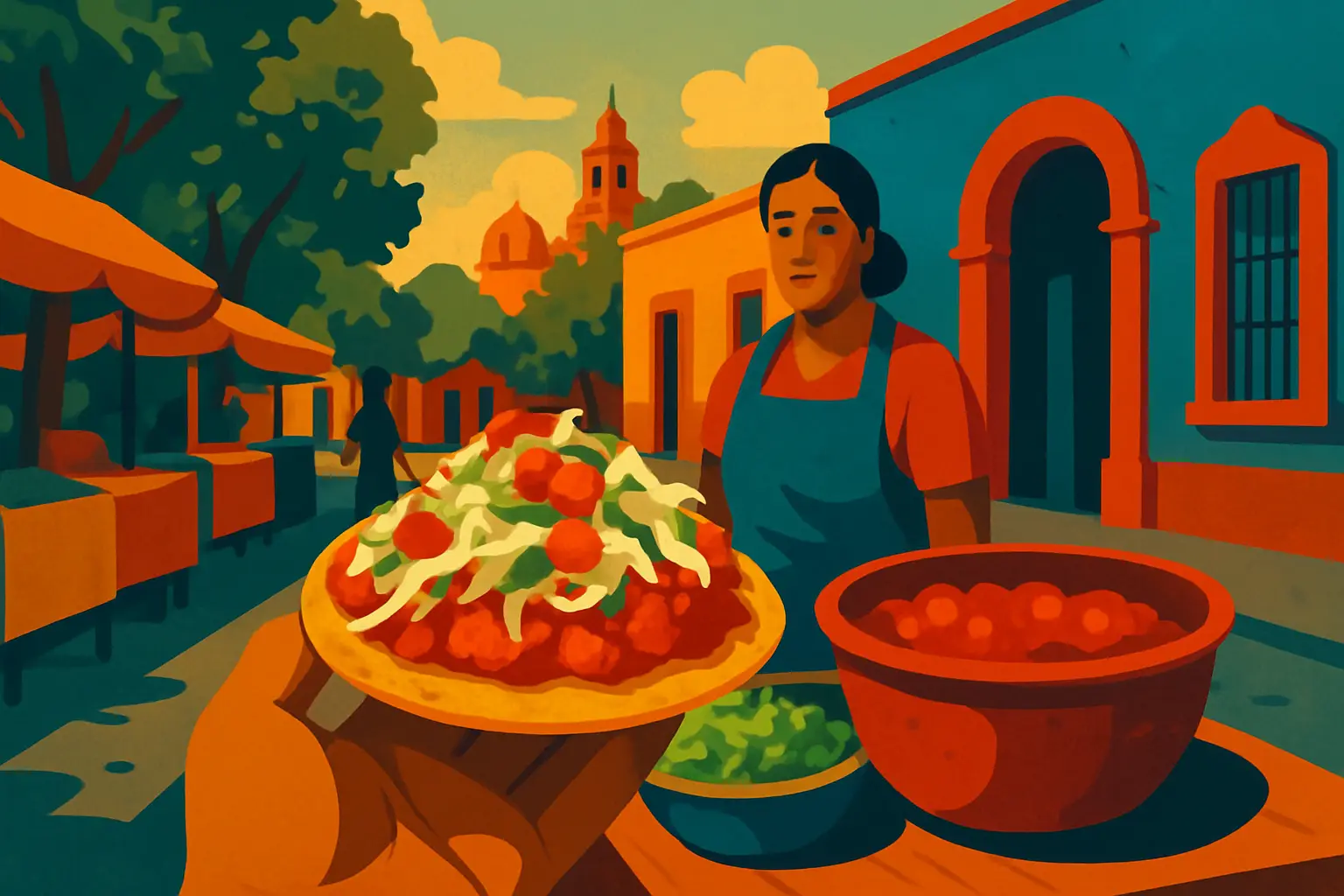
The foundational element is a flat corn tortilla that has been deep-fried until rigid and golden. Unlike a taco, which folds around its filling and is eaten like a soft vehicle, a tostada is a platform — you eat it flat, like an open-faced sandwich, loading it from the counter rather than folding it in your hand. The standard architecture starts with a thin spread of refried black beans directly on the fried tortilla (which also functions as a structural layer, slowing moisture absorption). Above the beans comes the protein, then a drizzle of crema mexicana (thinner and less sour than American sour cream), then crumbled cotija or queso fresco, then salsa verde or roja to taste.
The result requires two hands and rewards speed — eat a tostada slowly and the base softens before you finish it. A well-assembled tostada de tinga, eaten within a minute of the plate arriving, is one of the most satisfying single bites in Mexican street food: the crunch of the base against the soft richness of the chipotle chicken, the fat of the crema cutting the acid of the salsa. A bad one — soggy, under-seasoned, too much crema flooding the base — is immediately recognizable. The difference is always in the topping quality and the assembly timing. Market stalls that specialize in tostadas have both dialed.
Tostadas Coyoacán operates from a dedicated section inside Mercado de Coyoacán at Ignacio Allende 59, two blocks from the Jardin Centenario — the main plaza of Coyoacan's historic center. The market opened in the same year the stall did: 1956. Seven decades later, the operation has expanded to fill six communal bar-style eating counters arranged in a U-shape, with the menu printed on large yellow banners above the serving stations. The yellow-and-white color scheme is recognizable in every food photograph from every journalist who has eaten here across the past thirty years.
The menu lists more than forty toppings. The most ordered are tinga de pollo (shredded chicken in chipotle-tomato sauce), pata (cow foot pickled in vinegar and herbs), cochinita pibil (slow-roasted achiote-marinated pork), ceviche (lime-cured white fish with tomato, onion, and serrano), and pulpo (octopus marinated in olive oil and lime). The kitchen also serves tostadas de atun — canned tuna mixed with chipotle mayo and avocado — which sounds underwhelming and consistently surprises people who try it.
Each tostada arrives assembled; you add more salsa from shared containers on the counter. Prices run 35 to 65 pesos per tostada depending on the protein. Order three or four as a full meal. The communal bar seating creates a social dynamic that is not accidental: watching someone else's order arrive tends to redirect your own decision mid-stream, which is how you end up ordering the pata on your second visit.
Get short, interactive stories that make each place easier to remember while you travel.
Tinga de pollo is the baseline and the one to start with. Shredded chicken slow-cooked in tomatoes, onion, garlic, and dried chipotle chiles until the sauce reduces to a thick, smoky paste. Medium heat, deep savory-smoke flavor, a texture that holds on the tostada without sliding off. This is the tostada equivalent of the calibration dish — once you know it, you understand the kitchen's standard.
Pata (cow foot) is the locally specific topping that separates first-time visitors from regulars. The foot is cooked until the collagen breaks down entirely — the texture is soft, almost spreadable, with a vinegary marinade of lime, herbs, and pickled onion that cuts through the richness. It is nothing like what Americans imagine when they hear 'cow foot,' and it is more interesting than most of the other options on the menu.
Cochinita pibil brings the Yucatecan tradition to a Coyoacan counter: slow-roasted pork shoulder marinated in achiote paste and citrus, with a distinctly orange color and a mild earthiness. Typically topped with pickled red onion, which adds brightness and crunch. The combination of warm pork, pickled onion, and fried tortilla base is clean and direct.
Ceviche works particularly well on a tostada because the fried base holds its structure against the lime marinade better than a soft tortilla would. The crunch survives several bites before the edges soften. Order it with extra salsa verde. Pulpo (octopus) has a clean brininess that pairs well with the richness of the refried beans. Both seafood options are lighter than the braised-meat toppings and a good counterpoint if you're ordering multiple tostadas at once.
Tostadas are not exclusive to the Coyoacan market, though Tostadas Coyoacan is the most cited institution. In Mercado de La Merced — the largest market in Mexico City, spanning several city blocks east of Centro Historico near Circunvalacion — tostada stands appear throughout the covered sections alongside guisado stalls and pozole vendors. These are working-market tostadas: fast, inexpensive, built on tinga and beans with fewer specialty toppings. The crowds are local, the prices are lower (often under 30 pesos per tostada), and the atmosphere is significantly less curated than Coyoacan.
In Mercado de Medellin in Colonia Roma Sur — on Calle Medellin between Campeche and Coahuila — the strong mariscos (seafood) section means seafood tostadas dominate: ceviche de camaron (shrimp ceviche), aguachile-style tostadas with raw shrimp in chile-lime sauce, and fresh fish preparations that reflect the market's vendor mix. If you're already in Roma, this is the closest equivalent to a Coyoacan-caliber tostada experience without making the full trip south.
At the upscale end, restaurants in Polanco and Roma Norte have introduced elevated tostada formats: sushi-grade tuna with ponzu and microgreens, duck confit with pomegranate, smoked salmon with creme fraiche. These are expensive, visually considered, and intentionally distanced from the market tradition. They are worth eating once for the contrast. Neither replaces the other.
Tostadas Coyoacan exists within a broader food culture that makes the neighborhood one of the most specific eating destinations in the city. The same market at Ignacio Allende also houses carnitas stands (pork slow-fried in copper cazos), a dedicated barbacoa section on weekend mornings, and vendors selling regional Mexican specialties from Oaxaca and Veracruz. The concentration of distinct regional traditions in a single neighborhood market reflects Coyoacan's history as a pueblo that existed before Spanish colonization and was only formally incorporated into the Federal District in the mid-20th century — a neighborhood that built its own market culture before the city arrived around it.
Two blocks from the market, Cafe El Jarocho at Cuauhtemoc 134 has sold cafe de olla (coffee brewed in clay pots with cinnamon and piloncillo) from a street-facing window since 1953. The line moves fast and the cup costs around 20 pesos. A tostada breakfast at the market followed by a cafe de olla from El Jarocho and a walk to the Jardin Centenario is a locally recognized way to spend a Coyoacan morning. For everything else in the neighborhood — the Museo Frida Kahlo, Leon Trotsky's house, the colonial-era streets — the Coyoacan neighborhood guide covers the full picture.
Yes — a traditional tostada base is deep-fried, submerged in hot oil until the tortilla dehydrates and turns rigid. Industrially produced tostada bases sold at supermarkets are often baked to extend shelf life, but market stalls use the fried version. You can tell immediately: a properly fried base fractures completely when you bite it and has a faint oil sheen and toasted corn flavor. A baked base flexes before breaking and tastes more like a cracker. The oil adds flavor to the base itself, not just structural rigidity.
The practical consequence is that a tostada has a window — roughly the first few minutes after assembly — during which the base is at full crunch. After that, moisture from the beans and toppings begins to soften the edges. Good tostada stands assemble and hand plates directly; they do not pre-assemble and leave them sitting. If you're handed a tostada that's already soft on the bottom, the stand is either moving too slowly or was pre-assembling, and you will notice the difference. At Tostadas Coyoacan, turnover is high enough that this is rarely a problem.
Getting there: Metro Linea 3 (green line) to Coyoacan station, then a pesero south on Division del Norte to the Mercado de Coyoacan stop, or Uber/Cabify directly to Ignacio Allende 59. From Roma Norte, Uber takes 20 minutes and costs 80–120 pesos depending on traffic.
Hours: Tostadas Coyoacan is open daily roughly 8 a.m. to 7 p.m. Specialty toppings like cochinita pibil can sell out before 2 p.m. on busy days — arriving before noon guarantees the full menu.
Sunday crowds: Sunday is Coyoacan's busiest day — families from across the city make the trip to the market and the Jardin Centenario plaza. The tostada counters fill quickly. Arrive before 10 a.m. for guaranteed seating or expect a 15–20 minute wait. Weekday mornings between 9 and 11 a.m. give you the counters nearly to yourself and the same quality.
What to budget: Three to four tostadas with an agua fresca or Jarritos runs approximately 150–250 pesos per person — one of the better-value meals in a city where food is already inexpensive.
Combine with: The market is two blocks from the Museo Frida Kahlo (Casa Azul). The Casa Azul guide covers advance ticket booking, which is essential — it sells out days ahead. A tostada breakfast followed by a morning at the museum is a legitimately excellent way to structure the day.