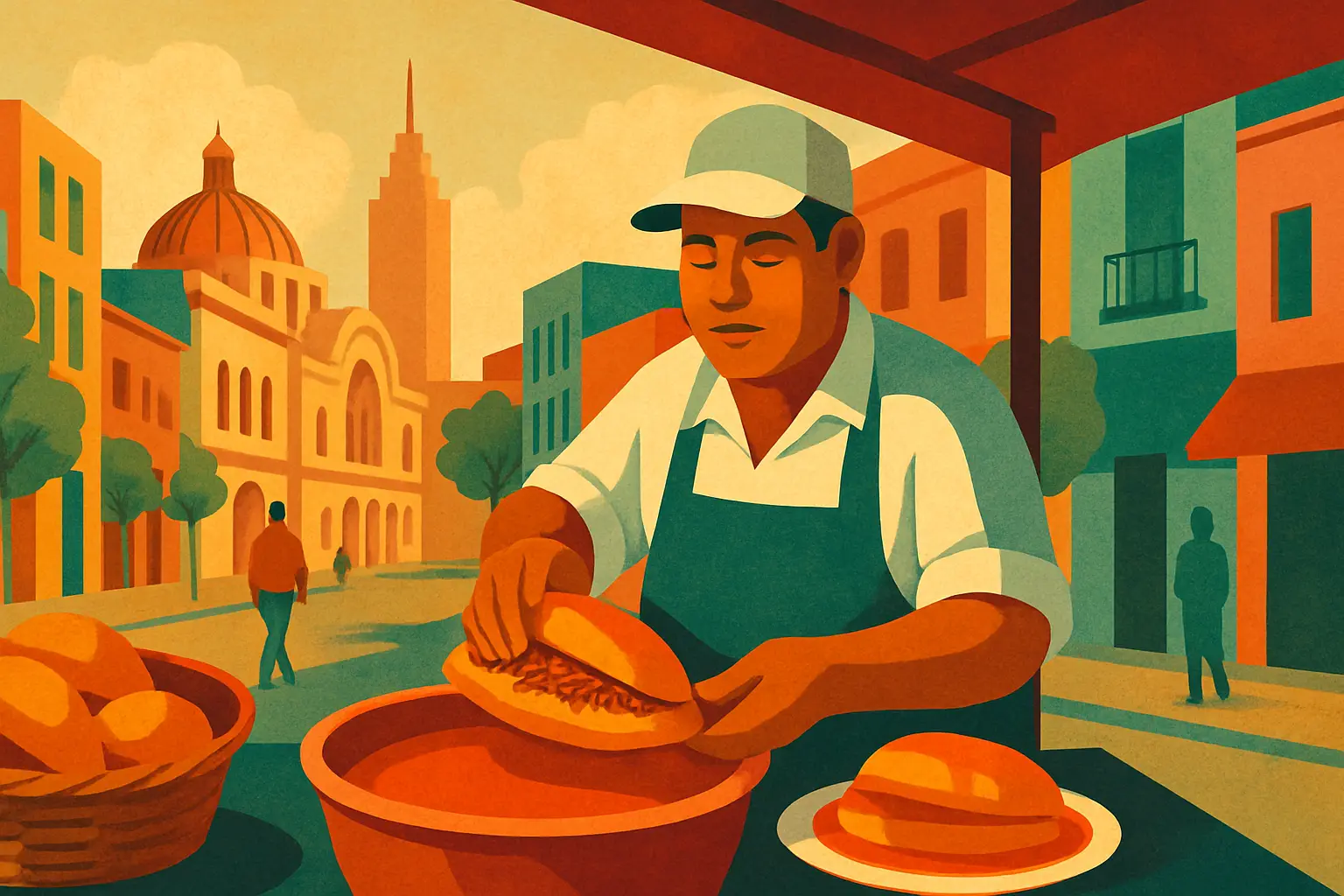
The torta ahogada — literally, the 'drowned sandwich' — is Guadalajara's answer to the question nobody asked: what happens if you put a carnitas sandwich into a pot of chile sauce?
The answer is one of Mexico's most specific and uncompromising regional foods. A thick roll of birote bread is filled with carnitas or shrimp, then submerged — not dressed, not dipped, not drizzled — in a sauce made from dried chiles de árbol, tomatoes, and aromatics. Raw white onion goes on top. You eat it with gloves on, over napkins, making the resigned face of someone who knew exactly what they were getting into.
There are two ways to order in Guadalajara: *media* or *ahogada*. Media gets half the sandwich dipped in mild tomato sauce, leaving the other half dry for contrast and structural integrity. Ahogada goes all the way under — the bread soaks the sauce until the sandwich becomes something between a torta and a stew. The two-sauce system is what distinguishes a proper torta ahogada from any other dipped sandwich: the base is cooked tomato sauce, and the heat layer is a separate pure-chile-de-árbol liquid ladled on top. It is not just spicy. It is constructed to be spicy in a specific, sequenced way.
The name alone has sold thousands of sandwiches. People who have never been to Guadalajara hear 'drowned sandwich' and immediately want to know what that means. The torta ahogada is very happy to demonstrate.
Everything about the torta ahogada depends on birote salado, a sourdough roll native to Guadalajara with a deeply crusted exterior, a dense and chewy crumb, and a saltiness baked into the dough. Birote is what allows the sandwich to survive drowning — a standard bolillo dissolves in that much liquid within minutes. Birote soaks up the sauce and holds its structure. The bread is the engineering.
Here is the problem: birote does not work outside Guadalajara.
This is not bakers being territorial about a regional product. It is food science. Guadalajara sits at 1,566 meters above sea level — significantly lower than Mexico City's 2,240 meters — and the city's water composition, atmospheric pressure, and humidity create specific conditions for the yeast strains and fermentation process that produce birote's distinctive crust. Bakers who have tried to replicate it in CDMX, Monterrey, and the United States consistently report the same failure: a roll that looks similar but lacks the structural depth that makes birote capable of surviving a sauce bath.
The only workable solution is to source the bread from Guadalajara. Which is exactly what El Pialadero de Guadalajara has been doing in Mexico City for over a decade.
Birote's crust structure depends on Guadalajara's specific altitude, water, and humidity — it cannot be replicated at Mexico City's elevation
Without authentic birote, the sandwich absorbs the sauce too fast and falls apart — the bread is the load-bearing element
El Pialadero ships birote directly from Jalisco, making it the only Mexico City operation with structurally correct tortas ahogadas
Get short, interactive stories that make each place easier to remember while you travel.
El Pialadero de Guadalajara has three locations in Mexico City, and the central fact about all of them is the same: they import birote bread from Guadalajara. This is not a marketing story — it is the operational backbone of the restaurant. Every torta ahogada served at El Pialadero starts with bread that left Jalisco on a truck.
The original and most respected Mexico City location is at Hamburgo 332 in the Cuauhtémoc borough, just east of Zona Rosa — a 10-minute walk from Metro Sevilla (Line 1, pink line). The second is in Santa Fe at Autopista Urbana Norte 50, and the third in Lomas de Chapultepec III. Of the three, Hamburgo draws the longest lines and is the one Mexico City food writers and local regulars point to first.
The menu goes beyond tortas. El Pialadero also serves carne en su jugo — a Jalisco-style stew of shredded beef cooked in its own broth with beans and bacon strips — plus birria de res and chicharrón de pescado. These are dishes from the Guadalajara food canon, and eating at El Pialadero is specifically a tapatio experience dropped into the capital. Most first-timers come for the torta and leave having also eaten carne en su jugo, then make a note to come back for that alone.
Weekend waits at Hamburgo regularly run to 45 minutes. There are no reservations. The move is to arrive, put your name in with the host, order a michelada to occupy your hands, and wait while smelling the chile sauce warming on the stove.
Hamburgo 332, Cuauhtémoc — 10-minute walk from Metro Sevilla (Line 1)
Also: Santa Fe (Autopista Urbana Norte 50) and Lomas de Chapultepec III
Weekend lines: 30–45 minutes. Weekday lunch before 1:30 p.m. is significantly shorter
El Pialadero offers four spice calibrations. Level 1 is no chile at all — just the cooked tomato base. Level 2 is the media format: one side drowned in mild sauce, one side dry. Level 3 is the full ahogada submersion. Level 4 is a heat test.
For a first visit: order the carnitas torta at level 3. Carnitas is the traditional filling — what the sandwich was built around — and the full submersion is the format that justifies the name. The shrimp version (*camarón*) is popular and works well, but it is a variation on the original concept rather than the concept itself.
When the plate arrives, El Pialadero will have provided disposable plastic gloves. This is not optional equipment. The bread will be soaked through within two minutes of hitting the sauce. Pick the sandwich up from below, tilt it slightly, eat from the end. The raw white onion on top is not garnish — it cuts the chile heat and adds a sharp textural contrast that the sandwich specifically needs. The extra cup of pure chile de árbol sauce on the table is for mid-meal heat adjustments.
Plan the rest of your afternoon accordingly. A fully ahogada torta with carne en su jugo is a serious meal. Nobody leaves El Pialadero hungry, and most people leave having loosened their belt and reconsidered the afternoon's ambitions.
Guadalajara's food identity has always operated on its own logic, distinct from Mexico City's. Where CDMX built its street food culture around the taco stand, the market stall, and the comida corrida, Guadalajara developed different formats: birria from decorated carts, carne en su jugo at standing tables, tortas ahogadas eaten from paper plates over trash cans on Avenida Federalismo.
The torta ahogada origin story is the kind that gets retold differently every time. Most versions involve a vendor in early 20th-century Guadalajara, a dropped sandwich, a pot of chile sauce, and the accidental discovery that the soaked version tasted better than the dry one. What matters is that the format is genuinely old and genuinely local — it developed in place, in a city with the specific bread that makes it possible, sustained by vendors who built their livelihoods around it.
The torta ahogada reached Mexico City through migration. Jalisco families who moved to the capital brought the sandwich with them, discovered no one was making it correctly, and eventually opened restaurants to fill the gap. El Pialadero is the most prominent example: a family from Jalisco, in Mexico City, refusing to compromise on the bread. The torta ahogada is a document of that refusal. For more on how Jalisco's carnitas tradition — another export from the same region — embedded itself into CDMX's food culture, the carnitas guide covers the parallel story.
Guadalajara's version is better. It will always be better — the birote is fresher, the chile sauce operations at Mercado Medrano and Avenida Federalismo have 80 years of practice, and the specific gravity of eating a drowned sandwich on a Guadalajara street corner at 11 a.m. cannot be reproduced inside a restaurant in Cuauhtémoc.
But Mexico City's version at El Pialadero is genuinely good. The imported birote makes the sandwich structurally correct in a way that no local approximation achieves, and the chile sauce is built on a proper base. If you are not going to Guadalajara on this trip, El Pialadero is the legitimate answer — not a consolation prize, but an honest version of the real thing.
For other regional Mexican dishes that made the same journey from their home states into CDMX's kitchen — arriving through migration, adapting slightly, and becoming part of the capital's layered food culture — the Oaxacan food guide covers how Oaxacan tlayudas, tasajo, and quesillo made a similar trip and found a home in the capital.
Budget: A torta ahogada at El Pialadero costs 120 to 160 pesos. Add carne en su jugo (~100 pesos) and a drink and you're at 300 to 400 pesos per person — a full, heavy meal.
Hours: The Hamburgo location runs roughly 11 a.m. to 9 p.m. on weekdays and 10 a.m. to 9 p.m. on weekends. Confirm before making a special trip, as hours vary by location.
Getting there: Hamburgo 332 is in Cuauhtémoc, within walking distance of both Metro Sevilla and Metro Insurgentes (Line 1, pink line). A 10-minute Uber from Condesa, Roma Norte, or Zona Rosa hotels.
What to avoid: Any place advertising 'torta ahogada estilo Guadalajara' without specifying where their bread comes from. Ask directly: *¿El birote es de Guadalajara?* If the answer is vague, you're about to eat a soggy torta with the wrong structural support. The bread is the entire point — without authentic birote, the sauce drowns the sandwich in the wrong way and you end up with mush. El Pialadero earned its reputation by refusing to cut corners on the one thing that cannot be improvised.