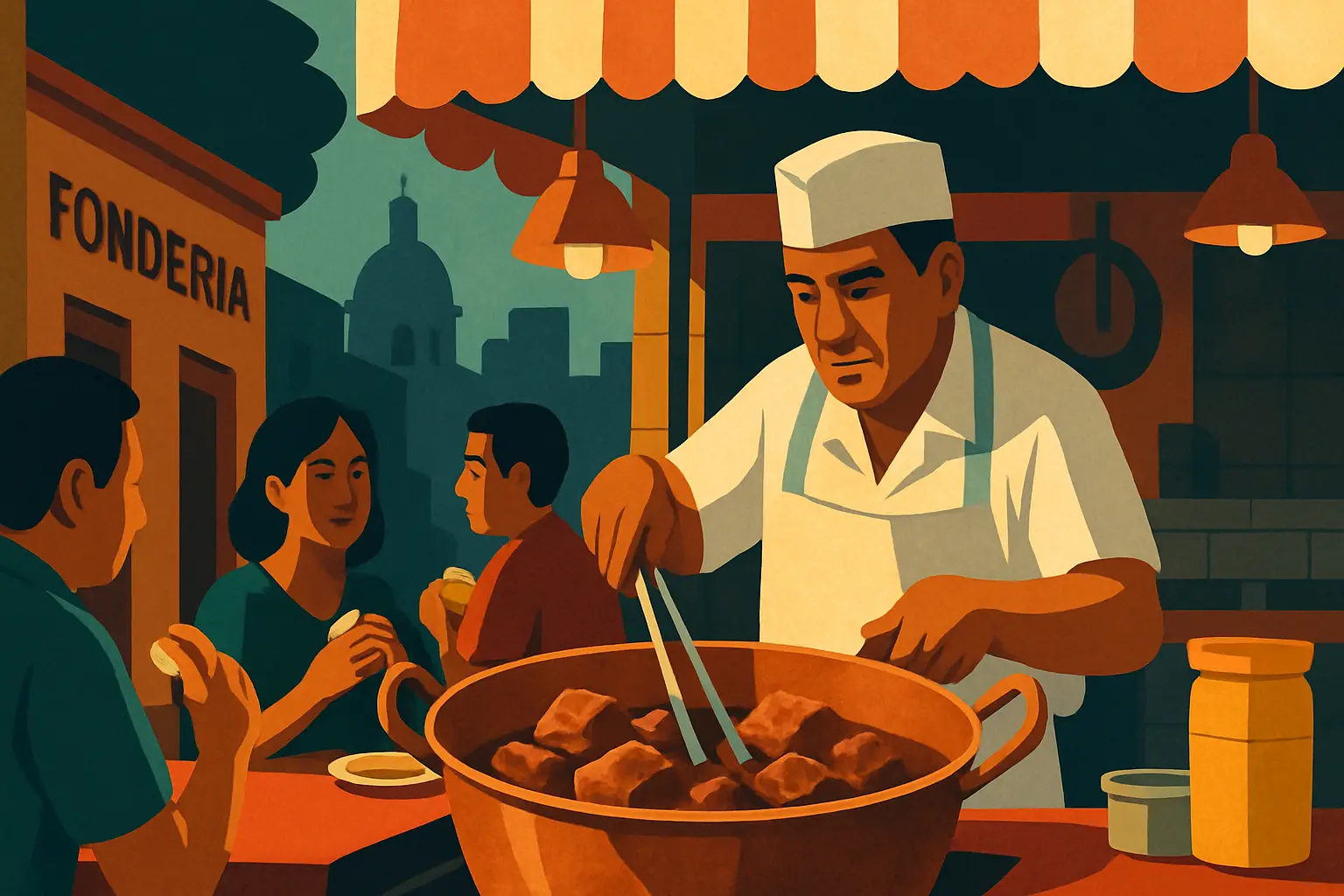
Carnitas means 'little meats' in Spanish, and the name undersells what is happening. Carnitas is pork cooked entirely submerged in its own rendered fat — lard — inside a large copper cazo (cauldron) over a wood or gas fire, for several hours, until the meat is tender through and slightly crisped at the edges. This is technically a confit, the same technique that French duck confit uses, and it produces results that are fundamentally different from braised pork or American pulled pork: the exterior caramelizes while the interior stays moist, because the fat conducts heat evenly without the moisture loss that water-based cooking produces. The copper pot is not decoration. Copper conducts heat more evenly than steel or iron, and a good cazo is the primary piece of equipment in a serious carnitas operation. When you see a taquero stirring a large shimmering copper cauldron at the front of a market stall, that is what you are looking at: a confit operation of serious precision. The pork is seasoned during cooking with orange juice, milk, and spices — the exact formula varies by cook and is rarely shared — and the cooking time and temperature determine everything about the final texture. This is why carnitas from two vendors standing twenty meters apart can taste completely different.
Carnitas = pork confit, cooked submerged in lard inside a copper cazo — not braised, not pulled, not roasted
Copper pot is functional, not decorative: copper conducts heat more evenly than steel, producing the consistent texture that makes carnitas difficult to replicate at home
Common seasoning additions during cooking: orange juice, milk, onion, garlic, bay leaf, cumin — each vendor's formula is proprietary
Carnitas is a Michoacán invention, and Michoacán vendors dominate the carnitas scene in Mexico City the same way that Oaxacan vendors dominate mole and Veracruz families have historically controlled certain seafood markets. The state of Michoacán, particularly the area around the town of Quiroga on the shores of Lake Pátzcuaro, is considered the birthplace of the dish — Quiroga has more carnitas vendors per capita than anywhere else in Mexico, and the preparation there has been documented to at least the 19th century. The technique arrived in Mexico City with Michoacán migrants and settled most heavily in the city's markets and working-class neighborhoods. You can still find stands run by families who have been cooking carnitas in Mexico City for two or three generations, using the same copper cazo brought from their home state. Mexico City's carnitas scene is concentrated on Sundays and early mornings — this is when demand peaks, when families stop at a market stall on the way to visit relatives or after mass, and when the most accomplished vendors set up their full operations. On weekdays, many of the best spots either do not operate or run with reduced stock.
Quiroga, Michoacán (near Lake Pátzcuaro) is the canonical birthplace of carnitas — the town has been selling it since at least the 19th century
Michoacán migrant families brought the tradition to Mexico City and still dominate the best stalls in the city's markets
Sunday is the primary carnitas day in Mexico City — many of the best vendors operate exclusively or primarily on weekend mornings
Get short, interactive stories that make each place easier to remember while you travel.
This is what a carnitas vendor is offering when they gesture at the piles in the cazo. Every cut comes from the same animal cooked in the same pot — but the texture, fat content, and flavor vary dramatically. Maciza is pure lean meat from the leg and shoulder, with no skin or offal. It is the safest order and, frankly, the least interesting — lean, slightly dry, and the cut that has no surprises. Most tourists order maciza by default because it is easiest to point at. Costilla (rib meat) is maciza's superior cousin: meat pulled from the ribs, slightly more tender and juicier because of the proximity to bone. Buche is stomach — cleaned thoroughly, with a gelatinous, yielding texture and a rich pork flavor that is more intense than any lean cut. This is the cut most carnitas enthusiasts consider the gateway to the serious side of the menu. Nana is uterus — tender, subtle, and often described as the most delicate offal cut. Trompa is face meat and lips — fatty, gelatinous, deeply savory, and the most texturally adventurous option. Surtido means mixed — tell the taquero 'surtido' and they will give you a combination. This is the correct order for anyone who wants to explore without committing entirely. Cueritos (pickled pork rinds, not from the cazo) are often offered as a topping rather than a main cut.
Maciza (lean leg/shoulder): the safe default — least fat, least complexity, preferred by first-timers
Buche (stomach): gelatinous, rich — the most popular offal cut among regulars and the recommended gateway cut
Surtido (mixed): the correct order for exploration — ask the taquero to choose and you will get a representative range
The best carnitas in Mexico City operates on a schedule that rewards early rising. A serious vendor starts their cazo at 5 or 6 a.m. The lard takes time to reach temperature. The whole cuts go in first — shoulders, legs, heads — and cook for hours before the taquero begins breaking them down into servable pieces. By 8 a.m. the operation is at full swing: the cazo is bubbling, every cut is available, the salsas are freshly made, and the line is manageable. By 11 a.m., the buche is gone. By noon, the trompa is gone. By 1 p.m., it is maciza or nothing. This is not a scheduling coincidence — it reflects the rhythm of Mexican Sunday life, where carnitas is consumed as a mid-morning meal (desayuno-almuerzo, the combined breakfast-lunch that Mexican families eat between 9 and 11 a.m.) before the afternoon comida at home. If you are planning a Sunday carnitas run, the window of 8 to 10:30 a.m. is when you get everything. The correct drink is agua fresca — jamaica (hibiscus) or horchata — or a club soda. Carnitas is not a heavy meal when eaten in tacos; two to three tacos with salsa and lime is the standard portion.
Best window: 8 to 10:30 a.m. on Sunday. Buche and trompa typically sell out before noon.
The cazo starts at 5–6 a.m. — by the time you arrive at 8, the meat has been cooking for 2–3 hours and is at peak texture
Carnitas in Mexico is a desayuno-almuerzo dish — a mid-morning meal, not lunch or dinner. The vendors know this and close when the stock is gone.
Tacos El Azul (known locally as El Capote) at Avenida Chapultepec and Amberes, just outside the Metro Insurgentes glorieta, is the most cited stop for serious carnitas in Mexico City — chef Enrique Olvera, whose restaurant Pujol is one of the most acclaimed in Latin America, has publicly named it his personal favorite. The stand is easy to miss: exit Metro Insurgentes at Chapultepec Norte, turn left at the top of the stairs, and it is ten meters down, operating out of a narrow opening in both directions. Carnitas El Kioskito operates near Mercado San Juan de los Arcos de Belén in Centro and has a Roma Norte outpost on Calle Sonora 6. Both locations are known for consistent maciza and solid buche. El Cherán near Mercado San Juan is another standby favored by the market workers who know the neighborhood's food supply chain. In Roma Sur, the pork butcher inside Mercado de Medellín is rumored to run a Saturday-only carnitas operation out of a copper cazo in the back — a detail most tourists never discover because the market is not primarily a carnitas destination. The Mexico City markets guide covers Medellín as a general destination, but the carnitas cazo appears only if you walk past the butcher stalls toward the back and ask.
Tacos El Azul (El Capote): Av. Chapultepec at Amberes, near Metro Insurgentes — Enrique Olvera's stated favorite, small and easy to miss
Carnitas El Kioskito: Centro (near Mercado San Juan) and Roma Norte (Sonora 6) — consistent and accessible for visitors
Mercado de Medellín (Roma Sur): Saturday-only cazo in the butcher section — worth asking for at the pork counter
The taquero will hand you a small corn tortilla — two stacked, because one alone tears — with meat on top. Everything else is self-assembly from the condiment station. The correct sequence: salsa verde first (tomatillo-based, bright and acidic, cuts the fat), then raw white onion (finely chopped, not caramelized — the crunch and sharpness are the counterpoint to the rich meat), then fresh cilantro, then a squeeze of lime. The combination is non-negotiable in the sense that carnitas fat without acid is cloying — the salsa and lime are doing structural work, not just adding flavor. Salsa roja (red, chile-forward) is a secondary option, typically hotter, used if you want heat rather than brightness. The tortillas are corn, small, and should be warm — if they are cold and stiff, the stand is not at full operation. Avocado or guacamole appears sometimes but is not traditional to carnitas tacos the way it is to other preparations. Cactus (nopales) is occasionally offered as a side — lightly cooked, tangy, and a good palate cleanser between cuts.
Two tortillas stacked: the standard for any taco with wet or heavy filling — one alone tears under the weight
Salsa verde + raw onion + cilantro + lime: the canonical carnitas taco assembly. The acid is structural, not decorative.
Nopales (cactus) as a side: tangy, slightly mucilaginous, an excellent palate reset between adventurous cuts
Yes — with the standard caveat that applies to all street food: look for a vendor with visible high turnover, a clean operation, and hot food. Buche (stomach) is cleaned thoroughly before it enters the cazo and is cooked submerged in lard at sustained temperature for hours — the cooking method is not kind to pathogens. The risk profile of offal at a busy carnitas stand with a hot cazo is not meaningfully higher than any other hot street food in Mexico City. The more relevant variable is freshness: at a slow vendor with stock sitting in cooled fat, the quality — and safety — declines faster than at a busy stand cycling through cuts quickly. A vendor with a Sunday morning line of local families is the right risk model. A vendor with no customers at 2 p.m. is not. The street food guide has a longer section on navigating safety at Mexico City food stalls generally — the framework applies here.
Buche is thoroughly cleaned and cooked submerged in hot lard for hours — the preparation method minimizes risk
Turnover is the key safety indicator: a stand with a constant line of locals is cycling fresh stock; a quiet afternoon stall is not
The 8–10 a.m. Sunday window is the peak freshness window — meat has been cooking the shortest time from the initial load
Best time: Sunday between 8 and 10:30 a.m. for the full range of cuts. Saturday mornings at market-based vendors are a reasonable secondary option. Weekday carnitas exists but tends toward larger commercial operations rather than the copper-cazo tradition. Getting there: Tacos El Azul is a three-minute walk from Metro Insurgentes (Line 1, pink). Carnitas El Kioskito in Centro is accessible from Metro San Juan de Letrán (Line 8). Mercado de Medellín in Roma Sur is a short walk from Metro Chilpancingo (Line 9). Budget: A taco de carnitas at a market stall runs 25–45 MXN per taco (roughly $1.25–$2.25 USD). Three tacos and an agua fresca is a complete meal for under 200 MXN ($10 USD). Restaurant carnitas, plated with rice and beans, runs 150–300 MXN per portion and is not the correct format — carnitas is market and taco stand food, and the casual context is part of the experience.
Metro Insurgentes (Line 1) → Tacos El Azul: 3 minutes on foot
Cost: 25–45 MXN per taco at a market stall — a three-taco meal with agua fresca is under 200 MXN
Restaurant carnitas is a valid format but not traditional — the copper cazo experience is only at market stalls and street stands