1. What tripa is — the cut, the anatomy, and why most people get it wrong
Tripa, in the Mexico City taco context, means the small intestines of a cow — not the stomach (that's menudo territory), not the large intestine (a different product entirely). The small intestine is a long, narrow tube with a thick muscular wall and a natural layer of fat on the exterior. That fat is why tripa tastes rich rather than gamey when cooked properly: it renders during the slow cook in the vat and bastes the intestine walls from the outside in.
The reputation problem tripa has among first-time eaters comes almost entirely from bad versions — intestine that wasn't cleaned thoroughly enough, or that was cooked briefly at high heat rather than slowly in fat, producing a rubbery, pungent strip that confirms every fear. A properly prepared taco de tripa has none of those qualities. The cleaning process removes the interior smell; the slow fat-cook tenderizes the walls; the final crisp on the comal converts the exterior into something with the texture of well-rendered pork crackling.
The result is a taco that is simultaneously crunchy and soft, rich without being heavy, and specific enough to this street-cook method that it cannot be meaningfully replicated in a home kitchen or approximated in a restaurant version. This is the kind of taco that rewards the commitment to seek it out.
2. The two-stage cook: from the vat to the comal, and why crispness is everything
Tacos de tripa share the same preparation logic as tacos de suadero: a long slow cook in a wide vat of rendered fat, followed by a quick high-heat finish on the flat comal. The difference is texture. Suadero in the vat becomes progressively tender and loose; tripa becomes something more complex — the muscular walls soften while the exterior fat layers render down, leaving a coiled piece that holds together but has lost most of its toughness.
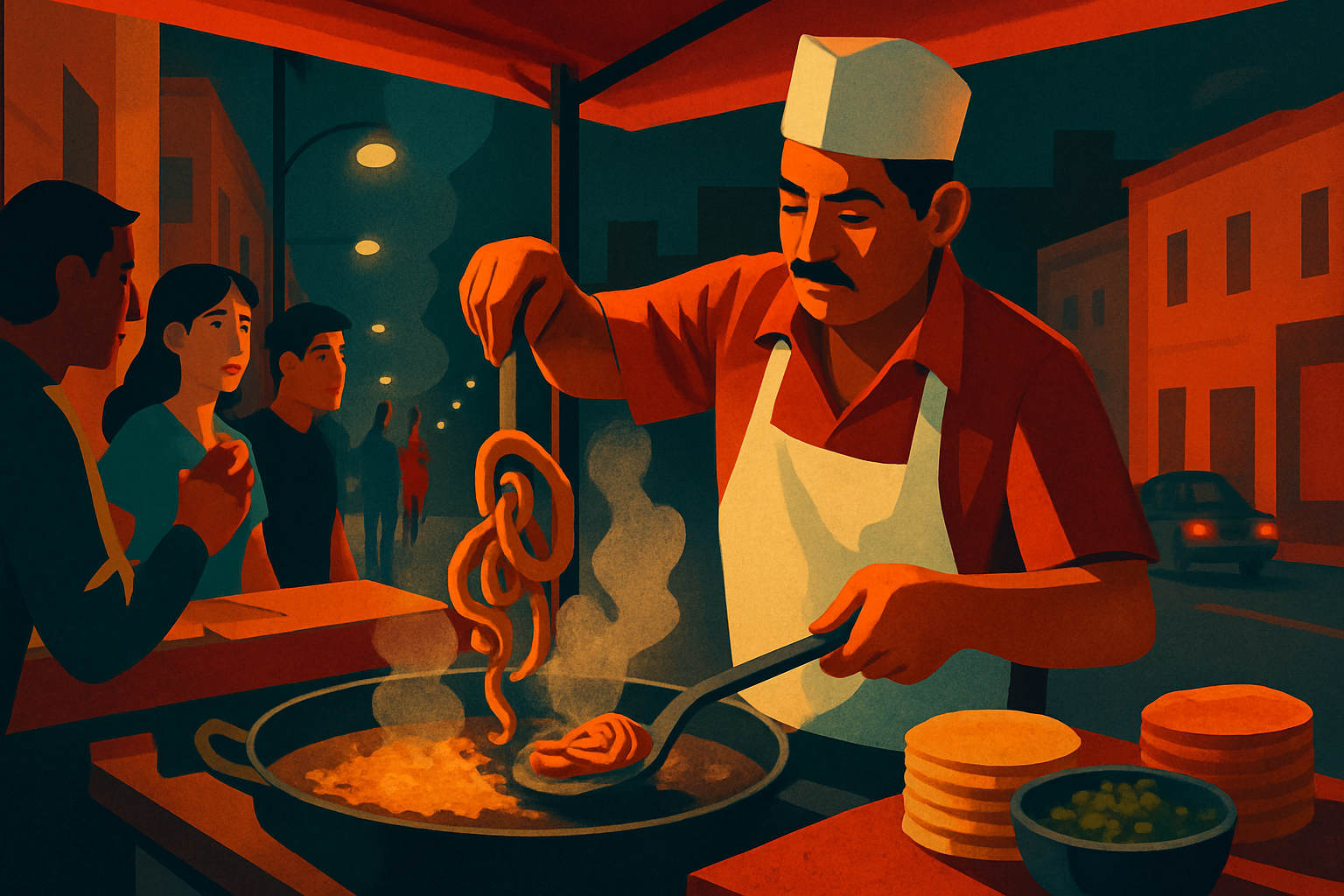
When an order arrives, the taquero pulls the coiled intestine from the vat with a slotted spoon, drops it on the comal, and spreads it flat. This is where the taco is made or broken. Over the next sixty to ninety seconds, the exterior fat hits the hot steel and starts to bronze — a visible transformation from soft and pale to golden and slightly stiff. A skilled taquero keeps the piece moving, pressing it against the comal with a spatula to ensure even contact, flipping once, then chopping it into irregular pieces just as the edges reach maximum crunch. Those pieces go straight onto doubled corn tortillas.
Underordered tripa — pulled off the comal thirty seconds too soon — is rubbery throughout. Over-crisped tripa becomes dry and loses its interior tenderness. The window between the two is narrow, which is why asking for 'bien dorado' at a good stand is the correct strategy rather than taking whatever the taquero delivers by default.
•Stage one: slow cook in fat vat — breaks down the muscular walls, renders exterior fat, eliminates gaminess
•Stage two: crisp on the comal — the deciding factor between rubbery and remarkable tripa
•Key phrase: 'bien dorado' — tells the taquero you want it fully crisped
3. Los Cocuyos — Centro Histórico, always open, the natural starting point
Los Cocuyos at Bolívar 56 in Centro Histórico is the most practical introduction to tacos de tripa in Mexico City for one specific reason: it is effectively always open. Through weeknight nights, past 2am on weekends, across holidays — the vat stays hot and the comal stays busy. For anyone in Centro after dinner looking for a first tripa experience, Los Cocuyos is the destination.
Tripa here is served in its own right or as part of a campechano with suadero — the classic combination. The taquero works the tripa with visible attention to the crisp: pieces come off the comal when the edges have bronzed and the interior is still yielding. The salsa verde, blended tomatillo and chile de árbol, is the right pairing — its acidity cuts through the rendered fat in a way the roja doesn't quite manage.
The stand is fully outdoors on the sidewalk, no seating, cash only. Bolívar 56 is about a five-minute walk from Metro Bellas Artes (Line 2, blue line) and close to Alameda Central. Taquería Los Cocuyos has Michelin Bib Gourmand recognition — not because it's a restaurant, but because the quality of what comes off that comal is consistently what it promises to be.
•Address: Bolívar 56, Centro Histórico — near the corner with República de Uruguay
•Hours: effectively 24 hours; heaviest activity from 9pm to 2am
•Best order: campechano de suadero y tripa, salsa verde, extra lime
4. El Vilsito — the mechanic shop that becomes a taquería at night
By day, El Vilsito on Petén 248 — in the Colonia del Valle / Narvarte border area, a short block from Av. Insurgentes Sur — is an automotive repair shop. By 9pm it transforms into one of the city's most photographed taco stands: the mechanic's bay still visibly a mechanic's bay, with tire equipment and tool cabinets pushed to the walls to make room for a taquero setup that serves hundreds of customers until the early hours.
El Vilsito is famous primarily for its tacos al pastor, which rotate on a spit positioned in what is normally the garage space. But the tripa is equally worth seeking out. The comal runs hot all evening, turnover is high, and the fat in the vat has been building flavor since the stand opened. Tripa at El Vilsito tends to come off the comal with a pronounced crunch — in part because the evening rush demands speed, and speed means heat, and heat means crisp.
The atmosphere is distinctive: the queue forms outside on Petén, along a sidewalk lit by the stand's own lights, with the auto shop aesthetic fully visible. It's the kind of place photographers and food writers return to repeatedly, not because of the novelty, but because the quality holds up under scrutiny. The nearest metro is Insurgentes (Line 1, pink line), about ten minutes' walk south along Insurgentes, or a short taxi ride from Roma Norte or Condesa.
5. Campechano — why tripa and suadero were made for each other
The campechano combination — two proteins on one doubled taco — is where tripa performs best. On its own, tripa is textural and rich but one-dimensional in flavor. Paired with suadero, which is silky and fat-forward with a slightly gelatinous interior, the campechano becomes a taco with layered textures: crunchy and bronzed from the tripa, tender and yielding from the suadero, unified by the doubled corn tortilla that absorbs the rendered fat from both.
Ordering is simple: 'campechano de suadero y tripa' at any stand that carries both. The taquero will pull from both vats simultaneously — some mix the two on the comal before chopping, some keep them separate and layer them on the tortilla. The layered version lets you taste both proteins distinctly; the mixed version produces more even flavor distribution. Neither is wrong. If the stand also carries longaniza, 'campechano de tripa y longaniza' is the second combination worth trying — the fresh pork sausage adds a different fat quality and a slight herbal note.
This is also why suadero stands are the most reliable locations to find good tripa: they share the same vat infrastructure and the same late-night format. Any serious suadero stand almost certainly carries tripa. The campechano is not a special order — it's the default for regulars, and asking for it is the single fastest way to signal you know what you're doing.
6. Tripa across the city — how to find it by neighborhood
Tripa follows the same distribution logic as suadero: it concentrates at stands in working-class neighborhoods, active at night, identifiable by the visible fat vat. The copper or aluminum pot over a gas flame, pulling visible steam, is the signal.
Centro Histórico has the densest tripa concentration, especially from 8pm onward. Los Cocuyos on Bolívar anchors the area; additional stands operate on Correo Mayor, around Mercado La Merced, and on the side streets east of the Zócalo. Tepito and its surrounding blocks carry tripa vendors integrated into the broader street food grid — less tourist-facing, firmly neighborhood-oriented.
Iztapalapa has one of the highest densities of late-night taco culture in the city, with tripa stands on Av. Lorenzo Boturini and around the streets near Metro Iztapalapa. These are high-volume, cash-only operations that locals use the way people elsewhere use a kebab shop at midnight. Colonia del Valle and Narvarte have El Vilsito at Petén 248 as the reference point, with a few additional corner stands on Insurgentes Sur and adjacent streets running from evening into the early morning.
•Centro Histórico: Los Cocuyos on Bolívar + Correo Mayor stands — busiest from 9pm to 2am
•Iztapalapa: Lorenzo Boturini corridor — high-volume, neighborhood-facing, open late
•Colonia del Valle / Narvarte: El Vilsito at Petén 248 — the late-night reference point south of the city center
7. What does tripa actually taste like — and is it right for you?
The honest description: a properly crisped taco de tripa tastes meaty, rich, and distinctly fatty — not in a greasy way, but in the way a well-rendered chicharrón is fatty, which is to say intensely savory and satisfying. The crunch at the edges is the dominant textural note. The interior, where the crisp hasn't fully penetrated, yields slightly under pressure — a contrast that makes each bite more interesting than a uniformly textured protein.
The flavor is not subtle. Tripa has a specific richness from the combination of the intestine walls themselves and the rendered fat they absorbed during the vat cook. If you enjoy carnitas — another long-cooked, high-fat taco — you will almost certainly enjoy tripa. If you find the flavor of offal generally unappealing, tripa is not the gateway; start with suadero or tacos de guisado and work your way toward the vat.
The fear of smell that many first-timers bring is almost entirely the result of raw or improperly cleaned intestine. At a functioning taco stand with high turnover, you will smell rendered fat, corn tortillas, salsa, and smoke. You will not smell what people fear. That version doesn't make it to the comal at the kind of stands worth visiting.
8. Is tripa safe to eat — and when is the best time to go?
Safety with tripa follows the same principle as any street food with extended holding time: high turnover is the real indicator. A stand that moves through its entire vat preparation by midnight because of volume is a completely different proposition from a vendor with the same tripa sitting in slowly cooling fat until 2am. Los Cocuyos in Centro and El Vilsito in Narvarte are both high-enough-volume operations that holding time is not a meaningful concern — the vat is being replenished, not depleted.
The cleaning process matters more with tripa than with most taco proteins. Small intestine that has been properly flushed and cleaned, then cooked slowly for hours in a fat-and-water vat, has had any functional risk addressed by the temperature and time of the cook itself. The subsequent crisp on a comal running above 250°C finishes the job. The danger scenario for tripa is the same as for carnitas or suadero: a stand with very low volume that holds the same product for too many hours. The correction is to eat at busy stands and arrive in the evening, not at the tail end of service.
Best time: 9pm to midnight. The vat fat is richest after a full day of cooking, the comal is hottest during the evening rush, and turnover is highest — meaning nothing sits. A late-night tripa campechano at a busy Centro stand after the June rain clears is one of the most specifically Mexico City things you can do on a summer evening: the pavement still wet, the air cooled, the taquero moving at full speed, and the taco in your hand still sizzling.