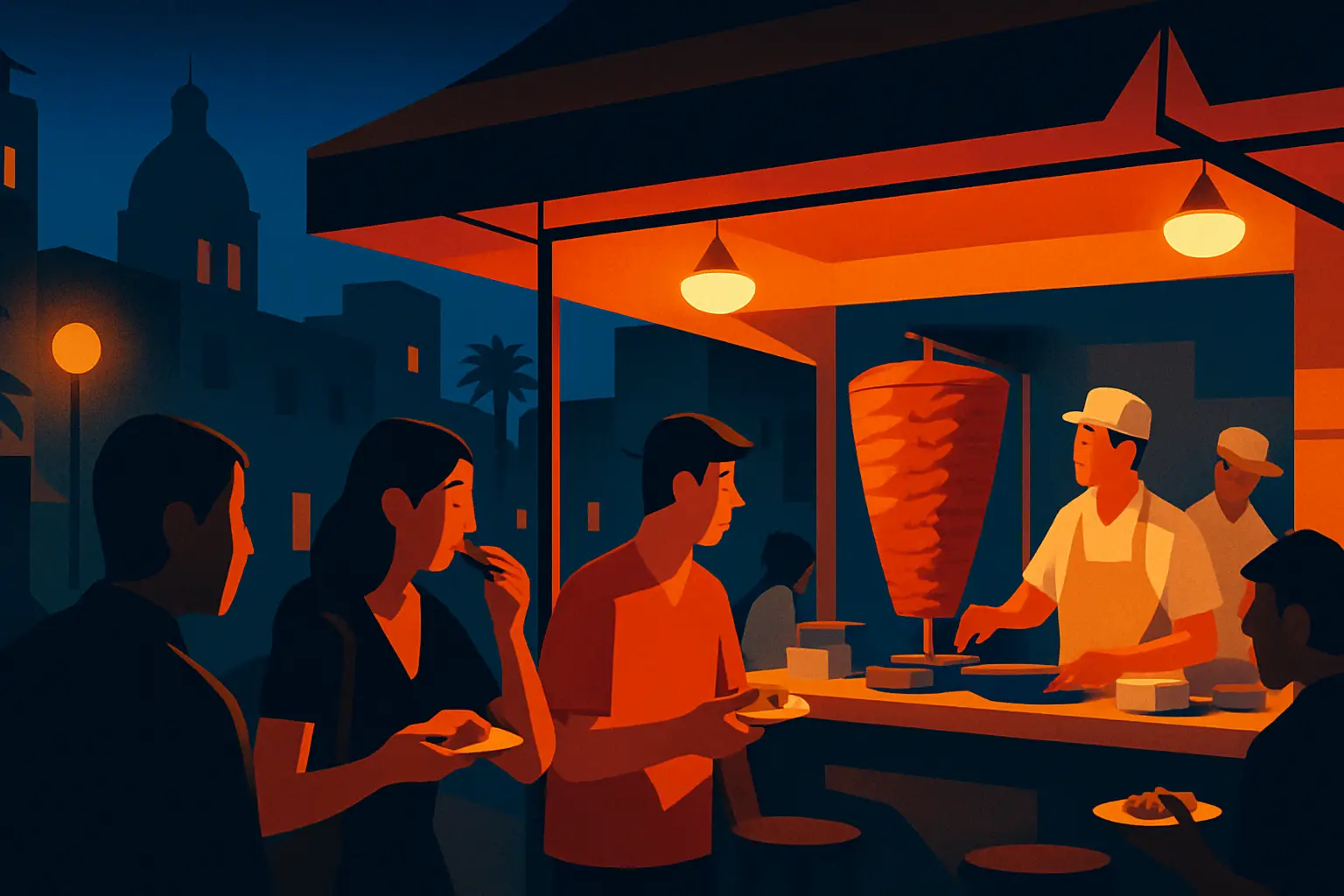
Mexico City runs on a schedule that would feel extreme in most cities. Dinner — la cena — is typically eaten between 9 p.m. and 11 p.m. Bars fill up around midnight. Mezcalerías and cantinas in Roma Norte, Condesa, and Centro Histórico don't hit their peak until 1 a.m. and often go until 4. This creates a sustained demand window from around midnight to 4 a.m. for food that can be made and eaten fast — and tacos are the answer the city has been refining for generations. The result is that CDMX has one of the densest ecosystems of genuine late-night taquerías in the world. These are not convenience-store hot dogs or fast food chains — they are family-operated stands and neighborhood institutions that have served the after-midnight crowd for decades. Some of them are only comprehensible in the context of a city that treats the night as a legitimate extension of the day. A taquería that opens at 10 p.m. and closes at 5 a.m. is not unusual here. It is simply what time that particular cook works.
Mexico City dinner time: 9–11 p.m. — bars peak at midnight, which pushes the eating window to 1–4 a.m.
The best late-night taquerías are family operations with fixed loyal clientele, not street-food startups or tourist traps
High turnover at a midnight stand means the meat is always fresh — a busy 2 a.m. taquería is often better than a slow 7 p.m. one
On Calle Bolívar 56 in Centro Histórico, Taquería Los Cocuyos has operated around the clock since 1980. It is a corner street stand — no chairs, no table, no address plaque — just a flat-top comal and a row of trays displaying the cuts. Anthony Bourdain named it his favorite taco spot in Mexico City, a designation that did nothing to change the prices or the format. The specialties here are what the taquería world calls casquería — the cuts that require knowing what you're ordering: tripe (tripa), cheek (cachete), tongue (lengua), and eyes (ojos). These are not challenge dishes. They are traditional cuts with long histories in the city's working-class food culture, and they reward the hours of slow cooking that only a 24-hour operation can deliver. The campechano is the safer starting point — a chopped mix of beef, longaniza sausage, and fatty suadero that comes off the same comal and is one of the more texturally interesting single tacos you can order anywhere in the city. Los Cocuyos also appears on the MICHELIN Guide's Bib Gourmand list — not for the address or the tablecloths (there are neither), but for what ends up inside the tortilla. The stand is a five-minute walk from the Zócalo, which means you can combine a late-night visit with a walk through the illuminated Centro Histórico at an hour when the square is quiet and actually navigable.
Calle Bolívar 56, Centro Histórico — open 24 hours, no chairs, cash only, running since 1980
Start with the campechano — chopped beef, longaniza, and suadero together in one taco
MICHELIN Bib Gourmand listed; Anthony Bourdain's stated favorite taco spot in Mexico City
Get short, interactive stories that make each place easier to remember while you travel.
El Borrego Viudo — The Widowed Ram — is located in Tacubaya, a working-class neighborhood in the western part of the city near the Miguel Hidalgo borough. This is not a neighborhood most visitors wander into, which is exactly why El Borrego Viudo has retained the character and pricing of an institution built for locals rather than tourism. The taquería operates 24 hours and was featured in Netflix's Taco Chronicles — the series that traced the origins and regional variations of Mexico's taco traditions — a recognition that came without changing anything about the operation. The specialty is suadero: slow-cooked beef brisket that becomes silky and deeply flavored after hours on a low-heat comal. Suadero benefits from extended cooking time more than almost any other taco filling. The fat renders down, the connective tissue softens, and the exterior develops a faint crust from contact with the iron surface. A suadero taco at 3 a.m. at El Borrego Viudo, made from meat that has been on the heat since the previous evening, is a fundamentally different experience than one from a lunch-only stand running four hours. The taquería also has a drive-through window — uncommon in CDMX — reflecting the neighborhood's car culture and late-night traffic patterns. The al pastor and longaniza are both worth ordering alongside the suadero, but suadero is the reason to make the trip.
Most late-night taquerías in Mexico City operate as standing-room-only street counters, which is fine at midnight but harder to sustain at 3 a.m. after a full evening out. El Califa on Altata 22 in the Hipódromo neighborhood — not to be confused with El Califa de León, the Michelin-starred stand on Insurgentes Norte in Colonia Guerrero — is one of the few late-night options that offers actual seating, an interior, and a more considered menu. Open until 4 a.m. daily, it serves al pastor from a trompo alongside carne asada, arrachera (skirt steak), and costillas, with proper tableside salsas and guacamole. The price point is higher than a street stand — expect 50 to 80 pesos per taco rather than 20 to 30 — but the context is different: this is where you sit down, order several rounds, and eat an actual meal rather than a quick two-taco stop. The Hipódromo Condesa location puts it in the center of one of the city's most active late-night zones, a few blocks from the mezcal bars on Avenida Ámsterdam and the cocktail spots near Avenida Álvaro Obregón. It is the natural endpoint of a long evening in that part of the city.
Altata 22, Hipódromo Condesa — open until 4 a.m. daily, one of the few late-night taquerías with actual seating
Not El Califa de León (the Michelin-starred stand in Colonia Guerrero) — a separate establishment entirely
Higher price than a street stand; the offer is a full sit-down meal, not a quick two-taco stop
The Roma Norte and Narvarte neighborhoods between Insurgentes and Sonora produce the highest density of after-midnight taco options in the city for travelers staying in those areas. Los Juanes, a taquería in Roma Norte, runs from 8 p.m. to 3 a.m. on weekdays and until 5 a.m. on Friday and Saturday — a schedule calibrated precisely to the bar-closing patterns of the neighborhood's mezcalerías. In Narvarte, El Vilsito (Avenida Nueva York) is the most visible institution: a functioning Nissan service center by day that converts to one of the city's best al pastor stands by night, staying open until 3 a.m. on weekdays and 5 a.m. on weekends. The Volcán — a large corn tortilla loaded with al pastor and melted Oaxacan cheese — is the signature order and is covered in detail in the al pastor guide. These two neighborhoods are the easiest zone for most visitors to navigate late at night: well-lit, high foot traffic, and multiple options within walking distance of each other. The food quality is consistently strong because both neighborhoods have enough informed local demand to keep substandard stands from surviving.
Los Juanes, Roma Norte: 8 p.m.–3 a.m. weekdays, until 5 a.m. Fri–Sat — timed to the mezcalería closing schedule
El Vilsito, Avenida Nueva York (Narvarte): al pastor until 3 a.m. weekdays, 5 a.m. weekends — the Volcán is the signature order
Both neighborhoods are well-lit and high-traffic at midnight — the easiest zone for first-time late-night taco exploration
A few cuts become clearer choices at midnight specifically because of what extended cooking time does to them. Suadero — slow-cooked brisket — is better at 2 a.m. than at noon because the fat has had more time to render down. A 24-hour stand that puts a fresh batch on the comal at 6 p.m. and serves it through the night is giving you meat that has been cooking for eight hours, longer than any lunch-only taquería can manage. Tripa (tripe) follows the same logic — properly prepared tripe requires long cooking on a low comal until the exterior crisps and the interior softens. At a slow daytime stand, tripa can be rubbery. At a 24-hour spot at 2 a.m., it is often the best thing on the menu. Campechano — the mixed meat order — is the hedge: it combines two or three cuts from the same comal in one taco, so you get range without committing to a single cut. Order it as your first taco at any new stand to understand what they're working with before you go deeper. On format: costras and volcanes (the cheese-shell and cheese-topped variants) make specific sense at this hour. The added fat slows absorption and the combination is more satisfying for a late-night meal than a plain corn tortilla. At a midnight stand, asking for a volcán is not upselling — it is the local order.
Suadero and tripa reward long cooking — 24-hour stands serve meat that has been on the heat for 8+ hours, which daytime stands cannot match
Campechano (chopped mixed beef and longaniza) is the hedge order — gives you range without committing to a single cut
Costras and volcanes (cheese-shell formats) are practical late-night choices — the added richness satisfies better at that hour
The question of safety around late-night taquerías in CDMX has two parts: the food and the surrounding environment. On food safety: a busy midnight taquería is generally safer than a slow mid-afternoon stand. High turnover means meat is being shaved or scooped constantly, the comal stays at consistent temperature, and nothing sits waiting to be ordered for hours. The problem case at any taquería — meat that has been in the heat zone too long without turnover — is the opposite of what happens at a packed midnight stand. On personal safety: the neighborhoods where the best late-night stands operate — Roma Norte, Condesa, Hipódromo, Centro Histórico near the Zócalo — are among the most actively patrolled and populated parts of the city at night. Street food stands attract crowds, and crowds mean visibility. The practical risks at 2 a.m. are more about general urban awareness than anything taquería-specific: stay aware of your phone and bag, use Uber or DiDi rather than hailing cabs off the street, and avoid poorly lit side streets on the way back. The late-night taco scene in CDMX is not a niche activity for adventurous travelers. It is what the city's residents do every weekend, and the infrastructure around it reflects that normality.
High turnover at a midnight stand means consistent comal temperature and constantly fresh meat — the opposite of a food safety risk
Best late-night spots are in Roma Norte, Condesa, and near Centro Histórico — all high foot-traffic areas at night
Use Uber or DiDi for the ride home — don't hail street taxis after midnight in CDMX