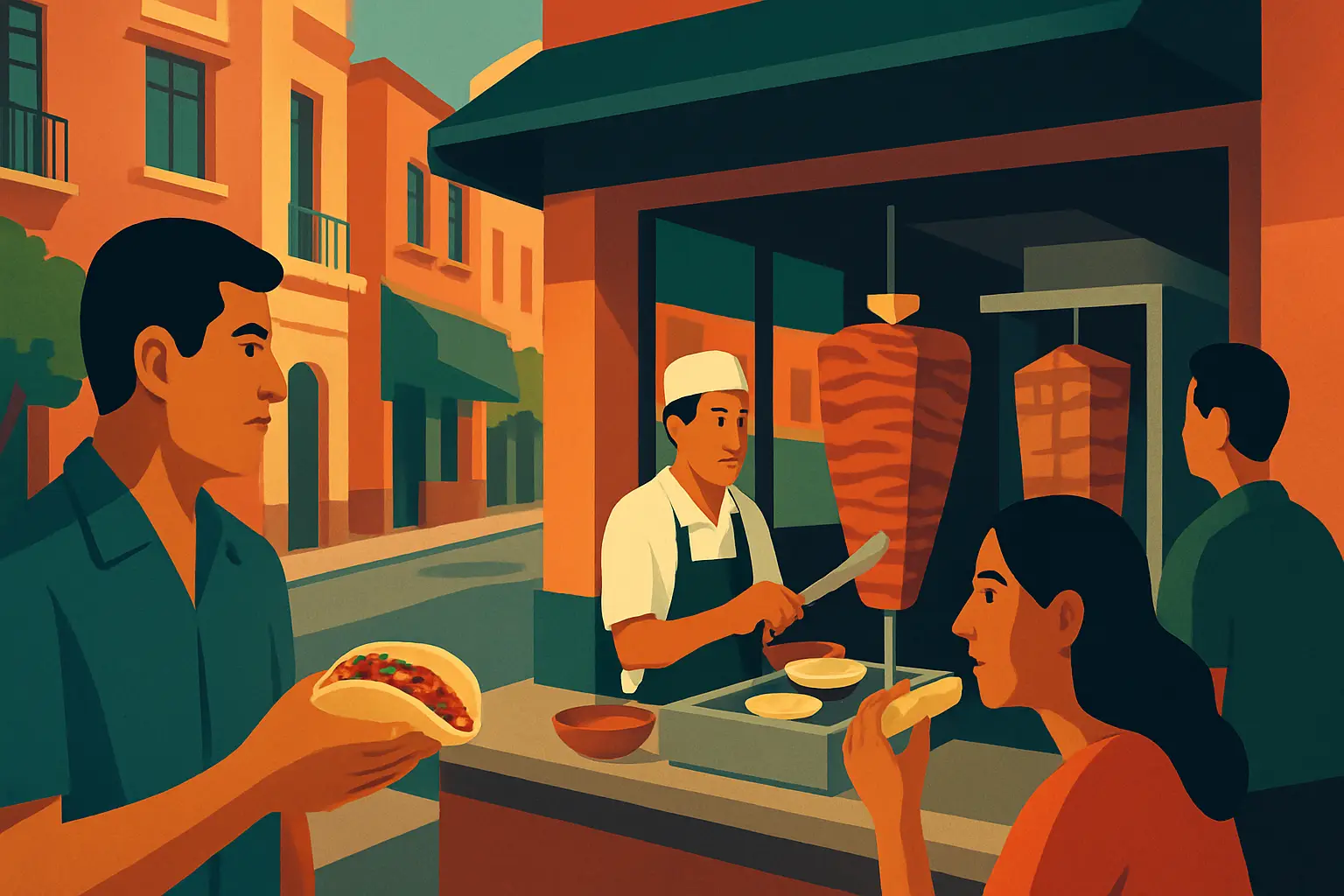
Both tacos árabes and tacos al pastor use pork cooked on a vertical rotating spit. That's where the similarity ends. A taco árabe comes on pan árabe — a thick, flour-based flatbread that resembles pita, slightly chewy with a charred edge from the griddle — rather than on a corn tortilla. The spice profile is different too: the meat is marinated with cumin, dried oregano, allspice, and garlic, seasoned closer to a Middle Eastern shawarma than to Mexico City's achiote-and-guajillo al pastor. There's no pineapple on a tacos árabes trompo. The condiment is chipotle salsa — smoky, with an earthy heat — paired with lime and sometimes dried oregano crumbled over the top, rather than the tomatillo salsa verde that pairs best with al pastor. The result tastes older, earthier, and less sweet: more savory and spiced, less caramelized. Once you've had both side by side, the distinction is obvious and stays with you.
Between the 1890s and the 1930s, waves of immigrants from the collapsing Ottoman Empire — primarily from what is now Lebanon and Syria — arrived in Mexico. Many settled in Puebla, drawn by the textile industry and a community of earlier arrivals who had already established themselves. They brought their food culture with them: shawarma, cooked on a vertical spit and wrapped in flatbread, seasoned with cumin, allspice, and cinnamon. In Puebla, lamb was expensive and scarce. Pork was cheap, abundant, and what local customers preferred. So the Lebanese cooks switched meats. They also adapted the bread — without access to the same grain and preparation of Lebanese pita, they developed pan árabe, a thick flour flatbread that approximated the texture and function of the original wrap. Mexican customers started calling the dish 'tacos árabes' — Arab tacos — as a straightforward description of what was being sold: a Middle Eastern cooking technique in taco format. The chipotle salsa and lime came later, a Mexican seasoning layer added to a dish that already worked.
Get short, interactive stories that make each place easier to remember while you travel.
By the 1950s, the trompo technique had migrated from Puebla to Mexico City, where the second generation of Lebanese-Mexican cooks began adapting it for a larger urban market. Three key changes transformed it into something new: they switched to a completely different marinade — achiote paste and dried guajillo and ancho chiles — which gave the meat a vivid orange-red color and a sweet-fruity heat completely unlike the original shawarma spice blend. They placed a pineapple on top of the trompo, where it caramelized and basted the meat with acid and sugar as it dripped down. And they moved to corn tortillas, which were cheaper, faster, and what every taquería customer already expected. This dish was named 'al pastor' — shepherd-style — a nod to the spit and the pastoral imagery of its Lebanese herder origins. It became one of the most recognized tacos in the world. But the original version — the taco árabe — never fully disappeared. Dedicated taquerías in Condesa and Narvarte kept making it on pan árabe with the older spice profile, serving customers who either grew up eating it or discovered it and never switched back.
Taquería El Greco on Michoacán 54, at the corner of Nuevo León in Colonia Condesa, is the address most associated with tacos árabes in Mexico City. It has been in the same location since 1978 and is Michelin-recognized — a distinction that has brought new waves of customers without changing what the place actually is: a tiny space with a handful of tables, a large takeaway operation, busy from lunch onward, cash only, no reservations. The meat is called 'doneraky' on the menu — El Greco's own portmanteau of 'doner' (the rotating spit technique tracing back to Middle Eastern cooking) and its house identity. You can order it on pan árabe or on corn tortillas, and there's a gringa option — pan árabe with Oaxacan cheese melted on top — that shows exactly how the flour-bread tradition from Puebla survived inside the al pastor world under a different name. Order con todo (onion, cilantro, lime) and ask for chipotle salsa specifically — the red salsas on the counter are for the other items. Expect a short queue at lunch that moves quickly.
Michoacán 54, corner of Nuevo León, Colonia Condesa
Open since 1978 — Michelin-recognized, cash only, no reservations
Order: tacos árabes on pan árabe, con todo, chipotle salsa — or the gringa with Oaxacan cheese
While El Greco is the Condesa institution, Narvarte has its own dedicated specialists. Hayito Tacos Árabes operates two locations: one at the corner of Doctor José María Vértiz and Avenida Universidad in Narvarte Poniente, and a second at Gabriel Mancera 501 in Del Valle Norte. Unlike El Greco, which is a full taquería with multiple items on the menu, Hayito is dedicated almost entirely to tacos árabes. The menu centers the dish: the Taco Árabe (pork on warm pan árabe, chipotle, lime), the Taco Costilla (short rib on pan árabe), and the Árabe Con Queso — a gringa-style version with cheese melted directly onto the flatbread, the flour and the fat from the meat combining in a way that a corn tortilla simply doesn't replicate. Hours run noon to 11 p.m. daily, which makes Hayito the most accessible option for travelers whose schedule doesn't match El Greco's lunch window. Both locations sit within walking distance of the food corridor on Obispo Labastida and the taquería strip that makes this neighborhood one of the city's best for eating.
Narvarte: corner of Dr. José María Vértiz and Av. Universidad — Narvarte Poniente
Del Valle: Gabriel Mancera 501 — open daily noon to 11 p.m.
Dedicated tacos árabes menu: Taco Árabe, Taco Costilla, Árabe Con Queso
Tacos Manolo occupies two storefronts directly across from each other on Calle Luz Saviñón 1305 in Narvarte Poniente — the second location exists because the first filled up. The restaurant is primarily known for the 'Taco Manolo,' a chopped-steak-and-bacon taco with caramelized onion that can be ordered on pan árabe. Tacos árabes — pork on the tortillota árabe (the house name for pan árabe) with chipotle salsa — appear as a permanent menu option, two for a fixed price, which tells you something about the neighborhood's relationship with the dish: here, flour flatbread is a standard format, not a novelty. Manolo opens in the afternoon around 3:30 p.m. and runs until late — midnight on weekdays, 3 a.m. on Fridays and Saturdays — making it a natural stop after dinner in Roma Norte or as a late-night destination when most spots have closed. Budget around 250–350 MXN per person for a full order.
Luz Saviñón 1305, Narvarte Poniente — two locations across the street from each other
Hours: Mon–Thu 15:30 to midnight, Fri–Sat until 3 a.m.
Famous for the Taco Manolo (steak + bacon + caramelized onion on pan árabe); tacos árabes also on permanent menu
The clearest way to understand the difference is through the bread. A corn tortilla means you're eating al pastor. A thick flour flatbread — pale, slightly chewy, charred at the edge — means tacos árabes. Beyond the bread: al pastor uses an achiote-and-guajillo marinade that gives the meat a vivid red-orange color. Tacos árabes use a cumin-and-oregano marinade with allspice and garlic — the palette is earthy and savory rather than sweet and acidic. Al pastor comes with pineapple, either on top of the trompo or cut as a garnish; tacos árabes never do. The salsas differ too: chipotle salsa is traditional with tacos árabes; tomatillo salsa verde pairs better with al pastor. The textures also read differently — al pastor at its best has caramelized, crisped outer edges from the trompo's heat; tacos árabes meat tends to be juicier and less charred, with the spice blend doing more work than the caramelization. Both are excellent. But they're different dishes with different histories, and knowing which one you're eating makes both taste better.
Yes — for one specific reason: they taste different, and the difference is worth experiencing. Al pastor is ubiquitous and some of the best versions in the city are genuinely brilliant. But tacos árabes offer a flavor profile that's demonstrably older — the cumin-forward, earthy, savory version that existed before the achiote marinade took over. If you've spent a week in Mexico City eating al pastor, tacos árabes will register as something clearly related but clearly distinct, which is exactly what good food history tastes like when it's still being made correctly. El Greco in Condesa is the most efficient stop: it's walkable from Roma Norte, the queue moves quickly, and three tacos árabes will cost less than 200 MXN. For a full Narvarte afternoon — fondas, coffee, and the taquería strip — Hayito or Tacos Manolo fit naturally into the neighborhood's rhythm without requiring a separate trip. One visit to any of these three spots is enough to understand why this older version of the dish has survived 70 years in Mexico City without needing to become something else to stay relevant.