1. How salsa arrived in Mexico City — and why it looks different here
Mexico City's dance culture didn't develop in isolation. In the 1940s and early 1950s, a wave of Cuban musicians and dancers arrived in the capital, bringing son cubano, mambo, and danzón — the Afro-Cuban form that blends French contradanza with African rhythm patterns. This wasn't peripheral immigration; the ballrooms of Colonia Guerrero became celebrated live music venues across Latin America, and Mexican musicians absorbed the Cuban styles and began creating their own hybrids. What we now call salsa codified in New York in the 1960s and 1970s, blending Cuban son with Puerto Rican, Colombian, and American jazz influences. By the time it reached Mexico City, it landed in a city with decades of Cuban-derived dance tradition already embedded in the local body. This is why the ballroom scene here feels distinctly different from salsa in Bogotá or New York — the steps, the etiquette, and the music carry traces of all those earlier arrivals.
2. Salón Los Ángeles: dancing in a ballroom that opened before World War II
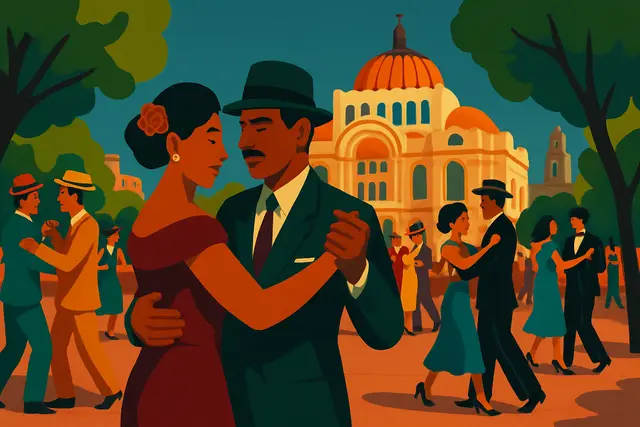
Lerdo 206 in Colonia Guerrero doesn't look like much from the outside — a plain facade on a commercial street northwest of the historic center. Inside, it's one of the most intact mid-century ballrooms in Latin America: a large sprung wood floor, a raised stage for the live orchestra, tiered seating around the perimeter, and chandeliers that look original to the 1937 opening. Salón Los Ángeles survived the 1985 earthquake that leveled much of Tepito and Guerrero, survived the disco era, and survived the decades when ballroom dancing looked like it might disappear entirely. The venue opens two nights a week: Tuesdays and Sundays from 5 p.m. to 11 p.m. Tuesday is the traditional night — the orchestras play danzón, cumbia, and son, and the regulars are mostly in their 50s and 60s, moving with the precision of people who've danced the same steps for forty years. Sunday leans toward salsa and draws a younger crowd. Cover runs around 100–150 pesos and includes the live band.
•Address: Lerdo 206, Colonia Guerrero — northwest of Centro Histórico
•Hours: Tuesdays and Sundays, 5 p.m. to 11 p.m.
•Tuesday is danzón night; Sunday shifts to salsa and attracts a broader age range
3. Mama Rumba: where Cuban salsa lives in Roma Norte
The contemporary anchor of Mexico City's salsa scene is at Querétaro 230, a short walk from Álvaro Obregón and the coffee shops that define Roma Norte by day. Mama Rumba operates Wednesday through Saturday from 9 p.m. to 2:30 a.m., and its format follows a deliberate sequence: a free beginner salsa lesson from 9 to 10 p.m., a DJ set while the room fills, then a live band from 11 p.m. onward playing salsa cubana — the style rooted in son, with circular footwork rather than the linear slot-style salsa common in US clubs. The lesson is worth attending even if you've danced before, because the Mama Rumba instructors teach the Cuban style specifically, which is mechanically different from the on-2 salsa taught at New York-influenced schools. The room gets hot, the live band is consistently good, and by midnight the floor is at capacity. Cover varies by night: 50–100 pesos Wednesday and Thursday, 140 pesos on Friday and Saturday.
•Address: Querétaro 230, Roma Norte — near the intersection with Álvaro Obregón
•Hours: Wed–Sat, 9 p.m.–2:30 a.m.; free beginner lesson runs 9–10 p.m.
•Cover: 50–100 pesos midweek, 140 pesos on weekends
4. The Condesa scene: open-air classes and social nights
The Hipódromo-Condesa neighborhood runs a parallel salsa economy built around outdoor classes and small social clubs. Grupo Esencia México holds open-air sessions at Parque México — the oval Art Deco park at the heart of Condesa — on Wednesdays at 6:30 p.m. and on Saturday and Sunday afternoons at 1 p.m. Classes are free or charge a nominal fee, with no registration required, and the informal social dancing that follows is open to anyone. Pata Negra at Tamaulipas 130, 1er Piso, is the neighborhood's bridge between class and club: it runs regular salsa nights where the crowd is a mix of dancers who came for the structured session and regulars who know the floor already. The atmosphere is less polished than Mama Rumba and more oriented toward people who want to practice rather than perform. Cover on salsa nights runs around 100–150 pesos.
5. Taking your first class: what to expect and how to prepare
If you've never danced salsa before, the free Mama Rumba lesson is the lowest-stakes entry point in the city. It's included in the cover charge, the instructors demonstrate steps bilingual enough to follow, and the room is full of other first-timers. The basic salsa pattern — a three-step rock that occupies four beats with a pause on the fourth — takes about twenty minutes to internalize, and the lesson typically covers both the step and two or three turns. For structured learning over multiple sessions, searching for 'escuela de salsa Roma CDMX' or 'clases de salsa Condesa' on Instagram surfaces weekly beginner courses sold as fixed-price cycles rather than per class. Multi-week formats are specifically worth it for leaders: following is easier to pick up quickly, but leading Cuban circular salsa takes deliberate repetition that one lesson won't give you.
•First timer: start at the Mama Rumba free lesson (9 p.m. Wed–Sat) — no partner or experience needed
•Cuban salsa vs. on-2: most CDMX schools teach circular Cuban style, different from the linear New York slot style
•Multi-week courses reward leads — following comes faster, leading takes sustained practice
6. What to wear, what to budget, and the best nights to go
Footwear matters more than most visitors expect. Dedicated dance shoes have a suede sole that lets you pivot cleanly on a wood floor without catching. If you don't own them, leather-soled dress shoes work at Salón Los Ángeles, and smooth-bottomed flats or low heels work for women at Mama Rumba. Rubber-soled sneakers grip instead of slide, which makes turns difficult and announces you as a beginner before you've taken a step. For Colonia Guerrero ballrooms, dress up — collared shirt, slacks, leather shoes for men; a dress or blouse and skirt for women. For Mama Rumba and the Condesa venues, business casual is the safe choice: people dress well but the vibe is younger and less formal. Budget roughly 100–300 pesos for a night including cover and one drink. Saturday nights at Mama Rumba and Sunday nights at Salón Los Ángeles are the peak nights for their respective scenes.
7. Do I need a partner? Is it safe to go alone?
No partner required at any venue listed here. Salsa and danzón in Mexico City follow the partner-rotation convention — during lessons you rotate partners frequently, and on the social floor it's normal to ask anyone to dance regardless of prior acquaintance. Solo travelers and expats make up a significant share of the crowd at Mama Rumba on any given night, and the venue feels oriented toward that reality. Salón Los Ángeles sits in Colonia Guerrero, a working-class neighborhood that gets less tourist foot traffic than Roma or Condesa — the venue itself is safe and has been for nearly 90 years, staffed by people who are there to run a dance hall, not a dive bar. The practical advice: take an Uber directly to the entrance and back, don't wander Lerdo Street after midnight. Inside, the crowd is there to dance, and solo visitors are common enough that no one registers your presence as unusual.