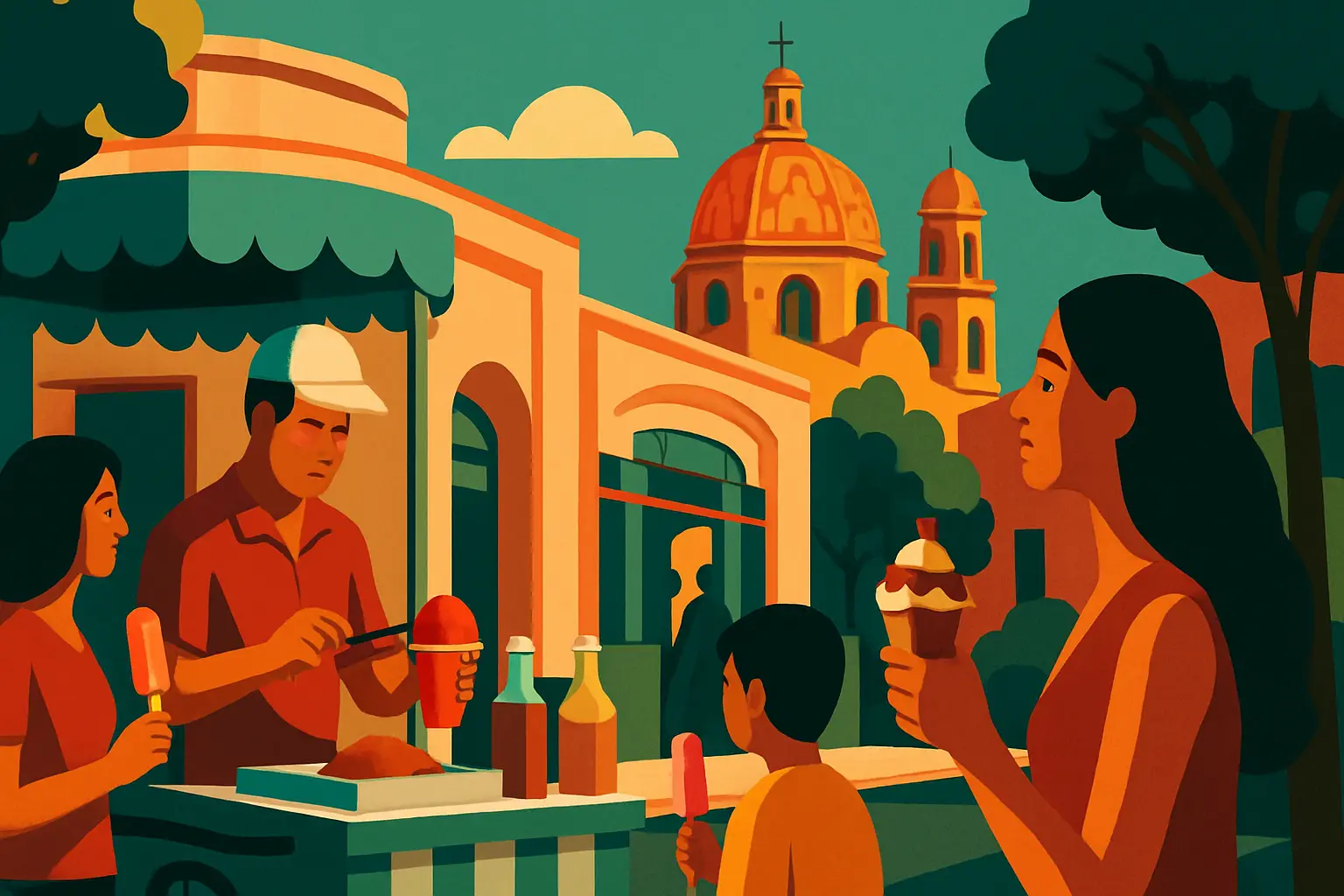
Mexico City's frozen sweet culture runs on four distinct things that are easy to confuse. A paleta is a popsicle on a stick — made either de agua (fruit juice or puree, no dairy) or de leche (milk or cream base). A nieve is a hand-scooped sorbet or sherbet served in a cone or cup, with a coarser, more granular texture than Western-style ice cream — the best versions are made in a garrafa, a large wooden barrel packed with ice and salt and rotated by hand until the mixture freezes into something dense and intensely flavored. Helado refers to proper ice cream with a creamier texture and higher fat content. And a raspado is shaved ice drenched in fruit syrup — the street version of what becomes a chamoyada when you add chamoy sauce, tajin chili powder, and fresh fruit chunks.
Knowing the difference matters because Mexican frozen sweets optimize for fruit intensity rather than richness or sweetness. A paleta de agua made with fresh guanabana or tamarindo has a clean, almost savory quality that disappears when you add dairy. Ordering a paleta de leche for a mango or jamaica flavor misses what the format does best. This is not a subtle distinction — it changes the experience completely.
The pink-and-white storefronts with a cartoon tiger logo that appear on nearly every block in Mexico City are all called La Michoacana — and none of them are related to each other. The name belongs to no company, no founder, no franchise. It is an orphaned brand, freely copied for over 80 years, and the story of how it got that way is one of the stranger business histories in Mexico.
In the late 1930s and early 1940s, workers from Tocumbo — a small agricultural town in the Tierra Caliente region of western Michoacan — began migrating to Mexico City and other cities to sell paletas. One account credits Agustin Andrade and Ignacio Alcazar, both from Tocumbo, with establishing early paleteria operations in the capital in the 1940s. They named their shop La Michoacana after the state they came from and — crucially — never registered the name or the concept. Other Tocumbo migrants copied both freely, opened their own shops, and passed the model to their relatives. By the time anyone considered a trademark, the name was already everywhere.
Today Tocumbo remains the paleta capital of Mexico. Roughly 70 percent of the town's families are involved in the ice cream trade, most running La Michoacana shops in cities across the country. An estimated 8,000 to 15,000 independently owned La Michoacana locations operate nationwide. They share a visual identity and a general product category but have no shared ownership, no central commissary, and no standardized recipes. The mamey paleta at the branch on Alvaro Obregon and the one on Insurgentes Sur were made by different families, probably using different proportions. Both are called La Michoacana. Neither can sue the other.
Get short, interactive stories that make each place easier to remember while you travel.
At Amsterdam 265 in Condesa, across from the tree-lined oval park that defines the neighborhood, Neveria Roxy has been making nieves from the same recipes since 1946. The original owners designed the interior to echo the nearby Roxy cinema — the Art Deco pink-and-white tile work, the rounded counters, the hand-lettered sign above the register. The cinema is long gone. Roxy is still there, still family-run, recipes unchanged.
The shop's specialty is nieves made from seasonal Mexican fruits that don't appear at most modern ice cream parlors: chicozapote (also called zapote or sapodilla — a brown-skinned fruit with reddish flesh that tastes like molasses mixed with cinnamon), mamey (best in summer, dense and orange), guayaba (guava, floral and tart), and tejocote (a small native fruit from the rose family, sharp and fragrant). These are not novelty flavors invented for a menu — they are the standard repertoire of traditional Mexican nieveria culture, preserved at Roxy while the rest of the neighborhood changed around it.
What to order: a copa (a sundae cup) with mamey and chicozapote if both are available. A single scoop of guayaba in a cone if you want to understand what Mexican fruit-forward nieve actually tastes like before the modern artisan version arrived. Roxy now has four locations across the city, but the Amsterdam 265 original has the best atmosphere and the longest institutional memory.
A wave of artisan paleterias and ice cream shops opened across Roma Norte and Condesa from the 2010s onward, using organic and seasonal ingredients with a more experimental approach to flavors. The best of them aren't novelty acts — they're serious about fruit sourcing and treat the paleta format with the same rigor a good cocktail bar applies to its base spirits.
La Pantera Fresca has become one of the city's go-to artisan options, known for rotating flavors based on what is available at market: guayaba, maracuya (passion fruit), mamey, and lavender appear regularly on the board. The paletas are made with real fruit puree, not concentrate, and the difference is noticeable — brighter color, cleaner finish, no coating of artificial sweetness.
Bendita Paleta operates out of Mercado Roma at Queretaro 225 in Roma Norte, and has a nearby affiliated stand called Dulce Almacen that specializes in alcohol-infused paletas: gin with lemon, rum with coconut, mezcal with tamarind. These are legitimate desserts, not gimmicks — the alcohol is measured into the freeze ratio so the texture holds properly.
For traditional nieve de garrafa — the hand-churned wooden barrel version — almost any classic neighborhood market is the right place to look. Most markets, including Mercado de Medellin in Roma Sur, have at least one vendor with a garrafa setup and three or four rotating flavors. This is often the cheapest and most authentic option in the city.
A raspado is shaved ice — compressed ice scraped with a blade into fine snow, then soaked with fruit syrup. The syrup options at any good raspado stand cover the full range of Mexican candy logic: tamarindo (sour and earthy), jamaica (hibiscus, tart and floral), limon (bright lime), mango, guanabana, and chamoy — a fermented sauce made from pickled fruit, chile, and lime that has a complex, almost umami quality that sounds wrong until you taste it.
The chamoyada is the maximum-complexity version: shaved ice plus a scoop of sorbet or ice cream (usually mango or tamarind), doused in chamoy sauce, dusted with tajin chili powder, topped with fresh mango or cucumber chunks, sometimes with a tamarind candy straw. The flavor hits sweet, sour, salty, spicy, and cold simultaneously. It is the defining summer street food of Mexico City — not a novelty, not a tourist version of something else. Ordering one from a street cart near Parque Espana or Metro Chapultepec on a June afternoon is the correct context.
Raspado carts set up near park entrances across the city from late April through October. The tricycle-and-cooler format means they move constantly — walk along the edges of Bosque de Chapultepec, Parque Mexico in Condesa, or the outer ring of Parque de los Venados in Portales and you'll find one within a few minutes.
Condesa has the highest concentration of quality options: Neveria Roxy at Amsterdam 265 for traditional nieves, multiple La Michoacana branches along Amsterdam and Tamaulipas, and raspado carts that cluster around Parque Mexico (Michoacan 15) on weekend afternoons. The covered oval of Amsterdam Avenue makes this the best walking circuit in the city — a paleta in hand fits the tempo.
Roma Norte has La Pantera Fresca for artisan options and Bendita Paleta at Mercado Roma. The stretch of Alvaro Obregon between Orizaba and Veracruz has several independent paleterias and niverias worth walking past — choose based on whatever flavor is written on the chalkboard outside that day.
Centro Historico has the densest concentration of traditional shops, particularly around Mercado San Juan at Aranda 12 and on the side streets east of the Zocalo near Correo Mayor. These are mostly family-run niverias and La Michoacana branches serving market workers rather than tourists — lower prices, more unusual flavors, less polished environment. Worth the detour if you're already in the historic center.
Any traditional market is also a reliable bet. Permanent market stalls in neighborhoods like Medellin, Jamaica, and La Merced all have nieve de garrafa vendors operating on weekday and weekend mornings. The market version is almost always cheaper than a dedicated shop and often just as good.
June is when everything converges in favor of paletas. Morning temperatures reach 24–28°C before the rainy season locks into its afternoon-storm pattern — the stretch from 11 am to 2 pm is hot, humid, and ideal for frozen food. Mamey is in peak season. Mango is at its sweetest. The chamoyada carts are at maximum deployment.
The season runs roughly May through October, with July and August the absolute peak for both heat and fruit variety. September and October bring cooler temperatures and the last of the tropical fruit window before the shift to tejocote, guava, and the more autumnal flavors. Tamarindo and jamaica are year-round stalwarts — always available, always correct.
November through February, paletas don't disappear but the culture shifts toward hot drinks — atole and champurrado take over the market stalls. You can still find a good La Michoacana in any month, but the chamoyada carts pack up when the first cold fronts arrive in November.
The one practical rule: show up in June, buy a chamoyada from a cart near a park, add extra tajin, eat it before the afternoon rain starts. That is the correct use of a Tuesday in Mexico City.