1. Why Mexico City's food radius is unlike almost any other megalopolis
Mexico City is ringed by active farmland in a way that most cities with 22 million people simply are not. The highland valleys of the Estado de México, Morelos, Puebla, Tlaxcala, and Hidalgo all begin within 80 to 130 kilometers of the Zócalo — within a long Saturday drive, or a short truck ride for a farmer headed to a Sunday market. Within the city limits themselves, Xochimilco's chinampa gardens — raised-bed plots built over the ancient lake by the Aztec civilization and still worked by local families — produce heirloom corn varieties, herbs, squash, and quelites (wild edible greens) less than 30 kilometers from downtown. Most megacities have to fly their specialty produce in. Mexico City can, in theory, grow some of it on islands inside the city boundary. That proximity made a specific kind of market movement possible starting in the late 2000s, when a coalition of chefs, farmers, and food activists organized around a single rule: everything sold had to originate within 100 kilometers of the city. That rule became Mercado el 100 — still the most important organic market in CDMX.
2. Mercado el 100: The Slow Food-certified Sunday flagship
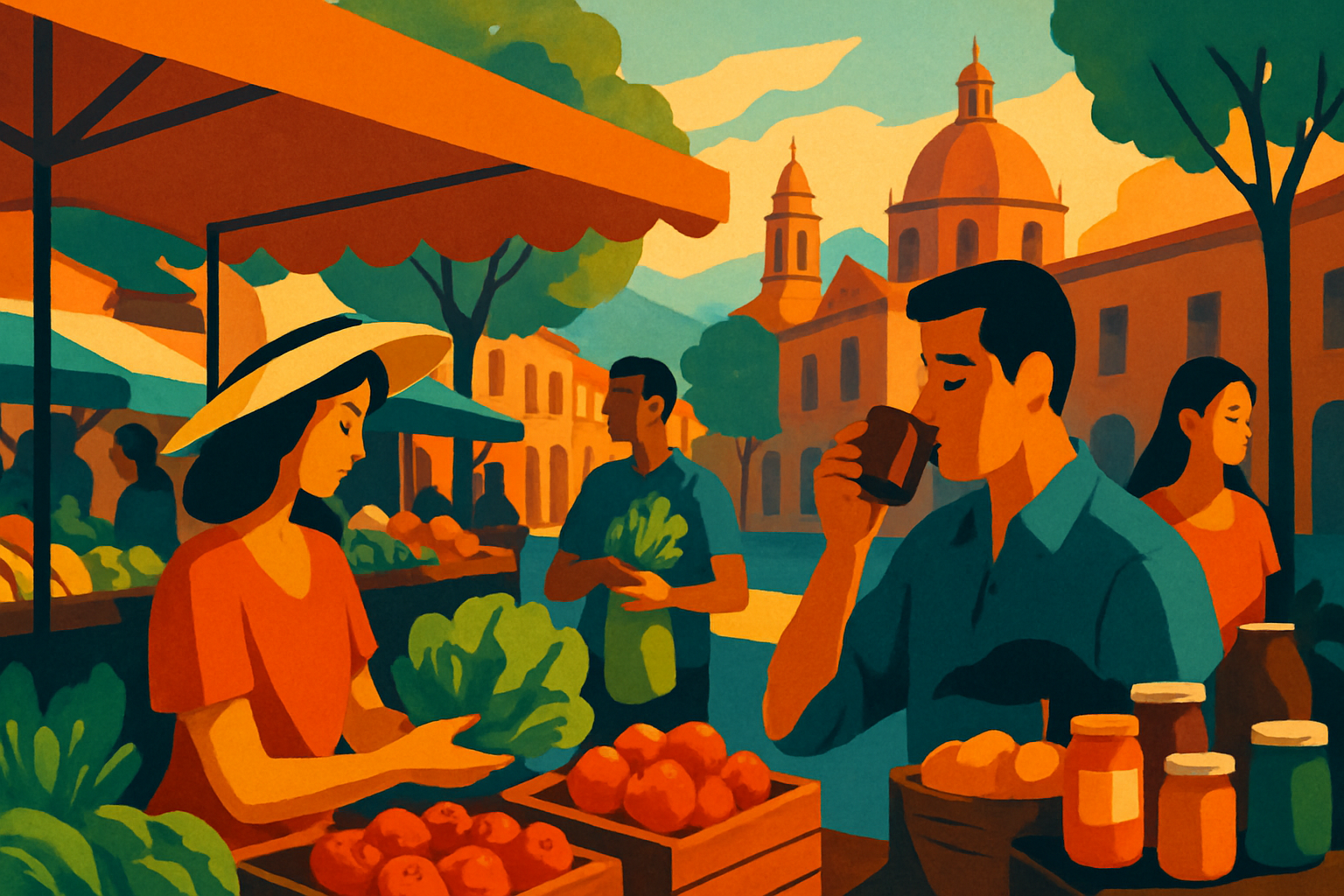
Mercado el 100 runs every Sunday from 9 a.m. to 2 p.m. at Plaza del Lanzador, on the border between Roma Norte and Roma Sur — about a ten-minute walk east of Parque México in Condesa, or a short walk south from the fountain on Álvaro Obregón in Roma Norte. The market has held Slow Food Earth Market certification since its founding in 2010, making it one of the few certified Slow Food markets in all of Latin America. The setup is open-air: about 50 stalls spread across one side of the plaza, selling organic produce, heirloom corn in blue, red, and white varieties, fresh Mexican cheeses (panela, quesillo, aged cotija from Chiapas), wild honey from Hidalgo, seasonal mushrooms from Tlaxcala and Puebla, organic coffee from Chiapas cooperatives, handmade soaps and skincare, and four or five hot-food stalls. The tortilla stall uses masa from heirloom corn — the tortillas come out denser, more corn-forward, and in the color of whatever variety was milled that week. On a good Sunday, that means blue corn tortillas hot off the comal at 9 a.m.
•Plaza del Lanzador, Roma Sur — every Sunday 9 a.m. to 2 p.m.
•Slow Food Earth Market certified since 2010 — one of the few such certifications in Latin America
•About 50 stalls: produce, artisan cheese, honey, organic coffee, hot food, skincare, flowers
3. What to buy at el 100 — specific finds worth arriving early for
The hot food stalls are the first to run out. By 11 a.m. the guisado tacos — usually four or five rotating fillings that include quelites (wild greens), nopales con huevo, bean-based options, and a protein — have sold through most of their first batch. Arrive between 9 and 10 a.m. if food is the priority. Produce stalls stay stocked longer, but the unusual items — heirloom tomato varieties, chinampa squash, epazote bundles, dried chiles from specific growing regions — move quickly once the Sunday crowd arrives around 10:30. The cheeses are worth pausing over. Artisan panela from the Estado de México has a fresher, milkier flavor than the commercial version sold at every supermarket in the country. The aged cotija from Chiapas is drier and more intensely salty — correct for grating over black beans or tacos rather than eating fresh. The fresh quesillo (Oaxacan string cheese) comes wound in tight balls and pulls apart in long ribbons, unlike the factory version. The honey vendors source from multiple states and can explain the difference between forest honey from Hidalgo, which runs dark and resinous, and wildflower honey from Morelos, which is lighter and more floral — both raw, both unfiltered, both priced at a fraction of what comparable honey costs imported.
•Arrive by 9:30 a.m. for hot food — guisado tacos and heirloom corn tortillas sell out before noon
•Look for chinampa-grown produce: squash, quelites, herbs — often labeled with the specific producer
•Artisan cotija, panela, and quesillo all taste noticeably different from the supermarket version
4. The Condesa tianguis circuit — Tuesday and Friday markets for weekly shoppers
Mercado el 100 is the Sunday destination, but the Condesa's rotating tianguis are what most expats and long-term residents actually use for day-to-day kitchen shopping. Every Tuesday from 10 a.m. to 5 p.m., the stretch of Pachuca Street between Agustín Melgar and Juan Escutia closes to traffic and fills with roughly 40 stalls. This is a traditional neighborhood tianguis, not a certified organic market, but the produce quality is reliably high, prices are lower than at el 100, and you can buy standard cooking staples — onions, garlic, dried chiles, tomatoes, avocados, fresh herbs, citrus — in the quantities that make sense for a week of cooking at home rather than in sample sizes. There's also a Friday tianguis on Campeche Street in Condesa with a different character: more flower stalls, more plants and gardening supplies, more clothing and household goods mixed in with produce. Both tianguis have a handful of cooked-food stalls — quesadillas, tamales, aguas frescas — that make a better quick lunch on market days than trying to find a restaurant in a neighborhood where weekend brunch crowds arrive early. For a broader sense of how all these markets fit into Mexico City's tianguis culture, the category goes much deeper than any single neighborhood circuit.
•Tuesday tianguis: Pachuca between Agustín Melgar and Juan Escutia, 10 a.m. to 5 p.m.
•Friday tianguis: Campeche Street — better for flowers, plants, and household items alongside produce
•Lower prices than el 100 and more volume — correct for weekly shopping, not a specialty destination
5. The chinampa connection: Ancient urban farming still supplying Sunday markets
Several vendors at Mercado el 100 source directly from Xochimilco's chinampas — the ancient raised-bed island gardens built over the lake system that once covered most of the Valley of Mexico. The chinampas are genuine engineered islands connected by canals, worked by local families using agricultural methods refined over centuries. Chinampa soil is among the most fertile in Mexico: it builds continuously from lake sediment, organic matter, and centuries of composting without chemical inputs. The result is that chinampa-grown vegetables taste different from field-grown equivalents in ways that are easy to notice without training — chinampa tomatoes are denser and more intensely flavored, chinampa herbs are more aromatic, chinampa heirloom squash has a deeper sweetness than anything that traveled four hours from Sonora. Xochimilco sits about 25 kilometers south of the Zócalo, well inside the 100km rule. When a vendor at el 100 sells quelites or amaranth or nopal labeled from Xochimilco, the distance from farm to market is shorter than a cross-city metro ride. If you want to see the chinampas directly, the neighborhood is worth more than just the trajinera boat rides — Xochimilco as a place has working farms, local markets, and pulquerías that predate the tourist infrastructure by centuries.
•Look for vendor signs reading 'chinampa' or 'Xochimilco' — these are genuinely different in flavor
•Chinampa soil is built from centuries of lake sediment — no chemical inputs needed historically
•Some chinampa producers at el 100 can connect visitors with farm tours in Xochimilco
6. Is the food at organic markets actually certified?
Mercado el 100 operates under Slow Food Earth Market certification, which requires vendors to demonstrate that products are grown within 100 kilometers of Mexico City and produced using sustainable methods. The collective that runs the market conducts inspections using a participatory guarantee system — farmers audit each other — rather than USDA or EU organic certification, which doesn't exist in Mexico in the same regulatory form. In practice, the produce is genuinely local, genuinely small-scale, and often grown without synthetic inputs, but 'organic' in the formal certification sense varies by vendor. Many farms at el 100 use fully organic methods but haven't pursued costly independent certification, a situation common across Mexico where small farms can't absorb the administrative cost of external audits. The honest approach is to ask directly: vendors at el 100 tend to be unusually forthcoming about their growing practices, their farm location, and their methods — it's part of the market's culture, not an exception. That transparency is what distinguishes it from uncertified produce at a conventional market where the origin of anything might be a wholesale distributor in Azcapotzalco.
7. Practical guide: How to reach the markets and what to bring
Mercado el 100 is the most accessible of the organic markets for visitors: take Metro Line 1 to Insurgentes, walk south along Insurgentes for about five minutes, then turn east on Orizaba toward Plaza del Lanzador. The walk from the metro to the market is around ten minutes and passes through Roma Norte, which rewards a slower pace than the shortest route suggests. The Sunday morning version of Roma Norte — before the brunch restaurants open their doors around 11 — is quieter than usual, and combining the market visit with a coffee and a walk through the neighborhood is the natural sequence. For the Condesa tianguis on Tuesday, take Metro Line 9 to Chilpancingo and walk west for about ten minutes to reach Pachuca Street. Bring a tote bag: no vendor at el 100 or the Condesa tianguis provides plastic bags, and trying to carry loose vegetables and a jar of honey without a bag is a commitment. Small-denomination cash (50- and 100-peso bills) moves faster at the stalls than larger notes. Budget 300–500 pesos for a pleasant Sunday visit with food and a few produce purchases; a full week's kitchen shop at el 100 runs around 600–800 pesos for a single person.
•El 100: Metro Insurgentes (Line 1) → south on Insurgentes → east on Orizaba to Plaza del Lanzador
•Condesa tianguis: Metro Chilpancingo (Line 9) → 10 minutes west to Pachuca Street
•Bring: tote bag, small bills (50–100 pesos), and nothing that can't survive being in a backpack under avocados
8. When to go, what to budget, and how to build the morning
The best window at Mercado el 100 is 9 a.m. to 10:30 a.m. — you arrive ahead of the main Roma-Condesa Sunday crowd, the hot food is fresh, vendors have time to talk, and the produce selection is intact. After 11 a.m. the plaza becomes crowded, the guisado tacos are gone, and the market becomes more of a browse than a shop. The Mexico City Sunday guide maps out how to sequence a morning that begins at el 100 and moves into the rest of the neighborhood — there are enough cafés and breakfast spots in Roma Norte within a ten-minute walk to make a full Sunday out of the combination. The Condesa tianguis is not worth traveling across the city for as a destination on its own — it earns its place as a neighborhood errand combined with a walk around Parque México or a morning coffee on Ámsterdam, the oval boulevard that circles the park. For visitors spending a week or more in either neighborhood, the Tuesday tianguis and the Sunday el 100 quickly become anchor points of the weekly rhythm in a way that no restaurant or bar manages to replicate.