1. The cactus on the flag — and in your tlacoyo
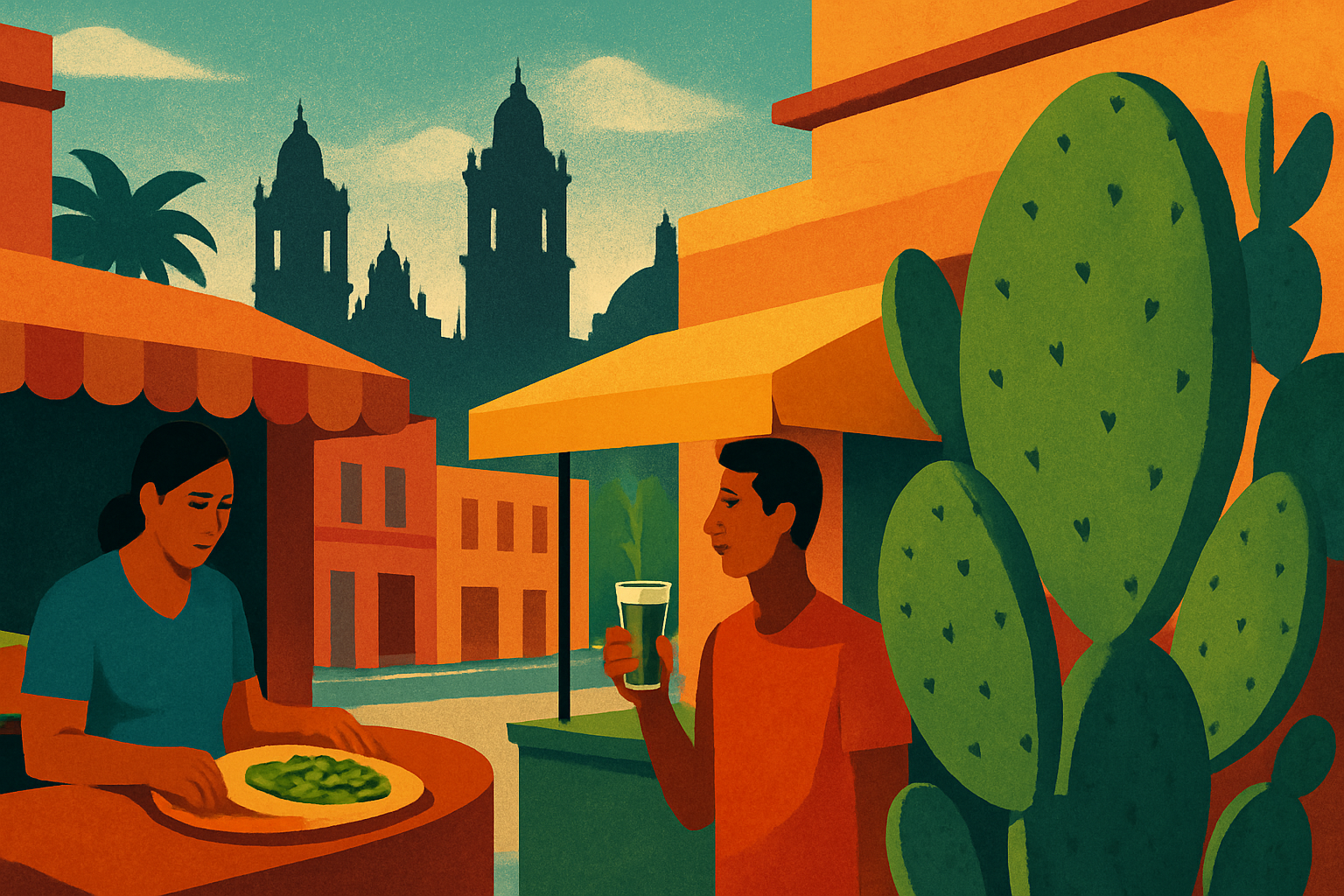
The nopal cactus has been at the center of Mexican identity longer than Mexico has existed as a nation. The country's coat of arms — on every peso coin, printed on the center of the flag — shows an eagle perched on a nopal cactus devouring a serpent. According to Aztec legend, the god Huitzilopochtli told the Mexica people to found their new city wherever they found this exact image. They found it on a small island in Lake Texcoco in 1325. They called the place Tenochtitlán. That city became Mexico City. The word 'nopal' comes from the Nahuatl nopalli — the Mexica were already cultivating and eating the cactus for centuries before the eagle became their founding myth. In today's Mexico City, the nopal is everywhere: piled high in market stalls, scrambled into eggs for breakfast, grilled on street-food corners, blended into the bright green morning juices at every juguería, and sitting on top of tlacoyos — the thick grilled blue-corn masa ovals sold at market stalls across the city. Most visitors eat nopales at least once without identifying what they are. This guide fixes that.
2. Milpa Alta: the borough that grows Mexico City's nopales
Southeast of the city center, where the urban sprawl finally gives way to cornfields and volcanic hillsides, lies Milpa Alta — the most rural of Mexico City's 16 boroughs and the source of the vast majority of the nopal eaten in the capital. Milpa Alta's farms stretch across the Ajusco-Chichinautzin mountain range at elevations around 2,400 meters, where volcanic soil and a cool climate produce paddles that are thicker and more tender than those from other regions. The borough accounts for roughly 70 percent of Mexico City's annual nopal harvest — thousands of hectares dedicated almost entirely to this one crop. Milpa Alta is also notable for a reason unrelated to agriculture: it has no Walmart, no McDonald's, no Oxxo, no large retail chains of any kind. The borough's communities have intentionally kept commercial chains out for decades, and the result is one of the few places within Mexico City's administrative limits that functions like a genuine small town. The main population center, Villa Milpa Alta, sits about 30 kilometers south of the Centro Histórico. Getting there from the city is straightforward: take Metro Line 12 (the gold line) to its southern terminus at Tláhuac, then board a pesero (a shared minibus) marked 'Villa Milpa Alta' — the ride takes roughly 45 minutes and costs around 15 pesos.
3. What nopales taste like — and the babas problem
If you have never eaten nopales before, the flavor is closest to a green bean crossed with a slightly tart cucumber: vegetal, mildly tangy, with a faint citrus quality when fresh. The texture when properly cooked is firm with a slight chew, similar to blanched green beans. The problem most first-time cooks encounter is babas — the mucilaginous slime that nopales release during cooking, similar in behavior to okra. Raw nopales are sticky with it; improperly cooked nopales remain slippery in a way that discourages second attempts. The fix is straightforward: boil diced or sliced nopales in salted water with half an onion and a pinch of tequesquite (a native volcanic mineral salt sold at markets, used in Mexican cooking since pre-Columbian times) for 8-10 minutes, then drain and rinse immediately under cold running water. The cold shock stops the slime from re-activating and locks in the bright green color. The alternative method — grilling whole paddles directly on a hot dry comal or over open flame — removes the babas through dry heat and produces charred, smoky, substantially firmer nopales. The two versions taste noticeably different: boiled nopales are brighter and more vegetal; grilled nopales are earthier, drier, and develop a slight bitterness at the char. Both are correct; they belong to different dishes.
4. The essential nopales dishes to order in Mexico City
Ensalada de nopales is the most common preparation — cooked diced nopales tossed with tomato, white onion, serrano chile, cilantro, queso fresco, and lime juice. Found at every market comedor and most traditional restaurants. The ratio of serrano to lime determines the character; a well-made version is bright, sharp, and cooling in the afternoon heat. Nopal con huevo is a breakfast standard across the city: diced nopales sautéed with onion, tomato, and jalapeño, then scrambled with eggs. The nopales must be pre-cooked before they go into the pan — well-made nopal con huevo is one of the most satisfying breakfasts in the city, and a reliable order at any fonda. Tlacoyos con nopales — the street food version — puts freshly cooked nopal strips on top of a grilled blue corn masa oval with salsa and crumbled cheese. Tlacoyos are always the right context for nopales when you're eating standing up at a market. Agua de nopal is raw nopal blended with cucumber, pineapple, lime, and water, strained into a bright green juice. Available at virtually every juguería in the city — look for the large green jar in the refrigerator display case. It is almost always listed on the board and almost always under 30 pesos for a large cup.
•Ensalada de nopales: the cold version — bright, acidic, served as a side at any market comedor
•Nopal con huevo: the breakfast version — pre-cooked nopales scrambled into eggs, a fonda staple
•Agua de nopal: raw, blended green juice — ask for it 'natural' at the jugueria if you want it without added sugar
5. Where to find nopales in Mexico City
Nopales are available year-round at every market in the city — this is not a seasonal ingredient like huitlacoche. The most reliable spots: [Mercado de Jamaica](/mx/blog/mercado-jamaica-mexico-city-guide) (Metro Jamaica, Line 9) has a large wholesale produce section where vendors sell fresh paddles by the kilo, already cleaned of spines, for around 20-30 pesos. The market's prepared food section always has ensalada de nopales ready at the counter. Mercado Medellín (Campeche at Medellín, Roma Sur) is a compact neighborhood market with strong produce quality and several breakfast fondas serving nopal con huevo — accessible and reliable for visitors staying in Roma or Condesa. At [Xochimilco](/mx/blog/things-to-do-in-xochimilco-mexico-city), chinampas farmers sell produce directly from their boats on the canals — nopales grown in the Xochimilco area appear at the weekend floating market alongside other fresh vegetables. For juice specifically: any juguería near a Metro station will carry agua de nopal; it is one of the ten standard juices displayed in every juice shop in the city.
•Mercado de Jamaica (Metro Jamaica, L9): wholesale paddles by the kilo, already cleaned — best source for buying fresh nopales in volume
•Mercado Medellin, Roma Sur: neighborhood-scale market, reliable breakfast fondas, easy access from Roma and Condesa
•Any jugueria: agua de nopal is a standard menu item across the city — the green jar in the refrigerator is the signal
6. The Milpa Alta day trip: nopal fields and market
If you want to see the production side — actual nopal fields with rows of cactus paddles stretching across volcanic hillsides — a trip to Milpa Alta is worth the 45-minute commute. Devoured Food Tours (devoured.com.mx) runs a dedicated Milpa Alta tour that includes a working nopal farm, a cooking demonstration with freshly cut paddles, and a farm-to-table breakfast cooked on-site. Eat Mexico (eatmexico.com) runs a 'Milpa Alta: Cactus, Corn & Mole' tour pairing the nopal fields with a visit to a traditional mole producer in the same area. Both are bilingual and depart from Roma Norte. For an independent visit: Metro Line 12 to Tláhuac (the gold line's southern terminus), then a pesero marked 'Villa Milpa Alta' — roughly 45 minutes through increasingly rural terrain. The market on Avenida Constitución in Villa Milpa Alta has fresh produce, mole pastes made with local chiles, and fondas serving regional dishes not easily found in the city center. The best time to visit is a weekday morning when the market is at full activity. Milpa Alta's communities have intentionally kept all large retail chains out — the contrast with central CDMX is immediate and significant.
7. Is the nopal hangover cure real?
The belief that nopales or nopal juice cure a hangover is deeply embedded in Mexican popular culture. At family gatherings across CDMX, someone will reliably suggest an agua de nopal the morning after a mezcal-heavy night. The science behind it is partial: nopales contain compounds that may reduce inflammation and help the liver process acetaldehyde, a toxic byproduct of alcohol metabolism. A 2004 study from Tulane University, published in the Archives of Internal Medicine, found that concentrated prickly pear extract taken before drinking reduced hangover severity in test subjects — particularly nausea and dry mouth. The caveats matter: the study used concentrated prickly pear extract, not a glass of blended nopal from a juice cart; and the effect was more pronounced as a preventive (taken before alcohol) than as a cure after the fact. Whether the agua de nopal you order at 9 a.m. will resolve your mezcal headache is genuinely debatable. Whether it will hydrate you, deliver fiber, potassium, vitamin C, and magnesium, and make you feel like you are actively doing something constructive about the situation — that is certain.
8. Nopal vs. tuna vs. xoconostle — three parts of the same plant
The same cactus produces three distinct ingredients that appear separately across Mexican cuisine: Nopal is the flat, oval paddle — the vegetable. Eaten grilled, boiled, or raw in juice. The ingredient this entire guide covers. Tuna is the fruit of the nopal cactus, also called prickly pear outside Mexico. It ranges from pale white-green to deep magenta depending on variety, with a sweet, almost floral flavor. Eaten fresh or blended into agua fresca. Available at market fruit stalls throughout the city and from street fruit carts, especially in autumn when the season peaks in September and October. Xoconostle is a sourer relative of the tuna — less sweet, significantly more acidic — used as a souring agent in mole de olla (a brothy beef stew that is one of the least internationally known classics of CDMX home cooking) and in certain regional salsas. Much harder to find in city restaurants but available at traditional markets, including Mercado de San Juan (Ernesto Pugibet 21, Centro Histórico), which carries specialty ingredients from across Mexico.
•Tuna (prickly pear fruit): sweet, colorful, eaten fresh or as agua fresca — look for the magenta-pink variety called tuna roja, which is more complex than the pale green version
•Xoconostle: the sour prickly pear — functions as a souring agent in mole de olla and regional salsas, available at Mercado de San Juan
•All three come from the same Opuntia cactus — the one on the national emblem