1. Two museums, one plaza — what Plaza Carso actually is
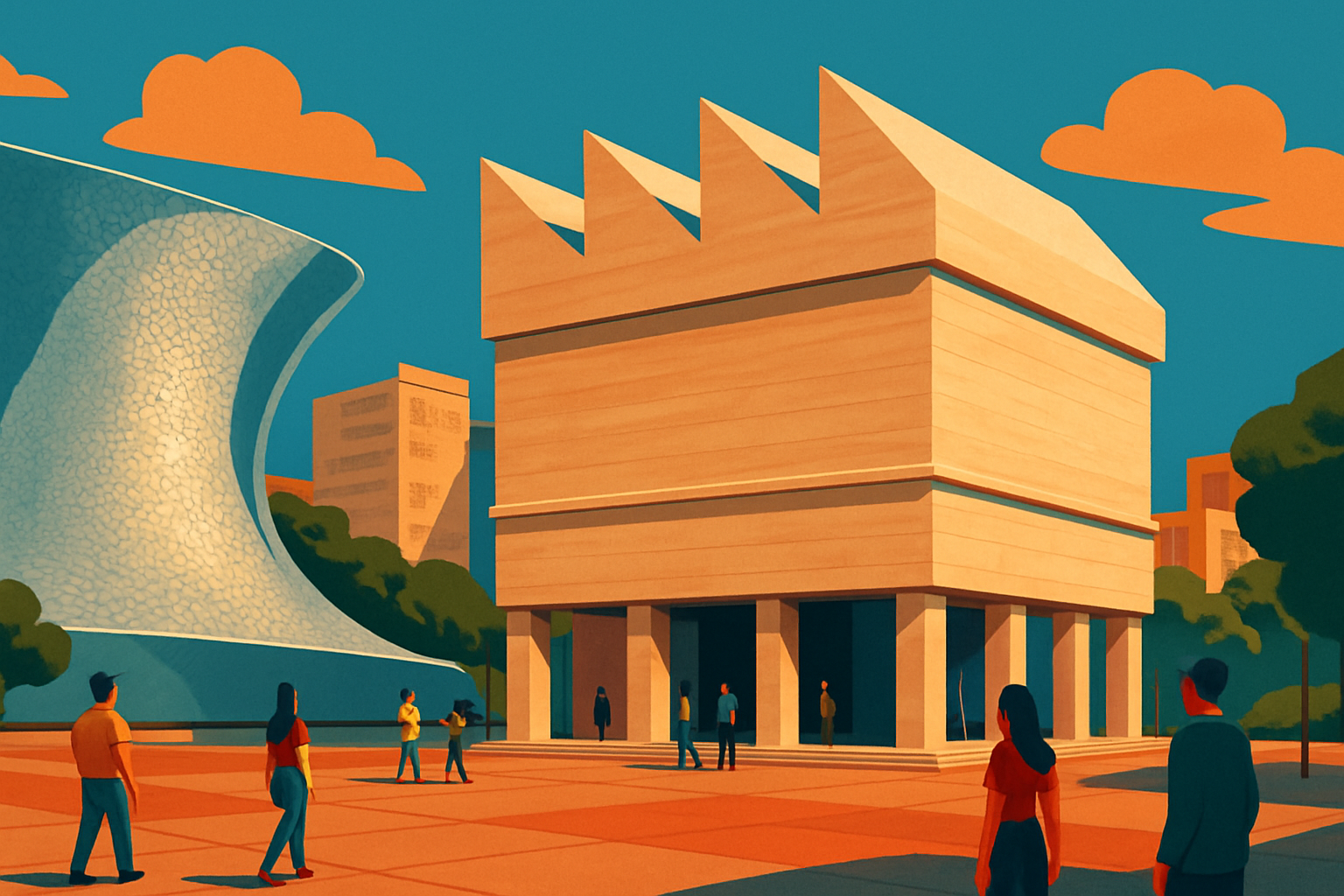
Most visitors arrive at Plaza Carso for the Soumaya and notice Jumex almost accidentally — the smaller building set back from the boulevard, angular and pale against the aluminum curves of its neighbor. Both museums face each other across the same development: Plaza Carso, a mixed-use complex that Carlos Slim's Grupo Carso built in Colonia Granada from 2009 onward on land formerly occupied by warehouses and light industrial buildings.
The two museums were designed by architects with completely opposite instincts. Fernando Romero — Slim's son-in-law — gave Soumaya its extravagant, signature-building energy: no straight lines, hexagonal aluminum skin, immediately recognizable from across the city. David Chipperfield gave Jumex the opposite: a rigorously ordered concrete and travertine box, a building whose main decorative gesture is its sawtooth roofline, visible from the street as a series of stepped profiles along the top of the structure.
Both are free. Together they take two to three hours. Most visitors do Soumaya (European masters, Rodin, pre-Hispanic artifacts) and skip Jumex, which is a mistake. The two collections represent different centuries and different philosophies about what a private art collection is for — and walking between them in an afternoon is one of the more instructive experiences Mexico City offers for anyone interested in art.
For full context on what Soumaya holds — the Rodin collection, the Slim family story — the Museo Soumaya guide is useful reading before you go.
2. The building: what David Chipperfield actually designed
Chipperfield's brief was unusual: design a contemporary art museum for a city with earthquake levels that require significant structural engineering, with a collection that includes large-scale light installations and video works that are destroyed by direct sunlight. The building he produced addresses both constraints without making them visible.
The sawtooth roofline — the series of stepped north-facing skylights running along the top of the structure — is the building's central idea. The north-facing orientation means no direct sunlight ever enters the gallery spaces through the skylights, only diffused ambient light. The effect inside is a cool, even luminosity across the upper floors that works specifically well for contemporary art: paintings don't fade, video screens aren't washed out, and the eye isn't distracted by glare or shadow.
The exterior walls are clad in Mexican travertine — the same pale limestone that covers floors and walls across Mexico City's older government buildings and the UNAM campus. Using it on a contemporary art museum built in 2013 was a deliberate choice: a material that roots the building in local quarrying and building tradition rather than importing a foreign vocabulary of glass and steel. The interior connects four levels via a black steel staircase that deposits visitors in dramatically different spatial conditions on each floor — the lobby is low-ceilinged and controlled; the top floor opens into the full volume of the sawtooth roof and feels entirely different from the floors below.
The building opened November 19, 2013. It was Chipperfield's first completed commission in Latin America, and it remains one of the most technically serious art museum buildings in Mexico — not for its budget or spectacle, but for how specifically it was designed around the needs of the work it shows.
3. The collection: 2,900 works and what makes them unusual
The Colección Jumex holds more than 2,900 works and is the largest private contemporary art collection in Latin America. The artists represented read like the last thirty years of international art — Jeff Koons, Damien Hirst, Andy Warhol, Martin Kippenberger, Olafur Eliasson, Tacita Dean. The collection also includes significant work by Mexican artists: Gabriel Orozco, Francis Alys (a Belgian artist who has lived in Mexico City since 1987 and whose work is deeply embedded in the city), and a generation of younger Mexican contemporaries.
What makes the collection unusual is not its contents — most of these names appear in major private collections worldwide — but its origin. The Colección Jumex was not assembled by a hedge fund manager or an investment strategist. It was assembled by Eugenio López Alonso, heir to Grupo Jumex, one of Mexico's largest fruit juice companies, who started buying contemporary art in 1994 with what he has described as personal obsession rather than investment thesis. Early acquisitions were displayed at Galería Jumex — a 15,000-square-foot exhibition space inside the Grupo Jumex bottling plant in Ecatepec, Estado de México, open to the public while employees worked around it. That arrangement — a serious art institution inside a working industrial facility in one of Mexico City's poorest adjacent municipalities — ran for over a decade before the Plaza Carso museum was built.
The permanent collection is shown on a rotating basis alongside temporary exhibitions, which means the specific works visible on any given visit are not fully predictable. The museum's website lists current exhibitions and the portions of the permanent collection on view. Large-scale installations by Eliasson and Dean have previously anchored full floors; whether those works are up on your visit is worth checking in advance.
4. Football & Art: A Shared Emotion — the World Cup exhibition (through July 26)
The timing of this exhibition is not accidental. Organized by Mexican art critic and independent curator Guillermo Santamarina, Football & Art: A Shared Emotion brings together 100 works by 60 artists from around the world, exploring football as cultural phenomenon, political arena, and aesthetic experience. The exhibition runs through July 26, 2026 — the week after the World Cup Final in New York.
The 60 artists represent a genuinely international range: painters, sculptors, photographers, video artists, and performance-based practitioners who have made work about football as ritual, as identity, as class, as joy, as violence. The thematic sections move through gender and the game, football and community, the body of the player, and the political uses of the sport — which covers more real history than that framing might suggest. The arena, the crowd, the flag: these are not neutral images.
The exhibition design was by architect Mauricio Rocha, who transformed the interior of the Chipperfield building into a series of spaces referencing football's symbolic elements — the pitch, the net, the tunnel. New commissions by Mexican artists Diego Berruecos, Iñaki Bonillas, and Sofía Echeverri were made specifically for this show.
If you are in Mexico City at any point between now and July 26, visiting this exhibition is the clearest possible expression of what the city is experiencing during the World Cup — the argument, made in 100 artworks, that football and contemporary art are drawing from the same well.
5. Objects of Glory: Maradona's 1986 jersey — back in the city where it happened
On June 22, 1986, at Estadio Azteca in the Pedregal neighborhood of Mexico City, Diego Maradona scored two of the most famous goals in football history within four minutes of each other. The first he put in with his left hand, which he later said was 'un poco con la cabeza de Maradona y un poco con la mano de Dios' — a little with the head of Maradona and a little with the Hand of God. The second he scored alone: 60 yards, 10 seconds, six players beaten, the most replayed goal in the history of the sport. Argentina beat England 2-1. Forty years later, the jersey Maradona wore that afternoon is on display at Museo Jumex, three kilometers from Estadio Azteca, in the same city.
Objects of Glory: Iconic Moments in the History of Football runs June 10 through August 30, 2026. Organized in partnership with Qatar Museums and the 3-2-1 Qatar Olympic and Sports Museum, the exhibition brings together 16 objects that trace football's transformation from 19th-century English school sport to global cultural force. The Maradona jersey is the centerpiece — the most valuable piece of match-worn football memorabilia in existence, acquired by Qatar Museums in 2022 for £7.1 million.
The exhibition occupies one room on the ground floor. Entry is free. It takes fifteen minutes if you stop to read everything. The jersey is displayed without fanfare — a small royal-blue number 10, behind glass, in a room that is otherwise quiet.
The Estadio Azteca, where the 1986 game was played and where 2026 World Cup matches are now happening, is detailed in the Estadio Azteca history guide.
6. Eugenio López and how a juice company built the best contemporary art collection in Latin America
The name on the museum — Jumex — is the name on the juice carton. Jugos México, founded in 1961, became one of Mexico's dominant packaged juice brands under the López Montiel family. Eugenio López Alonso, born in 1969, was the heir who was supposed to run the company. Instead he became a collector.
López bought his first work of contemporary art in 1994. He has said the purchase was instinctive rather than calculated — he saw a piece he wanted, bought it, and the interest accumulated from there. Through the late 1990s he accumulated work rapidly, with a particular focus on artists working in conceptual, installation, and video formats — practices that were underrepresented in Mexico's existing institutional structures, which had prioritized muralism, printmaking, and figurative painting for decades.
The decision to show the collection at the Ecatepec factory was genuinely unconventional. Ecatepec is one of Mexico City's largest and most economically challenged adjacent municipalities — not an art-world address by any standard. Galería Jumex operated there from 2001 onward, running serious international exhibitions that artists like Gabriel Orozco, Thomas Demand, and Tacita Dean were willing to show in. The gallery's location made it a point of argument: about access, about where contemporary art belongs geographically, about the absurdity and the sincerity of bringing a Damien Hirst show to a bottling plant in Ecatepec.
The Plaza Carso museum is a different kind of institution — more visible, more central, more obviously a monument to what the collection has become. But the factory origin story matters. It explains why the Jumex collection has always felt slightly outside the norms of how private art collections in Latin America typically behave — less trophy-hunting, more genuinely invested in the argument that contemporary art is for people who don't usually get access to it.
7. How to get there, how long to spend, and what to do around it
Getting there: Metro Line 7 (orange) is the cleanest option. From Polanco station, walk west along Ejército Nacional and turn left on Miguel de Cervantes Saavedra — about 15 to 20 minutes, or 5 minutes by Uber. The San Joaquín station on the same line places you at approximately the same walking distance coming from the opposite direction, following Lago Andrómaco south toward the plaza.
Ecobici stations are available directly on Cervantes Saavedra near the plaza entrance — if you're cycling from Roma, Condesa, or Polanco proper, the ride along Ejército Nacional is flat and well-marked.
How long to spend: Budget 90 minutes minimum for Jumex alone when a temporary exhibition like Football & Art is running. If you are doing both Jumex and Soumaya in the same afternoon, allow 3 hours total and start with Jumex — it tends to be quieter in the morning, and Soumaya sees its largest crowds around noon.
What's around the plaza: Plaza Carso also includes the Inbursa Aquarium (paid admission, family-oriented, occupies the lower level beneath the plaza), the Antara Polanco shopping center two blocks south, and a cluster of mid-range restaurants and cafes along the ground floor of the development. The restaurants directly adjacent to the museums are unremarkable; better lunch options are a short walk away in Polanco proper or back along Ejército Nacional.
Closing day: Mondays only. Every other day the museum opens at 10am. Saturday is the late night: the doors stay open until 7pm, which makes it the best day to arrive after an afternoon of other things.
•Metro Line 7 (orange) — Polanco or San Joaquín stations, 15–20 min walk each; Cervantes Saavedra 303, Colonia Granada
•Closed Mondays only — open Tue–Fri 10am–5pm, Sat 10am–7pm, Sun 10am–5pm. Always free.
•Allow 90 min for Jumex alone; 3 hours for both Jumex and Soumaya in the same visit
8. Is Museo Jumex worth visiting if you're not a contemporary art person?
The honest answer depends on which exhibitions are running. During Football & Art and Objects of Glory — June through late July 2026 — yes, without qualification: Maradona's jersey is one of the most historically loaded objects in sport, and the Football & Art show requires no prior knowledge of contemporary art to engage with. Most of the works are immediately readable as images and arguments; the exhibition's subject is football, which is its own entry point.
Outside of the World Cup window, the calculus shifts. The permanent collection requires more patience than Soumaya's classical and Impressionist content — the works are more conceptual, less immediately beautiful in a traditional sense, and the rotating schedule means you cannot predict what will be on view. Visitors who found the Soumaya experience overwhelming might find Jumex more focused and easier to absorb on a given day.
One practical note: the museum's ground-floor reading room and bookshop is genuinely good. The selection runs to contemporary art theory, Latin American art history, and architecture — a narrow category, but well-curated, with editions not available at generic bookshops elsewhere in the city. Worth fifteen minutes even if the exhibitions don't hold you.