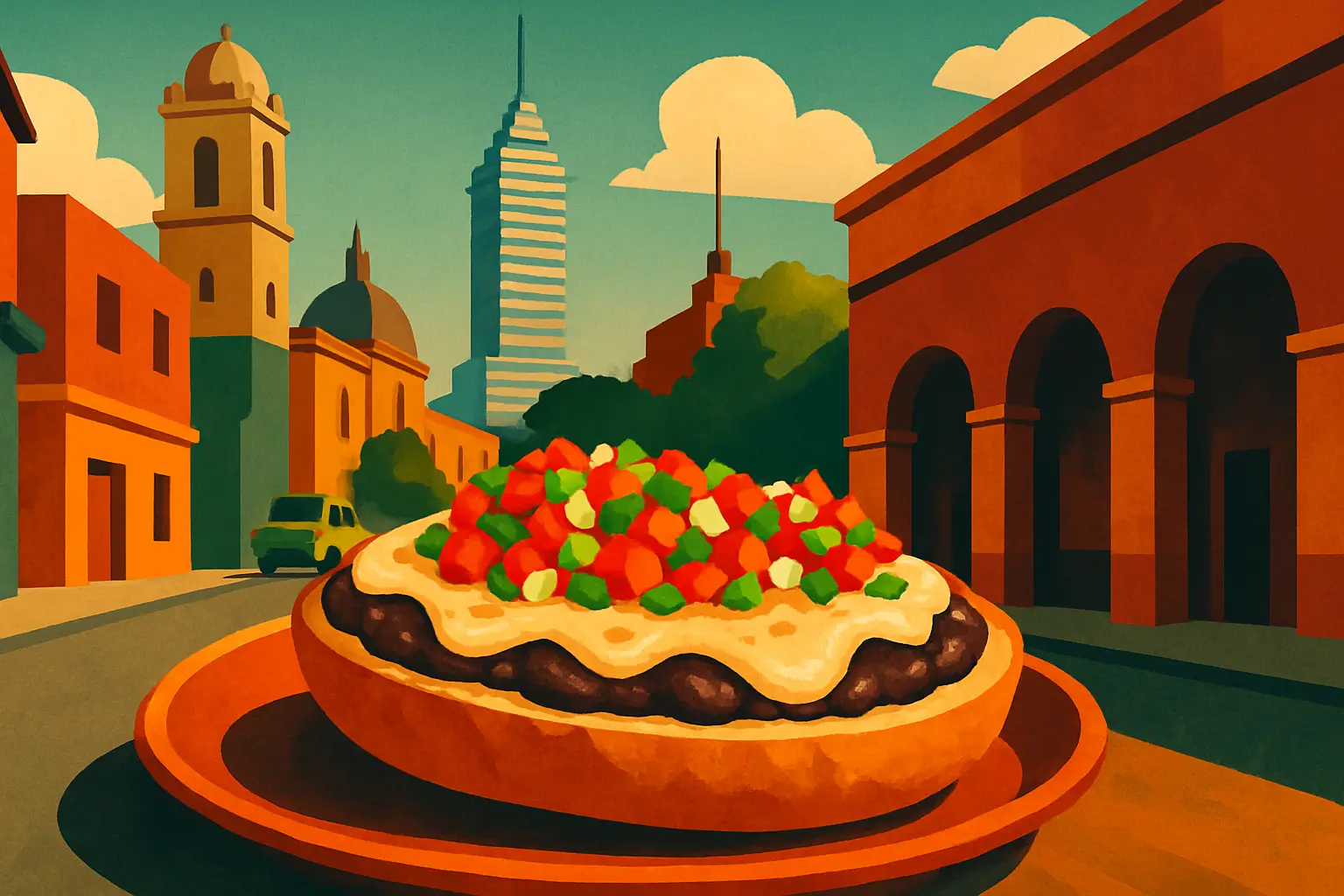
A mollete starts with a bolillo — Mexico City's ubiquitous torpedo-shaped roll with a crackling crust and a soft, slightly chewy interior — sliced lengthwise and partially hollowed out so it sits flat. The hollow is spread with a thick layer of frijoles refritos (refried beans), the cheese goes on top, and the whole thing goes under a broiler or into a hot oven until the cheese melts and the bread edges turn golden. It comes out topped with pico de gallo: finely diced tomato, white onion, cilantro, and chile serrano, barely dressed with lime juice, piled generously on top just before serving.
What separates a good mollete from an afterthought is precision in each of those layers. The beans need to be thick enough to hold their shape on the bread without sliding off — watery refritos are a failure. The cheese needs enough time under the broiler to fully melt and begin developing some color at the edges rather than just softening. The bread needs to be bien dorado: genuinely toasted through, not merely warmed. And the pico de gallo needs to be freshly made, not from a jar and not from a container that has been sitting since yesterday — the raw crunch and acid are structural, not decorative.
When all four components are working, the result is simultaneously rich, bright, crunchy, and creamy in a way that justifies the dish's reputation as one of the most satisfying breakfasts the city offers. When any component is off, a mollete tastes like cafeteria food.
The word mollete traces to Andalusia in southern Spain, where it describes a specific style of soft, round bread — split open, its yielding interior exposed — used as the base for a traditional open-faced breakfast preparation. When the Spanish colonized Mexico in the sixteenth century, that tradition traveled with them, though the local grain economy and milling infrastructure made the exact replication of the Andalusian original impossible in the new world.
The version Mexico City eats today took its decisive form in the 1860s, when Emperor Maximilian I of Habsburg — installed as monarch of the Second Mexican Empire under French pressure — arrived in Mexico City with a retinue that included French bakers. Those bakers introduced the bolillo: a bread derived from the French baguette tradition, adapted to Mexican ovens and local wheat varieties, with a harder crust and denser crumb than the soft Andalusian original. The bolillo spread rapidly from Mexico City outward over the following decades, carried by the same railroad network that industrialized the country under the subsequent government of Porfirio Díaz.
By the 1880s and 1890s — the same years that the comida corrida was being invented in the fondas feeding Mexico City's factory workers — the mollete had been fully recomposed with Mexican ingredients. Refried beans replaced whatever spread the Andalusian version used. Oaxacan cheese replaced Spanish varieties. Salsa fresca replaced whatever condiment had accompanied the original. The result was a dish that carried European bread history in its structure while being nutritionally and culturally Mexican in every other respect.
Get short, interactive stories that make each place easier to remember while you travel.
The frijoles in a mollete are not background — they are the substance of the dish. Understanding what goes into them explains why the same simple preparation can taste transformatively different depending on where you eat it.
Frijoles refritos are cooked beans — almost always black beans (frijoles negros) in Mexico City, pinto farther north — mashed and then fried in fat until they tighten into a thick paste. In the traditional preparation, the fat is manteca de cerdo (lard), which gives the beans a particular richness and an underlying depth that vegetable oil cannot replicate. Most contemporary fondas and chain restaurants use vegetable oil for cost and health reasons, but the traditional lard version is still common in market fondas and at restaurants that emphasize pre-Hispanic or regional cooking.
The quality signals to watch for: thickness (the beans should stay in place on the bread rather than seeping into the hollowed crumb — if they're too liquid, they've either been thinned with broth or simply not fried long enough), smokiness (a slight caramelization on the surface of the beans when they come off the stove is a positive sign), and seasoning (underseasoned beans are the most common failure at cheap places — ask for a bit of salt if needed, as the cheese will not do that work for you).
At home or at a serious fonda, you may encounter molletes made with frijoles de olla — whole beans in their cooking broth, not mashed — scooped directly onto the bread. This is a softer, brothier preparation and it works well, but it requires bread that has been toasted dry enough to absorb the liquid without becoming soggy before it reaches the table.
The default cheese for molletes in Mexico City is queso Oaxaqueño (also called quesillo) — a string cheese made by stretching curds into a ball that unwinds into long ribbons when pulled. Under heat it melts into a stretchy, slightly savory layer that connects the beans to the bread without overwhelming either. It is not the most flavorful cheese on its own, which is precisely why it works: it provides richness and texture without competing with the beans or the pico de gallo.
Manchego mexicano — a mild, semi-soft yellow cheese that melts into a creamier, smoother pool — is the common alternative. Sanborns uses manchego as its default, which is why the chain's molletes have a slightly richer, more uniform melt than the stringier quesillo version. Either is correct. What is not correct is using a cheese with too strong a flavor (cotija, for instance, is the wrong call here — its salinity and dryness work on elotes, not on a mollete where everything needs to combine).
The pico de gallo is not a side condiment. It is a functional layer. The raw tomato and onion add water and crunch to a dish that is otherwise entirely warm, fat, and soft. The chile serrano adds a sharp, fresh heat that is categorically different from the baseline richness of beans and cheese. The lime juice in the pico cuts through the fat of the entire preparation. A mollete eaten without pico de gallo is a less interesting object. If yours arrives without it, ask: '¿Me pone el pico de gallo?'
Some CDMX spots add a line of chipotle salsa underneath the cheese before broiling — a move that adds smoke and heat before the fresh pico goes on top. If you see this offered, take it.
The highest-reliability mollete in the city requires no complicated navigation: Sanborns Casa de los Azulejos (Madero 4, Centro Histórico — inside the famous 16th-century Talavera-tiled palace) serves molletes from their breakfast menu starting at 7 a.m. The dining room is one of the most beautiful in the city, and the mollete itself is consistent, properly toasted, and arrived at by a kitchen that has been preparing it the same way since the branch opened. The chain format means standardization, not mediocrity, in this case.
Café de Tacuba (Tacuba 28, Centro Histórico) is the other Centro institution worth knowing for molletes. Founded in 1912, it is one of the oldest continuously operating restaurants in Mexico City. Their mollete is less festival-ready and more plainly traditional: black beans, Oaxacan cheese, pico de gallo, bread toasted to a proper crunch. Order with a cup of café de olla — coffee brewed with cinnamon and piloncillo in a clay pot — and the morning makes sense.
For market-adjacent molletes that taste like they were made by someone who has been making them daily for twenty years: the fondas along the corridor inside Mercado Medellin (Monterrey 67 at Campeche, Roma Sur) start their breakfast service by 7:30 a.m. and sell molletes for 45 to 65 pesos. The beans here come directly from the market vendors setting up on the adjacent aisles — provenance that makes a difference. Similar quality at the fondas inside Mercado de Medellín de Moctezuma near the Insurgentes entrance.
In the Roma and Condesa corridor: Bésame Mucho (Pachuca 49, Hipódromo Condesa) and several small cafes along Avenida Ámsterdam serve molletes that lean toward the brighter, more cafe-culture end — better cheese sourcing, more chile in the pico, and usually a vegetarian option using avocado alongside the beans. For the full brunch context of where molletes fit among Mexico City's weekend eating habits, that guide covers the neighborhood breakdown.
Sanborns Casa de los Azulejos (Madero 4, Centro): the most beautiful dining room in CDMX for a morning mollete, breakfast from 7 a.m.
Café de Tacuba (Tacuba 28, Centro): founded 1912, traditional preparation — black beans, quesillo, pico de gallo, café de olla
Mercado Medellin (Monterrey 67, Roma Sur): fonda corridor molletes from 45 pesos starting at 7:30 a.m., market-sourced beans
From May 1 through June 30, 2026, Sanborns is running a dedicated Mollete Festival across all its national locations — ten different mollete versions, priced from 79 to 149 pesos, alongside hourly promotions that add juice and coffee in the morning (7:00–13:00), soup and dessert in the afternoon (13:00–18:00), and drinks from coffee to beer in the evening. The menu spans from the classic bean-and-cheese original to the 'Molletzza' — a hybrid that combines mollete structure with pizza toppings (pepperoni, Hawaiian, Mexican, Campechana, chicken pibil variants) that has become the most photographed item in the lineup.
The Festival has spread across TikTok and Instagram in a way that caught mainstream food media off guard. The pattern driving it: Gen Z Mexicans, many of whom grew up eating molletes at school cafeterias and Sunday family breakfasts, are returning to the dish as a deliberate act of cultural reclaiming — the same dynamic that has driven the recent comeback of pan dulce, pulque, and tepache as culturally serious rather than merely nostalgic. Molletes went from 'what your grandmother made on Sunday' to 'the thing everyone is posting about' between February and May 2026, with the Festival providing an easy focal point.
The Molletzza specifically has functioned as a bridge format: familiar enough in its pizza references to be non-threatening, Mexican enough in its bolillo base to feel like an evolution rather than a fusion gimmick. Whether it lasts beyond the festival is less important than what the trend signals: there is genuine appetite in Mexico City to look at traditional cheap food with fresh eyes. The mollete was always worth that attention. The festival just made it loud.
Is a mollete vegetarian? Usually yes, with one asterisk: the frijoles refritos. Traditional preparation uses lard (manteca de cerdo), which makes them technically non-vegetarian. At most Sanborns and VIPS locations, vegetable oil is used instead. At fondas, you can ask: '¿Los frijoles están hechos con manteca o aceite?' A fonda cook who is using lard will tell you directly — it is not something they hide, since in the traditional culinary framework it is the better preparation. If you need strict vegetarian versions, the cafe-style spots in Roma and Condesa reliably use vegetable oil.
Breakfast or lunch? Firmly breakfast and late morning, with a narrow extension into midday at fondas that keep beans warm into early afternoon. Unlike the comida corrida, which peaks between noon and 3 p.m., the mollete belongs to the morning window — 7 a.m. to 11 a.m. at a serious place. This is also why the Sanborns morning promotion (juice + coffee bundled with the mollete from 7 to 13:00) makes cultural sense: it is calibrated to how CDMX actually eats the dish.
How is it different from a torta? A torta is a cold or room-temperature assembly: a bolillo stuffed with fillings — meat, avocado, cheese, chipotle — and eaten at lunch or as a street food. A mollete is hot, open-faced, and finished under heat. The bread direction is literally opposite: a torta is hinged and closed, a mollete is split flat and exposed. They share the bolillo as infrastructure but belong to completely different eating occasions, different times of day, and different food categories. Thinking of a mollete as 'a warm torta' is the single most common misunderstanding foreign visitors bring to it.