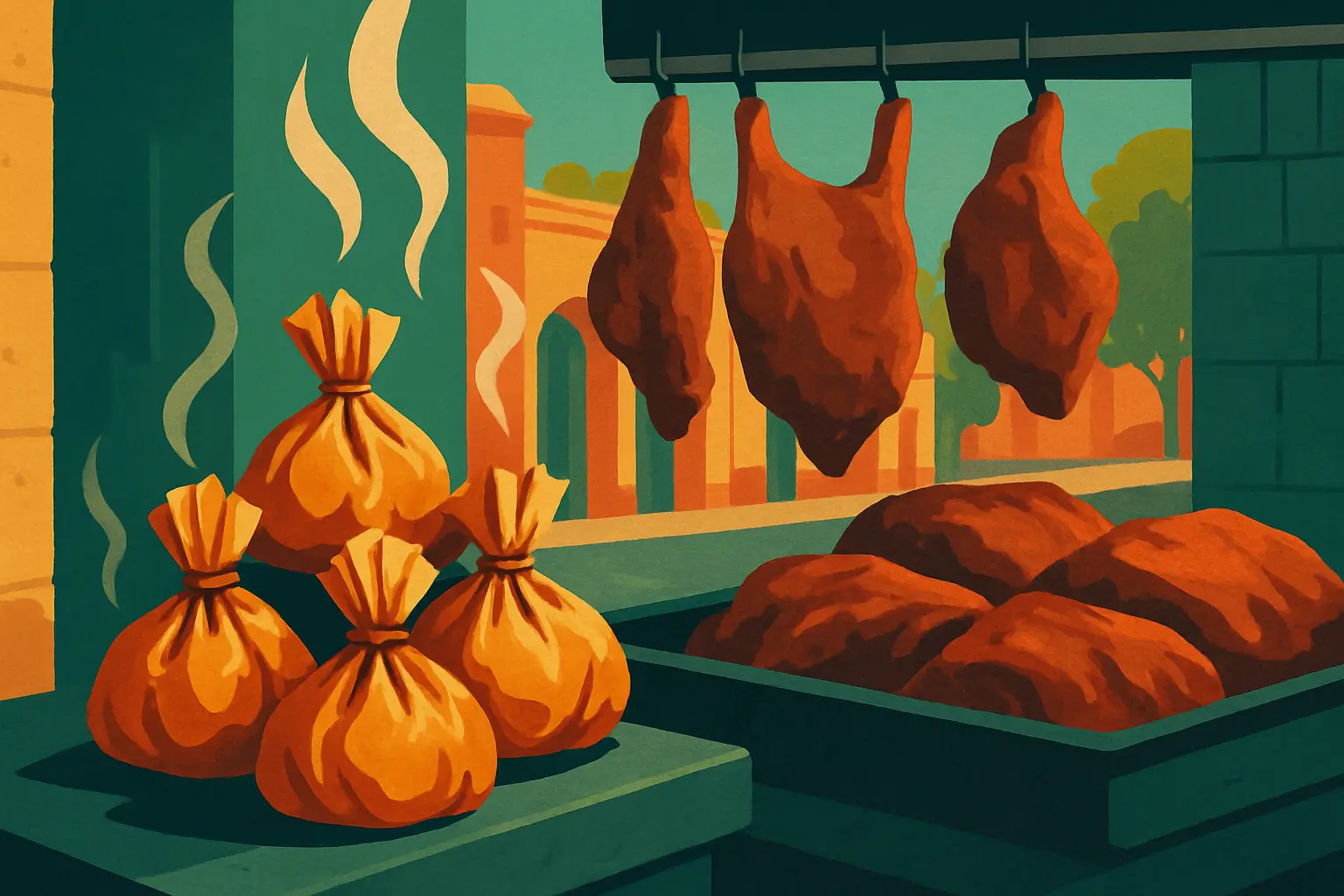
The word 'mixiote' comes from two Nahuatl roots: metl, meaning the maguey plant (agave), and xiotl, which refers to the thin, translucent membrane that lines the inside surface of its thick outer leaves. Combined, they name both the wrapper and the dish at once — a word that doubled as a method.
The preparation is specific: raw meat, most often lamb but also chicken, rabbit, or pork, is marinated in a chile adobo built around dried guajillo and ancho chiles, garlic, cumin, cloves, and herbs. That marinated meat gets packed into an individual portion, wrapped inside a piece of maguey membrane (or, in most modern versions, parchment paper), tied shut at the top, and steamed or pit-cooked until the interior becomes a concentrated pocket of tender meat and accumulated broth. You receive it sealed. The opening is part of the experience.
What comes out when you untie the packet is not dramatic in appearance — a tight bundle of meat, a small pool of reddish-brown liquid formed from the chile marinade and the meat's rendered juices, and sometimes a softened dried chile still draped across the top. The aroma that hits first is the real signal: the earthy sweetness of the maguey diffused through every strand of protein, layered with the warmth of dried chiles and a faint lift of vinegar. It smells like something cooked very slowly, with full attention. At 8 a.m. on a Sunday morning at El Hidalguense on Campeche 155, that smell crosses the dining room before the packet reaches your table.
Mixiote predates the Spanish arrival in Mexico by centuries. Archaeological and pictorial sources from the central Mexican highlands document maguey-wrapped preparations as part of both ritual offerings and everyday cooking, placing the technique firmly within the Aztec culinary tradition — and almost certainly before it.
The maguey plant was the most economically important organism in pre-Hispanic Central Mexico. A single mature agave provided fiber for textiles, needles for sewing, pulque for fermented drink, roofing material, and the thin translucent membranes that made natural cooking pouches. The technique of wrapping protein in the membrane and cooking it in an earthen pit or over steam emerged from a civilization that had mapped every possible application of a single plant.
When the Spanish arrived and introduced sheep and chickens to the Central Mexican plateau, the existing mixiote format absorbed those new proteins without changing its underlying logic. Lamb found a natural home in the volcanic highland geography of Hidalgo and Tlaxcala, and over the following centuries it became the dominant filling. The adobo marinade evolved to incorporate the European spices brought by colonizers — cumin, cloves, cinnamon — but the maguey wrapper and the slow-steam method remained exactly as they were.
The dish served at a weekend barbacoa spot in Roma Sur today runs the same technical process that cooks were performing in the Valley of Mexico six hundred years before Mexico City's current streets existed.
Get short, interactive stories that make each place easier to remember while you travel.
Here is the part most guides skip: harvesting the maguey membrane is now illegal in most Mexican states.
The problem is botanical. Stripping the thin inner skin from a maguey leaf requires deep cuts into the plant, which typically kills or seriously damages it. Maguey plants take between eight and thirty years to mature depending on the species — agave tequilana, used for tequila, takes at least seven — and wild agaves used for the mixiote membrane can take significantly longer. When demand grew through the twentieth century and vendors began stripping hundreds of plants per week, the impact on agave populations in Hidalgo, Tlaxcala, and Estado de México became measurable. In the 1990s, Mexico classified agave as a protected non-timber forest resource, and harvesting the hojas para mixiotes became restricted under federal law.
In practice, nearly every mixiote sold in Mexico City today is wrapped in parchment paper or, occasionally, banana leaves. Traditionalists argue this changes the flavor — and they are right, slightly. The original maguey membrane contributed a faint vegetal bitterness and permeability that lets steam work differently than a sealed parchment pouch. But the difference in the final product is smaller than purists suggest. The quality of the marinade, the cut of meat, and the cooking time matter far more than the wrapper. A well-made parchment mixiote from a serious kitchen beats a carelessly made maguey-wrapped version without question.
The marinade that goes inside a mixiote is built from rehydrated dried chiles: guajillo for color and a mild, fruity heat; ancho (dried poblano) for body and a faint chocolate undertone; and sometimes chipotle for smokiness. Garlic, white vinegar or lime juice, cumin, black pepper, and a bay leaf pull it together. The resulting paste is deep red and thick before it ever hits heat.
Lamb (carnero): The classic, and still the most rewarding. The same cuts that appear in barbacoa — maciza (shoulder and leg), costilla (rib), sometimes cachete (cheek) — go into the packets, though individual portions tend to favor shoulder cuts that stay moist through the long steam. The fat from the lamb renders into the broth inside the packet; that accumulated liquid at the bottom is arguably the best part of the dish. Pour it over your tortillas.
Chicken (pollo): More widely available through the week, lighter in fat, and faster to cook than lamb. Chicken mixiote is what you'll find at non-barbacoa market counters and some fondas outside the Sunday window. It's a different experience from the lamb — cleaner, less unctuous — but the guajillo-ancho marinade works beautifully against the neutral background of the pollo.
Rabbit (conejo): The most traditional protein and arguably the most pre-Hispanic in character. Rabbit appears at specialty vendors and some weekend barbacoa spots, but less consistently than lamb or chicken. The meat is lean and slightly game-y, which takes the heavy chile marinade well. Worth ordering if the spot has it.
Lamb: rich, with rendered fat broth pooling inside — pour that liquid on your tortillas, not just the meat
Chicken: weekday-available, cleaner profile — the right choice outside the Sunday barbacoa window
Rabbit: the most pre-Hispanic protein, lean and slightly gamey — order it when available
El Hidalguense at Campeche 155 in Roma Sur is the most consistent place to eat mixiotes alongside serious barbacoa in the city. Open Friday through Sunday from 7 a.m. until sold out, the kitchen prepares both pit-cooked lamb and lamb mixiotes overnight — which means the mixiotes here are genuine small-batch preparations, not made-to-order shortcuts. Ask for them specifically when you arrive; they are not always displayed prominently at the counter. A full breakdown of El Hidalguense's Sunday logistics — timing, cuts, consomé ordering — is in the barbacoa guide.
Mercado de San Juan at Ernesto Pugibet 21 in Centro Histórico carries mixiotes through the week at several of the prepared-food counters along the market's back wall. The versions here tend toward chicken or pork rather than lamb, and the format is market-counter rather than sit-down restaurant — you eat standing or take away in a container. Go before noon when the preparation is freshest. The Mercado de San Juan guide covers the full navigation and timing.
Barbacoa Renatos in Azcapotzalco, one of the city's most respected barbacoa operations with more than fifty years running, also serves lamb mixiotes on weekends. The northern location requires a longer Uber from central colonias, but the quality of the lamb preparation makes it worth planning for a dedicated Sunday morning.
Weekend market vendors throughout the city sell mixiotes from covered pots at neighborhood tianguis on Saturday and Sunday mornings. These are the least consistent option — quality depends entirely on the individual vendor — but they are also the format you are most likely to find organically while walking a neighborhood market on a Sunday.
El Hidalguense, Campeche 155 (Roma Sur): Fri–Sun from 7 a.m. — ask for mixiotes at the counter specifically
Mercado de San Juan, Ernesto Pugibet 21 (Centro): available weekdays, chicken/pork focus, go before noon
Barbacoa Renatos (Azcapotzalco): Sat–Sun, lamb mixiotes, one of the city's most respected operations
At a barbacoa spot, you order at the counter before sitting. Ask for 'un mixiote de carnero' (lamb) or 'un mixiote de pollo' (chicken). It arrives sealed — tied at the top or folded shut — on a plate.
Open it yourself. Tear from the top, peeling back the parchment to reveal the contents. The cloud of steam that releases carries most of the scent: chile, maguey sweetness, rendered fat. The meat will be falling apart. The liquid at the bottom is cooking juice and fat from the overnight process.
Fold the meat into tortillas and top with the table salsa verde or the red salsa on the side. Use the broth inside the packet as a dipping liquid — it is the equivalent of consomé and should be treated with the same urgency: hot, now, before it cools. The parchment wrapper goes to the side. If it is a true maguey membrane wrapper, which you are unlikely to encounter at standard spots, you can chew a small piece — it has a faint herbal bitterness that is interesting once.
One mixiote plus two or three tortillas is a complete breakfast. If you are in a group, order both lamb and chicken to compare directly: the lamb's richness against the chicken's clarity is an immediate and instructive contrast, and it costs less than a coffee back home.
The base marinade — guajillo and ancho chiles — is mild to medium heat. Guajillo sits around 5,000 Scoville units, well below jalapeño level; ancho is milder still. The mixiote itself, as it comes from the packet, is unlikely to challenge anyone with even a moderate chile tolerance. The table salsas at barbacoa spots are a different matter: the salsa verde at El Hidalguense is genuinely hot, and the red chile de árbol sauce finds your limit quickly. Add those to taste.
Vegetarian mixiotes exist but are not reliably available at traditional barbacoa restaurants. The most common version substitutes nopales (cactus paddles), portobello mushrooms, or a combination of both, marinated in the same guajillo adobo. Mercado de San Juan occasionally has a nopales-and-mushroom version at the prepared-food counters, though availability is inconsistent by day.
One practical note for visitors with strict dietary requirements: the broth inside a lamb or chicken mixiote permeates everything it is cooked alongside. At a traditional barbacoa operation, cross-contamination between proteins and between meat and vegetarian preparations is the norm. Confirm with the vendor directly if this matters for you.
When to go: Sunday between 8 and 10 a.m. is the prime window for lamb mixiotes at dedicated barbacoa spots. After 10, the best batches are often gone; after noon many spots have sold out entirely. Chicken mixiotes at market counters are more available through the week, particularly Tuesday through Friday when the morning preparation is freshest.
What it costs: A single mixiote at a dedicated barbacoa restaurant runs 100 to 180 pesos. Paired with two tacos and a consomé, a full Sunday breakfast at El Hidalguense comes to 200 to 300 pesos per person. Market versions at Mercado de San Juan run slightly cheaper — 80 to 120 pesos — with a more casual format.
Getting there:
- El Hidalguense (Campeche 155, Roma Sur): 10-minute walk from Metro Hospital General (Line 3, yellow), or a short ride from anywhere in Condesa or Roma Norte
- Mercado de San Juan (Ernesto Pugibet 21, Centro): Metro Salto del Agua (Lines 1 and 8), four-minute walk north
Bring small bills. Most barbacoa counters do not process cards. The real rule is simple: arrive early, arrive hungry, and ask the vendor what just came out of the kitchen.