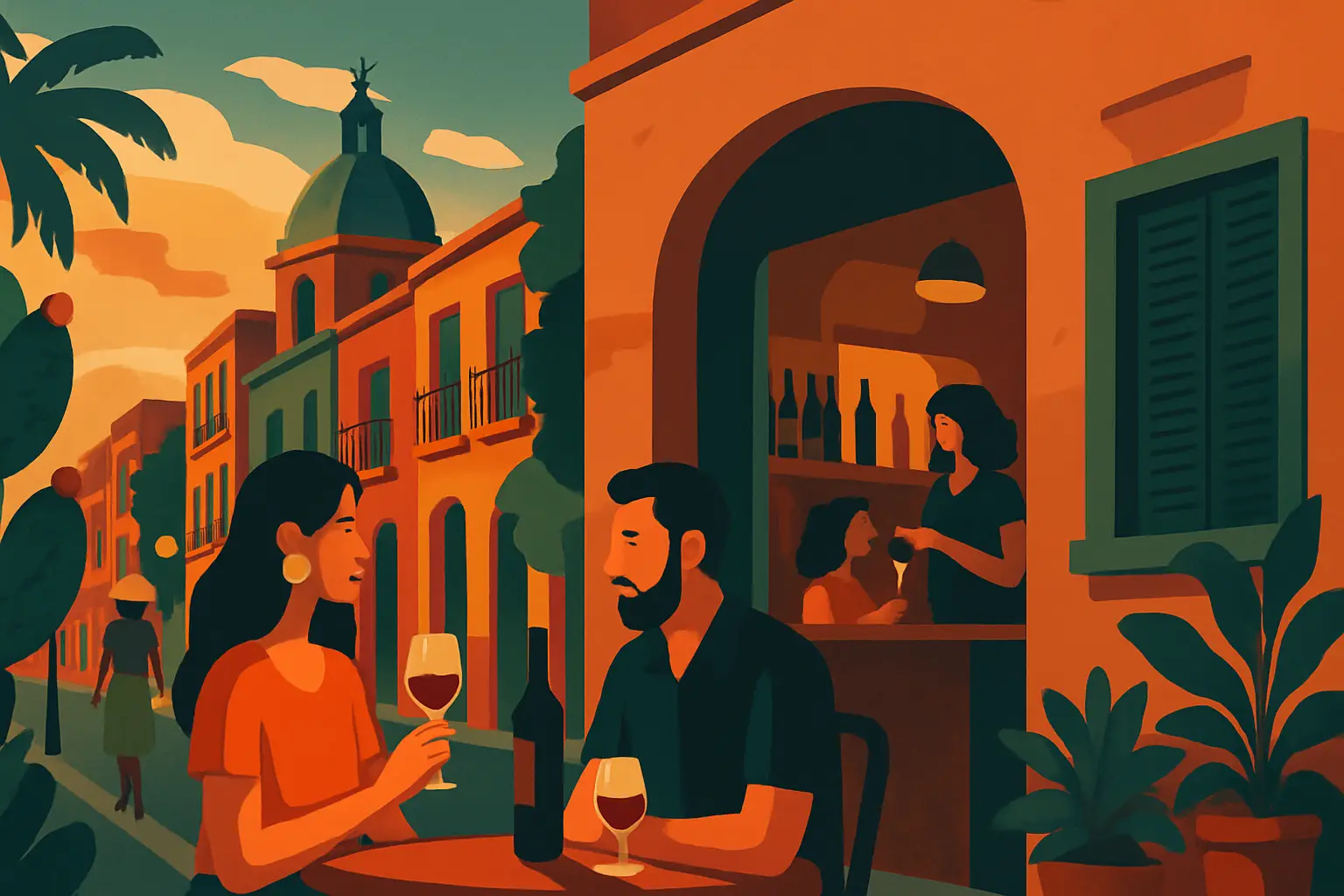
Mexico's wine industry spent most of the 20th century as a footnote to the country's beer duopoly. Not because Mexicans didn't drink wine, but because the retail infrastructure for small producers barely existed — the same exclusivity contracts that kept craft beer off bar shelves also compressed independent wine distribution. The regulatory reforms of the early 2010s opened both markets simultaneously. Valle de Guadalupe in Baja California, which had roughly 20 wineries in 2000, grew to nearly 200 by 2020, and international critics began including the valley's reds in conversations alongside Napa and southern Rhône. A parallel story was unfolding in the city itself: a generation of Mexican sommeliers who trained in France, Spain, and New York came home and opened small, focused bars in Roma Norte and Colonia Juárez. The places they built look and operate like wine bars in Paris or Copenhagen — tight menus, serious curation, knowledgeable staff — but stocking bottles that don't exist outside Mexico. The result is a wine scene that's genuinely distinctive and almost entirely unknown to visitors who arrive expecting only mezcal.
Valle de Guadalupe sits about 120 kilometers south of the US-Mexico border, 20 kilometers north of Ensenada. The Mediterranean climate — hot, dry summers, cool nights — produces conditions comparable to southern France and coastal California, and the valley's volcanic soils add a mineral depth that distinguishes Baja wines from anything made in Mexico's central highlands. Nearly 200 wineries operate here today, ranging from LA Cetto (the largest, with 600 hectares of vines, producing accessible bottles widely stocked at La Naval across the city) to small boutique operations with production measured in cases rather than pallets. The signature reds — Cabernet Sauvignon, Grenache, Syrah, and increasingly Tempranillo and Nebbiolo — run bold and fruit-forward, reflecting the valley's warm growing season. The whites, particularly Chenin Blanc and Viognier, tend toward richness rather than the lean mineral style of a Loire or Alsace equivalent. Order a Mexican wine at Hugo, Loup Bar, or Escorpio and ask the staff for a recommendation, and you'll almost certainly receive a Valle de Guadalupe bottle — and it will be better than most visitors expect.
Location: 120km south of the US border, 20km north of Ensenada, Baja California
Scale: nearly 200 wineries today, up from about 20 in 2000
Key grapes: Cabernet Sauvignon, Grenache, Syrah, Nebbiolo, Chenin Blanc, Viognier
Get short, interactive stories that make each place easier to remember while you travel.
The address on Calle Tonalá 23 in Roma Norte leads to what looks, from the outside, like a quiet residential building. Downstairs is Loup Bar; upstairs is Maison Artemisia, a cocktail bar in a Victorian parlor room that regularly appears on Latin America's best bars lists. The two are connected by ownership and sensibility but operate independently — you don't need to visit one to drink at the other. Loup Bar is co-owned by Gaëtan Rousset, a wine importer who has built direct relationships with small producers in France's Loire and Rhône valleys. The list reflects that sourcing: Muscadet from the Loire, Grenache blends from the Rhône, Chenin Blanc from Vouvray, alongside a rotating selection of natural and skin-contact wines from smaller regions that shift with the season. Small plates are designed to work alongside the wine rather than compete with it. Of the natural wine bars in CDMX, Loup Bar is the one that most closely resembles a Parisian cave à manger: dimly lit, unhurried, no pressure to turn over the table faster than the conversation calls for.
Address: Calle Tonalá 23, Roma Norte — downstairs from Maison Artemisia cocktail bar
Co-owned by Loire and Rhône importer Gaëtan Rousset — the European list is the anchor
Small plates designed for pairing; the format rewards staying two hours rather than one
Hugo was opened by two former New York residents who relocated to Mexico City and wanted a neighborhood wine bar that felt like the unpretentious places they'd left behind in Manhattan — candlelit, wine-serious, with a kitchen that treats food as part of the evening rather than an afterthought. The address is Avenida Veracruz 38 in Roma Norte, half a block from Parque España, and the outdoor tables fill fast on any weeknight with good weather. The wine list leans heavily on Valle de Guadalupe producers — natural and low-intervention Baja bottles that haven't reached export markets — alongside European selections that reflect what the owners were drinking in New York. The food: small plates worth ordering as part of the evening. The kampachi crudo and roasted chicken have both drawn consistent praise from diners who initially came only for the wine. Hours: Monday through Saturday 2 p.m. to 11:30 p.m., Sunday 2 p.m. to 9 p.m. Book in advance on weekends via OpenTable — the outdoor tables on Veracruz are the hardest seats to get in Roma Norte on a Friday evening.
Address: Avenida Veracruz 38, Roma Norte — half a block from Parque España
Hours: Mon–Sat 2 p.m.–11:30 p.m., Sun 2 p.m.–9 p.m.
Reserve via OpenTable on weekends; walk-in possible weekday afternoons before 5 p.m.
Most Mexico City wine bars are Baja-centric — Valle de Guadalupe is where the conversation starts and, for many, ends. Si Mon takes a different position. Located on Calle Zacatecas 126 in Roma Norte, it carries what is widely described as the largest collection of Central Mexico wines in the city: producers from Querétaro, Coahuila, Aguascalientes, and the highland states whose wines are made in conditions entirely unlike coastal Baja. The most historically significant of these regions is Coahuila's Parras Valley, where the Casa Madero winery has been in operation since 1597 — making it the oldest continuously operating winery in the Americas. The wines from Central Mexico don't share Baja's bold, warm profile; the altitude and climate tend toward more restrained, structured styles with better natural acidity. Si Mon's interior fits the concept: brick ceilings, wood beams, a basement-level coziness that suits a two-hour conversation over a half-bottle far better than a quick glass between dinner and a bar. Mexican cheeses and tapas on the food menu pair with the wines on the list rather than around them.
Escorpio sits on Calle Versalles 96 in Colonia Juárez — the neighborhood that has accumulated some of the city's best boutique food and drink operations over the last decade. It was founded by natural wine importer Alonso Maldonado alongside restaurateur Jake Lindeman, who was among the first people to serve natural wines in Mexico City at all. The format is shop-first, bar-second: shelves hold a tightly curated selection of Mexican producers alongside European natural wines, primarily from France and Spain. The staff's ability to navigate you through both lists is the reason to visit — asking 'what's most interesting right now?' will produce a different answer every week and a correct one every time. Tastings are free on some days; check @escorpiocdmx on Instagram before visiting. Hours: Tuesday through Saturday 2 to 9 p.m., Sunday noon to 7 p.m. The Mexican label selection changes as Maldonado finds new producers, which means repeat visits surface different bottles. It's one of the few places in CDMX where buying a bottle to take home is as valid a purpose as sitting down for a glass.
Not every encounter with Mexican wine needs to happen in a bar. La Naval has operated as a wine retailer in Mexico City since 1932 and has grown to eight locations across the city. The range is not curated in the natural wine sense — you'll find mass-market bottles from Chile and Spain alongside domestic producers — but the selection runs to roughly 600 red wines and 200 whites across all locations. The Del Valle branch at Félix Cuevas, corner of Moras, consistently carries the best domestic section for the price: a good Valle de Guadalupe bottle from a producer like LA Cetto or Monte Xanic can be found here for 300–500 MXN, far less than the same wine poured by the glass at Hugo or Loup Bar. The atmosphere is closer to a wine shop than a bar, which makes it more practical for visitors who want to take a bottle back to an apartment rental than for an evening out. If you want to build a mental map of Mexican wine before visiting the natural wine bars, La Naval is where to start.
Eight locations across CDMX — Del Valle branch (Félix Cuevas, corner of Moras) has the strongest domestic section
Valle de Guadalupe bottles from 300–500 MXN — best-value entry point for trying Mexican wine
Retail shop, not a bar — better for buying to take back to accommodation than for a night out
Good — and the reputation gap has a specific explanation. Mexico exports less than 5 percent of what it produces, and the exported fraction is dominated by the country's largest commercial producers. The result mirrors what happened with craft beer: what the rest of the world calls 'Mexican wine' reflects none of what Mexico's best small producers are actually making, the same way Corona doesn't reflect what Wendlandt or Insurgente are doing in Baja California. Valle de Guadalupe reds — particularly the Grenache and Syrah blends, and the Cabernet Sauvignon from producers with older vines — are genuinely world-class for bold, warm-climate styles. Central Mexico whites from Querétaro's altitude regions produce restrained Chardonnay and Sauvignon Blanc at prices that make them arguably the best-value fine wines in the country. Budget at the natural wine bars: 150–350 MXN per glass (roughly $7–17 USD). The practical shortcut: at any bar on this list, ask the staff what Mexican producer they're most excited about right now. The answer will be different every visit — and correct every time.