1. What Mercado Roma is — and how it came to exist
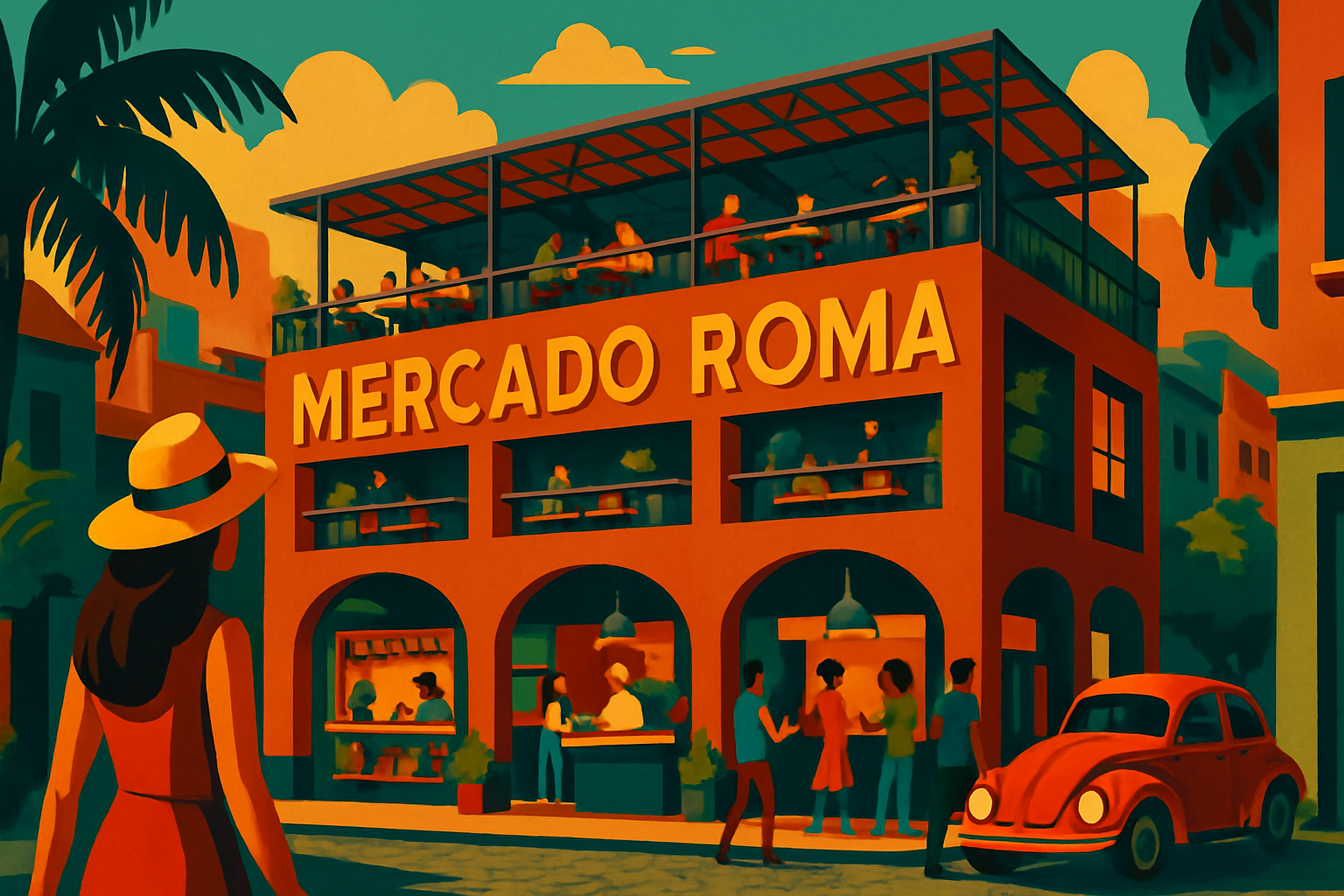
Mercado Roma opened in May 2014 on Querétaro 225 in Colonia Roma Norte, in a former industrial space that had sat largely underused before the renovation. The architects at Rojkind Arquitectos — one of Mexico City's most recognized firms — worked alongside Cadena + Asociados, a hospitality design group, to reconfigure the three-story building into a market format that had no direct precedent in the city. The brief was simple: gather a curated group of quality food vendors in a single space that felt like a market rather than a mall food court.
The concept was unusual for 2014. Mexico City already had working mercados, specialty import stores, and growing craft beer bars — but not a purpose-designed food hall that combined all three in a walkable, communal setting. When it opened, the mix of a working taquería, a French Breton crêpe counter, a craft beer garden, and a gluten-free bakery occupying 18,836 square feet in Roma Norte felt genuinely new. In the years since, the format has been widely imitated across Mexico City, but Mercado Roma remains the original.
The ground floor houses 53 vendor stalls arranged in a fluid, organic layout — deliberately not a grid — with communal tables in the open areas between them. A vertical vegetable garden runs along one wall, supplying several of the produce-focused vendors. The upper floors hold a pair of full restaurants and the rooftop terrace. The whole building is compact enough to cover in a single visit but varied enough to reward exploring in a different order each time.
2. The ground floor: what 53 stalls actually looks like
The ground floor is where the cooking happens, and the category mix is deliberately wide. The majority of stalls are Mexican — tacos, quesadillas, tlayudas, barbacoa, bone marrow preparations — but they coexist with an arepa counter, a Japanese ramen and sushi bar, a Spanish tapas station, and Saint-Malo, a compact French counter whose owner cooks recipes from Brittany, including buckwheat galettes filled with ham, egg, and Gruyère. The arrangement means you can do a first pass, eat a barbacoa taco at one end, a galette in the middle, and finish with churros near the exit.
A few stalls have developed regular followings since the market opened. The barbacoa taquería serves slow-cooked lamb on handmade corn tortillas with consommé de barbacoa in a clay cup on the side — the same format you'd find at a good market in Hidalgo or Estado de México, done carefully. The bone marrow counter (tacos de tuétano) serves roasted marrow bones split lengthwise with salsa and warm tortillas, and has been a standard order for regulars long enough that vendors rarely need to explain the format. La Otilia, the gluten-free specialty stall, sells the only certified gluten-free beer commercially available in Mexico City, alongside baked goods.
The vertical vegetable garden on the east wall is a functioning hydroponic system — not decorative — used by the produce-focused counters. It's an architectural detail that reflects how deliberately Rojkind Arquitectos designed the space down to its operational specifics.
3. The rooftop beer garden and Cigar Point
The third-floor rooftop is what makes Mercado Roma different from a standard food court and what keeps it in regular rotation for Roma Norte residents years after the initial novelty wore off. The terrace has unobstructed views over the neighborhood's tree-lined streets, a craft beer and cocktail bar, and Cigar Point — a small cigar bar where you can order stogies and have food delivered directly from the stalls downstairs.
The craft beer selection trends local: expect labels from Baja California producers, including Cerveza Fauna from Ensenada, alongside Mexico City craft operations and imported bottles. The terrace is shaded in the afternoon and open-air at night, which makes it noticeably better as an evening destination — the street-level noise rises, the Roma Norte roofline goes dark, and the space becomes genuinely pleasant in the way outdoor bars in this neighborhood can be. For a broader read on where Mexico City's craft brewing scene has gone, the craft beer guide covers the city's best spots.
On Thursdays and Fridays — when the market stays open until 1:30 and 2 a.m. — the rooftop operates as a late-night destination rather than an extension of a lunchtime market visit. The crowd shifts: fewer tourists, more Roma Norte regulars using it as a first stop rather than a last one. If you visit Mercado Roma primarily for the food stalls, the rooftop can feel like an add-on. If you're looking for an outdoor bar in Roma Norte that runs late, it becomes the reason to come in the first place.
4. How Mercado Roma compares to Mexico City's other markets
Mexico City has roughly 300 public markets, and Mercado Roma doesn't compete with most of them. The comparison visitors most often make is between Mercado Roma and Mercado de San Juan, and the distinction is useful. Mercado de San Juan, in Centro Histórico, is a procurement market: it's where restaurant chefs source imported manchego and sashimi-grade tuna, and where the buying and selling of specialty ingredients is the actual function of the space. You can eat there, but eating is secondary. Mercado Roma is a food hall: the entire point is to eat on-site, in a designed environment, with a drink in hand. The supply chain is reversed — vendors here are selling finished food to end consumers, not raw ingredients to professionals.
Compared to working mercados like La Merced or Jamaica, Mercado Roma is a completely different proposition — higher prices, curated vendors, no wholesale function, no household goods or clothing sections. It serves a different customer, which isn't a criticism. The useful thing to understand is that visitors sometimes arrive at Mercado Roma expecting a traditional Mexican market experience and leave confused, or arrive expecting a polished tourist trap and leave surprised by how good some of the cooking actually is. Neither expectation is quite right.
For expats living in Roma Norte or Condesa, Mercado Roma operates as a reliable default when you want a real meal without committing to a full sit-down restaurant experience. The walk-in flexibility, communal tables, and variety across 53 vendors make it a practical option for a working-week lunch that you can't reliably plan around a specific taquería.
5. How to eat through the market: a recommended order
The most efficient approach is to walk the entire ground-floor loop before buying anything. A full circuit through all 53 stalls takes about 10 minutes and gives you a useful map of what's here and where it's placed. Vendors near the back of the space get less foot traffic than those near the entrance, which sometimes means shorter waits and more attentive service — and occasionally better preparation, since rush pressure is lower.
For food, the practical three-stop sequence that works for first-timers: barbacoa tacos with consommé from the barbacoa station, a galette or crêpe from Saint-Malo as a palate change, and a dessert option (churros, a sweet crêpe, or a pastry from La Otilia) before heading upstairs. Portions are designed to be single-serving, which makes ordering across two or three stalls feasible without overeating — the standard way to use the market is as a grazing circuit rather than a single-vendor sit-down.
For drinks: the ground floor has a bar counter with aguas frescas and basic cocktails. The rooftop has the broader craft beer selection and the better setting. The natural sequence for an afternoon visit is ground-floor eating first, rooftop drinks after — both because the food tastes better warm and because the rooftop gets noticeably more pleasant as the Roma Norte afternoon light drops below the roofline around 6 p.m.
6. When to go and what each visit day actually feels like
Weekday afternoons from Tuesday through Thursday between noon and 3 p.m. are the lowest-pressure window. Stall operators are attentive, communal tables have space, and the rooftop is calm enough to hold a conversation. This is the best time to browse unhurriedly, ask vendors questions, and figure out your preferences before a return visit.
Thursday evenings shift the dynamic entirely. The extended hours until 1:30 a.m. bring in a crowd that's using Mercado Roma as a night-out destination rather than a lunch stop. The rooftop gets loud and social in the way Roma Norte bars do on a weeknight. If that's what you're looking for, this is Mercado Roma at its most fun. If it isn't, Thursday afternoon and evening are two completely different places.
Weekend afternoons are peak visitor traffic. The space fills, wait times at popular stalls stretch, and communal tables require patience. The food quality doesn't change. If Saturday afternoon is your only window, arrive before 11:30 a.m. before the lunch rush peaks. Sunday closes earlier at 7:30 p.m. and has a slightly quieter energy than Saturday, which makes it a better option for families or slower visits.
7. Is Mercado Roma overpriced? The honest take
The standard complaint in expat forums and travel reviews is that Mercado Roma is expensive by Mexico City standards. That's partially true, and it's worth being precise. Ground-floor stalls price at 80–200 pesos per dish — higher than a street taquería at 25–35 pesos per taco or a comida corrida lunch at 80–120 pesos, but in the same range as a sit-down restaurant in Roma Norte where mains run 180–320 pesos. If the comparison is a taco de canasta, then yes, Mercado Roma costs more. If the comparison is a Roma Norte restaurant, it's competitive or cheaper, with more variety and no reservation required.
The rooftop craft beers at 80–130 pesos are priced like any mid-range bar in the neighborhood — not cheap, not exceptional, just normal for the area. La Otilia's gluten-free products are priced at specialty food prices, which is what they are and what the market explicitly set out to offer.
The visitors who leave disappointed are almost always the ones who arrived expecting street food prices in a designed food hall — an expectation that doesn't fit any curated market in the city at any price point. The visitors who leave happy are the ones who treated it as a mid-range dining experience in an interesting space, which is exactly what Mercado Roma has been since 2014.
8. How to get there
Mercado Roma is at Querétaro 225, Colonia Roma Norte. The easiest public transit option is Metrobús Line 1 running along Insurgentes — the Querétaro stop (at the corner of Insurgentes and Avenida Querétaro) is a two-minute walk east to the market entrance. Metrobús Line 1 connects Buenavista in the north to Ciudad Universitaria in the south, running directly through the center of Roma Norte; a single fare is 12 pesos.
By Metro, the closest station is Sevilla (Line 1, pink line), at Insurgentes and Álvaro Obregón. From Sevilla, walk six minutes north along Insurgentes to the Querétaro corner, then two blocks east to number 225. From Metro Hidalgo near Bellas Artes, total transit time is about 20 minutes. Uber or DiDi from Condesa runs 5–8 minutes and typically costs 40–70 pesos.
From within Roma Norte — near Parque México, Álvaro Obregón, or Orizaba street — Mercado Roma is a 5–10 minute walk depending on your starting point. The streets between Parque España and Querétaro are well-lit and walkable in the evening, making this a natural on-foot destination from most of the neighborhood's main anchors.
•Metrobús Line 1: Querétaro station on Insurgentes — 2-minute walk east to the market entrance at Querétaro 225
•Metro Sevilla (Line 1): walk 6 minutes north on Insurgentes, then 2 blocks east on Querétaro
•Hours: Mon–Wed 9 a.m.–9 p.m. | Thu 9 a.m.–1:30 a.m. | Fri–Sat 9 a.m.–2 a.m. | Sun 9 a.m.–7:30 p.m.