1. Why Mexico City started the craft beer revolution — and how the duopoly almost killed it
Mexico's mainstream beer market spent most of the 20th century controlled by two companies: Grupo Modelo (Corona, Modelo, Pacifico) and Cuauhtémoc Moctezuma (Tecate, Dos Equis, Sol). Together they maintained exclusivity contracts with bars and restaurants that effectively blocked small breweries from reaching retail shelves — a system that stayed intact until antitrust regulators dismantled it in 2013. Despite this, the first craft brewer in Mexico set up not in Baja California but in Mexico City. Gustavo Rodríguez discovered American microbrews on a trip to Texas in 1993, started homebrewing in CDMX in 1995, and opened Cosaco — generally cited as the country's first craft brewery — around 2000. Beer Factory followed in Mexico City in the same era. Both operated as almost underground operations, building a loyal local audience while the duopoly's exclusivity deals made wider distribution impossible. When 2013 finally opened the market, Baja California's scene — which had been building quietly in Tijuana and Ensenada — exploded into national distribution. But CDMX had the customers, the culture, and the infrastructure already in place. Today, Mexico City accounts for the largest craft beer sales market in the country, even though Baja California produces the most beer.
2. Cru Cru Brew: a 16th-century monastery and a beer made with grasshoppers
The entrance is easy to miss: a narrow alley off Calle Sonora in La Romita — the semi-autonomous micro-neighborhood folded into the east edge of Roma Norte — that opens into a stone courtyard that has been in continuous use since the 16th century. Cru Cru Brew operates inside a structure originally built as a monastery, and the low arches, stone walls, and uneven floors give the taproom a weight that most craft beer bars can't replicate. The beer list is short on purpose: a pale ale, a porter, an American lager, and the signature — a gose brewed with chapulines (grasshoppers), lime, and salt. The style is appropriate: goses are historically sour and saline, and the chapulines add a mineral depth that reads as distinctly Mexican without being a novelty. If you haven't eaten chapulines before — the toasted grasshoppers sold in Oaxacan markets and at the stands inside Chapultepec Park — this is a low-stakes introduction to the flavor in liquid form. The food menu runs to bar snacks: curly fries and wings, both consistently good, which gives the place staying power beyond the first curious pint.
•Address: Callejón de Romita 8, La Romita (east edge of Roma Norte)
•Signature beer: the chapuline gose — sour, saline, mineral, and unlike anything in a standard tap list
•The monastery structure dates to the 16th century; the courtyard is partially open-air
3. El Depósito: the bottle shop that changed craft beer distribution in CDMX
El Depósito was founded as a joint venture between two of Mexico's earliest craft breweries — Minerva from Guadalajara and Primus from Mexico City (the producer of the Tempus brand) — and launched its first location as an open-air, cement-floored taproom at a time when craft beer retail was still largely shut out of normal distribution channels. The model: a large refrigerated wall of Mexican craft bottles, 20+ rotating drafts, and staff who can navigate you through producers you've never heard of. Today the chain has locations across the city — Roma Norte, Condesa (Av. Baja California 375), Narvarte, Coyoacán, Colonia Juárez, and Polanco — making it the widest-footprint craft beer retailer in CDMX. The Condesa location at Baja California 375 is the best starting point for first-timers: more space than the Roma Norte spot, an easy walk from Parque México, and a consistently stocked cooler that rotates through Wendlandt, Insurgente, Colima Beer, and smaller regional producers that rarely make it onto bar tap lists.
•Condesa location: Av. Baja California 375 — most spacious, easy from Parque México
•Other locations: Roma Norte, Narvarte, Coyoacán, Juárez, Polanco
•Founded by Minerva (Guadalajara) and Primus (CDMX) — two of Mexico's first craft breweries
4. Fiebre de Malta: thirty drafts, two locations, and the Ángel glowing outside
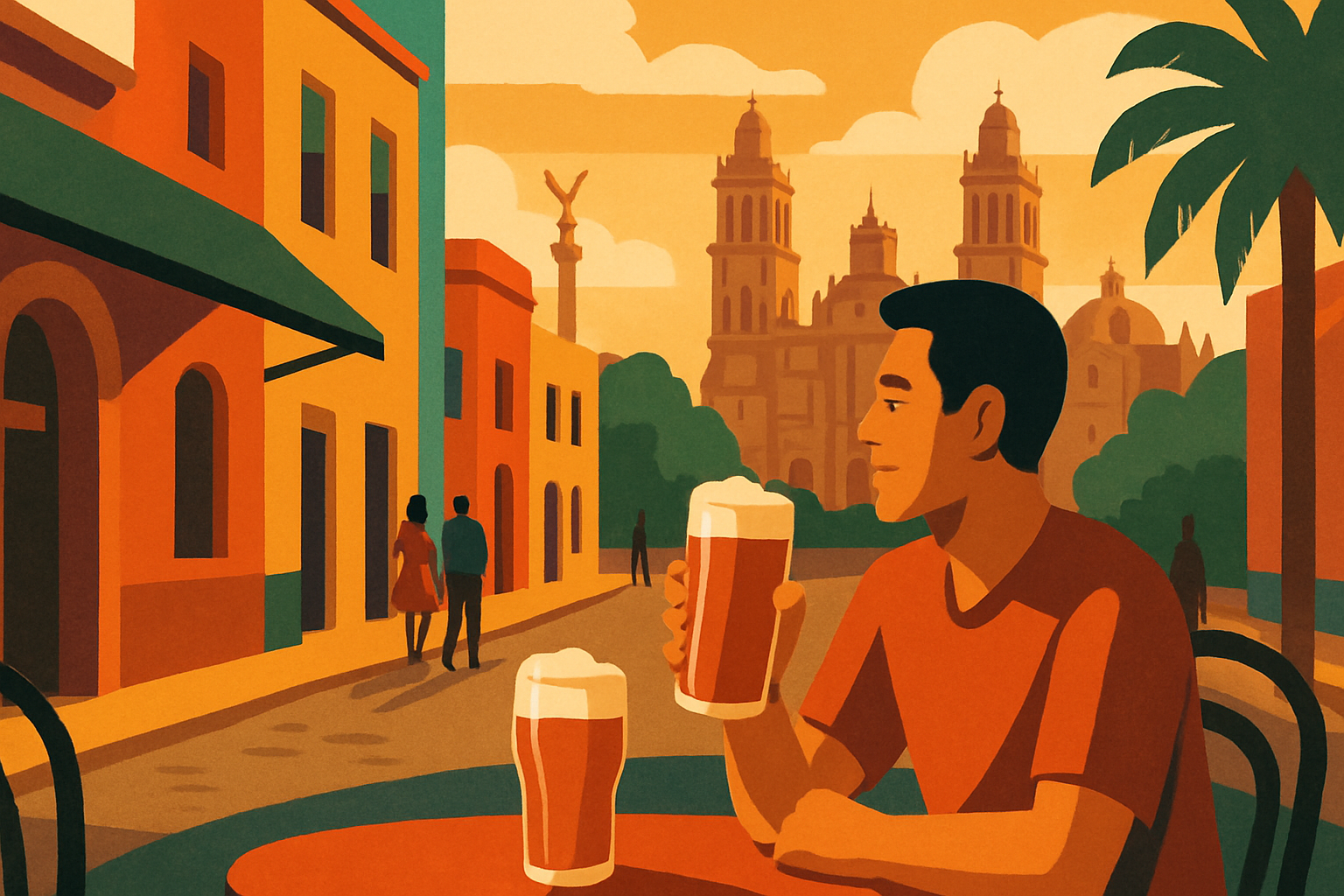
At Río Lerma 156 in Colonia Cuauhtémoc — a few minutes' walk from the Ángel de la Independencia — Fiebre de Malta was one of the first bars in Mexico City to run more than thirty draft lines simultaneously, at a time when that number would have been unusual at craft beer bars in most US cities. The format is unadorned: exposed brick, long communal tables, a chalkboard tap list that rotates enough to reward repeat visits. Mexican craft beers rotate alongside imported bottles, the hours stretch late on weekends (until 2 a.m. Thursday through Saturday), and the kitchen handles casual food that actually works with beer — not the afterthought menus that plague most dedicated beer bars. A second location at Presidente Masaryk 48 in Polanco draws a more corporate crowd but runs the same tap selection. The Cuauhtémoc location is worth it for the setting: Río Lerma sits in a stretch of Colonia Cuauhtémoc where the architecture is late Porfiriato era, the streets are quieter than Roma Norte, and on a clear evening the illuminated Ángel is visible from the corner table.
•Address: Río Lerma 156, Colonia Cuauhtémoc (near the Ángel de la Independencia)
•Second location: Presidente Masaryk 48, Polanco
•Hours: Mon–Wed noon to midnight, Thu–Sat noon to 2 a.m., Sun noon to 10 p.m.
5. What to order: the ingredients that make Mexican craft beer its own category
Mexican craft brewers use ingredients that don't appear in German, Belgian, or American brewing traditions — which means many styles have no clean comparison point. Jamaica (hibiscus) is the most common: the flower adds a tart, cranberry-like sourness that works in wheat beers and sours and turns the beer a deep crimson. Tamarind shows up in ambers and sours, contributing a sticky sweetness with enough acidity to cut through malt. Cacao from Oaxaca — high-quality, minimally processed, grown in the same Sierra Norte that produces Mexico's best coffee — produces dark beers richer than most chocolate stouts brewed with Dutch-process cocoa. Nopal (cactus) adds a subtle vegetal quality in session ales that's hard to pin down but distinctly regional. And chapulines, as at Cru Cru Brew, supply mineral depth in low-ABV salty styles. The simple ordering rule: if a tap list includes a beer made with a local ingredient you don't recognize, that's the one to order. The house IPA will be competent. The chapuline gose will be the thing you describe to people when you get home.
6. Wendlandt, Insurgente, and the Baja California breweries that supply CDMX
Most of the bottles stocked at El Depósito and the guest taps at Fiebre de Malta came from Baja California, and knowing the key producers makes navigating a 40-label cooler easier when the staff are busy. Wendlandt — based in Ensenada, the Pacific port city about 130km south of Tijuana — has been stocking CDMX bars since the early 2010s. Their Dobladora IPA became the benchmark that convinced Mexico City drinkers that domestic craft could compete with American imports, and it's still the most widely recognizable Mexican craft beer in restaurants across the city. Cervecería Insurgente from Tijuana runs a wider and more experimental range: the XPA (extra pale ale) is the accessible entry point, and their collaboration releases with international breweries regularly appear on shortlists of the best Mexican craft beer of the year. Colima Beer, from the Pacific state of the same name, specializes in tropical fruit additions — mango, tamarind, passion fruit — that work especially well in the warm weather of a CDMX May. If you want to take beer home, El Depósito's retail shelf is better labeled than most liquor stores in the US: every bottle lists the brewery, the city, and the style.
7. Is Mexican craft beer actually good — or just interesting because of the ingredients?
Good — and the disconnect between quality and international reputation has more to do with export economics than brewing skill. The two industrial giants account for the vast majority of Mexico's beer exports, which means what the rest of the world calls 'Mexican beer' is Corona and Dos Equis. Mexico's craft breweries are almost entirely domestic operations; they compete on the local market, brew for local palates, and don't have the export marketing infrastructure that gives Belgium or Germany their global reputations. What you'll actually find in CDMX's best taprooms is on par with a solid independent brewery in Denver, Portland, or San Diego — and in certain categories (indigenous-ingredient sours, cacao stouts, hibiscus wheat ales) it's better than what those cities produce, because no tradition elsewhere has been doing it as long or with the same source materials. The surprise is real and consistent: visitors who arrive expecting Modelo and leave having drunk a Wendlandt IPA or a Cru Cru grasshopper gose reliably describe it as one of the better unannounced discoveries of the trip.
8. Practical logistics: when to go, how to plan a crawl, and what to budget
A beer crawl through Roma Norte and Colonia Cuauhtémoc covers the best spots within a 2km radius. The logical sequence: start at Cru Cru Brew (Callejón de Romita 8) for the history and the grasshopper gose, walk northwest toward Fiebre de Malta (Río Lerma 156, about 1.5km) for the full tap list, then take an Uber to El Depósito in Condesa or Narvarte if you want retail bottles to take back to your accommodation. May through October is rainy season — afternoon downpours arrive reliably between 4 and 6 p.m. and last 30–60 minutes. Cru Cru's courtyard is partially open-air, so arriving in the morning or evening is smarter than a 3 p.m. visit during a downpour. The other bars have full indoor seating. Budget: craft beer runs 80–150 pesos per pint (roughly $4–8 USD at current exchange rates), significantly more than the 25-peso Modelo at a corner cantina, but still cheap compared to what the same quality costs in New York or London. Many bars run 2-for-1 happy hours on weekday afternoons from 3–7 p.m., which is worth building the schedule around.
•Crawl sequence: Cru Cru Brew (La Romita) → Fiebre de Malta (Río Lerma) → El Depósito Condesa
•Rainy season afternoons (May–Oct): Cru Cru's courtyard is exposed; go before 3 p.m. or after 7 p.m.
•Budget: 80–150 pesos per pint; weekday happy hours (3–7 p.m.) often run 2-for-1 drafts