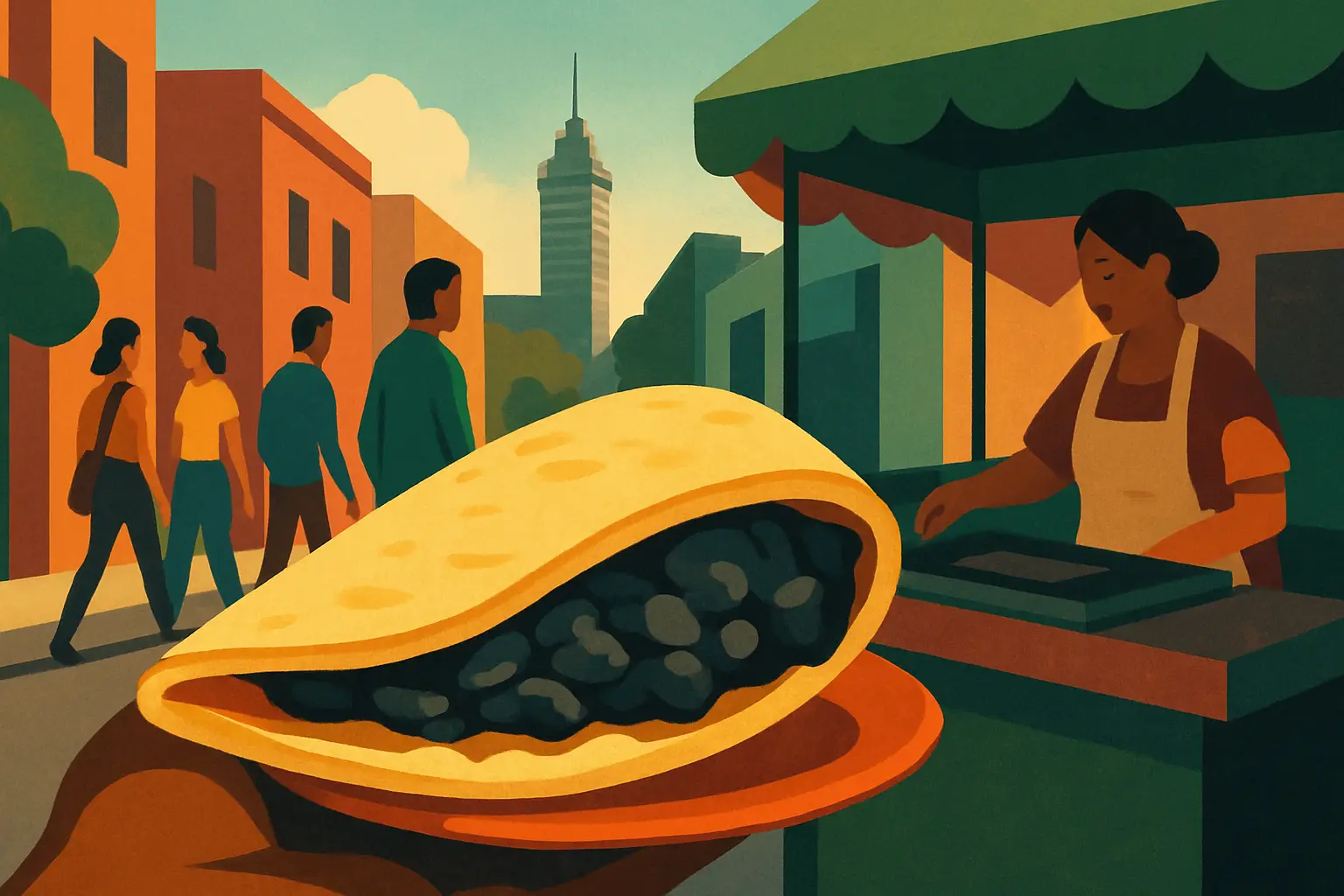
Huitlacoche (pronounced hwee-tlah-KOH-cheh) is a fungus — specifically Ustilago maydis — that infects ears of corn during humid, rainy conditions. When it colonizes a corn kernel, the kernel swells and darkens into a soft, smoky-grey to charcoal-black mass with a texture somewhere between a mushroom cap and a marshmallow. The technical term in plant pathology is 'smut,' which is exactly why it has an image problem whenever it appears outside of Mexico. American corn farmers spray and burn infected ears. Mexican cooks sell them at a premium. That divergence is one of the most interesting food-culture gaps in North America, and it goes back thousands of years: huitlacoche has been harvested and eaten in central Mexico since before the Aztec empire, appearing in records from pre-Columbian civilizations who considered it a gift that the rain brought on the corn. The Nahuatl name comes from roots meaning the dark, sleep-like transformation the corn undergoes — the ear appears to 'sleep' as it is colonized. The nickname 'Mexican truffle' is a marketing invention — huitlacoche is not related to truffles botanically — but it captures something real: like a black truffle, this is a fungus that transforms a simple base ingredient into something with extraordinary depth of flavor.
The honest answer is that huitlacoche tastes like nothing else. The closest approximation most people land on after their first bite is a cross between a deeply roasted mushroom, sweet summer corn, and something faintly smoky — with an earthiness that sits at the back of the palate the way a good mole rojo does. The texture when cooked is soft and slightly glossy, not rubbery. Because the infected kernels retain the corn's natural sugars even as the fungus breaks down the starches, there is a sweetness underneath the earthiness that surprises first-timers. When it is sautéed in the traditional preparation — with white onion, serrano or jalapeño, epazote (a pungent Mexican herb that is close to a requirement in any huitlacoche preparation), and sometimes tomato — the color goes almost completely black, like squid ink. That black color, more than anything, is what puts people off before they taste it. The moment they do, most change their mind. Pairings that work: melted quesillo (string cheese), crema, squash blossom (which appears at the same markets at the same time of year), and a lightly griddled blue corn tortilla.
Get short, interactive stories that make each place easier to remember while you travel.
In most of Mexico, a quesadilla has cheese by definition. In Mexico City, a quesadilla is a folded corn tortilla filled with whatever the stand is offering — you must explicitly ask for queso if you want it. This CDMX-specific interpretation of the quesadilla is the subject of a low-level national argument that never fully resolves, but it matters for huitlacoche because the classic chilango preparation is a corn tortilla folded over a scoop of sautéed huitlacoche, with or without cheese, pressed on a comal until just sealed. The quesadillas Mexico City guide covers the broader debate, but for huitlacoche specifically: try it sin queso first to taste the ingredient clearly, then try it con quesillo on your second one. Squash blossom (flor de calabaza) is the natural companion filling — the two appear at the same stands during the same season, and a quesadilla that combines both is a distinctly CDMX rainy-season food. The tortilla matters: stands using freshly pressed blue corn masa produce a nuttier base that complements the fungus better than commercially made white corn tortillas.
Con queso: Oaxacan string cheese (quesillo) melts around the filling and adds salt and fat
Sin queso: the cleaner option — pure huitlacoche flavor, often preferred by people who've eaten it before
Con flor: paired with squash blossom — both are rainy-season ingredients that appear together naturally
The densest concentration of huitlacoche quesadillas in the city is in Roma Norte. Jenni's Quesadillas, on the corner of Mérida and Colima, makes them to order with freshly pressed blue corn masa — arrive before 2pm, since the stand runs out of niche fillings quickly on weekday afternoons. A few blocks east on Orizaba 209, Ricas Quesadillas operates evenings only (Monday through Saturday from 7:30pm, until around 1am), covers the checkered-tablecloth sidewalk, and keeps huitlacoche on the board through the full rainy season. For the market experience, the interior Mercado de Antojitos in Coyoacán at Higuera 6 — a dedicated daily market just for antojitos — has vendors offering huitlacoche in quesadillas and crêpes (crepas de huitlacoche are a Coyoacán specialty: a thin flour crêpe filled with the fungus and drizzled with crema). Mercado de San Juan at Ernesto Pugibet 21 in Centro Histórico is the best place to see it raw: produce vendors at the back of the market sell fresh huitlacoche by the kilo during season, packed in bags alongside rajas and flor de calabaza. Buying it there and cooking it yourself is the lowest-cost version of the full experience — a bag runs about 60–80 pesos.
Jenni's Quesadillas: Mérida esq. Colima, Roma Norte — blue corn, pressed fresh, open mornings to mid-afternoon
Ricas Quesadillas: Orizaba 209, Roma Norte — evenings only, 7:30pm to 1am Mon-Sat
Mercado de Antojitos Coyoacán: Higuera 6, Coyoacán — crepas de huitlacoche alongside quesadilla options
Mexico City's rainy season runs roughly from May through October, with the most intense rainfall in July, August, and early September. Huitlacoche tracks this cycle exactly: the fungus requires the humid, wet conditions of a corn field in active rain season to colonize ears at scale. Fresh huitlacoche begins appearing at markets and stands as the June rains establish themselves — which is exactly where we are right now. Peak availability is July through September, when street stands that don't normally carry it add it to the board, and market bins overflow with it. By late October it fades as the rains taper off. Canned and jarred huitlacoche exists year-round — several brands pack it commercially — but the difference in flavor is noticeable. Fresh huitlacoche has a brighter, more complex earthiness; canned has a flatter, slightly metallic version of the same note. If you're visiting Mexico City between June and September, fresh huitlacoche is one of the specific seasonal things you can taste here and only here, in this window. The rainy season guide covers what the weather actually means for visitors; for food specifically, the season also brings squash blossom, fresh nopales, and heirloom corn varieties to market alongside huitlacoche.
One of the more unusual things about huitlacoche is that it appears at every price point in Mexico City without contradiction. A three-taco lunch from a street stand in Roma Norte costs around 90 pesos. The same ingredient shows up in the tasting menus at Pujol (Tennyson 133, Polanco) and Quintonil (Newton 55, Polanco), two restaurants that consistently rank among the 50 best in the world, where the preparations might involve huitlacoche in a corn broth, as a consommé, or folded into a more structured antojito with foraged herbs. Rosetta (Colima 166, Roma Norte) has used it in seasonal pasta preparations — a reflection of chef Elena Reygadas' approach of pairing Italian techniques with Mexican rainy-season ingredients. This span is not a contradiction. Huitlacoche is a genuinely complex ingredient that rewards both simple and elaborate preparation. The street version — sautéed quickly with onion and epazote, folded into a hot tortilla — is not a lesser version of the restaurant one. It is the version that has existed for thousands of years, and it remains the best introduction.
Yes — completely, when properly cooked, which it always is when served at a market stall or restaurant. Ustilago maydis is not toxic to humans. It has been a regular part of the Mexican diet for millennia and contains a complete amino acid profile plus significant levels of fiber, phosphorus, and antioxidants — a more nutritionally interesting profile than most common mushrooms. The reason it was eradicated from North American agriculture outside Mexico is economic, not safety-related: infected corn ears cannot be processed industrially. Some food scientists have argued that huitlacoche was one of the agricultural losses of the 20th century, in the same way that heritage grain varieties were lost to industrial wheat monoculture. The only caution worth noting: like any mushroom or cooked vegetable, buy it from clean vendors and eat it hot. Raw huitlacoche is not typically eaten.
Pronunciation first: hwee-tlah-KOH-cheh. Say it slowly the first time and the person behind the counter will know exactly what you want — it's not an obscure order in Mexico City. The full sentence at a quesadilla stand: 'Una quesadilla de huitlacoche, por favor'. If you want to specify cheese: 'con queso' or 'sin queso'. If you want the squash blossom combination: 'de huitlacoche con flor'. If you're at a market counter and they're listing fillings, huitlacoche may be written as 'cuitlacoche' — an alternate spelling of the same ingredient, equally common. Point at the dark filling in the pan if you're not sure. One more phrase worth knowing: '¿Es de temporada?' (Is it in season?) signals to the vendor that you understand the ingredient has a season — which tends to result in a slightly more engaged explanation of what they have that day. In rainy season, the answer will always be yes.