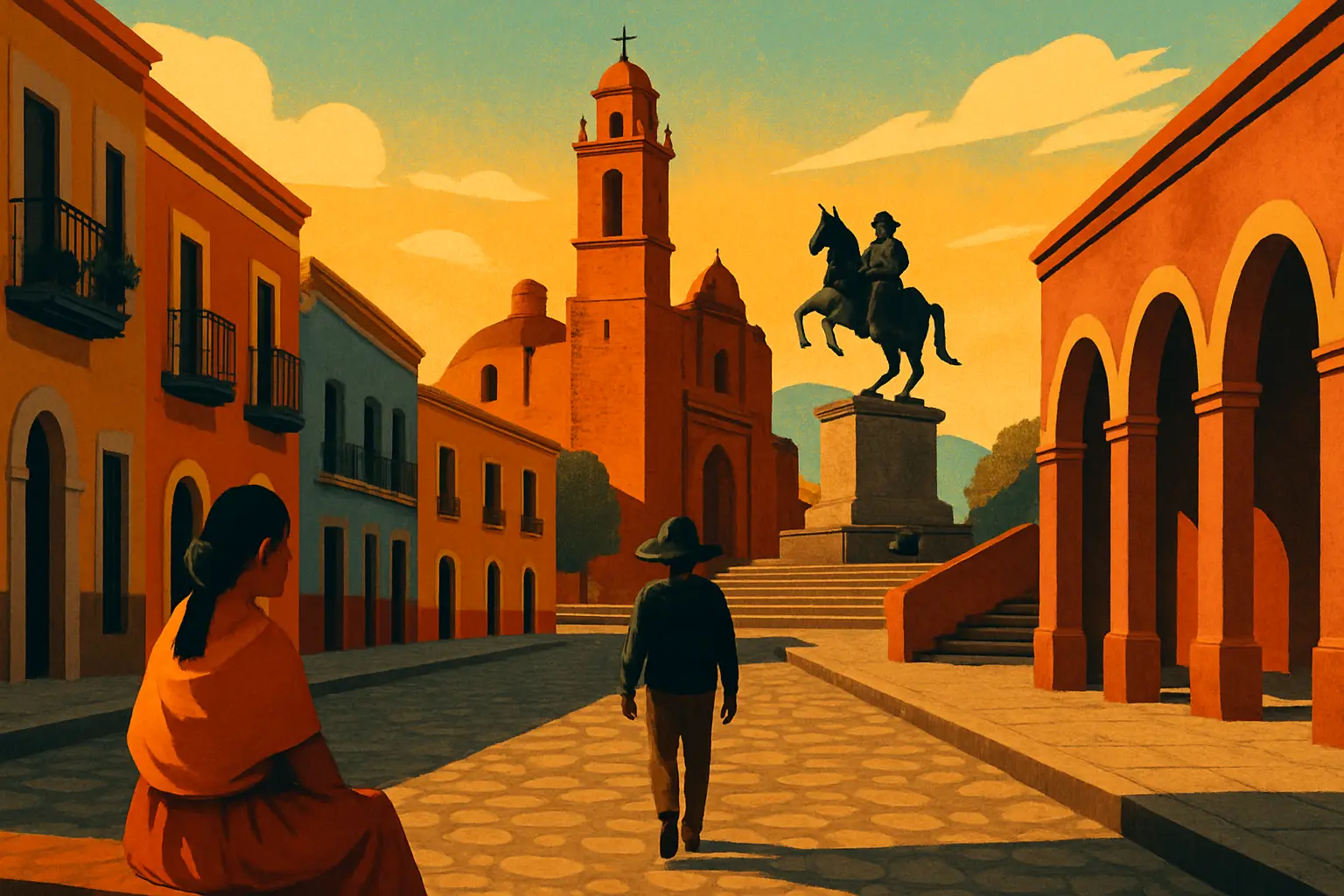
Tlaxcala's name means 'place of corn tortillas' in Nahuatl, which understates what this place actually is: the only independent state in the Aztec era to resist incorporation into the Triple Alliance of Tenochtitlán, Texcoco, and Tlacopan. The Aztecs tried repeatedly to conquer Tlaxcala and eventually stopped after enough failed campaigns. The trade-off for the Tlaxcaltec was harsh — surrounded by Aztec territory on all sides, they had no access to cotton, salt, or the luxury goods flowing through the empire — but the military defiance held for generations. That stubborn independence set up the most consequential alliance in Mexican history. When Hernán Cortés arrived in 1519 with roughly 400 Spanish soldiers, the Tlaxcaltec initially attacked him, fought to a standoff, then made a strategic calculation: the Spanish had weapons the Aztecs didn't, and the Aztecs were the common enemy. Cortés spent 20 days in Tlaxcala negotiating. When he left, 6,000 Tlaxcaltec warriors marched with him toward Tenochtitlán. Without that alliance, the conquest almost certainly fails. The Spanish Crown recognized the debt — after the conquest, Tlaxcalans were granted the right to carry arms, ride horses, hold noble titles, and govern their own settlements autonomously. No other indigenous group in New Spain received those rights, and Tlaxcala's colonial architecture is noticeably better-preserved than most Mexican cities of similar size because of it.
The route starts at TAPO — Terminal de Autobuses de Pasajeros de Oriente, Calzada Ignacio Zaragoza 200. Take Metro Línea 1 (the pink line) to San Lázaro station and follow the signs into the terminal. At the ticket windows, look for Autotransportes Tlaxcala-Apizaco-Huamantla or Autobuses Supra — both run hourly service to Tlaxcala, cost between 120 and 180 pesos, and complete the trip in about 90 minutes. The bus drops you at the Central de Autobuses de Tlaxcala on the edge of the city. From there, fixed-rate taxis to the Zócalo cost about 50 pesos — confirm the price before getting in. By car from Mexico City via the MEX-190D toll highway, the drive is roughly 120 kilometers and takes 90 minutes in normal traffic. Leave early if you're planning to add Cacaxtla: the ruins open at 9 a.m. and morning light is significantly better for photographing the murals.
Metro Línea 1 (pink) to San Lázaro → follow signs into TAPO terminal
Hourly buses, 120–180 pesos, about 90 minutes to Tlaxcala
Taxi from Tlaxcala bus terminal to Zócalo: fixed ~50 pesos
Get short, interactive stories that make each place easier to remember while you travel.
Tlaxcala's Plaza de la Constitución is one of the most architecturally intact colonial squares in central Mexico — it stayed that way partly because the city never grew large enough to require demolition. The arcade running along the south side is built in an Arabic-influenced style with stone arches and columns, an aesthetic brought by 16th-century Spanish builders who'd grown up with Moorish architecture in Spain. Directly adjacent is the Catedral de Tlaxcala, dating from 1524 and considered one of the first Franciscan convents established anywhere in the Americas. Its nave is wider and simpler than later Mexican baroque structures, which makes it feel genuinely ancient in a way more ornate buildings don't. The main reason to stand in this square, though, is the Palacio de Gobierno on the east side. Inside, artist Desiderio Hernández Xochitiotzin spent 40 years — from 1957 until his death in 1997 — painting 450 square meters of frescoes that wrap the interior patio and climb the main staircase. The murals depict Tlaxcaltec history from pre-Hispanic agricultural society through the conquest alliance and into the colonial era. Hernández Xochitiotzin updated the work continuously as new archaeological discoveries emerged, and the technique combines pre-Hispanic codex imagery with European fresco methods. Entry is free. The scale of what you're looking at doesn't register until you're standing directly under it.
Palacio de Gobierno murals: free entry, open Monday–Friday and Saturday mornings
Cathedral dates from 1524 — one of the oldest Franciscan buildings in the Americas
The Arabic-style arcade on the south side of the Zócalo is rare in Mexican colonial architecture
Cacaxtla is about 20 kilometers from Tlaxcala city — shared combis from the Zócalo make the trip in 20 to 25 minutes for about 25 pesos. The site was occupied by the Olmec-Xicalanca people between 650 and 900 CE, a cultural mix influenced by both the Maya lowlands and the central Mexican tradition, which is why its art looks unlike anything else in this region. When INAH archaeologists excavated the main temple complex in 1975, they found murals that still had most of their original pigment, protected under later construction and by an alkaline plaster that had bonded the paint to the stone over more than 1,300 years. The centerpiece is the Battle Mural, which runs nearly 26 meters across the base of the main temple and depicts an armed confrontation between two groups — one wearing jaguar pelts, one in bird costumes. Dated to before 700 CE, it's among the oldest continuous narrative-scene murals in Mesoamerica. A second set, the Red Temple murals, depicts a merchant figure surrounded by Maya glyphs, evidence of how far Cacaxtla's trade network reached. The site museum explains the Olmec-Xicalanca cultural mix clearly and puts the imagery in regional context. Budget at least two hours, and combine with Xochitécatl — the ceremonial hill site 500 meters away — if you have extra time.
Combi from Tlaxcala Zócalo to Cacaxtla: ~25 pesos, 20–25 minutes
Battle Mural: nearly 26 meters long, dated before 700 CE, still in original color
Xochitécatl hill site is 500 meters from Cacaxtla — adds about an hour, includes a unique spiral pyramid
The Basilica de Nuestra Señora de Ocotlán sits on a hilltop northeast of the city center — visible from the Plaza de la Constitución on clear days and worth the 20-minute uphill walk for the views alone. The facade is an extreme example of Mexican churrigueresque architecture: two white stucco towers flanked by elaborate red-tiled panels stacked with carved saints, niches, and ornamental stonework on every available surface. The white-and-red contrast looks almost graphic-design modern from a distance. Inside, the camarín — the dressing room for the Virgin's statue — is covered in gold-leaf altarwork executed by a single indigenous craftsman, Francisco Miguel, who began in 1700 and was still finishing it 25 years later. The Virgin of Ocotlán reportedly appeared here in 1541, just 20 years after the Conquest, and the basilica became a major pilgrimage destination almost immediately. The hilltop setting gives it an atmosphere the far more-visited Basílica de Guadalupe in Mexico City can't replicate — you arrive slightly out of breath, and the city spreads out below.
About 20 minutes uphill on foot from the Plaza de la Constitución
Gold-leaf camarín was the life's work of Francisco Miguel — started 1700, took 25 years
Arrive in the morning for the clearest views back over the city
Lunch at the fondas inside Mercado Emilio Sánchez Piedras, two blocks from the Zócalo, is the right move. Mole prieto is Tlaxcala's signature dark mole — made with four types of chiles and blackened with cuitlacoche (corn fungus, sometimes called the Mexican truffle), served over turkey or chicken with blue corn tortillas pressed to order. It tastes earthier and more fermented than Oaxacan mole negro. Mixiotes are another staple: chicken or rabbit wrapped in the membrane of a maguey leaf with chile sauce and herbs, then pit-steamed until the meat falls apart — the technique is pre-Hispanic and unchanged. Tlaxcala is maguey country, which means pulque is fresh and cheap in a way it rarely is in Mexico City. Pulquerías near the central market serve curados — pulque mixed with seasonal fruit, nuts, or oatmeal — for about 30 to 50 pesos per half-liter. If you want to finish with something sweet, muéganos are the local candy: small fried dough puffs glazed with piloncillo honey, sold at market stalls in paper cones.
Yes — they're different enough to justify both trips. Puebla is larger, more tourist-oriented, and built around its baroque cathedral, the talavera pottery tradition, and the nearby Cholula pyramid. Tlaxcala is smaller, far less visited by foreign travelers, and tells a specific story about indigenous alliance and strategy that Puebla doesn't. The Palacio de Gobierno murals and the Cacaxtla ruins are unique to this area with no close equivalent nearby. The two cities are also only 30 minutes apart by combi, which makes a combined full-day trip workable: leave TAPO by 7 a.m., spend the morning at Cacaxtla and the Tlaxcala city center, catch a combi to Puebla for lunch and the Cholula pyramid in the afternoon, then take a direct bus back to CDMX from Puebla's CAPU terminal by early evening.
One long day — leaving TAPO by 7:30 a.m. — is enough for Cacaxtla and the city center including the Palacio murals and a proper lunch. If you want to add Xochitécatl or spend a slow afternoon at the Basilica, an overnight stay is worth it. Tlaxcala has several small hotels directly on or within a block of the Zócalo. Ideal weather runs October through April — the rainy season from June through September brings afternoon downpours that can make Cacaxtla's outdoor sections slippery. Summer visits are still manageable if you start at the ruins by 9 a.m. and finish before noon. Altitude is a non-issue: Tlaxcala city sits at about 2,252 meters, nearly identical to Mexico City, so no acclimatization adjustment is needed.
Leave TAPO no later than 7:30 a.m. for a full day including Cacaxtla
Best weather: October through April — afternoon rains are common June–September
Altitude matches Mexico City — no acclimatization adjustment needed