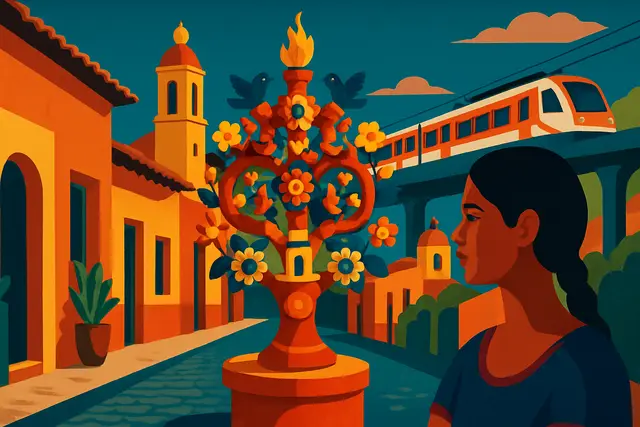
San Miguel de Allende sits at 1,900 meters elevation in the highlands of Guanajuato state — high enough that the light looks different, softer and golden even at midday, which is part of why painters and photographers have been drawn here for over a century. The city was founded in 1542 by Franciscan missionary Juan de San Miguel, became a staging ground for the Mexican War of Independence in the early 1800s, and was declared a UNESCO World Heritage Site in 2008 alongside the Sanctuary of Atotonilco — a baroque pilgrimage church 14 kilometers outside town that art historians sometimes call the Sistine Chapel of Mexico for its floor-to-ceiling frescoes. That combination of intact colonial architecture, revolutionary history, extraordinary light, and proximity to thermal springs explains why San Miguel now hosts the largest American expat community of any city in Mexico. The streets are narrow enough that two cars struggle to pass each other, the walls are coated in bougainvillea, and every plaza is framed by a church that has been standing longer than the United States. It photographs well because it was built well.
The correct departure point is Terminal Norte — not TAPO (which handles eastern and southern routes) and not Terminal Poniente. From Metro Insurgentes Norte on Line 6, Terminal Norte is a short walk. ETN and Primera Plus both operate deluxe first-class service with reclining seats, air conditioning, and onboard bathrooms, running every one to two hours from roughly 6 AM to 9 PM. The journey takes 3.5 to 4.5 hours depending on traffic through the Queretaro corridor — Thursday and Friday afternoons run consistently longer. Tickets cost 450–650 MXN ($26–38 USD) per person each way and can be booked online through each operator's website or purchased at the terminal counter. Buses arrive at San Miguel's Central de Autobuses on Calzada de la Estacion, about a 15-minute walk or 50–80 MXN taxi ride from El Jardin. Book your return ticket before you leave CDMX on any weekend — the Sunday evening departures back to the capital fill hours in advance.
Terminal Norte (not TAPO) — ETN and Primera Plus, every 1–2 hours, 6 AM to 9 PM
3.5–4.5 hours each way; 450–650 MXN per person — book online, especially for weekend returns
Bus terminal is on Calzada de la Estacion — taxi to El Jardin runs 50–80 MXN
Get short, interactive stories that make each place easier to remember while you travel.
El Jardin — formally the Jardin Principal or Jardin Allende — is the central plaza and the obvious starting point. The pink stone spires of La Parroquia de San Miguel Arcangel dominate the skyline in a way that stops people mid-sentence. The original church was built in the late 1600s in standard colonial baroque style. What you're seeing today dates to the 1880s, when a self-taught indigenous stonemason named Zeferino Gutierrez was commissioned to redesign the facade. His source material was a collection of postcards depicting Gothic cathedrals in Europe — primarily Cologne Cathedral — that he had studied without ever traveling outside Mexico. He sketched his designs in the sand and had them transferred to stone by craftsmen who also had no direct reference point for what they were recreating. The result is something that resembles Gothic architecture but has its own geometry: the proportions are slightly different, the details are compressed or exaggerated in ways that become more interesting the longer you examine them. It is a self-taught interpretation of a postcard interpretation of Gothic, executed in pink quarry stone at 1,900 meters. Around El Jardin, Calle Correo and Calle Canal are the main walking streets — both lined with galleries, restaurants, and stores that sell the same painted ceramic plates you can find in every tourist market in Mexico, as well as studios with work that is genuinely worth looking at.
Mercado Ignacio Ramirez on Calle Loreto is the practical food center of San Miguel — two floors of stalls, with the upper level dedicated to lunch counters running full comida corrida meals (soup, rice, main dish, agua fresca) for 80–120 MXN. This is where residents eat, not tourists, which means the salsas are seasoned for people who actually grew up eating them. Look specifically for enchiladas mineras — a regional Guanajuato preparation with dried chile ancho sauce and crumbled fresh cheese that you will not encounter in Mexico City in this form. For breakfast, the stalls around Calle Mesones serve tamales and atole from early morning, the same way they do in every Mexican city where the mornings are cold enough to want something hot. For dinner, the rooftops on Calle Canal that face the Parroquia are worth booking in advance: the food is secondary to the timing, and the timing is the 45 minutes between 7 and 8 PM when the floodlights come on and the pink stone goes from golden to almost white against the darkening sky.
La Gruta ('the grotto') sits 7 kilometers northeast of San Miguel's centro and is the most famous of the several thermal spring operations near town. The complex has multiple outdoor pools at varying temperatures, but the reason people make the trip is the cave: a 20-meter tunnel carved through volcanic rock that opens into a natural underground pool at 37–40 degrees Celsius. The water is geothermally heated and mineral-rich — the cave walls are coated in calcium carbonate deposits that glow pale orange under the lighting installed inside. At the entrance to the tunnel, there is a sunken swim-up bar where you can float with a beer or a fresh juice and watch other visitors disappear into the passage. Admission runs 250–300 MXN. Most hotels in SMA can arrange shared shuttle transfers, or ask any taxi driver — the fixed rate from centro is around 150–200 MXN each way. Arrive before 11 AM on weekdays. Weekends are a different calculation: before 9:30 AM if you want the cave to yourself, or accept that you will share it.
20-meter volcanic cave tunnel leading to a natural thermal pool at 37–40°C — the reason people come
Admission 250–300 MXN; taxi from centro 150–200 MXN fixed rate — confirm before getting in
Weekday morning before 11 AM for low crowds; weekends require arriving before 9:30 AM or accepting the queue
On the northeastern edge of town, El Charco del Ingenio is a 65-hectare botanical garden and nature preserve built around a former hacienda dam. The collection focuses on native Mesoamerican cacti and succulents — over 1,500 documented species — but the main draw is the canyon trail that winds through highland landscape to a ridge with views over San Miguel's skyline and the Parroquia spires from a distance that makes the whole city visible at once. The garden also sits on a monarch butterfly migration corridor, so between November and March the trees along the trail are sometimes covered in clusters of monarchs resting during their journey south. Entry is 90–100 MXN. From the centro, the garden is a 20-minute uphill walk via Calle Homobono through Colonia Atascadero — a quiet residential neighborhood that most day-trippers never reach. The walk itself passes through the non-touristic version of San Miguel, which after an afternoon on Calle Correo is worth it on its own.
The shoulder seasons — October through November and February through April — offer the best combination: dry warm days around 22–25 degrees Celsius, lower tourist volumes than December and Semana Santa peaks, and active cultural calendars. The Jazz Festival runs in November; the Festival de Musica de Camara chamber music festival happens in August. June through August is rainy season: afternoons bring brief, hard storms lasting 30–45 minutes and then clearing completely. This keeps temperatures cooler and the volcanic landscape intensely green, but bring a light rain layer. December and Easter week are the most expensive and crowded periods by a significant margin — hotel prices in the centro double or triple. For a day trip from Mexico City, any weekday is straightforward. Weekend day-trippers should book the return bus ticket before leaving CDMX; the Sunday evening departures do not have spare seats by the time you're thinking about heading back.
San Miguel de Allende consistently ranks among the safest cities in Mexico. The centro — the area bounded by El Jardin, Calle Correo, Calle Canal, and Calle Mesones — is well-lit, heavily trafficked by locals and visitors throughout the day and into the evening, and has consistent municipal security presence. The precautions here are the same practical ones that apply anywhere: use Uber or registered hotel taxis rather than street hails, keep valuables in a front or interior pocket rather than a backpack pocket, and avoid poorly lit residential streets far from the centro after midnight. Day visitors from Mexico City spending 8–12 hours in the historic center, markets, and La Gruta will encounter nothing that requires more caution than any major tourist destination. The expat community that has made SMA home for decades is not there despite the safety situation — it is partly the reason for it.