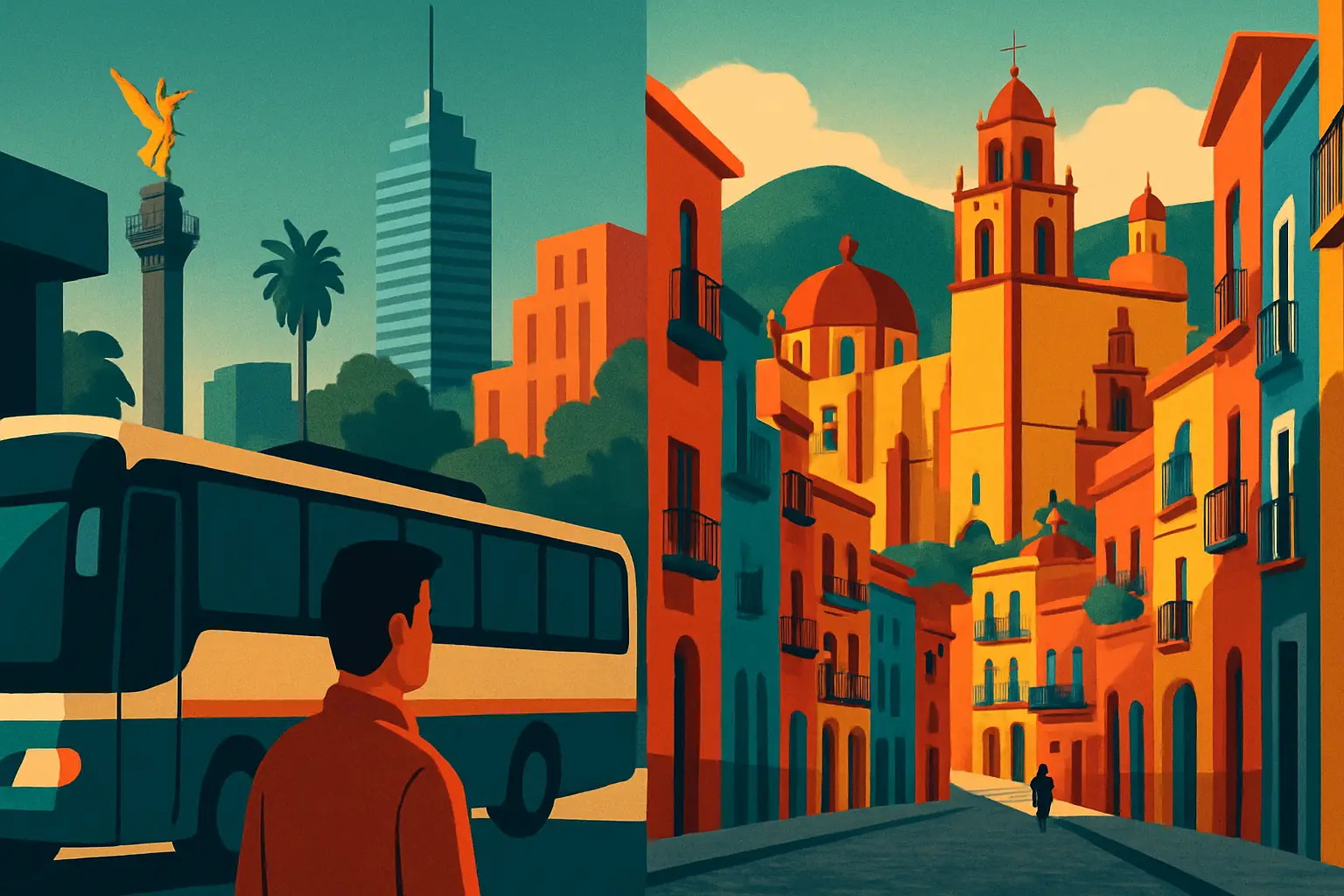
Guanajuato sits 350 kilometers northwest of Mexico City in a narrow canyon of the Sierra de Guanajuato range. The journey by bus runs 4.5 to 5 hours from Terminal Central del Norte — the city's main long-distance hub on Avenida de los Cien Metros (Metro Autobuses del Norte, Line 5, yellow line). ETN and Primera Plus both serve the route with several daily departures; tickets run 350–600 MXN depending on class and how early you buy. Buses arrive at Guanajuato's terminal on the city outskirts; a taxi from there to the historic center costs about 100–120 MXN. If you drive, the route runs MEX-57D toward Queretaro, then MEX-45D via Silao — about 4 hours with roughly 400–480 MXN in tolls. Parking inside the historic center is nearly impossible due to the canyon geography: use Estacionamiento Alhondiga near the Jardin de la Union (~150 MXN per day) and walk everywhere from there. At 2,000 meters altitude, Guanajuato is actually lower than Mexico City's 2,240m, so visitors from CDMX feel no adjustment effects. One committed day is possible; two nights is the version you won't regret.
Guanajuato's most disorienting feature on arrival is the traffic. Cars vanish into hillsides and emerge from them without warning. This is not a trick of the canyon geometry — it is the tunnel network running beneath the streets. The Rio Guanajuato ran through the heart of the historic center and flooded it regularly. In 1823, a colonial dam was built upstream and the first diversion tunnel — El Cuajin — was opened to route the river underground. More tunnels followed over the next century as the city expanded. By the 1960s, planners had paved the old riverbed and expanded the network into the Subterraneo Miguel Hidalgo, the primary underground artery beneath the city, with additional tunnels added in the 1990s to accommodate modern traffic. The result is a multi-level system of one-way corridors, underground roundabouts, and junctions that surface-level navigation doesn't prepare you for. Walking the Subterraneo on foot takes about 20 minutes and is worth doing once on arrival — it gives you the three-dimensional map of a city that makes little sense from the streets alone.
Get short, interactive stories that make each place easier to remember while you travel.
On September 28, 1810, Miguel Hidalgo's insurgent army — estimated at around 20,000 people — surrounded the Alhondiga de Granaditas, the colonial grain exchange building where Guanajuato's Spanish elite had barricaded themselves with silver, weapons, and a few hundred soldiers. The rebels could not breach the thick stone walls until a miner named Juan Jose de los Reyes Martinez Amaro — nicknamed El Pipila — improvised a solution: he strapped a large flat stone slab to his back as a shield, crawled through open gunfire across the courtyard, and used pitch to set the heavy wooden doors on fire. The insurgents stormed through. The Alhondiga's post-battle history turned darker: when Hidalgo and his three key commanders (Allende, Aldama, and Jimenez) were captured and executed in 1811, colonial authorities hung their severed heads in iron cages from the building's four corners as a public warning. They stayed there for ten years, until independence was achieved in 1821. Today the building is a regional history museum with Diego Rivera murals on the interior staircase walls — Rivera was born in Guanajuato in 1886 and painted them between 1955 and 1966. Admission is about 80 MXN. The El Pipila monument overlooking the city is reached by funicular from a station near Calle Sopena (25 MXN one way). For the full story of how 1810 unfolded across Mexico, read the Mexican Independence Day guide.
Guanajuato's historic center is a dense mesh of callejones — narrow alleys that climb the canyon walls in every direction, branching off main streets without warning and reappearing halfway up a hillside. The Callejon del Beso, 68 centimeters at its narrowest point, is the most famous. The legend: two households faced each other across the alley, a wealthy Spanish family on one side and a less prosperous Mexican one on the other. Their children fell in love and met nightly at their opposing balconies, close enough to touch. The girl's father discovered them and stabbed her in the hand with a dagger; she died. The tradition that survives from the story: buy a red rose from the vendors at the alley entrance, kiss on the third step, and receive seven years of good luck. The alley is a five-minute walk from the Jardin de la Union — Guanajuato's main triangular plaza bounded by the Teatro Juarez (completed 1903, neoclassical exterior, Moorish interior), the basilica, and the long bronze benches beneath Indian laurel trees that shade most of the garden. Allow at least two hours to walk the callejones above the Jardin without a fixed route — the architecture shifts constantly, stone houses painted terracotta, cobalt, and yellow ochre, with views over the canyon appearing between buildings every few hundred meters.
The Museo de las Momias de Guanajuato sits near the Panteon Municipal cemetery, a 20-minute walk or short taxi from the Jardin de la Union. Between 1870 and 1958, the municipal government charged an annual burial tax — roughly one peso per year — to guarantee a permanent resting place. Families who fell behind had relatives exhumed. Cemetery workers discovered that Guanajuato's dry climate and the mineral chemistry of its soil had naturally mummified many of the bodies. By the 1890s, workers were quietly charging visitors to see them. When the burial tax was abolished in 1958, authorities formalized the collection into a museum, which opened in 1969. Today, 59 of the museum's 111 mummies are on public display — upright in glass cases, many still in burial clothes, some with expressions preserved in the desiccation. The collection includes the world's smallest naturally mummified fetus and a body found face-down with abraded fingernails, interpreted as evidence of premature burial. Admission is 130 MXN for adults. It is not a horror attraction — it is a museum about a burial-tax law, a specific geology, and the economics of death in 19th-century Mexico.
Guanajuato has one dish that belongs specifically to this city: the enchilada minera — the miner's enchilada. The concept is familiar: corn tortillas in guajillo red chile sauce, filled with fresh cheese and onion. What distinguishes the minera version is the topping — boiled potato, boiled carrot, pickled jalapeno strips, shredded chicken, and fresh lettuce. The potato and carrot are the signature, a nod to the starchy, filling meals that sustained miners through 12-hour shifts in the silver mines during the 18th and 19th centuries. La Carreta, near the Jardin de la Union, serves a reliable traditional version; An'ca Carmen, a few blocks into the callejones, has a shorter menu and lower prices. For a midday meal, the lower floor of Mercado Hidalgo on Avenida Juarez — a 1910 iron-and-glass building that the city's Porfiriato-era administration built to modernize commerce — has comida corrida stalls serving full three-course lunches for 70–100 MXN. The upper floor is tourist-facing; the lower floor is where the city eats. For breakfast, guacamayas — bolillo rolls stuffed with roast pork, chicharron, avocado, salsa, and lime — are sold from carts near the market and around Plazuela de Baratillo from about 8 a.m.
The best version of Guanajuato in the evening starts with a callejoneada — a walking parade led by an Estudiantina, one of the city's traditional student string bands who dress in medieval cape-and-beret costume and play folk songs while leading a growing crowd through the callejones. Callejoneadas have run in Guanajuato since the 1960s and depart nightly from the Jardin de la Union at around 8 p.m. for 100–150 MXN per person. The route winds through different alley sequences each night, stopping at plazas, and typically ends at an upper neighborhood with a full city view. Teatro Juarez on the southwest edge of the Jardin runs its own programming most evenings — check the box office for the schedule, as entry for performances is 100–200 MXN. The building is worth stepping inside regardless of what's playing: the Moorish interior with gilded boxes and a painted ceiling is in contrast with the neoclassical columned facade facing the plaza. The Jardin itself stays alive until after midnight on weekends, with musicians, vendors, and several generations of residents sharing the bronze benches in the way only a Mexican plaza square manages.
Is Guanajuato city safe for tourists? The historic center is consistently considered one of Mexico's safer destinations for visitors — it is a university city built around cultural tourism, with dense pedestrian activity throughout the day and evening. Standard travel awareness applies: use phone-dispatched taxis rather than flagging them on the street, keep your phone in a pocket in crowded areas, and avoid unlighted alleys alone after midnight. Is Uber available? Uber does not operate in Guanajuato's historic center. Use the local taxi network or walk — nearly everything in the center is within 20 minutes on foot. Best time to visit? October for the Festival Internacional Cervantino, which fills Guanajuato's plazas and theaters with international orchestras, dance companies, and performers for three weeks — one of Latin America's largest performing arts festivals. June and July are warm and fine; the rainy season here is lighter than in Mexico City. One more thing: The Museo Casa Diego Rivera at Calle Positos 47 — Rivera's birthplace — is worth an hour for the early work on display (admission 40 MXN). For another colonial city accessible by bus from CDMX, the Queretaro guide covers a closer, equally walkable option.