Real del Monte sits in a narrow valley in the Sierra Madre Oriental, 120 kilometers northeast of Mexico City and 14 kilometers above Pachuca. The town was a major silver-mining center during the colonial period — more than half of the silver produced in New Spain over 300 years came from this region — and by the early 19th century its mines had flooded and fallen into disuse. The silver was still there. The technology to reach it wasn't.
What followed is one of the stranger chapters in Mexican history: a group of English investors bought the mines in 1824, formed the Company of the Gentlemen Adventurers in the Mines of Real del Monte, and shipped more than 130 Cornish miners and engineers across the Atlantic to drain the tunnels with industrial-era steam pumps and restart production. At peak operations in the 1830s and 1840s, up to 350 Cornish workers lived in Real del Monte, mostly arriving from the mining towns of Camborne, Redruth, and Gwennap in Cornwall.
They built English-style homes along the cobblestone streets, planted turnips in the local soil (a vegetable previously unknown in the region), and buried their dead in a hillside cemetery oriented toward England. When the mining venture eventually wound down, many of the families stayed. The descendants of those 19th-century Cornish miners still live in the area today, and the town they shaped — its architecture, its food, its football tradition — is what you're visiting when you come to Real del Monte.
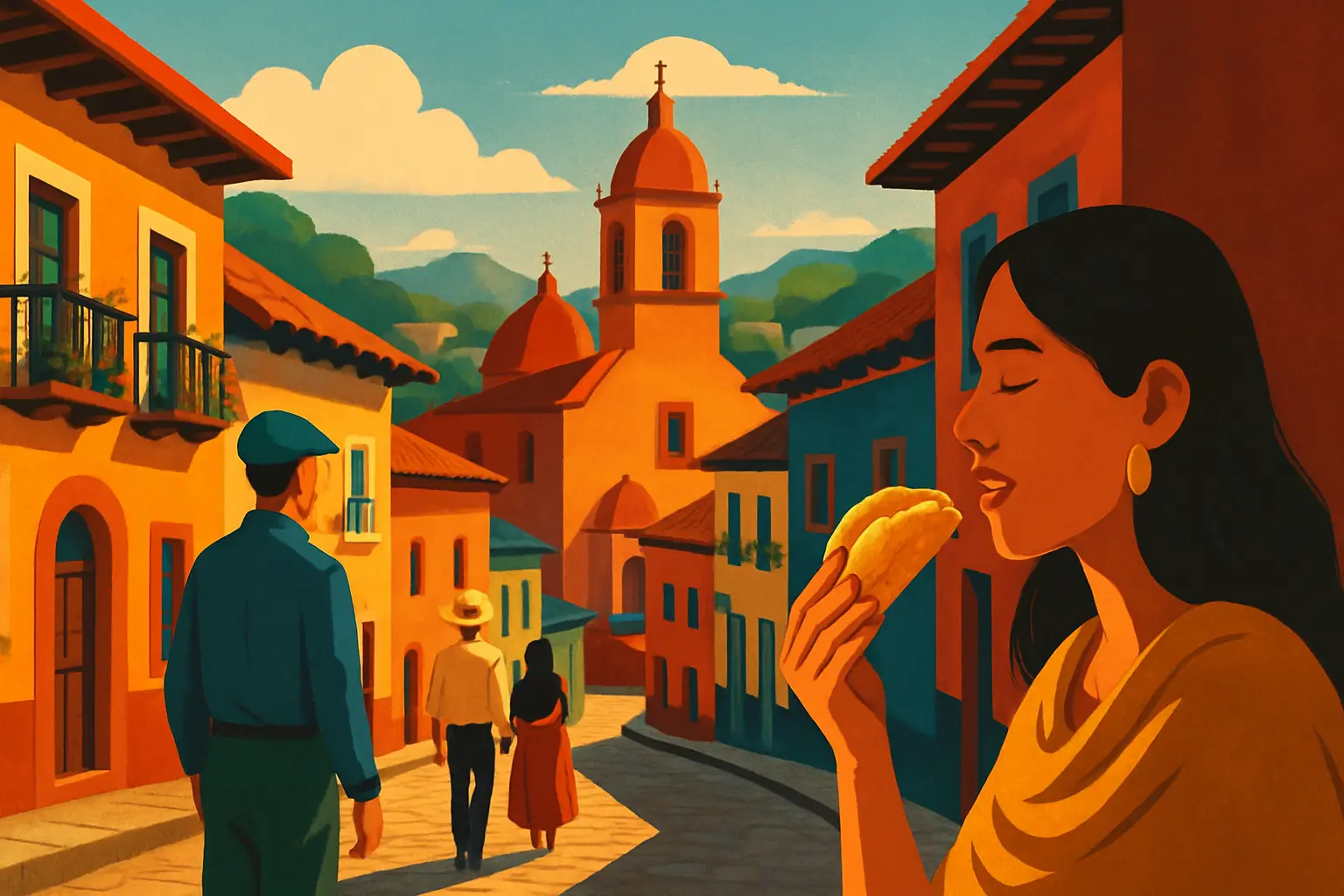
The most direct legacy of the Cornish migration is the paste (pronounced PAH-steh) — a direct descendant of the Cornish pasty, the folded shortcrust pastry that miners traditionally carried down the mine in their jacket pockets as a portable lunch. The first paste in Real del Monte was baked in 1824 by Mary Jenkins, one of the Cornish women who arrived with the first wave of miners. She used the same filling her family made in Cornwall: diced potato, turnip, swede, and beef, seasoned with salt and pepper, all folded inside a crimped pastry shell.
What happened next is what makes the paste interesting: over two centuries of adaptation, the original Cornish filling expanded into an entire taxonomy of flavors. You can still get the traditional potato-and-beef version — and you should, because it's the clearest line back to 1824 — but the Real del Monte paste has evolved to include fillings that Mary Jenkins would not have recognized. Apple paste is now the most popular sweet variety, filled with cinnamon-spiced apple compote. There is also pineapple, strawberry with cream cheese, chocolate, mole, rajas con queso (poblano pepper and cheese), tinga, and mushroom with cheese. More than 30 established paste producers operate in the town, and the main street heading toward the plaza is essentially a continuous parade of paste shops.
The format is the same across all of them: a semicircular pastry, palm-sized, with a thick crimped edge running along the curve, served wrapped in paper and eaten warm. A single paste costs 25–45 pesos depending on the shop and filling. A proper visit involves eating at least three or four across multiple stops.
Get short, interactive stories that make each place easier to remember while you travel.
A short walk uphill from the main plaza, past the old mine works, is the Panteón Inglés — the English Cemetery — and it is one of the genuinely strange and moving places in Mexico.
The cemetery was established on land donated by Thomas Straffon, one of the mine managers, to give the Cornish workers who died in Real del Monte a place to be buried under familiar customs. The oldest legible grave dates to 1834. There are 755 tombstones in total. Every single one is oriented toward England.
The inscriptions mix English and Spanish. The surnames are a collision of Cornish — Trevithick, Bolitho, Rodda, Oates, Trembath — and, as the generations passed and families intermarried with local Mexican families, gradually more Spanish-inflected names appear on later stones. Victorian-era mourning imagery — weeping willows, hourglasses, funerary urns — sits alongside local folk Catholic symbols. The cemetery looks out over the whole valley, with Real del Monte's terracotta rooftops and the ruins of the old mine machinery visible below.
Admission to the cemetery is free or by small voluntary donation. The gate is generally open during daylight hours. Plan to spend 20–30 minutes walking the rows and reading the stones — there are family clusters that tell the arc of entire Cornish lineages from the 1830s to the 1890s in five or six adjacent graves.
On the main street leading to the plaza, the Museo del Paste is a small but well-organized museum that tells the full history of the town, the mining operation, and the paste itself. It opened in 2011 and occupies a colonial-era building with four main rooms: an audiovisual sala showing a short documentary on the Cornish migration, a historical room with photographs of the miners and original mining tools, a traditional kitchen sala showing paste-making techniques, and a Cornish-heritage room dedicated to the cultural exchange that produced the paste tradition.
The museum also runs paste-making workshops where you can make your own version from scratch — worth booking in advance if you want the hands-on experience. A standard visit without the workshop takes 45–75 minutes.
The Plaza Principal at the center of town is compact and genuinely pretty: cobblestones, iron benches, a colonial-era church on one side, and paste shops radiating outward in every direction. Pastes El Portal, on the corner of the plaza, has a terrace with direct views of the square — the right place for a slow paste-and-coffee break mid-afternoon. The Iglesia de la Asunción, the main church, dates to the 17th century and is worth a few minutes inside for the gold altarpiece and the light that enters from the lateral windows in the afternoon.
Museo del Paste: main street near the plaza, open Tuesday–Sunday, admission approximately 40 pesos
Pastes El Portal: corner of the plaza, great terrace view, strong coffee alongside the pastes
Iglesia de la Asunción: 17th-century colonial church on the main square — free entry, best lighting in early afternoon
There is one more thing Real del Monte is responsible for that most visitors don't know until someone tells them.
The Cornish miners who lived here in the 19th century brought football with them — the Association Football code that became soccer. After the British mining enterprise eventually wound down and was taken over by Mexican operators in the 1870s, a community of English workers remained in the Pachuca–Real del Monte area. Those workers founded the Pachuca Athletic Club in 1892, and on Christmas Day 1900, they organized what is documented as the first official football match played in Mexico, at a field in Pachuca.
The Pachuca Athletic Club went on to become Club de Fútbol Pachuca — still one of Mexico's oldest professional clubs, still based in the city 14 kilometers down the hill from Real del Monte. The Cornish brought silver-mining technology, pasties, and English cemetery customs. They also brought the sport that is now Mexico's most watched, most played, and most passionately argued-about.
By direct bus on weekends: The easiest option. Grupo Estrella Blanca runs a weekend-only direct service from Central de Autobuses del Norte (Terminal Norte, accessible via Metro Linea 5 at the Autobuses del Norte station) to Real del Monte. Buses depart at 7 a.m. and return at 5 p.m. The journey takes approximately 1 hour and 40 minutes. Tickets cost around 148 pesos one-way. Seats sell out on long weekends — buy the day before or at the terminal early.
On any day of the week: Take a bus to Pachuca first. ADO and Futura both run frequent service from Terminal Norte to Pachuca — departures every 15 to 30 minutes, journey time 1.5 hours, tickets approximately 90–110 pesos. From Pachuca's Central de Autobuses, local combis and microbuses depart constantly for Real del Monte — the route is signed at the terminal, costs 15 pesos, and takes 20 minutes. The combi drops you near the main plaza.
By car: 120 kilometers northeast of Mexico City via the Autopista México-Tuxpan (toll). The route goes through Pachuca and then climbs steeply into the hills on Federal Highway 105. Allow 2 hours each way from central Mexico City accounting for toll plazas and the final mountain climb. Parking is available near the main plaza.
Weekend direct bus: Terminal Norte → Real del Monte, Estrella Blanca, 7 a.m. departure, ~148 pesos, 1h40
Any day: Terminal Norte → Pachuca (ADO/Futura, 90 min, 90-110 pesos), then combi from Pachuca bus station → Real del Monte (15 pesos, 20 min)
Terminal Norte: Metro Linea 5, Autobuses del Norte station — look for the Hidalgo/Pachuca windows
Day trip or overnight? Real del Monte is small — genuinely small, about 12,000 residents — and a focused day trip covers the main sights: the cemetery, the Museo del Paste, the main square, and three or four paste shops. Arriving by 10 a.m. and leaving by 4 p.m. gives you comfortable time without rushing. An overnight is only necessary if you're combining Real del Monte with Pachuca, which has its own cathedral and market worth visiting, or if you're timing a visit around the annual Festival Internacional del Paste in October, when paste producers from across Hidalgo set up on the main square and the town's population temporarily triples.
Best time to visit? October for the Festival del Paste. Any weekend from October through February for the clearest weather and coolest temperatures — fog is common in June through September, which gives the cemetery an atmospheric quality but can limit views. Weekdays are significantly quieter if you're not locked to a weekend schedule.
What should you bring? Cash — most paste shops don't take cards, and the museum admission is cash-only. A jacket — at 2,700 meters and in the shade of the valley walls, the temperature can drop noticeably from the midday warmth. Reasonable walking shoes — the cobblestones between the plaza, the museum, and the cemetery are steep and uneven in places.
Is it safe? Yes. Real del Monte is a designated Pueblo Mágico with established tourism infrastructure and steady weekend visitor traffic. The standard Mexico City travel sense applies — be aware of your surroundings, don't flash expensive equipment, use the combis and established buses rather than unlicensed rides. The town itself, particularly the plaza and main street, is active and well-trafficked on weekends. For context on how day trips from Mexico City generally work, the how to visit Pachuca from Mexico City guide covers the hub city and practical transport details that apply to both destinations.