Most travelers based in Mexico City eventually ask the same question: 'Should I go to Oaxaca?' The answer is not complicated. Oaxaca City has a historic centro that is one of the most walkable and architecturally coherent in Mexico — green-stone baroque churches, wide shaded streets on a grid, a Zocalo that stays animated until midnight with vendors, musicians, and political banners hanging from the Palacio de Gobierno. The state of Oaxaca is home to 16 recognized indigenous groups, each with distinct textile traditions, food cultures, and languages, and much of that diversity concentrates in the city's markets and artisan quarters. What makes it feel different from Mexico City is the scale: 350,000 people instead of 22 million, and everything worth seeing is 15 minutes away on foot. If you have already sampled Oaxacan food in Mexico City — the mole negro, the tlayudas, the quesillo — the real thing is better, and eating it in the city where it originated changes what you are tasting.
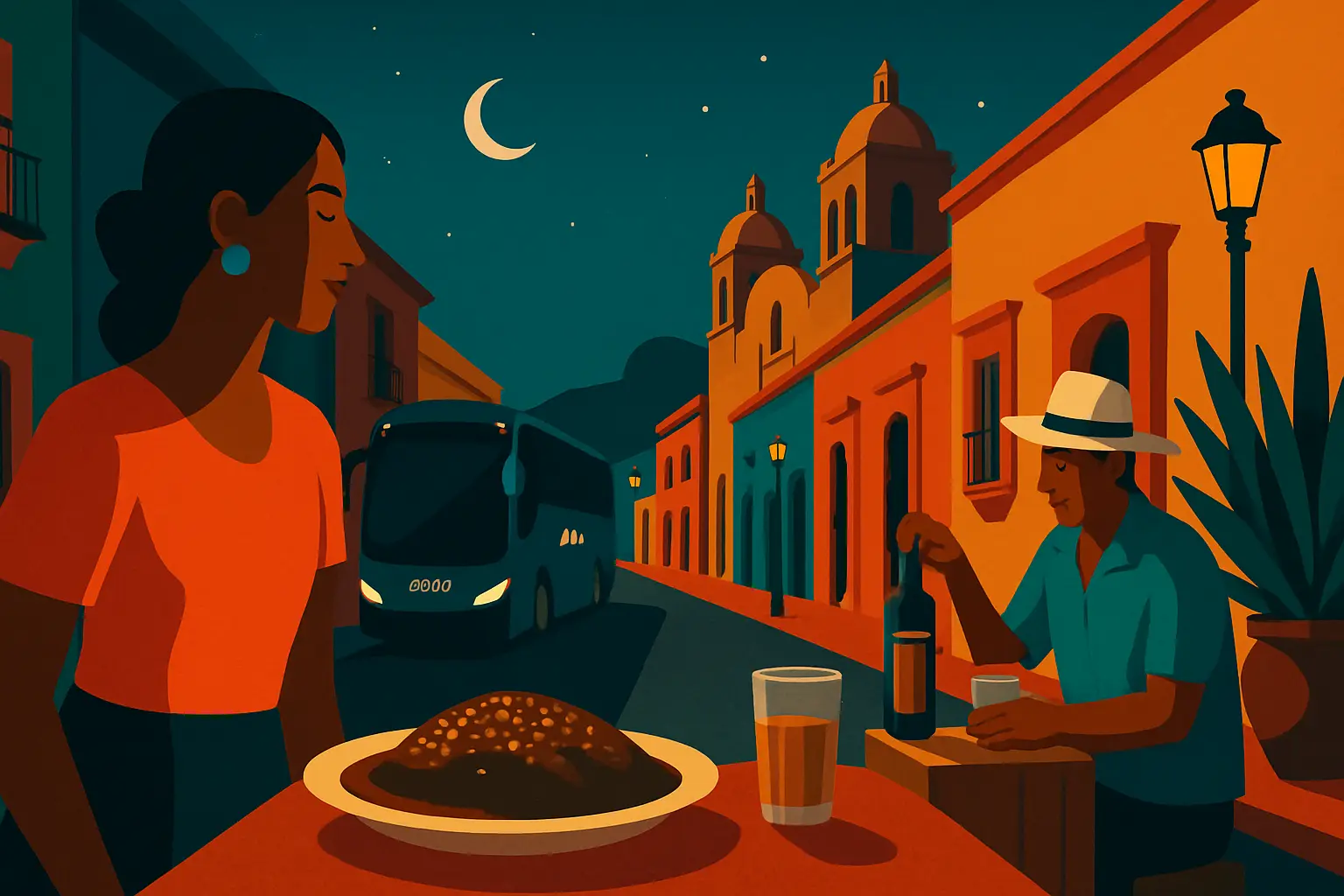
By bus from TAPO (Terminal de Autobuses de Pasajeros de Oriente, Metro San Lazaro on Line 1, the pink line): ADO runs several service levels. ADO standard costs 540–790 MXN and takes 7 hours. ADO GL (reclining seats, USB charging, entertainment screens, 997 MXN) is the most popular choice for daytime travel. ADO Platino (fully reclining seats that become near-flat, individual screens, snacks, separate toilets, 1,274 MXN) is the right call for the overnight departure. The overnight bus is the efficient move for a tight weekend — depart TAPO at 10:30–11 PM, arrive at Oaxaca's ADO terminal on Calzada Heroes de Chapultepec around 5:30–6 AM. A taxi from the terminal to any centro hotel costs 60–80 MXN. You arrive with a full day and saved a hotel night. By flight: Aeromexico, VivaAerobus, and Volaris all serve the Mexico City–Oaxaca route from AICM. Flight time is 45–55 minutes; fares start around 800–1,200 MXN one way booked 1–2 weeks out. From Oaxaca International Airport (OAX), shared fixed-rate taxis to centro run 80–100 MXN per person, or 250–300 MXN private. Fly if your time is genuinely limited. Take the overnight bus if you have a full weekend and want to land in the city already having slept.
Book ADO at ado.com.mx or at the TAPO counter — the overnight Platino fills up on Thursdays and Fridays; book same-day for midweek departures
The ADO terminal in Oaxaca City is on Calzada Heroes de Chapultepec, a 15-minute walk or short taxi to the Zocalo
If flying, check VivaAerobus and Volaris from the Santa Lucia airport (NAICM) — fares are often cheaper but add 45 minutes of ground transport from CDMX
Get short, interactive stories that make each place easier to remember while you travel.
The most important thing to understand about Monte Alban before you go is that it is not a temple complex with a view — it is a city with a view. The Zapotec civilization began leveling the ridge of the Sierra de Monte Alban around 500 BC and built continuously for 1,300 years, creating a capital that housed up to 17,000 people at its peak and controlled the Oaxacan valleys from above. When the site is quiet — early on a weekday morning — the scale of the main plaza becomes legible: 300 meters long, flanked by massive platform temples on all four sides, designed to accommodate large-scale public ceremony. The view from the North Platform extends across all three Oaxacan valleys simultaneously, the city grid spread below, mountains in every direction. Tomb 7, discovered in 1932, yielded one of the richest archaeological finds in Mexico: gold filigree jewelry, carved jaguar bones, and Mixtec-made artifacts suggesting the Mixtec repurposed existing Zapotec tombs after the city was abandoned around 900 AD. The original finds are now in the Museo de las Culturas de Oaxaca inside the Santo Domingo convent in centro — visiting the museum after Monte Alban makes the site's full arc comprehensible. Monte Alban is 9 km from Oaxaca City center. Buses depart from a terminal on Calle Mina near Mercado 20 de Noviembre for about 60 MXN round trip. Entry is 90 MXN. Arrive by 9 AM before tour groups and midday heat.
Site is open Tuesday–Sunday, 8 AM to 5 PM; last entry at 4 PM
The site has no shade — bring water, a hat, and sunscreen regardless of season
The on-site museum near the parking lot is small but useful context before walking the platforms
Oaxaca City's two central markets sit one block apart just south of the Zocalo and serve completely different purposes. Mercado Benito Juarez (between Calle 20 de Noviembre and Miguel Cabrera, running from Flores Magon to Aldama) is the general market: produce, dried chiles displayed by variety and heat level, chocolate tablets ground to order at the molinos, and Oaxacan string cheese — quesillo — wound into fist-sized balls by hand at the counter. The molinos inside Benito Juarez grind cacao with cinnamon, sugar, and almonds to a texture that packaged brands don't replicate. Buy chocolate here for the bus ride home. Mercado 20 de Noviembre, one block south on Calle 20 de Noviembre between Aldama and Francisco Javier Mina, is prepared food. The section everyone talks about is smoke alley — a corridor of charcoal grills where vendors display raw cuts of tasajo (thin-sliced, salt-cured beef), cecina (chile-rubbed pork), and chorizo negro. You choose your cuts, they grill them in front of you in a corridor thick with charcoal smoke, and you bring the plate back to a shared table with handmade tortillas, black bean paste, and salsa. Budget 150–200 MXN per person. Arrive at noon before the best cuts sell out. Inside the market, Comedor Marie Alejandra's is consistently good for tlayudas because of the quality of its asiento — the unrefined pork lard that gives the tortilla its flavor base.
The tlayuda is the baseline food experience in Oaxaca. It is a large tortilla — 30 to 40 centimeters in diameter — baked over coals until it is partially crispy, spread with asiento and black bean paste, then topped with quesillo and a protein. At the corner of Calle 20 de Noviembre and Nuño del Mercado, street vendors set up in the evenings with reliably good versions at low prices. The open-faced preparation at Comedor Marie Alejandra's inside the market keeps the tortilla crispy under the toppings, which is the right texture. Mole negro — the darkest and most complex of Oaxaca's seven canonical mole varieties, built on mulato and negro chiles, plantain, chocolate, and charred tortilla — is best eaten at a fonda at lunch, not a tourist restaurant at dinner. Order *mole negro con guajolote* (turkey) and eat it slowly. For something that predates mezcal and colonialism both: tejate is a cold, frothy drink made from corn masa, cacao, rosita de cacao flowers, and mamey seed, prepared by hand in a ceramic bowl. Vendors sell it from large clay pots in the Zocalo and outside Benito Juarez market for 20–30 MXN. It tastes genuinely unlike anything else on the menu. Try it before deciding whether you like it.
If you have drunk mezcal in Mexico City, you already know it is not tequila. In Oaxaca, the distinction becomes sharper — because here, mezcal is not primarily a bar product, it is an agricultural one. Most of the mezcal in Oaxaca's bars and markets comes from small producers in surrounding villages like Matatlan (on the road to Mitla, the self-described 'mezcal capital of the world'), San Luis del Rio, and Santa Catarina Minas, using roasted agave hearts and clay pot distillation methods that predate glass vessels in the region. The variation between producers is enormous: some mezcals have almost no smoke, some taste like roasting vegetation, some have a mineral quality from clay distillation that shifts completely as they warm in the glass. Mezcaleria In Situ on Calle Hernandez near the Reforma corridor offers one of the most serious tasting experiences in the city — hundreds of expressions organized by agave variety, with staff who explain the differences without lecturing. La Mezcalerita, near the Zocalo streets, has a rooftop terrace with views toward Santo Domingo and a more relaxed approach. For the broader production context, the mezcal vs. tequila guide covers why these two spirits diverged. In Oaxaca, those differences become tangible.
Tobala, espadin, and tepextate are three agave varieties worth tasting side by side — the flavor differences are dramatic and educational
Single-producer bottles from Matatlan are available in Benito Juarez market at lower prices than bars — buy one to take back
Oaxaca produces over 85 percent of all certified mezcal in Mexico; what is sold as 'mezcal' in CDMX bars often originates within 100 km of where you are standing
Three nights is the minimum that doesn't feel rushed. A practical outline: arrive via overnight bus early on day one, drop bags at the hotel, walk to Benito Juarez market for a chocolate-and-coffee breakfast, then take the early bus up to Monte Alban. Back by early afternoon for the Museo de las Culturas de Oaxaca in the Santo Domingo convent and a slow walk of the historic centro. Evening mezcal at In Situ. Day two: smoke alley lunch at Mercado 20 de Noviembre, then the Jardin Etnobotanico — a 2-hectare living collection of Oaxacan native plants in the convent grounds, open by guided tour only at 11 AM and 1 PM for 80 MXN, genuinely worth it. Evening: tlayudas on Calle 20 de Noviembre. Day three: if it's a Sunday, take a colectivo (40 MXN) east to Tlacolula de Matamoros for the weekly market — one of the oldest continuously operating indigenous markets in Mexico. If not Sunday, take a colectivo via Mitla to Hierve el Agua (66 km east, 80 MXN each way), where petrified mineral waterfalls cascade off a cliff edge above a valley that is among the more improbable landscapes in Mexico. A fourth night unlocks both.
Is Oaxaca City safe for tourists? The historic center is consistently considered among the safer urban environments in Mexico for visitors. It is a state capital with a substantial university population, a well-established tourism economy, and dense foot traffic through late evening. Standard travel awareness applies: use app-based taxis (InDriver operates in Oaxaca), keep bags closed in market crowds, and avoid unlighted streets alone after midnight. The city sees periodic political protests on the Zocalo — typically teachers' union demonstrations — that are loud and visible but not dangerous to bystanders. Best time to visit? October through April is the dry season with peak international tourism. The Guelaguetza festival (last two Mondays of July) is the single best calendar event in Oaxaca — 16 indigenous communities perform in the open-air Auditorio Guelaguetza above the city — but it fills accommodation completely and doubles hotel prices. June is an underrated window: mornings are clear and cool, Monte Alban has shorter queues, and shoulder-season hotel rates are in effect. Brief afternoon rains rarely last more than 90 minutes and usually end by 5 PM. Dia de los Muertos in late October and early November is also genuinely atmospheric in Oaxaca — less touristic than in Mexico City — but book accommodation three months out.