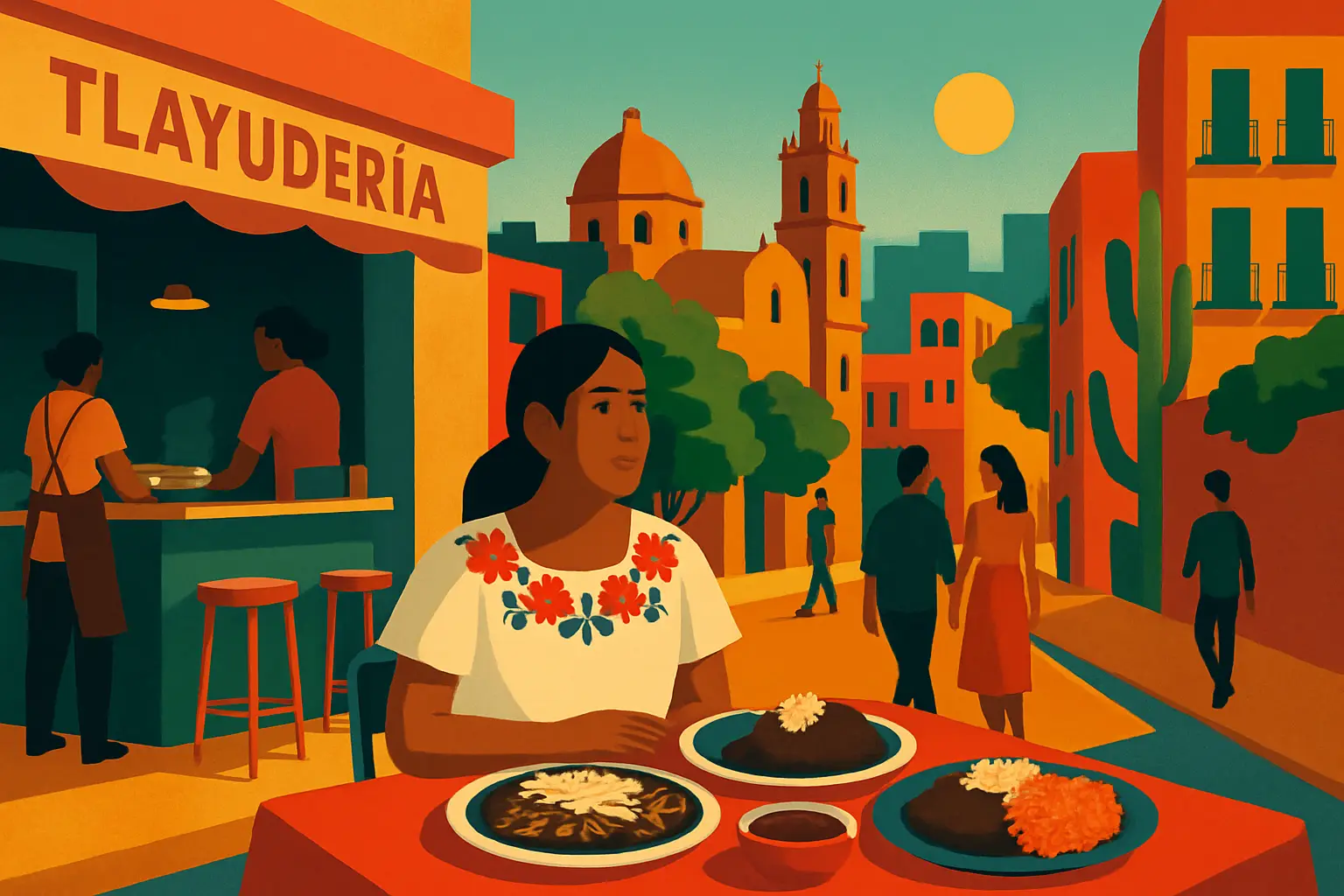
The state of Oaxaca is one of the most economically marginalized in Mexico. Since the 1950s, and accelerating sharply after the 1994 NAFTA collapse of small-scale agriculture, millions of Oaxacans migrated north — not to the US, but to Mexico City. The capital absorbed this wave the way it absorbs everything: it turned it into a neighborhood, a market corridor, a food culture.
Estimates of the Oaxacan-origin population in the Mexico City metro area range from 700,000 to over one million. This is not a small expat enclave serving nostalgia food. It is a full transplanted food ecosystem: women who learned to grind corn on a metate in the Sierra Juárez now run market stalls in La Merced and Tepito. Chefs who grew up eating mole negro at family celebrations in the Valles Centrales open restaurants in Roma Norte. The result is a layer of Oaxacan food woven through nearly every corner of the city — if you know what to look for.
You find it in the asiento (unrefined pork fat) on a tlayuda, the pulled quesillo on a small plate, the bag of chapulines next to the register at a market stand, the black chorizo at the back of a butcher's display case. Most of the time it isn't labeled 'Oaxacan food.' It's just food, made by someone from Oaxaca.
A tlayuda is the dish you need to understand before anything else. Start there and everything else in Oaxacan cuisine falls into context.
The base is a large corn tortilla — 30 to 40 centimeters across — that has been dried and then toasted on a comal until it partially crisps while keeping a slight flexibility in the center. This is not a tostada. A tostada is fried brittle; a tlayuda is baked leathery-crisp, with a chew at the center and a snap at the edge. The corn flavor is concentrated. A good tlayuda smells distinctly of comal smoke.
On top of that base goes asiento — the thick, slightly bitter unrefined lard skimmed from the top of a carnitas pot, darker and more complex than standard lard — spread like butter, edge to edge. Then a layer of black bean paste (*frijoles negros*), thick and slightly fermented in flavor. Then your choice of protein: tasajo, cecina, chorizo negro, or grilled vegetables for a vegetarian version. Finally, pulled quesillo laid across the top, which melts under the heat of the grill.
You eat a tlayuda by folding it in half if it's served that way, or breaking off sections from the edges and using them to scoop the interior. The crispy edge is part of the texture contract. A proper tlayuda in CDMX costs 90–160 pesos depending on the protein and the neighborhood. Anything cheaper than 80 pesos with tasajo on it is cutting something somewhere.
Large dried-and-toasted corn tortilla — not fried; the crunch and chew are different from a tostada
Always comes with asiento (unrefined pork fat) and black bean paste as the base layer
Proteins: tasajo (air-dried beef), cecina (chili-marinated pork), or chorizo negro — tasajo is the one to order first
Get short, interactive stories that make each place easier to remember while you travel.
The protein on your tlayuda is where cooks show their sourcing. The three classic Oaxacan meats are each distinct enough that they're worth understanding separately — and all three are available in CDMX at good Oaxacan spots.
Tasajo is air-dried beef, typically cut from the hip, salted with lime and sea salt, then sun-dried until the exterior forms a dark crust that concentrates the flavor. It's grilled over coals and comes out chewy with an intensely savory char. Good tasajo has a slight tang from the drying process, similar to what you'd expect from a dry-aged cut. Bad tasajo is just tough. The difference is immediately apparent. Tasajo is not widely available outside Oaxacan restaurants — this is not a meat you'll find at a standard taquería.
Cecina in Oaxacan usage means something different from the cecina you'll find in Morelos and other states. Oaxacan cecina is thin-sliced pork marinated in a dried chili paste — typically chilhuacle rojo — then sun-dried and grilled. It's spicier and more complex than tasajo, and the chili paste gives the surface a deep red-brown color after the grill. Order it if you want heat; order tasajo if you want the purest expression of the meat itself.
Chorizo negro — Oaxacan black chorizo — is made with chilhuacle negro, the same dark wrinkled dried chili that anchors mole negro. The result is a sausage that is almost black when cooked, mildly spiced rather than hot, with a deep earthiness that has nothing in common with the red chorizo found everywhere else in Mexico. It's the most polarizing of the three for first-timers and the one that makes converts feel like they've discovered something.
Oaxaca is known as 'the land of seven moles,' and the claim holds up: negro, coloradito, rojo, amarillo, verde, chichilo, and manchamanteles each represent a distinct tradition with different chili bases, textures, and uses. In Mexico City's Oaxacan restaurants, you will primarily encounter mole negro and mole amarillo, with the others appearing in seasonal dishes or more specialized menus.
Mole negro is the darkest and most complex. It's built on chilhuacle negro and mulato chilies that are toasted until nearly burned — deliberately, carefully, because the char is part of the flavor — then combined with Mexican chocolate, dried fruit, toasted seeds, and upward of twenty other ingredients, ground together and cooked for hours. The final sauce is near-black, glossy, and carries a bitterness-sweetness balance that takes time to understand. It's not spicy in the conventional sense; it's deep and round and earthy, with a finish that lingers. In CDMX it's usually served over turkey (*guajolote*) or chicken with handmade tortillas.
The easiest way to tell a real mole negro from a reconstituted paste: real mole negro has visible texture, slight graininess from ground seeds, and a smell that fills the room. Paste-based mole is flat, uniformly smooth, and sweet in a way that reveals the shortcuts. At a good Oaxacan restaurant in Roma Norte or Coyoacán, the mole negro is made in-house, in large batches, and served warm with tortillas pressed that morning. That combination is the reason people keep flying to Oaxaca — and the reason CDMX has become a credible substitute for those who can't.
Mole negro: the darkest, built on charred chilhuacle negro and Mexican chocolate — order it over turkey or chicken with handmade tortillas
Mole amarillo: lighter, more herbaceous, often used in tamales oaxaqueños or with vegetables
Tell: real mole negro has visible texture and a room-filling aroma; paste-based versions are uniformly smooth and too sweet
Chapulines are dried and toasted grasshoppers — seasoned with lime juice, garlic, dried chili, and salt — and they have been part of Oaxacan food culture since before the Aztecs organized their empire. The pre-Hispanic tradition of eating insects (*entomofagia*) persisted through colonialism in Oaxaca in ways it didn't elsewhere in Mexico, and chapulines are the most visible result. In Mexico City's Oaxacan restaurants they are everywhere: at good spots they arrive on the table alongside the salsa without being ordered.
The flavor is easier than the category sounds. Toasted chapulines are crunchy, salty, slightly sour from the lime, with a nutty umami note that reads more like roasted corn than anything obviously insect-like. The texture is the crunchiest part of a tlayuda when they're sprinkled on top, which is the best introduction. If you eat them first that way — as one element in a bite with asiento, bean paste, quesillo, and char from the tasajo — you'll understand why they've survived as a food for 3,000 years. If you order a bag of them cold from a display jar and eat them by themselves in one sitting, you will have a different experience.
A note on buying: Mercado de San Juan on Ernesto Pugibet in Centro Histórico has vendors selling chapulines in multiple sizes and spice levels. Small-sized (*chapulines chicos*) are crunchier and more delicate; large-sized (*chapulines grandes*) have more chew. Start with the small ones.
The best Oaxacan food in CDMX does not cluster in one neighborhood. It distributes itself the same way the Oaxacan population did — in working-class areas around major markets, in Roma Norte where the newer restaurant scene took hold, in Coyoacán where the mezcal-forward dining crowd made space for it, and in corners of Centro that most visitors never reach.
Roma Norte has the highest concentration of well-reviewed Oaxacan restaurants aimed at Mexico City's dining public. Yuban on Tonalá, run by chef Fernando Martínez Zavala, was one of the restaurants that made CDMX take Oaxacan cuisine seriously as a fine-dining proposition — the menu draws specifically from Zapotec cooking traditions in the northern sierra of Oaxaca rather than the Valles Centrales. For something more casual, look for the small tlayuderías on and around Orizaba that serve a short menu of tlayudas, tasajo, and mezcal without any of the design.
Coyoacán has Corazón de Maguey on the edge of the jardín, which combines a serious mezcal list with Oaxacan antojitos and tlayudas in a setting that draws both locals and visitors. It's the right place for someone who wants mole negro and a joven mezcal in one sitting without having to navigate the more intense market food scene.
La Merced and the market corridors in eastern Centro Histórico are where Oaxacan food becomes unselfconscious. Small stands run by Oaxacan women serve memelas, tlayudas, and tamales oaxaqueños — corn masa stuffed with mole negro and chicken, wrapped in banana leaf rather than corn husk — to the surrounding market workers. This is the food that doesn't care about your Instagram. Prices are roughly half of what you'll pay in Roma Norte; the corn is often ground that morning.
Roma Norte: Yuban (Tonalá) for serious Zapotec-focused cooking; small tlayuderías on Orizaba for casual and cheap
Coyoacán: Corazón de Maguey near the jardín for tlayudas and mezcal in a setting that works for first-timers
La Merced area: market corridor stalls for tamales oaxaqueños and tlayudas at half the price, served by Oaxacan cooks
The question comes up a lot, and the honest answer is: often yes, sometimes no, and you can usually tell within the first bite.
The case for yes: many of the cooks in CDMX's Oaxacan restaurants learned in Oaxaca — not from a cookbook, but from family kitchens in the Valles Centrales, the Sierra Juárez, or the Mixteca Alta. The migration brought the knowledge with it. A woman running a market stall in La Merced making tamales oaxaqueños with banana leaf and mole negro she ground herself is not performing authenticity; she is making the food she grew up eating, for a clientele that includes plenty of other Oaxacans who would notice immediately if it was wrong.
The case for no: the restaurants in tourist corridors that put tlayudas on the menu alongside burgers and margaritas are usually buying pre-made asiento and opening jars of mole paste. These exist, and they're not hard to identify. A menu that has 30 items including something called a 'tlayuda pizza' is not making the real thing.
The honest comparison: Oaxacan food in Mexico City is not the same experience as eating at Mercado Benito Juárez in Oaxaca City, sitting at a plastic table with a plate of tasajo, black beans, and memelas while women on the aisle keep refilling your tlayuda. The physical context is different. But the food in a good CDMX Oaxacan restaurant — comal smoke, fresh-ground masa, mole made in-house — is genuinely the same food. You can eat very well here. You should also still go to Oaxaca.
A few practical pointers that make the experience easier.
On mezcal: Oaxacan food is paired with mezcal the way French food is paired with wine. A joven (unaged) espadín mezcal is the standard pairing for tlayudas and mole negro — the smoke and agave cut through the fat of the asiento and the richness of the mole in a way that beer doesn't quite do. You don't have to drink mezcal, but if you're at a Oaxacan restaurant in CDMX that takes the food seriously, the mezcal list is usually worth a look. For more on how CDMX's mezcal scene works, the mezcalerías guide covers the terminology in detail.
On tortillas: Oaxacan tortillas are slightly thicker and more textured than the machine-pressed tortillas common in most of CDMX — they're also smaller and more irregular in shape, made from masa ground on a metate or a molino rather than a tortilla press. If a restaurant brings you uniform machine-pressed tortillas with your mole negro, that's a tell.
On the order of operations: at a proper tlayuderías, you order the tlayuda, then they ask which protein. You don't need to know the rest of the menu to have the full experience. Add a bowl of black bean soup (*caldo de frijoles negros*) if it's on the menu — simple, earthy, often the best thing on the table. Skip the quesadillas unless you see them being made from fresh masa. Start with chapulines. Order mezcal. Ask for more tortillas when they run out. That covers most of it.