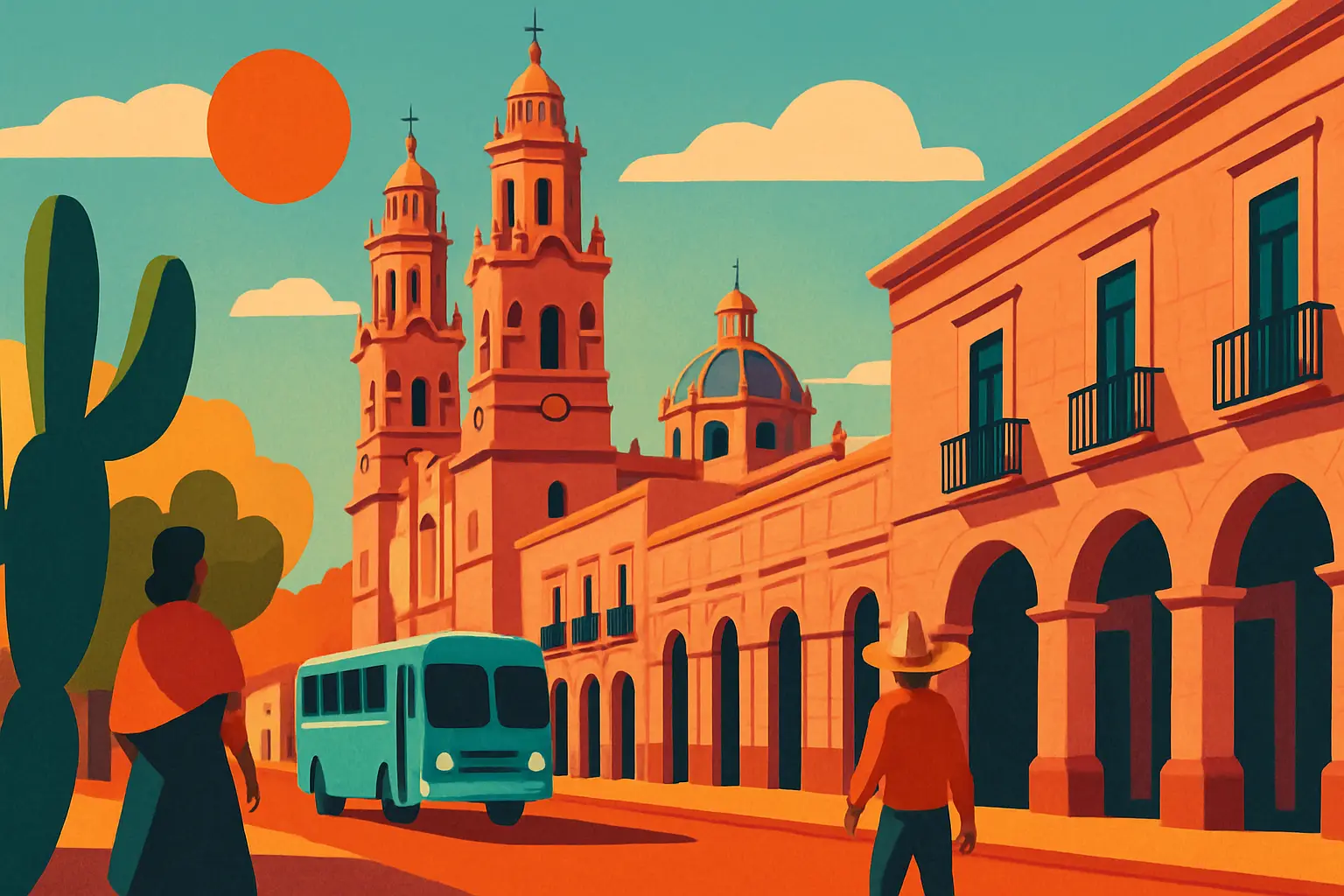
Morelia is the capital of Michoacán state and holds one of the most intact baroque historic centers in all of Mexico — 1,113 buildings in the UNESCO World Heritage zone, nearly all constructed from the same pale rose-pink quarried stone called cantera rosada. The effect of walking through it is unlike any other Mexican city: the materials are consistent, the scale is consistent, and three centuries of construction exist in a single city block without the intrusions that industrial expansion brought to most capitals.
Two things set it apart from the more popular colonial day trips. First, it is a real city with 800,000 residents — not a museum town swamped by tour groups. The restaurants and markets serve the people who live here, not visitors. Second, Michoacán is the culinary origin of carnitas — the slow-cooked pork preparation now sold everywhere in Mexico began as a regional technique in this state. Eating carnitas in Morelia is the equivalent of eating barbacoa in Hidalgo: the source version, at a different level.
The journey from Mexico City takes 4 hours by bus and costs under 700 MXN. No flight, no rental car, and no mountain highway required.
The key detail most guides miss: Morelia-bound buses depart from Terminal Central de Autobuses de Poniente (Terminal Poniente), not from Terminal Norte where most other long-distance routes originate. Take Metro Line 1 to Observatorio — the bus terminal is connected directly to the metro exit. ETN, Primera Plus, Pegasso, and Autovías all serve the route with roughly three to four departures per hour throughout the day; the fastest runs 3 hours 45 minutes, the average is just over 4 hours. Ticket prices run 500–700 MXN for comfortable first-class service; ETN's deluxe buses include wider reclining seats and a snack. Buy online at the company websites or at the terminal windows same-day — except on Day of the Dead and Semana Santa weekends, when buses sell out days ahead.
You arrive at Morelia's Central Camionera on the northwest edge of the city — first-class services use Terminal A. Uber and official taxis wait outside and charge 80–100 MXN for the 15-minute ride to the historic center. Once downtown, everything in this guide is within a 25-minute walk. Driving from Mexico City (365 km) follows MEX-43D and MEX-48D and takes about 4 hours with roughly 500 MXN in tolls — manageable, but the bus is faster net of parking.
Terminal Poniente, not Norte — take Metro Line 1 to Observatorio
ETN offers the most comfortable seats; Primera Plus and Pegasso are reliable and slightly cheaper
Book ahead for Day of the Dead (November 1–2) and Semana Santa — buses fill completely
Get short, interactive stories that make each place easier to remember while you travel.
The Catedral de Morelia faces the Plaza de los Mártires, the city's main square, from the north side. Construction began in 1660 and was completed in 1744 — 84 years spanning three generations of builders and two shifts in European architectural fashion, both visible in the facade. The tower bases follow the austere Herreresque style dominant in early 17th-century Spain: flat pilasters, minimal ornament, a sense of controlled power. The midsections are full baroque with paired column clusters and carved floral stonework. The tops of the twin 70-meter towers pivot to neoclassical, with columned colonnettes and restrained caps. All of it is cut from cantera rosada — the local pink quarry stone that makes the entire historic center glow differently in morning sun than at dusk. The interior holds a 4,600-pipe organ installed in the 18th century and still used in regular performances; check the schedule at the door.
On Saturday evenings at 20:45, the cathedral becomes a projection surface. A free luz y sonido show — light, sound, and projected imagery — maps the history of Michoacán across the baroque facade for an audience that fills Avenida Francisco I. Madero completely. The show runs year-round and is one of the more technically impressive pieces of public programming in Mexico. Arrive 30 minutes early on the cathedral steps for the best view.
East of the historic center, Avenida Acueducto terminates at the most striking piece of colonial engineering still standing in Michoacán: the Acueducto de Morelia, built between 1785 and 1789 to solve the city's chronic water shortage. It stretches 1,700 meters with 253 semicircular arches, each nearly 10 meters tall, carrying water from the El Tío spring in the hills northeast of the city. The construction took four years. Water flowed through the channel until 1910, when Morelia modernized its infrastructure; today the entire length is a tree-lined pedestrian promenade — flat, well-lit, with street food vendors and evening walkers in both directions.
At the western end stands the Fuente de Las Tarascas, a stone fountain where three Purépecha women hold aloft a traditional tray of fruit — a direct reference to the indigenous civilization that built Michoacán before Spanish arrival and that the Aztecs never managed to conquer. The Purépecha (also called Tarascans by the Spanish) repelled every Aztec military campaign sent against them; Morelia sits in the territory they defended. Walking the aqueduct after dark — with the arches lit and the Fuente illuminated — is one of the more atmospheric 40 minutes available on any Mexican city trip.
Michoacán's food identity rests on three things worth understanding before you arrive.
**Carnitas**: Michoacán is where carnitas was systematized as a technique — slow-cooking pork submerged in lard in heavy copper pots, a method that developed in this state during the colonial period. The Morelia version uses more maciza (lean shoulder) and kidney than the tacos-de-canasta style common in Mexico City, with a chewier, more mineral-forward result. Carnitas Don Pepe, on Calle Bocanegra about 10 minutes' walk west of the Plaza de Armas, has operated since 1942 and sells out by early afternoon most days. Order individual tacos first; buy by the kilo if you're converted.
Gaspacho Moreliano is not the cold Spanish soup — it is a fruit salad of finely diced mango, jicama, pineapple, and watermelon dressed with lime, orange juice, chili powder, and crumbled cotija cheese, served in a cup. Gaspachos El Güero de la Merced, near the Mercado de San Agustín a few blocks from the cathedral, is the most referenced vendor in the city.
Sopa Tarasca is the regional soup: a thick, slightly smoky red broth of pureed pinto beans, dried pasilla and ancho chiles, tomato, and garlic, served with fried tortilla strips, crema, and panela cheese on top. Every sit-down restaurant in the historic center puts it on the menu and charges 80–120 MXN. It is the best quick lunch the city offers.
For dessert, look for nieve de pasta at heladerías around Plaza Valladolid — a dense, condensed-milk-based ice cream with a texture somewhere between soft-serve and mochi.
Carnitas Don Pepe on Calle Bocanegra — operating since 1942, sells out by early afternoon
Gaspachos El Güero de la Merced near Mercado de San Agustín for gaspacho moreliano
Sopa tarasca appears on every sit-down menu — pinto bean and dried chile broth, 80–120 MXN
The Palacio Clavijero, one block south of the Plaza de los Mártires on Calle Nigromante, is one of the finest Jesuit buildings in Mexico. It was constructed in the 1660s as the Colegio de San Francisco Javier — a school that educated Michoacán's colonial elite — and was later renamed for Francisco Javier Clavijero, the 18th-century Jesuit historian who wrote one of the earliest systematic accounts of pre-Columbian Mexico while in Italian exile. The building wraps around a large interior courtyard with a two-story carved-stone arcade. Today it functions as a free cultural center with rotating photography exhibitions and permanent regional history displays. Spend 45 minutes here before heading to the aqueduct.
Directly across Plaza Valladolid, the Casa de las Artesanías de Michoacán occupies a former Augustinian monastery. It is the central marketplace for state-produced handicrafts: copper bowls and platters from Santa Clara del Cobre (a village 70 km away where every household is a copper workshop), painted lacquerware from Uruapan, embroidered textiles, and handmade guitars from Paracho — a town that produces more classical guitars than any other in the world. Prices are fixed and state-regulated; this is not a bargaining-floor market but an artisan cooperative. A hand-hammered copper serving bowl here costs roughly the same as a mass-produced version in Mexico City and is made by one person.
Day trip or overnight? A committed day trip is possible — take the 6 a.m. bus from Terminal Poniente, arrive by 10, cover the cathedral, the aqueduct, and lunch, and catch a 5 p.m. return — but it is tight. One overnight is the better format and changes the experience considerably: the Saturday cathedral light show, the aqueduct lit at night, and a carnitas breakfast before the 11 a.m. return bus are the version you will remember.
Two nights opens up Pátzcuaro, 60 kilometers southwest of Morelia by local bus (40 minutes, 50 MXN). Pátzcuaro is a smaller, quieter colonial town on the shore of Lago de Pátzcuaro and is widely considered one of the most scenically composed historic downtowns in Mexico. The plaza, the arcades, the whitewashed walls, and the lake visible from every upper street make it a sharp contrast to Morelia's denser baroque core — the two cities are complementary in the way that Querétaro and Guanajuato are.
Best timing: November 1–2 for Día de los Muertos — the celebrations in Michoacán and especially around Lago de Pátzcuaro are the most documented in Mexico, with flower-covered cemeteries, candlelit boat processions to Isla Janitzio, and city-wide altar displays. Book accommodation in Morelia three to four weeks ahead. February is Monarch butterfly season: the oyamel fir forests 100 km northeast of Morelia (Reserva de la Biosfera Mariposa Monarca) host 100 million overwintering butterflies, one of the more astonishing natural spectacles in North America.
One overnight minimum — two nights adds Pátzcuaro and changes the whole caliber of the trip
November 1–2: book early, the city fills for Day of the Dead, and Michoacán is the cultural heartland
February: Monarch butterfly season in the reserves 100 km northeast — pair with Morelia for a long weekend
Is Morelia safe for visitors? The historic center is consistently regarded as one of the safer zones in Michoacán — it is a state capital with active police presence, a large university, and a tourism economy that depends on being accessible. The U.S. State Department places Michoacán state at Level 3 (reconsider travel) as a broad advisory, but the historic center of Morelia has a materially different risk profile than rural state highways. Thousands of international travelers visit annually without incident. Use the same practices that apply anywhere in Mexico: take Uber or official taxi stands rather than hailing street cabs, keep your phone pocketed in the market, and avoid driving through rural Michoacán highway routes after dark.
Is Uber available in Morelia? Yes — Uber operates in the city and works reliably from the bus terminal to the historic center and between attractions.
What altitude is Morelia? The city sits at 1,921 meters — lower than Mexico City (2,240 m), so visitors from CDMX will notice no altitude adjustment. Temperatures are mild year-round, ranging from 18–26°C (64–79°F) in the dry season.
Historic center is safe — major university city with consistent tourist infrastructure
Uber works in Morelia — use it from the bus terminal instead of flagging street cabs
1,921 m altitude — lower than Mexico City, no adjustment needed for CDMX visitors